
Council Launches Downtown Short-Term Rental Pilot With Reduced 10-Permit Cap
City Council • OakleyAugust 11, 2026
Locunity is an independent informational service and is not an official government page for this commission. All information is sourced from public footage and an analysis of official agendas with the aid of responsible, fact-checked AI. to report an error or omission.
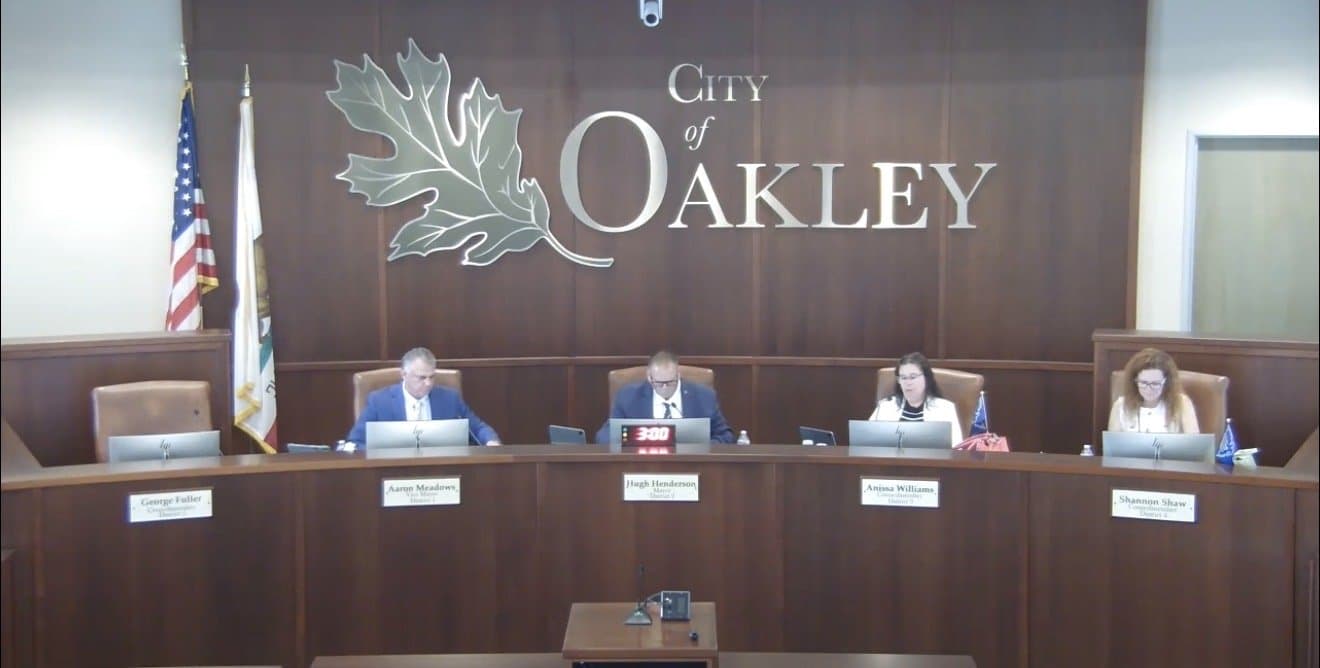
Oakley's City Council unanimously approved the city's first-ever allowance of vacation rentals — but only downtown, only 10 permits, and only for one year before a mandatory check-in. The cautious pilot approach, paired with four fast-tracked road construction contracts, signaled a council eager to boost economic activity and fix infrastructure while keeping a tight leash on neighborhood impacts.
- Council approves downtown short-term rental pilot with 10-permit cap — reduced from the staff-proposed 15 — and orders a one-year review including a police report on calls for service
- Four major road construction contracts awarded for street resurfacing, O'Hara Avenue widening, and two Main Street intersection improvements, with council members praising unusually fast budget-to-execution timelines
- Tri Delta Transit cuts routes and frequency effective this week as the agency grapples with post-pandemic ridership losses and rising costs
- Advisory Council on Aging warns of Medi-Cal changes including reinstated asset limits and work requirements that could strip coverage from vulnerable residents
- Residents push County Supervisor recall, Delta cleanup, and leaf blower ban during public comment
Oakley's First Vacation Rental Rules: A Downtown-Only Experiment
The council approved an ordinance amending Chapter 5.15 of the Oakley Municipal Code to allow unhosted and vacation short-term rentals — but only within the Downtown Specific Plan area, with tighter limits than staff originally proposed.
The basics: Until now, Oakley permitted only hosted short-term rentals, where the owner remains on-site. The new ordinance, the product of two prior work sessions in February and April, opens the door to unhosted stays (no owner present) and full vacation rentals. It prohibits special events at vacation rentals, bans limousine and bus parking, requires properties with multiple units to rent only as a whole, and mandates 500-foot neighbor notification. The ordinance also incorporates SB 346 language to help the city track rental listings through platforms.
Why it matters: This is Oakley's first venture into vacation rentals, designed to attract overnight visitors — particularly for events like the city's bass tournaments — while protecting housing affordability in a downtown area where homes tend to be smaller and more affordable.
Where things stand: Councilmember Anissa Williams drove the key amendment, expressing concern that vacation rentals could pull homes out of the ownership market downtown. "I would like to see it more of like a pilot program where one, I would love to reduce the permits down to 10. And then, if we're finding that that's not enough, that it comes back to council," she said.
Vice Mayor Aaron Meadows agreed, running the numbers aloud: "10 is 5% of the housing stock in that area. How many days out of the month would it even be rented? And does it even make financial sense to make that happen?"
The other side: No one on the dais opposed vacation rentals outright — the debate was over guardrails. Councilmember Shannon Shaw supported the reduction to 10 permits but flagged enforcement concerns, referencing a recent incident in the Vintage neighborhood. "We had a big party in Vintage at a rental that got out of hand. And I want to make sure that we're loosening the restrictions. And right now, while the restrictions are tighter, we're still having these problems," she said, requesting a comprehensive police department report as part of the one-year review. Shaw also raised questions about boat and trailer parking given the city's bass tournament events.
Shaw also expressed personal enthusiasm for the concept: "When I travel, I stay in Airbnbs because I want my whole family to be together, and it's easier to do that than a hotel. And we only have one hotel here."
Senior Planner Jose Cortez presented the ordinance, noting: "The proposed amendments would allow for short-term rentals to operate as a vacation rental only if the residence is located within the downtown."
No members of the public testified during the hearing.
Decisions: The motion — reducing the cap from 15 to 10 vacation rental permits and requiring a one-year review after implementation — passed 4-0 (For: Williams, Shaw, Meadows, Henderson; Absent: Fuller).
What's next: Staff will begin accepting vacation rental applications under the new rules. A mandatory review, including police department data on calls for service, will come back to council after the pilot's first year.
Road Projects Fast-Tracked: Four Construction Contracts Approved
Council members pulled four capital improvement projects from the consent calendar — not to oppose them, but to ensure residents noticed them.
Why it matters: The contracts cover street resurfacing citywide (CIP 333B with Consolidated Engineering Inc.), O'Hara Avenue widening from one to two northbound lanes between Grapevine and Laurel (CIP 320 with R&R Pacific Construction), Main Street/Rose Avenue intersection improvements (CIP 211 with Redgwick Construction Co.), and Main Street/Delta Road signalization (CIP 268 with S&H Construction Inc.). Together, they represent Oakley's most aggressive infrastructure push in recent memory, addressing traffic and safety complaints that have mounted alongside housing development.
Where things stand: Councilmember Williams pulled item 4.9 to spotlight the investment: "I just wanted to pull this because I think it's important to highlight to the community the capital improvement projects that we're doing."
Vice Mayor Meadows pulled items 4.10 through 4.12, describing the O'Hara widening as "going to two lanes in the northbound direction from just south of Grapevine, all the way up to Laurel. So improving the traffic flow there."
Councilmember Shaw praised the timeline from budget workshop in April to contract authorization in August. "Everyone talks about how slow government works and this is one of those moments where we get to really start seeing this. And we also have residents that we keep hearing we are building houses, but we're not doing the infrastructure," she said.
Decisions: All four items passed 4-0 (Absent: Fuller).
Transit Cuts Hit This Week as Tri Delta Struggles to Balance Books
Augustine Diaz, Manager of Planning and Grants for Tri Delta Transit, told the council that significant service reductions took effect the same week, driven by decreased revenues, increased fuel and materials costs, and a new, more expensive operations contract.
Why it matters: Some bus routes have been eliminated entirely, others lost weekend service, and several saw reduced frequency — directly affecting transit-dependent residents in eastern Contra Costa County. Eliminated routes will retain Tri-Mor ride-on-demand as a backup.
Despite returning to pre-pandemic service levels in fall 2022, ridership never recovered as expected due to remote work trends. "This service reduction that we have planned this fiscal year will serve as a right-sizing of our system to align with post-pandemic ridership and travel trends," Diaz said. The agency reprogrammed $2.8 million from capital projects to operations and still had to cut service. Diaz noted the agency received one-time BART feeder bus funds but emphasized these were non-recurring.
Community engagement included a July town hall in Antioch and field outreach at BART stations and on affected bus routes. The council had no questions.
Medi-Cal Changes Could Strip Coverage From Vulnerable Residents
Chalo Buckman of the Contra Costa County Advisory Council on Aging warned of major Medi-Cal changes over the next two years: reinstated asset limits, a freeze on full-scope enrollments for unsatisfactory immigration status, mandatory six-month work requirements, eligibility checks, and potential monthly premiums. She urged current Medi-Cal recipients to stay enrolled to protect existing benefits, including dental care.
Buckman also promoted Transit Ready, a free Contra Costa Transportation Authority program launching Sept. 30 at Maple Hall in San Pablo, offering hands-on training to help older adults and people with disabilities ride buses and BART independently.
Residents Raise Supervisor Recall, Delta Cleanup, Leaf Blower Ban
Three members of the public addressed the council during open comment.
Tracy Casamoto outlined a recall effort against County Supervisor Diane Burgess, citing concerns over the reappropriation of the Brentwood Veterans Memorial property, a $25 million budget overrun at the East County Community Service center, placement of a discredited healthcare funding figure on the June ballot, a 170-unit low-income housing project in Discovery Bay without adequate infrastructure, and withdrawal of Measure X funds while deferring a $7.4 million developer fee.
J. Connor B. Ortega, a District 5 resident, announced plans to organize a volunteer monthly Delta River cleanup crew to address growing trash in the waterway.
A young Oakley resident urged the city to follow Walnut Creek and Lafayette in banning gas-powered leaf blowers, citing California Air Resources Board data that one hour of use equals emissions from a 1,100-mile car trip and noting associations with cancer, heart disease, and dementia.
Minor Items
- Consent calendar (items 4.1–4.8, 4.13) approved 4-0, including minutes from three July meetings, closed session reports, quarterly city and Successor Agency investment reports, a voting delegate designation (Councilmember Williams as delegate, Councilmember Shaw as alternate for the League of California Cities annual conference), and an updated online public comment policy.
- Salary schedule correction (item 6.1): Council adopted a corrected FY 2026/27 salary schedule and created two new positions — a full-time Senior Recreation Leader (consolidating two part-time roles at Studio 55, adding approximately $15,000 in benefits) and a Deputy City Clerk reclassified from administrative assistant (adding approximately $12,500 in partial-year costs starting January 2027). The Deputy City Clerk will serve as the primary contact with the city's insurance company and sit on the Municipal Pooling Authority board. Combined fiscal impact: approximately $27,500. Passed 4-0.
- Planning Commissioner training ordinance (item 6.2): City Attorney Derek Cole presented a cleanup ordinance aligning OMC Section 2.3.002 with state FPPC rules, which allow six months for commissioners to complete Brown Act and planning training rather than requiring it before taking office. First reading waived; ordinance introduced 4-0.
- Freedom High School homecoming: Student Body President Logan Nelson invited the council as distinguished guests to the school's first-ever downtown homecoming parade on Aug. 27, expecting over 1,100 participants.
- City Manager report: City Manager Joshua McMurray highlighted the Heart of Oakley celebration on Sept. 19 and new Studio 55 programming for seniors.
- Council liaison reports: Councilmember Williams attended a poverty rates webinar noting Contra Costa County's 13.8% poverty rate and 15% child poverty rate, and met with staff from Assemblymember Lori Wilson's and Chris Cabaldon's offices on transit and job access. Councilmember Shaw listed 15-plus events since the July 16 meeting, including National Night Out across five neighborhoods, a Stuff the Bus backpack giveaway, and the Contra Costa Mayors Conference hosted by Oakley. She announced that Congressman Josh Harder would hold a community outreach event at City Hall on Aug. 13. Vice Mayor Meadows attended CCTA and MCE board meetings. Mayor Henderson reported on the Delta 6 meeting and Iron House Board meeting.