City Council - Jul 21, 2026 - Special Meeting
City Council • OakleyJuly 21, 2026
Locunity is a independent informational service and is not an official government page for this commission.We use AI-assisted analysis and human editorial review to publish information.
Oakley Moves to Permanently Ban Data Centers After Joint Work Session
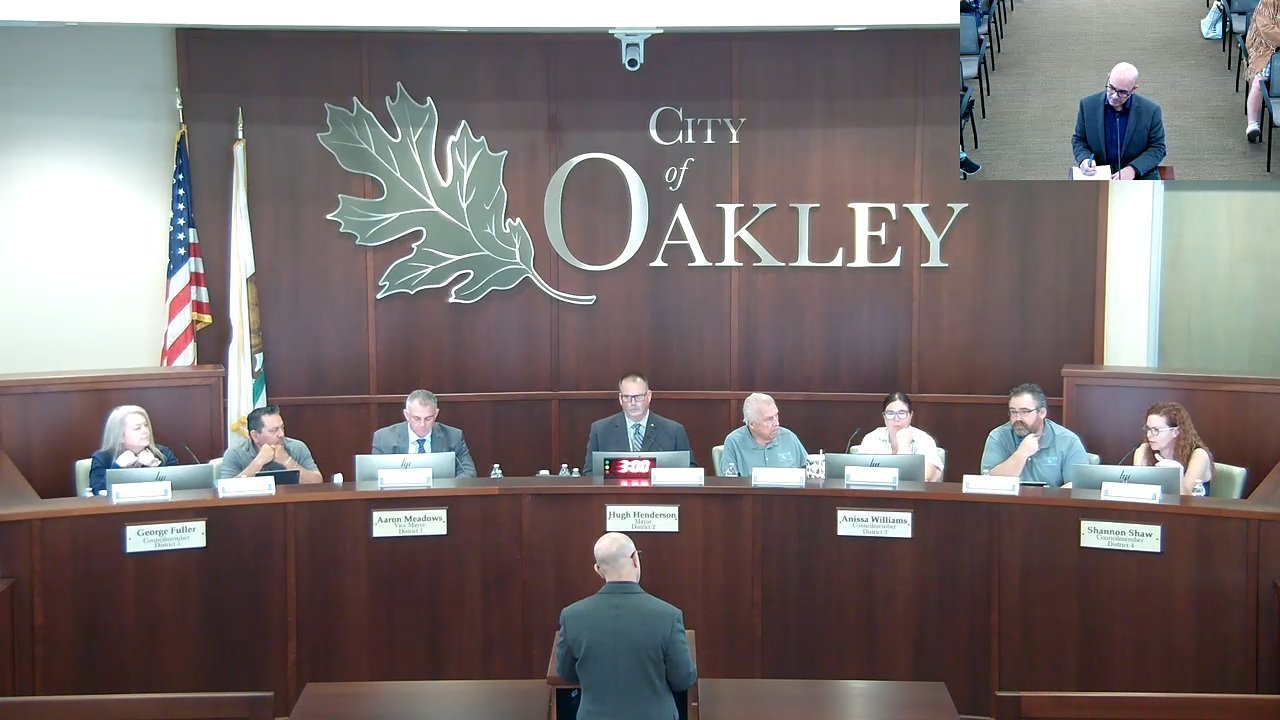
Oakley's City Council and Planning Commission came together for a joint special meeting work session on July 21 and sent a clear signal: they intend to draft an ordinance permanently banning data centers from the city. With a temporary moratorium nearing expiration and a 99-megawatt AI data center already approved in neighboring Pittsburg, council members directed staff and the city attorney to prepare draft ban language for a focused follow-up workshop, likely in September.
- Council and planning commissioners signal support for a permanent, broadly worded ban on data centers — defined by use and operations, not just the name
- Public comment runs 5-to-1 in favor of an outright ban, with residents and tech workers citing water costs, e-waste, and the AI speculation bubble
- Building trades coalition is the lone voice urging the council to regulate, not ban, calling data centers critical digital infrastructure
- City attorney outlines a three-meeting legislative path — workshop, planning commission recommendation, council adoption — with a workshopable draft expected in September
- Council members push for airtight definitions to prevent operators from circumventing a ban by adopting a different name or technology label
Council Charts Path Toward Outright Ban
The basics: Oakley's existing moratorium on data centers is set to expire, and the joint work session was designed to give staff and the city attorney clear policy direction. Community Development Director Ken Strelo framed the session's purpose as presenting staff research and a legal opinion on whether data centers can lawfully be banned, receiving public input, and getting marching orders from council.
Why it matters: The decision will shape Oakley's industrial land-use landscape for decades. Nearby Pittsburg has already approved Project Perseus, a 99-megawatt AI data center with expansion capacity up to 500 megawatts — and any data center locating in Oakley would compete for the same water and power resources.
Where things stand: Council members and commissioners coalesced around a ban rather than a regulatory or ballot-measure approach. The central debate wasn't whether to ban but how to write an ordinance broad enough to stick.
Councilmember Anissa Williams stressed that a ban limited to facilities called "data centers" would be easily circumvented. "We aren't banning data centers, we're banning what a data center is," said Councilmember Shannon Shaw, echoing Williams's concern. "I just want to make sure that it's very strongly, like, no loopholes."
Strelo confirmed staff would draft catch-all language describing the use itself: "It would really describe the use and how the use operates. That would be the key." He cited Monterey Park's ballot measure as a potential model.
Williams also raised a scenario staff had not anticipated — the proliferation of home-based data center equipment. "I could say, 'I've got room on the side of my house. I'm going to put one on the home version of data centers that they're now coming out with.' So what is the impact of a thousand of those?" she asked.
Strelo acknowledged the blind spot: "Home version data center is not something we've even thought about, to be completely honest."
Williams further proposed a jobs-per-acre threshold as an additional safeguard, similar to how housing density standards function — ensuring that any future use claiming it isn't a data center would still have to meet minimum employment benchmarks.
Commissioner Ireland pushed for the ordinance to go beyond naming and include objective, effects-based criteria. "Look at objective criteria, things like the external effects of what a data center is — it's the water use, the noise, the power, and also environmental risk for battery and fuel storage, backup systems," Ireland said.
Decisions: No formal motion or vote was taken — the session was a work session — but council consensus pointed firmly toward a ban ordinance drafted with broad, use-based definitions, to be developed through a focused follow-up workshop.
What's next: City Attorney Derek Cole outlined a three-meeting legislative pathway: a focused workshop to develop draft ban language, a planning commission recommendation, then council introduction and second reading. He estimated a workshopable draft could be ready by September but cautioned that new 20-day notice requirements and the November election cycle make year-end completion "ambitious."
"I don't envision that staff and I would be able to have a workshopable product to you until September," Cole said. "And the law has changed recently such that we now have a 20-day published notice requirement."
Shaw asked whether the follow-up workshop could again be held jointly with the planning commission — signaling a preference for continued collaboration and speed.
Residents and Tech Workers Line Up Against Data Centers
Why it matters: Five of six public speakers urged an outright ban, delivering a strong political tailwind for the council's direction. Their arguments ranged from utility costs and environmental harm to the fundamental economics of the AI industry.
Jasper Willowbrook warned about the scale of what's already approved next door: "Project Perseus in Pittsburg has already been approved for 99 megawatts with expansion up to 500 megawatts. This is five times the size of the horribly destructive data centers we're already seeing around the country."
Louis J. Gentry, a software engineer, argued that hyperscale facilities are unnecessary for everyday digital services and raised concerns about what happens if the AI industry contracts. "This AI boom is a bubble. It's speculation. It's the new gold rush. Not every participant is going to survive. Now what happens if companies go belly up and this data center is abandoned and empty?" He also flagged thousands of tons of potential e-waste — mercury and lead — and noted that old computers can be repurposed to run AI models.
Randy Sullivan, a longtime Oakley resident, cited already-doubled water and PG&E bills and the loss of the city's small-town character. Melinda Morgan, a Pittsburg resident who has built data centers professionally, supported the ban, arguing that essential data center needs for hospitals, police, and city services can be met with small, self-contained facilities. John Basinger, who described himself as an "AI Sheriff," argued that useful AI work can be done on consumer-grade machines and urged the city to develop an AI education framework for local students.
The other side: The sole dissent came from Cherie Cabral, representing the California Construction Labor Management Trust and a coalition including the building trades and the Western Steel Council. She argued that most data centers are far smaller than the hyperscale facilities dominating the headlines — over 65% are between 500 and 200,000 square feet, smaller than a Home Depot — and serve as critical digital infrastructure comparable to utilities.
"I would encourage you, as opposed to banning everything and considering everything with a blanket umbrella, that you utilize the planning process for the governance as opposed to an outright ban," Cabral said.
Her argument did not appear to shift the council's direction, though it underscored a tension likely to resurface as draft language takes shape: how to draw the line between the small-scale server rooms that power everyday services and the massive facilities the community opposes.
Minor Items
- John Basinger offered to volunteer as an AI education expert for Oakley middle and high school students, arguing that young people are frightened of the technology and need practical exposure.
- Vice Chair Harvey of the Planning Commission asked about the cost of a potential ballot measure and urged the council to designate all data centers as H2 heavy industrial and protect the city's water supply.