
City Council - May 26, 2026 - Regular Meeting

City Council - May 26, 2026 - Regular Meeting

City CouncilOakleyMay 26, 2026

Sources:

Locunity is a independent informational service and is not an official government page for this commission.We use AI-assisted analysis and human editorial review to publish information.

Council Joins Regional Stormwater JPA, Approves City Manager's $333,500 Salary

Oakley's City Council approved a suite of regional governance and compensation decisions Tuesday night, all passing 4-1 over the persistent dissent of Councilmember George Fuller, who used the evening to press a broad critique of regional tax structures, developer-friendly policies, and executive pay. Separately, a resident's plea to protect homeowners from a $5 million drainage cost-shift in a developer lawsuit set the stage for a closed-session showdown.

  • Council joins voluntary regional stormwater JPA, giving Oakley a new off-site compliance tool — but Fuller warns it will favor developers building on small infill lots

  • City Manager Joshua McMurray's salary rises to $333,500 with a $15,589 longevity bonus; one dissent calls it "excessive, exorbitant and unwarranted"

  • Summer Lake resident urges council to shield homeowners from $5M in drainage costs driven by new development

  • 15-year regional clean water agreement locks Oakley into stormwater partnership through 2041

  • Assessment district proceedings advance toward June 9 public hearing on street lighting and landscape levies


A New Tool — or a Developer Giveaway? Stormwater JPA Sparks Debate

The evening's most substantial debate centered on whether Oakley should join the Contra Costa County Regional Alternative Compliance (RAC) Joint Powers Authority — a voluntary regional body that lets cities and private developers purchase off-site stormwater compliance "units" from certified green infrastructure projects instead of building bioretention on every site.

Why it matters: State stormwater mandates require cities and developers to treat runoff, typically through on-site bioretention basins. For smaller or constrained sites, building those facilities can be physically impossible or prohibitively expensive. The RAC JPA creates a regional market for compliance, potentially lowering costs — but critics argue it removes a barrier that has kept dense infill off undersized lots.

Where things stand: Public Works Director Billilee Saengchalern walked the council through a roughly four-minute overview of the program, emphasizing that joining imposes no obligations on the city or its residents.

"It could just sit there, but it is another tool in the toolbox to be used should the need arise," she said.

Vice Mayor Aaron Meadows pressed on the voluntariness question, confirming that property owners can always build their own on-site bioretention instead.

"So this JPA will be set up to provide the bioretention for stormwater. Property owners do not have to join in or do not have to buy units in the project. They can provide that same facility on site," he said.

Councilmember Shannon Shaw asked whether staff would retain discretion over developer applications. Saengchalern confirmed that RAC would be a last resort:

"We would make sure that doesn't happen and that this would be the last resort. Meaning there is no other alternative for them to be able to fit a bioretention area on site because they're constrained."

The other side: Councilmember George Fuller delivered an extended dissent, framing the vote as part of a pattern in which regional JPAs erode local control. He pointed to BART tax measures and MCE energy bills as examples where regional voting blocs overwhelmed Oakley's preferences.

"San Mateo and San Francisco and Santa Clara, they got in there and they overwhelmed us. And we pay a tax that we didn't want and that's under JPA," he said.

Fuller then pivoted to land use, arguing the JPA would unlock infill development on small lots near Brownstone and Main Street that currently can't support their own drainage.

"I believe that favors the developer much more than the residents. And I say it favors the developer because it allows infill," he said.

Councilmember Anissa Williams pushed back directly, saying fears about new taxes were unfounded.

"I feel like we sometimes have misinformation given to people that there's going to be taxes. And this is an additional assessment," she said, noting the JPA is entirely voluntary.

Meadows added a factual correction: "I just want to point out MCE is also optional. You can opt out and you can opt back into PG&E."

Williams also confirmed that staff would advocate for population-based cost sharing within the JPA rather than equal splits — an important detail for a smaller city like Oakley.

Decisions: The council adopted the resolution 4-1 (For: Shaw, Williams, Meadows, Henderson; Against: Fuller). Saengchalern was appointed as Oakley's JPA board representative. Approximately 12 other Contra Costa cities are expected to join.

What's next: The JPA will begin establishing community facilities districts. Oakley is under no obligation to purchase compliance units, but the tool is now available for both city capital projects and private development applications that meet staff's last-resort threshold.


City Manager's Pay Hits $333,500 After 7% Raise and Longevity Bonus

City Attorney Derek Cole presented the sixth amendment to City Manager Joshua McMurray's employment agreement, disclosing the terms orally as required under SB 707. The package includes a 7% base salary increase — bringing pay to $333,500 per year — plus a 5% longevity bonus of $15,589.

Why it matters: The total fiscal impact is $43,400 including PERS contributions, which will be folded into the FY 2026–27 budget due for presentation at the next council meeting. Roughly 3% of the increase reflects cost-of-living adjustments; the remaining 4% is a retention component.

Councilmember Anissa Williams offered an important correction during the discussion: the 5% bonus was for longevity and retention — not performance.

"Seeing as Mr. McMurray is, I think, the fourth or fifth most senior city manager in all of Contra Costa County, I believed that was what that was," she said.

Cole accepted the correction, noting the resolution language confirms the retention purpose.

Councilmember George Fuller was blunt:

"I find the amount that's being discussed excessive, exorbitant and unwarranted, and I will vote no."

Decisions: Passed 4-1 (For: Shaw, Williams, Meadows, Henderson; Against: Fuller).


$5M Drainage Fight Puts Developer Cost-Shifting in the Spotlight

During public comment, Sean Ireland — identifying himself as a Summer Lake resident — urged the council to ensure existing homeowners aren't forced to pay for $5 million in drainage improvements needed to accommodate new development. The remarks addressed the ACD TI Oakley LLC v. Summer Lakes HOA lawsuit listed on the closed-session agenda.

"New development should pay for itself and existing homeowners should not have to foot the bill," Ireland said, adding: "I would hope that the council would look beyond just what the city is legally forced to do or strictly liable for. Please look at how the city can support the Summer Lake residents."

Ireland cited a precedent from the council's own April 28 meeting, when Vice Mayor Aaron Meadows successfully argued during the Stone Creek subdivision fencing discussion that developer-created burdens should stay with the development. He acknowledged the city cannot stop a private developer from suing the HOA but asked the council to consider its posture carefully.

Why it matters: The Summer Lake infrastructure has served the community for over 20 years. If the developer prevails, it would establish a local precedent for shifting development-driven infrastructure costs onto existing homeowner associations — a concern that could ripple across future infill projects citywide.

The council later entered closed session to discuss this case among six pending litigation matters.


Clean Energy Jobs and Transit Funding: Council Reports Signal Emerging Opportunities

During liaison reports, Councilmember Anissa Williams offered the most substantive update, covering a Green Empowerment Zone meeting focused on sustainable aviation fuel production at Phillips 66 using non-crop feedstocks, with the Governor proposing a $1–2 tax break to support the industry. She noted Bay Area manufacturing employs over 300,000 people, with nearly half of those jobs not requiring four-year degrees.

"The technician jobs don't typically require college degrees and they're starting at mid-$20s per hour with comprehensive benefits," Williams said.

Williams also reported on two Governor's office webinars regarding Opportunity Zones, noting tightened restrictions may limit Oakley's eligibility.

Vice Mayor Aaron Meadows reported attending a two-day CCTA Board workshop focused on a potential 2028 ballot measure renewal — a measure that could reshape regional transportation revenue for the next decade and directly affects Oakley street maintenance funding. Earlier in the meeting, Andrea Everage of the CCTA Citizens Advisory Committee briefed the council on SB 63 transit funding proposals and Measure J Growth Management Program compliance reviews for Richmond, Moraga, Orinda, and Martinez.


Minor Items

  • Consent calendar remainder (items 4.2 and 4.5) approved 5-0, including a resolution formally calling the Nov. 3, 2026 general municipal election for three council seats and a closed session report memo.

  • May 12 meeting minutes approved 4-1 after Fuller pulled them from consent, citing quality concerns with the documentation. (For: Shaw, Williams, Meadows, Henderson; Against: Fuller)

  • Contra Costa Clean Water Program Agreement (2026–2041) adopted 4-1, committing Oakley to the regional stormwater compliance partnership through 2041. Fuller was against and cited tax burden concerns. (For: Shaw, Williams, Meadows, Henderson; Against: Fuller)

  • FY 2026–27 Street Lighting and Landscape Assessment District proceedings initiated 4-1. Fuller objected to requiring residents to attend a council meeting to weigh in on rates. A public hearing is set for June 9. (For: Shaw, Williams, Meadows, Henderson; Against: Fuller)

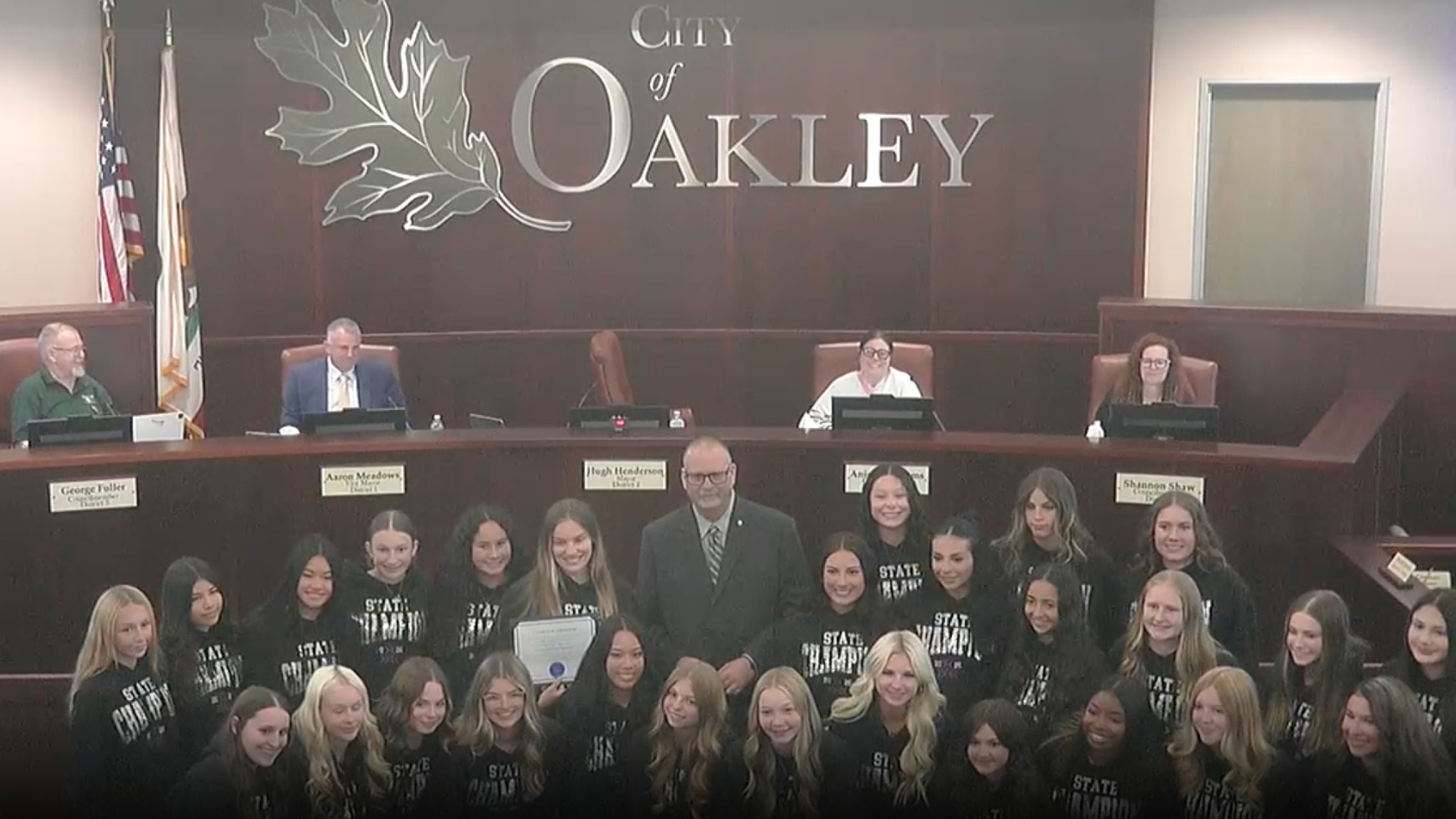
  • Freedom High School STUNT Team received a Certificate of Recognition for winning the Division 2 state championship — the school's first state title in its 29-year history. Coach Jamie Chatham thanked the council and noted athletes practice six days a week.

  • City Manager report highlighted upcoming community events including Friday Night Bites, Juneteenth, and Summerfest.

  • Councilmember Fuller praised the refurbished Dakota Dog Park but raised safety concerns about young children being at face level with dogs.

Council Joins Regional Stormwater JPA, Approves City Manager's $333,500 Salary | City Council | Locunity