
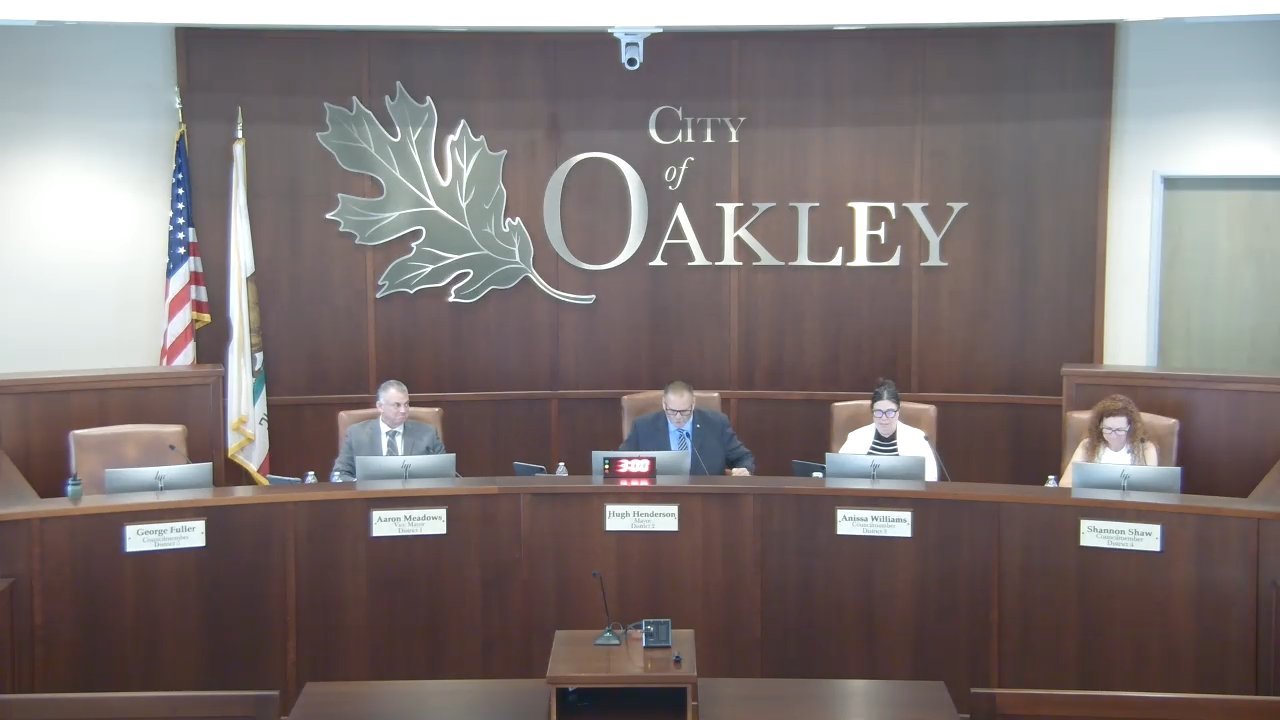
City Council - Jul 14, 2026 - Regular Meeting
City Council • OakleyJuly 14, 2026
Locunity is a independent informational service and is not an official government page for this commission.We use AI-assisted analysis and human editorial review to publish information.
Council Launches $100K Public Art Pilot, Tackles Housing Design Standards
Oakley's City Council used a packed July 14 agenda to invest in civic identity and wrestle with the rules that will shape how future neighborhoods look and feel. The council unanimously greenlit its first structured public art program, approved a $5.3 million landscape and lighting assessment, and gave staff substantive direction on new objective design standards for housing — all while a privacy advocate alleged the police department is illegally sharing license plate data with a federal agency.
- $100,000 public art pilot approved to bring sculptures to downtown, artwork to City Hall and a mural to the community
- Council directs staff on new housing design rules that will replace the city's 2003 guidelines, pushing for neighborhood character, native trees and visual clarity
- Privacy advocate alleges Oakley PD is illegally sharing automated license plate reader data with federal Border Patrol, citing California law
- $5.3 million landscape and lighting assessment confirmed for FY 2026-27 with no public protests filed
- Oakley Civic Access Portal goes live, bringing online permitting and licensing to the city for the first time
- Resident calls for a dedicated senior center, comparing Oakley's limited programming to neighboring cities
New Rules for New Homes
The longest and most substantive discussion of the evening was a work session on draft objective design standards — the measurable rules that will govern how all streamlined residential projects look in Oakley. Associate Planner Evan Gorman walked council members through the stakes and the process.
The basics: California law now requires cities to evaluate certain housing projects solely against objective, quantifiable standards rather than subjective aesthetic judgments. Oakley's current residential design guidelines date to 2003 and rely heavily on discretionary review — a framework the state has effectively made unenforceable for many project types.
Why it matters: Without adopted objective standards, Oakley has limited leverage over the design of housing that qualifies for streamlined approval. "Without adopted objective standards, the city has limited ability to shape the design of housing projects that qualify for streamlined review," said Associate Planner Evan Gorman. "These standards are how we ensure housing construction is aligned with our goals and values while still welcoming new Oakley residents."
Where things stand: Staff presented preliminary drafts for both single-family and multifamily chapters, organized around three focus areas: public safety integration (ensuring emergency vehicle access is spelled out), site design (open space, pedestrian pathways) and building envelopes (massing, height transitions, facade variation). Community outreach surfaced a clear theme: build communities, not just housing.
Gorman emphasized the cost-quality tension that runs through the entire exercise. "We want buildings that look good and hold up over time. But our standards need to be realistic about costs. If design requirements push project costs too high, housing does not get built and that doesn't help anyone."
The other side: Council members pushed back against the idea that streamlining should come at the expense of design quality. Councilmember Anissa Williams challenged whether the standards could inadvertently pad developer profits without delivering affordability or aesthetics: "Are we concerned at all that developers are going to put things down to the bare minimum and they're still not going to have anything affordable and they're just making bigger margins?"
Williams also made an unconventional but specific request: updating the city's tree planting lists to include more native and female species, arguing that current landscaping standards contribute to pollen-related allergies.
Councilmember Shannon Shaw was equally direct, requesting a comparison matrix showing exactly what was retained, modified or removed from the 2003 guidelines. "I would be interested in some sort of matrix on what was retained, modified, removed, added, and which of those were required," she said. Shaw made clear where her priorities lie: "I'm not concerned about the cost for the developer being more able to pencil. I'm concerned about these residents living here long term and being proud of their neighborhoods going forward."
Vice Mayor Aaron Meadows took a practical approach, asking staff to replace text-heavy standards with visual illustrations: "I would like to see picture books so that it's easier for us to follow along in what you're trying to describe in words." Mayor Hugh Henderson emphasized integrating public safety considerations and making the final document accessible to non-professionals.
What's next: Staff will incorporate council direction and prepare a full draft for public review before taking it to the Planning Commission and then back to the City Council for formal adoption. No timeline was specified.
Oakley's First Public Art Program Takes Shape
The council unanimously approved a two-year, $100,000 agreement with Local Edition Marketing to launch Oakley's first structured public art program — a pilot that had been in the works since former council members requested a work session on the topic.
Why it matters: Oakley, a growing suburban city in eastern Contra Costa County approaching 50,000 residents, currently has minimal public art. The pilot is designed to build civic identity through three categories of work: six rotational sculptures in downtown Oakley, interior artwork for the renovated City Hall lobby and conference areas, and a mural at a location to be determined. The contract spans two fiscal years at $50,000 each.
Where things stand: City Manager Joshua McMurray outlined the scope: "The main bucket would be sculptures in our downtown. So there would be six locations where Local Edition Creative would procure sculptures that would then be mounted and secured in various places in the downtown to really enhance the civic enhancement of the city."
Tari Loring of Local Edition Creative, who presented the firm's experience across Contra Costa County cities including Fairfield, Pittsburg, Concord and Mare Island, pushed back against viewing public art as decorative: "This is by no means a decoration. This is civic infrastructure. A lot of cities now, even large cities across the country, are going, hey, public art — the impact now has been studied. It is like having libraries and parks."
Council members were enthusiastic. Councilmember Williams framed the investment in community-building terms: "I think it's important for people to feel — we obviously provide the homes, but are we really giving people a place where they can be proud of?" Councilmember Shaw encouraged the consultants to research Oakley's history and Delta identity. Vice Mayor Meadows noted the blank walls in the newly remodeled council chambers as a canvas.
Decisions: The resolution passed 4-0 (For: Henderson, Williams, Meadows, Shaw; Absent: Councilmember George Fuller). Motion by Councilmember Williams, seconded by Mayor Henderson.
Privacy Watchdog Flags Police Data Sharing
During public comment, Mike Katz-Lakabe, Director of Research at Oakland Privacy, delivered a pointed allegation: "I discovered that the Oakley Police Department is illegally sharing license plate reader data with San Diego Sector Border Patrol, a federal agency. Sharing license plate reader data with federal and out-of-state agencies — these became illegal back in 2016 when SB 34 was signed into law."
Why it matters: SB 34, signed in 2016, prohibits California law enforcement from sharing automated license plate reader data with private entities, out-of-state agencies or federal agencies. A 2023 California Department of Justice bulletin reiterated that prohibition. If the allegation is substantiated, the city could face legal liability, and the practice raises direct privacy concerns for residents whose vehicle movements are captured by the readers.
Katz-Lakabe called for a transparent investigation, accountability for those responsible and a plan to prevent future violations. He also questioned whether the required regular ALPR audits under Oakley PD policy are being conducted. The council took no action — public comment rules do not allow for council response — but the allegation puts pressure on city staff and police leadership to address the claim publicly.
$5.3M Assessment Levy Confirmed With No Protests
The council concluded a continued public hearing on the Landscaping and Lighting Assessment District No. 1 levy for FY 2026-27, approving the annual assessment 4-0 with no public testimony and no written protests.
The basics: The district, originally formed in 2000, funds parks, landscaping and street lighting maintenance across approximately 80% of Oakley's parcels in three benefit zones. Public Works Director Billilee Saengchalern reported total collections are estimated at approximately $5,294,000 for the coming fiscal year. The proposed rates do not exceed the maximums established at formation or annexation.
What's next: Staff flagged that a separate analysis to address previously identified funding challenges for the LLAD will be conducted later this year — a signal that future rate discussions may be on the horizon.
Decisions: Passed 4-0 (For: Henderson, Williams, Meadows, Shaw; Absent: Fuller).
Minor Items
- Consent calendar: June 9 meeting minutes approved 4-0 (Fuller absent).
- Proclamations: Council honored Lizzy Morgan for extraordinary bravery during a house fire and proclaimed July as Park & Recreation Month.
- Civic Access Portal: City Manager McMurray announced the Oakley Civic Access Portal went live July 14, enabling residents and businesses to submit plans, apply for permits and licenses, pay fees, request inspections and download approvals at oakleyca.gov. The system was roughly 18 months in the making.
- Data center joint meeting: A joint Planning Commission–City Council meeting on data centers is scheduled for Tuesday, July 21 at 6:30 p.m.
- Planning Commission vacancy: Applications are open July 13 through Aug. 20 for one open seat.
- Leadership Academy: The 2026 Oakley Leadership Academy begins Aug. 19, running five consecutive Wednesdays through Sept. 16.
- Senior center request: Public commenter William Carpenter asked the council to study a dedicated senior center, noting Oakley's Studio 55 operates limited hours compared to facilities in Antioch, Brentwood, Concord and Pleasanton. "Oakley has grown into a city of nearly 50,000 residents. As our senior population continues to grow, it is time to consider whether our current level of senior services reflects the needs of our community," he said.
- Assembly Member town hall: Eric Cortez, field representative for Assembly Member Lori Wilson (11th District), announced an upcoming town hall at Oakley on Friday, Aug. 7, from 10 a.m. to 5 p.m.
- Transit and regional updates: Councilmember Williams reported that a state audit found transit agencies cannot overcome structural deficits with current BART fees, and that consolidating Tri Delta Transit would increase obligations by 78%. She also previewed CCTA's Measure J replacement planning.
- Public comment policy: Vice Mayor Meadows proposed a future agenda discussion on capping public comment time at the start of meetings and deferring overflow to the end. Councilmember Shaw seconded the idea.
- Closed session: Council entered closed session for a City Manager performance evaluation and discussion of existing litigation (ACD TI Oakley, LLC v. Summer Lakes HOA et al.). No reportable action.