City Council - Apr 14, 2026 - Regular Meeting

City Council - Apr 14, 2026 - Regular Meeting

City CouncilOakleyApril 14, 2026

Sources:

Locunity is a independent informational service and is not an official government page for this commission.We use AI-assisted analysis and human editorial review to publish information.

Oakley Unanimously Halts All New Data Center Applications

The Oakley City Council moved swiftly Tuesday night to impose an emergency moratorium on data center development, responding to intense community opposition that erupted last month over a proposed facility. The unanimous urgency ordinance — effective immediately — buys the city time to write permanent rules for an industry it has no regulations to evaluate, while sobering presentations on BART's fiscal cliff and Delta water threats underscored the mounting pressures facing this East Contra Costa County community.

  • Council adopts urgency ordinance banning all new data center applications, effective immediately, with plans to extend the moratorium up to one year at the May 12 meeting

  • BART warns of $350–$400M annual deficit that could close all East County stations, slash 70% of service, and trigger 1,200 layoffs if a regional ballot measure fails

  • Oakley councilmembers put BART on notice: closing East County stations while residents keep paying BART taxes would kill any future voter support

  • Delta Conveyance Project cost estimates balloon to $60–$100 billion while key Kern County backers slash contributions by 97%

  • Diablo Water District flags new state turf law requiring Oakley to audit and convert non-functional landscaping at public facilities by January 2027


Data Centers on Ice: Council Acts Fast on Moratorium

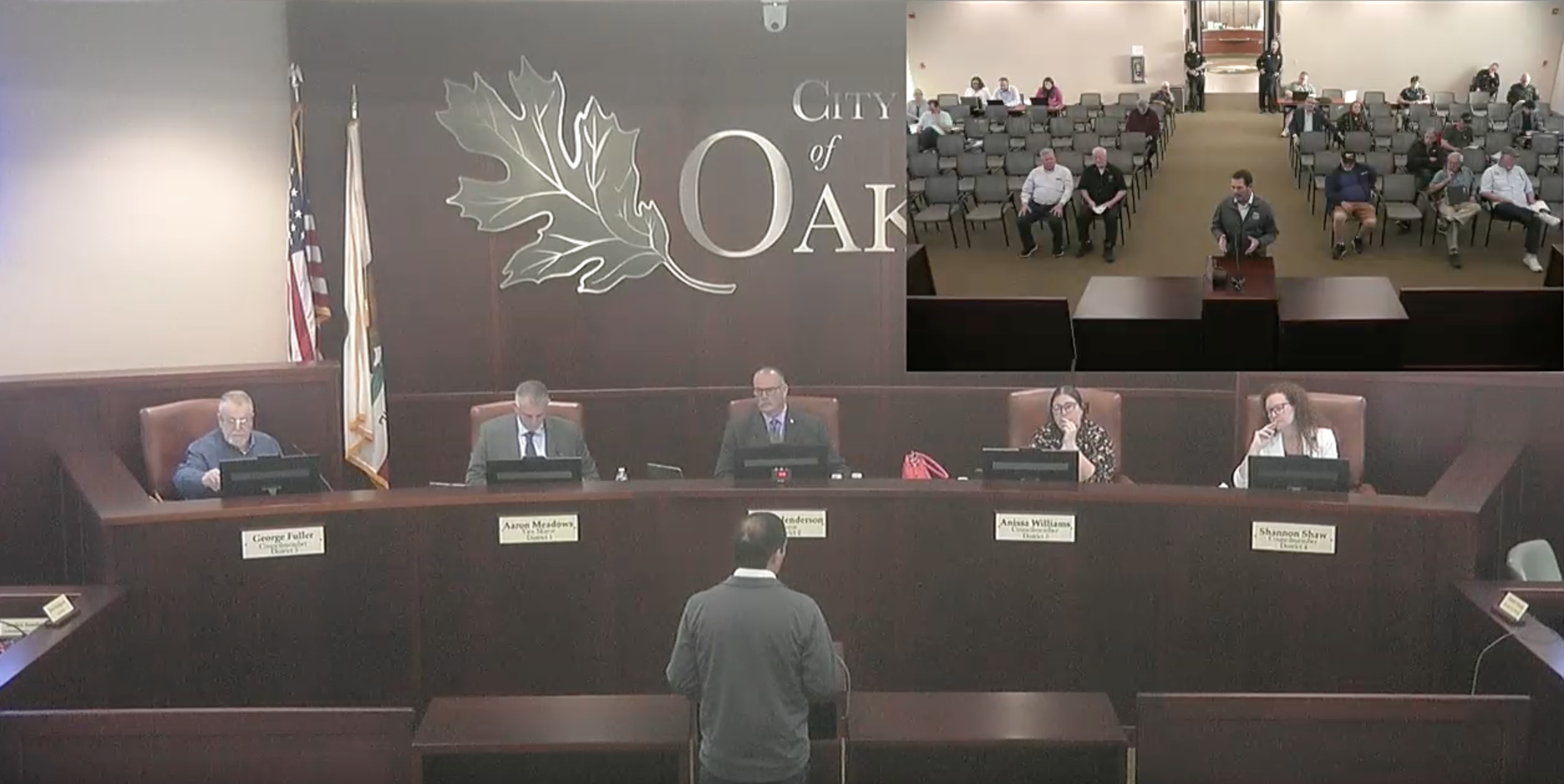
The biggest action of the night came on agenda item 6.1, where the council unanimously adopted an urgency ordinance imposing an immediate 45-day moratorium on the processing and approval of all new data center land use applications within city limits.

Why it matters: Oakley currently has zero regulations specifically governing data centers — their power consumption, water use, noise, or environmental footprint. A proposed facility that drew fierce public backlash last month left the city exposed: without standards, staff had no framework to evaluate the application. The moratorium slams the door shut while the city builds one.

Where things stand: City Attorney Derek Cole laid out the legal mechanics. Under California Government Code planning and zoning law, the urgency ordinance takes effect immediately and lasts 45 days. The council can then extend it up to one year, followed by a potential additional year — creating a two-year window to develop permanent regulations.

Cole drew an analogy to the early days of cannabis regulation, when cities similarly lacked tools to assess an emerging land use.

"Cannabis only became legal in 2016, and so before 2016, you really couldn't, as a city or a county, adopt, although some were starting to regulate land use. But because it was so new, you didn't have all of the knowledge that you had," he explained.

He also made clear the moratorium prevents any data center application from moving forward while it's in effect:

"I don't believe as a lawyer that we could just adopt an ordinance in one night and ban something and call it a day."

Councilmember Dave Shaw pushed to accelerate the timeline, calling for a joint planning commission–city council workshop and urging the extension vote come before the 45-day deadline.

"I want to streamline this process and make it happen as quickly as possible. Let's combine meetings, let's make sure we don't miss a deadline, let's make sure that there are zero cracks to fall through," she said.

Councilmember Anissa Williams raised a cautionary flag based on the city's track record, referencing a prior regulatory effort to adopt rules for storage facilities, fast food restaurants, and car washes. Mayor Hugh Henderson directed staff to aim for completion before the end of calendar year 2026.

The other side: Councilmember George Fuller initially questioned whether a moratorium was necessary at all, asking whether the city could begin drafting regulations without pausing applications. He ultimately voted yes but flagged trust concerns, warning that the 45-day window could be susceptible to abuse.

"The hybrid thing frightens me," he said, referencing broader transparency worries about city processes.

Three members of the public spoke during the hearing, all in favor of restrictions. Sue Ellen urged the council to protect Oakley, questioning the long-term value of data centers and asking what happens when operators leave. Deborah called for a permanent ban and asked that battery storage facilities be included in the moratorium, referencing Maine's recent statewide ban on large data centers drawing over 20 megawatts. Bud urged the council to reject data centers outright, warning that Oakley would be bringing "a knife to a gunfight" against corporations like Amazon and Meta, and referencing water quality risks and the Moss Landing battery storage explosion.

Decisions: The motion passed 5-0. As an urgency ordinance, it required a four-fifths supermajority and took effect immediately. (For: Henderson, Shaw, Fuller, Williams, Meadows. Against: none.)

What's next: Staff will bring the extension vote to the May 12 council meeting. A joint planning commission–city council workshop is planned for this summer to begin developing permanent data center regulations.


BART's Fiscal Cliff Threatens to Strand East County

BART Director Mark Foley delivered a presentation that mixed good operational news with a stark financial warning for Oakley and surrounding communities.

The basics: BART has posted a 41% crime reduction, 89% rider satisfaction — the highest in a decade — and March 2026 was its strongest ridership month since the pandemic. New fare gates have cut corrective maintenance by 1,000 hours.

Why it matters: None of that may be enough. Fare revenue has plummeted from 71% of BART's operating budget before the pandemic to roughly 32%. Once emergency COVID-era funds run out in July 2026, BART faces a $350–$400 million annual operating deficit.

Where things stand: The Connect Bay Area ballot measure — a five-county, half-cent sales tax — would generate roughly $310 million annually for BART, still leaving a $50–$70 million gap. If the measure fails, the consequences escalate in two phases.

Phase one: 600 employee layoffs, weekday service ending at 9 p.m., the system shrinking from five lines to three, yellow line headways increasing from 10 to 30 minutes, and a 30% fare hike. Phase two, six months later: a potential 70% service reduction, 600 additional layoffs, possible station closures, and potential segment shutdowns.

"The day after, we are scheduled to meet with our labor partners to discuss implementation of the first round of layoffs, which would be 600 employees, reduction in service to 9 p.m. during the week," Foley said.

He acknowledged that under staff's original closure plan, he would lose every station in his own district:

"Based on staff's plan, I would have no stations in my district. I would be a director with no stations."

The other side: Oakley councilmembers were blunt. Councilmember Dave Shaw pressed on whether Oakley residents would continue paying BART taxes even if their stations closed — Foley confirmed they would.

"Those of us in these newer neighborhoods, our left side of our tax bill is much higher than our right side of our tax bill. So it's going to be an uphill battle. Taxes are a nasty word here in Oakley," Shaw warned.

Councilmember Anissa Williams argued the impact extends far beyond transit riders:

"It doesn't matter if you're a BART rider or not. This will impact you if you have to go on [Highway] 4 or if you have to leave your house for anything, really."

She praised Assemblymember Lori Wilson for securing Tri Delta Transit funding in the ballot measure legislation and called for a community town hall.

Vice Mayor Aaron Meadows delivered the sharpest warning:

"If all three are closed in East Contra Costa County, I would say don't come back asking for money from us, because there's no way you're going to get a vote."

What's next: The Connect Bay Area ballot measure timeline and BART's budget decisions will unfold over the coming months. Williams urged BART to hold a public town hall in Oakley to engage residents directly.


Delta Tunnel Costs Soar as Infrastructure Crumbles

Resident Delta expert Roger Mammon delivered his regular update to the council, painting a dire picture of the Delta Conveyance Project's finances and California's aging water infrastructure.

Why it matters: Oakley sits squarely in the Sacramento–San Joaquin Delta. The tunnel project, water rights battles, and infrastructure failures all carry direct implications for the city's water supply and the health of the surrounding ecosystem.

Where things stand: The California Water Impact Network now estimates the total cost of the Delta Conveyance Project at $60–$100 billion — far beyond the $20 billion projection from six years ago.

"$20 billion is a projection cost for the Delta Conveyance Project six years ago and hasn't increased. The California Water Impact analyzed the total cost of the project and they estimate it to be between 60 billion and $100 billion," Mammon reported.

The state Department of Water Resources has already spent roughly $700 million over 15 years, with ongoing costs estimated at $1 million per day.

A 2025 DWR study found that land subsidence could reduce State Water Project delivery capacity by 87% by 2043. Meanwhile, key financial support is eroding: Kern County's Wheeler Ridge Maricopa Water Storage District has cut its contributions by nearly 97%. Assemblymember Rhodesia Ransom's audit request for DWR and the project was postponed but still pending.

Other developments include SB 872, which proposes dedicating $300 million annually to repair Delta levees and State Water Project canals; a Sites Reservoir draft water rights decision proposing annual Sacramento River diversions of 986,000 acre-feet at an estimated $6.2–$6.8 billion cost; and lawsuits filed against the Trump administration for violating the Endangered Species Act by increasing water exports.

What's next: The Delta Stewardship Council will issue its decision on DWR's certificate of compliance at its April 23–24 meeting.


Water Supply Stable, but Costs Keep Climbing

Diablo Water District General Manager Dan Muelrath delivered the district's annual update, offering a mixed picture: local supply is holding steady despite historically low snowpack, but costs and new state mandates are on the horizon.

Why it matters: Oakley residents face a potential $5–$6 per month rate increase this year as fixed infrastructure costs rise even as consumption drops. A new state law also requires the city to audit and convert non-functional landscaping at public facilities.

Where things stand: Shasta Reservoir is at 100% of normal for this time of year; Los Vaqueros is at 92% capacity; and the local groundwater aquifer is at full balance. However, without typical snowmelt runoff, supply pressures could emerge later this year. Per-connection water demand has dropped 40% over 20 years due to plumbing code changes and conservation, but more than 60% of system costs are fixed — pipes, pumps, and staff — creating upward rate pressure.

The district has adopted a $35 million, five-year capital improvement plan covering seismic retrofit of a 5-million-gallon steel reservoir, fleet electrification, treatment plant upgrades converting chlorine gas to liquid, additional groundwater wells with reverse osmosis treatment, and 100% backup generator coverage.

"Diablo Water District is one of the only, if not the only in the state that's on this 100-year replacement cycle for our assets," Muelrath said.

AB 1572, which bans irrigating non-functional turf with potable water, sets staggered compliance deadlines: public agencies by Jan. 1, 2027; commercial, industrial, and institutional properties by 2028; and HOAs by 2029. The district is working with the city to audit public landscaping. Councilmember Anissa Williams asked about the lawn-to-garden conversion program and pushed for collaboration on updated design standards.

Councilmember George Fuller raised concerns about how further conservation can be achieved by low-use customers. Muelrath reassured him:

"There's no additional requests for customers like that. Even when we go into droughts, that's a common question we get from customers — I've already done everything that's been asked, how can I do more?"


Minor Items

  • Consent calendar items 4.2–4.5 passed unanimously 5-0, including Ordinance No. 5-26 updating administrative hearing procedures for citation challenges; a resolution authorizing sale of surplus police firearms; creation of Zone 202 within the Oakley Special Police Tax Area for the Delta Pointe Plaza project; and a resolution transferring the city-owned agricultural lease at 1785 Walnut Meadows Drive from Mulehead Growers to Brownstone Growers.

  • March 24 meeting minutes approved 4-1 after Councilmember Fuller pulled the item from consent and voted no, citing concerns about the hybrid minute format. "The hybrid thing frightens me also because that means the city manager can look at the minutes and put in what he wants to put and remove what he wants to remove," he said.

  • City Manager report previewed a Day of Service, a prescription drug take-back event, and the Mercantile Market, delivered by Assistant City Manager Danielle Navarro.

  • Council reports touched on Tri Delta Transit diesel costs doubling, Anaheim Transit's recent shutdown, and an e-bike legislative toolkit under review. Councilmember Shaw reported on BART and Tri Delta Transit board activities; Councilmember Williams flagged e-bike safety policy developments.

  • A public commenter reported a trail safety hazard on an East Bay Regional Park trail near Marsh Creek, warned about mosquito monitoring traps, and raised concerns about a carbon capture project at the former Antioch power plant.