
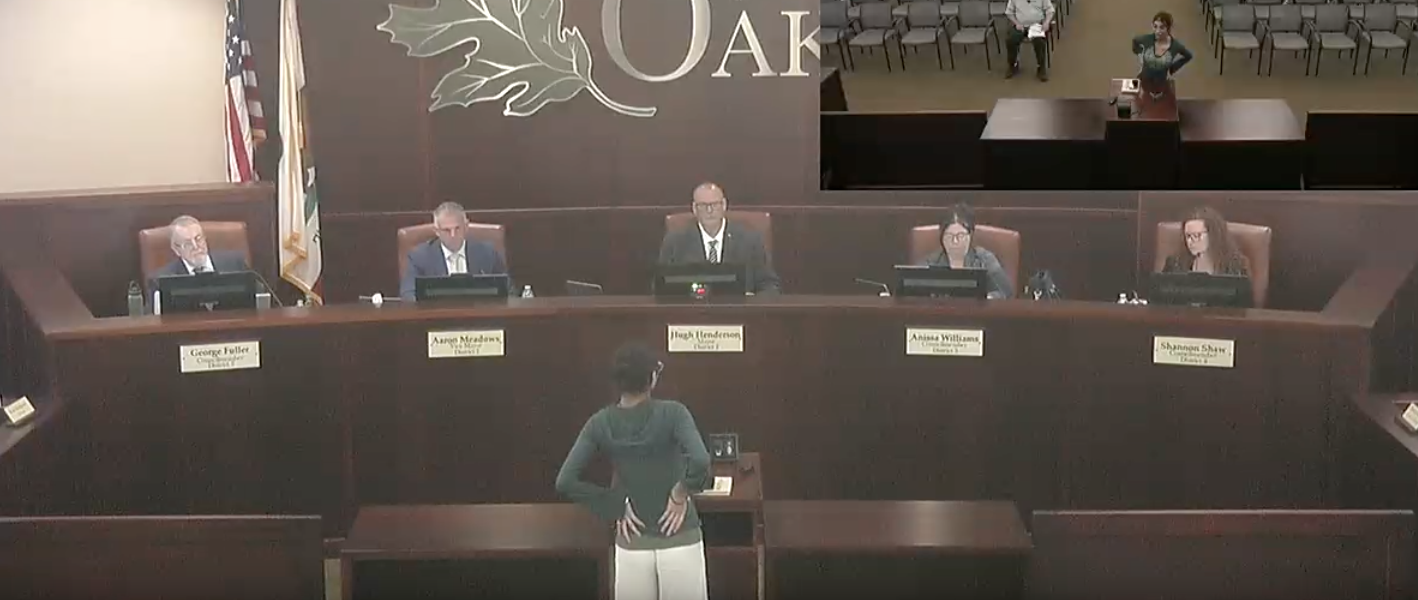
City Council - Mar 24, 2026 - Regular Meeting
City Council • OakleyMarch 24, 2026
Locunity is a independent informational service and is not an official government page for this commission.We use AI-assisted analysis and human editorial review to publish information.
Council Approves Bridgehead Industrial Project After Drafting Error Ignites Firestorm
The Oakley City Council's March 24 meeting turned contentious when a drafting error in the Bridgehead Industrial ordinances — leaving "data center" as a permitted use after the council had voted to remove it — forced public apologies from the city manager and city attorney, drew passionate opposition from residents, and exposed deepening trust gaps between the community and city leadership.
Bridgehead Industrial PUD approved 4-1 after city staff publicly apologizes for failing to remove "data center" from ordinance findings
Three residents deliver heated testimony over air quality, property values, and council responsiveness near Vintage Parkway
Council reaffirms 25-year-old $30 stormwater fee amid social media claims it's a new tax
Councilmember Fuller votes no on every pulled item and publicly challenges city over undisclosed disciplinary investigation
Bridgehead Ordinance Error Draws Apologies, Opposition, and a 4-1 Vote
The basics: The Bridgehead Industrial Planned Unit Development — a large industrial project in Oakley's eastern corridor — returned for its second reading as Ordinance 326 and Ordinance 426. On March 10, the council had voted to remove "data center" as a permitted use. But when staff pulled the item from the consent calendar, it was to acknowledge that language had never actually been removed from the ordinance findings.
Why it matters: The error validated what residents had been saying for weeks — that they don't trust the city to handle this project carefully. The Bridgehead PUD will bring industrial uses adjacent to the Vintage residential community, and the project's own environmental impact report acknowledges air quality impacts that cannot be mitigated. For neighbors along Vintage Parkway, this is personal: they see health risks, property devaluation, and a city government that isn't listening.
Where things stand: City Manager Aaron Meadows (who also serves as McMurray in his staff role) read a detailed public statement taking full responsibility and explaining the correction timeline — the error was discovered March 18 and the ordinance was reposted the same day, with notifications sent to email subscribers and social media followers.
"I firmly believe in accountability and transparency, as does the entire city leadership team. We as a team understand how mistakes like this erode the public's trust," said City Manager McMurray.
City Attorney Derek Cole also apologized, offering a self-deprecating analogy: "In many ways, I was the goalie. We all play defense, we have layers of defense, but I'm the one standing in front of the goal. And in this case I let the ball go sailing right by me."
The other side: Three residents used the moment to voice broader opposition to the project — and to the council members who approved it.
David Monson, a public commenter, criticized each council member by name. He accused Councilmember Anissa Williams of pre-deciding her vote based on union support and called out Councilmember Shannon Shaw for prioritizing a $100,000 deposit over residents' wishes. He cited potential property value losses of $200 million to $400 million for Vintage homeowners and said he would not vote for Shaw's reelection.
Jasper Willowbrook, a disabled veteran who identified as living within a quarter mile of the project, delivered an impassioned rebuke. He argued residents opposed all industrial development at the site — not just data centers — and raised concerns about wind-carried pollutants reaching Vintage Parkway and invasive non-native plants in the project's landscaping plan. He said the council had been unresponsive to his emails.
Miza Fayas, a health psychology and environmental humanities student who has lived in Oakley for 20 years, described reoccurring pneumonia and hospital visits. She urged the council to invest in community gardens and local businesses instead of industrial infrastructure, linking declining dragonfly populations to emissions and calling for development that uplifts residents rather than importing commuter traffic.
Councilmember George Fuller sided with the opposition, pointing to the project's own environmental review: "Our own EIR that we put together says the air quality will be detrimental and cannot be corrected."
Councilmember Shaw pushed back on claims about battery energy storage, clarifying that the developer had confirmed batteries at the site would be ancillary — comparable to Tesla Powerwalls — not industrial-scale battery energy storage systems. She also offered broader context: "The EIR from 2008 had more unmitigated impacts than the current project. And I'm happy to provide that to anybody that is interested in seeing it."
Decisions: The corrected ordinances passed 4-1 (For: Shaw, Williams, Vice Mayor Meadows, Mayor Henderson; Against: Fuller). The project will now proceed into development in Oakley's eastern industrial corridor.
What's next: The political fallout from Bridgehead — the trust deficit, the organized resident opposition, the accusations lobbed at individual council members — will likely carry into the November council elections. Residents near Vintage Parkway face acknowledged but unmitigable air quality impacts under the project's certified EIR.
$30 Stormwater Fee Isn't New, but the Fight Over It Is
The basics: Stormwater Utility Area No. 18 is a Contra Costa County-established assessment that Oakley has been part of since its incorporation in 1999/2000. The $30 maximum equivalent runoff unit rate has been unchanged since 2004 and has historically passed the council unanimously. Staff pulled the item from consent — for the first time in four years — to address misinformation circulating on social media that it was a new tax.
Why it matters: The general fund currently subsidizes $100,000 to $150,000 annually in stormwater compliance costs, and statewide mandates are only increasing. Even though no rate increase was proposed, the underlying fiscal pressure makes future discussions almost inevitable — and any increase would require a Proposition 218 public vote.
Where things stand: City Manager McMurray provided extensive historical context, noting the assessment originated under 1992 state legislation. "What is in front of the city council tonight is something that has been routine for the last 25 years," he said. He acknowledged that regional discussions about addressing stormwater funding shortfalls have taken place — including a workshop that Councilmember Fuller attended — but emphasized that no bond or new tax has been proposed.
Councilmember Shaw drove the point home directly: "So this is not a new tax or an increased tax or any talk of a tax. This is just a formality for the county, correct?" McMurray confirmed, adding: "I can say with certainty I've never discussed the potential of a Prop 218 vote to increase this assessment with any one of you."
Councilmember Williams asked about the general fund subsidy, learning the city contributes roughly $100,000 to $150,000 annually to cover stormwater compliance costs beyond what the $30 assessment generates — a shortfall she noted is not unique to Oakley.
Mayor Hugh Henderson displayed his own property tax bill on screen, pointing to the line item: "This is your tax bill for 25-26 under special taxes and assessments. The second line down is Oakley stormwater number 18 — $30." He cited five prior unanimous council resolutions approving the same rate.
Councilmember Fuller voted no, characterizing the assessment as a tax he opposes. He invoked a prior multi-city meeting where he said participants agreed to hold off: "I remember distinctly that at that point they all said, no, we ought to wait three years. The county is not ready to pass any more taxes."
Decisions: The assessment confirmation passed 4-1 (For: Shaw, Williams, Vice Mayor Meadows, Mayor Henderson; Against: Fuller).
Fuller Publicly Challenges City Over Undisclosed Investigation
During council member comments, Councilmember George Fuller escalated an ongoing dispute with city administration. After thanking the Disabled American Veterans for placing accessible parking spots at Studio 55, he turned to a personal grievance — alleging he is being punished based on an investigation by the city manager whose results have not been publicly released.
"They won't release the results, in violation of the Sixth Amendment, without due process or confronting witnesses, which they refuse to release," Fuller said.
City Attorney Derek Cole intervened, warning that Fuller was treading into personnel matters. Fuller pushed back, asserting it was his own personnel matter and linking the situation to a broader pattern he sees of the city "hiding things," referencing the Bridgehead ordinance error as evidence.
The exchange underscores ongoing friction between Fuller and city administration — a dynamic that has colored every contested vote this session and raises governance questions heading into November.
Minor Items
Consent calendar remainder approved 5-0 after six items were pulled for separate discussion.
Meeting minutes approved 4-1; Fuller voted no, arguing the minutes failed to document residents' concerns about Bridgehead and his ADA-related departure from the dais at a prior meeting.
Medical Center for Birds recognized for receiving a 2026 East Bay Innovation Award in Life Sciences from the East Bay Economic Development Alliance. Dr. Brian Spears, who has lived in Oakley since 1983, leads the center, which was honored alongside John Muir Health Concord Campus, Fremont Bank, and Ohlone College.
Cub Scout Pack 152 led the Pledge of Allegiance.
The meeting recessed due to technical issues with closed captioning on the livestream. Items 4.4, 4.6, and 4.8 were pulled from consent but were not discussed in the available portion of the meeting transcript.