
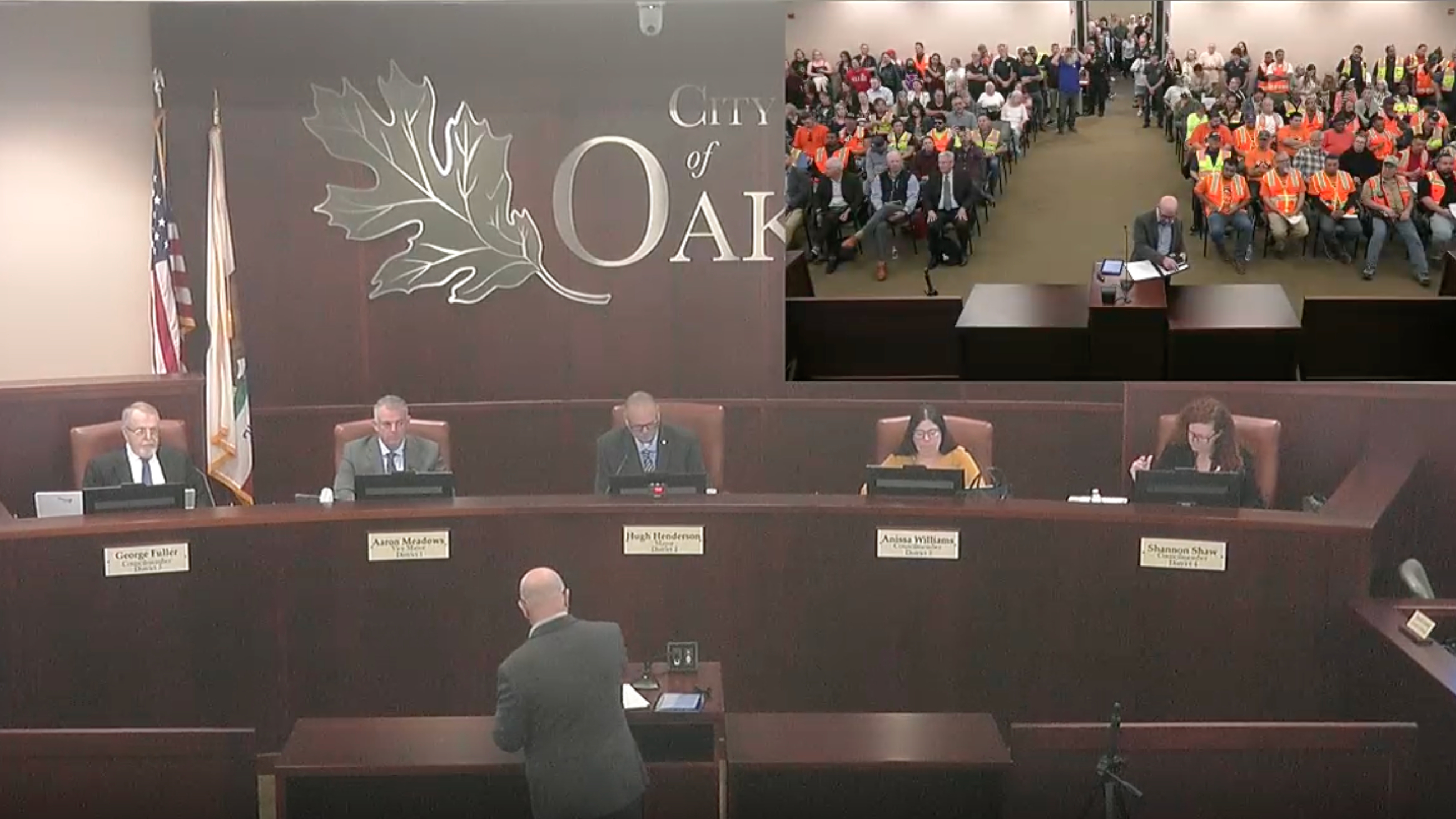
City Council - Mar 10, 2026 - Regular Meeting

City Council - Mar 10, 2026 - Regular Meeting

City CouncilOakleyMarch 10, 2026

Sources:

Locunity is a independent informational service and is not an official government page for this commission.We use AI-assisted analysis and human editorial review to publish information.

Council Approves Massive Industrial Park After Developer Drops Data Centers

Oakley's City Council approved the biggest economic development project in the city's history after a marathon five-hour public hearing that drew roughly 80 speakers, ran past midnight, and turned on a dramatic mid-meeting concession: the developer's decision to eliminate data centers from the plan entirely.

  • 164-acre Bridgehead Industrial Project approved 4-1 after developer JB2 Partners voluntarily removed data centers from the planned unit development

  • Roughly 80 public speakers divided sharply — union workers championing local jobs versus residents opposing air quality, traffic and data center impacts

  • $1.4M in estimated annual city revenue and 3,500 permanent jobs from the 3.2 million-square-foot light industrial park on Klein family vineyard land

  • Council orders citywide data center policy work session after community opposition signals broader resistance to AI-era infrastructure

  • $150,000 approved for hybrid meeting technology to comply with SB 707 remote-participation requirements


Bridgehead Industrial: Five Hours, 80 Speakers, One Big Concession

The basics: The Bridgehead Industrial Project would transform 164 acres of vineyard land in Northwest Oakley — owned by the Cline family and developed by JB2 Partners — into a 3.2 million-square-foot light industrial park spread across 10 buildings. The council was asked to approve five entitlements: certification of an Environmental Impact Report (EIR), a general plan amendment, a rezone to a Planned Unit Development, a tentative map with design review and master sign program, and a 20-year development agreement. The project site's southern parcel already carries an entitled 2008 specific plan — River Oaks Crossing — that permits roughly 690,000 square feet of big-box retail with its own certified EIR, meaning commercial development could proceed there regardless of this vote.

Why it matters: Oakley has long struggled with a severe jobs-housing imbalance, forcing residents into long commutes and starving the city of commercial tax revenue. Staff estimated the project would generate an annual $1.4 million general fund surplus, approximately $340 million in annual wages, and 3,500 permanent jobs — while requiring the developer, not the city, to fund road improvements on Big Break Road, Bridgehead Road, and Main Street that Oakley cannot otherwise afford. The developer also committed $250,000 toward a future Bridgehead Road railroad overcrossing and agreed to extend the Big Break Regional Trail through the northern parcel.

The Data Center Flashpoint

The hearing's center of gravity was not warehouses or traffic — it was data centers. Though the Planning Commission had already downgraded data centers from a permitted to a conditionally permitted use at its Jan. 20, 2026, meeting, residents demanded an outright ban. Speaker after speaker warned of energy consumption, water demand, noise and environmental damage.

"A computer in a data center is about the size of a refrigerator and requires electricity of about 50 houses. And a data center will have thousands of these machines in them demanding the power equal to the city of Walnut Creek to be added to our town instantly," said Christopher Long, a computer information systems professor.

Long also predicted power bills would rise 25% and property values would drop.

Tracy Boyam, a 34-year Vintage Parkway resident, proposed specific amendments — limiting building heights to 40 feet along Big Break Road, increasing setbacks and banning data centers outright. Greg compared the situation to the city's bans on marijuana dispensaries, arguing residents opposed data centers for the same reasons.

Joe, a 35-year Oakley resident, called the EIR inadequate for mentioning data centers five times without analyzing their impact and called the conditional use permit process a way to slip a data center in later.

The emotional peak came from Gina Vancil, a 16-year Vintage Parkway resident whose 14-year-old son Kaleb was killed riding his bike on Big Break Road in 2016 due to a lack of bike lanes and safe infrastructure. She pleaded for road safety improvements and opposed data centers for increasing traffic on an already dangerous road.

Union Workers Push Back

Dozens of union construction workers countered that the vote was fundamentally about jobs, not data centers. Representatives from the North Coast States Carpenters Union, Sheet Metal Workers Local 104, Carpenters Local 152, and Plumbers and Steam Fitters Local 159 testified that the project would provide years of living-wage work close to home.

A field representative for the North Coast State Carpenters Union said the project would provide years of work with livable wages, medical and retirement benefits, and spare workers long commutes — representing 3,800 members in Contra Costa County, including more than 300 in Oakley.

EJ Cire of Sheet Metal Workers Local 104, speaking on behalf of more than 300 Oakley residents across multiple trades, argued the jobs-housing imbalance is a critical East County issue that drives greenhouse gas emissions. He also stated this project could be "a pathway into the middle class" for over 750 residents.

Samantha, an Oakley resident and mother, pushed back on union testimony directly, criticizing non-resident workers speaking on behalf of temporary construction jobs while residents bear long-term impacts. She called for development that actually serves the community, like grocery stores, parks and playing fields.

The Turning Point

The pivotal moment arrived during the applicant's presentation. Jason Bennett of JB2 Partners told the council:

"I respectfully request to modify our application to remove data center from the PUD and from the application in its entirety...it was never our principal strategy to develop data centers here. In fact, we haven't fully even vetted the feasibility of bringing the infrastructure to the park to accommodate data center uses."

The room shifted. All four supporting council members confirmed the removal was essential.

Council Deliberation: Air Quality vs. Economic Need

Councilmember Shannon Shaw established early that a no vote would not mean no development, given the existing entitled retail plan. During deliberation, she was direct:

"I was not in any way ready to support this project with the data centers in it."

Councilmember Anissa Williams framed the broader tension:

"We have been talking ad nauseam about how to bring in living wage jobs because we bring a housing project and everybody doesn't like it and we bring fast food and nobody likes it."

She confirmed data center removal was a prerequisite for her vote and requested a future work session on citywide data center zoning policy — a request Shaw seconded.

Mayor Hugh Henderson demanded explicit language in the final ordinance:

"What I would like to see in the resolution is that it says there's no data center on this project, period."

The lone dissenter, Councilmember George Fuller, focused on the EIR's three significant unavoidable impacts — conversion of farmland of statewide importance and exceedances of regional air quality thresholds for ROG and NOx emissions. He acknowledged the union workers but held firm:

"I want to see the workers, but it's not the right project."

EIR consultant Rod Stinson of Raney Planning and Management had earlier clarified that those air quality impacts are regional basin-wide measurements, not localized health risks:

"Those criteria pollutants are set on the basin-wide level, and those are looking at concentrations in the entire basin, not concentrations of pollutants at a neighbor's house."

The project's health risk assessment found cancer risk and other health impacts to nearby residents below Bay Area Air Quality Management District thresholds.

Former Mayor Brad Nix supported the project, citing decades of failed economic development efforts and noting the existing River Oaks Crossing retail plan would generate far more pollution from thousands of cars.

Decisions: The council approved all five entitlements 4-1, with data center use removed from the PUD and a Diablo Water District utility coordination condition added. (For: Shaw, Williams, Meadows, Henderson; Against: Fuller.)

What's next: The development agreement runs 20 years. Williams' requested work session on whether data centers should be permitted anywhere in Oakley's zoning code will be scheduled for a future meeting. The developer's road improvements on Big Break Road, Bridgehead Road and Main Street, along with the Big Break Regional Trail extension, will be tied to project phasing.


Invasive Yellow Fever Mosquito Threatens East County

Why it matters: The Aedes aegypti mosquito — carrier of Zika, dengue, yellow fever and chikungunya — has likely survived a second winter in neighboring Antioch and may be establishing a permanent presence in East County.

Michael Krieg, Oakley's appointed trustee to the Contra Costa Mosquito and Vector Control District, reported that the invasive species now covers approximately 950 acres in Antioch between Hillcrest and Lone Tree. District scientists believe eggs laid last year survived the warm winter and adults will appear in traps within months, potentially marking the third consecutive year. The species breeds in standing water as small as a child's toy left outside, and Krieg urged residents to eliminate any sources.

The district is also rebuilding its 40-year-old facility on Mason Circle in Concord, completely draining an $8.5 million capital reserve and requiring an additional loan, with completion expected in September.


Minor Items

  • Red Cross Month proclaimed: The council declared March 2026 as National Red Cross Month. The Red Cross installed 96 smoke alarms in 32 Oakley homes and assisted four families impacted by home fires in the past year.

  • $150,000 for hybrid meeting AV system approved 5-0 to enable remote public participation in council meetings for the first time under SB 707. Fuller confirmed the purchase covers both audio and video before voting in favor.

  • Meeting minutes approved 4-1: Fuller voted no, arguing minutes were too brief and did not adequately capture the substance of public comments.

  • Public commenter Bud raised concerns about carbon capture plans to pump waste under the river near the former Antioch PG&E plant site, reported seeing native species returning to the creek, and mentioned Southern California cities confiscating electric bikes and writing tickets.

Council Approves Massive Industrial Park After Developer Drops Data Centers | City Council | Locunity