
Oakley Advances Citywide Data Center Ban on 3-1 Vote
City Council • OakleyNovember 10, 2026
Locunity is an independent informational service and is not an official government page for this commission. All information is sourced from public footage and an analysis of official agendas with the aid of responsible, fact-checked AI. to report an error or omission.
Oakley is moving to prohibit data centers in every zone of the city, choosing an outright ban over regulation of a growing commercial use. At its Nov. 10, 2026, meeting, the City Council voted 3-1 to introduce the ordinance, with Vice Mayor Aaron Meadows dissenting. The council also funded construction of a library promised since incorporation and chose education over enforcement on neighbor lighting disputes.
- Data center ban introduced 3-1 after two work sessions and a Planning Commission recommendation; Vice Mayor Meadows dissents.
- Library and Community Center heads to construction at a $14.35M total budget, approved 3-0 with one recusal.
- No light trespass ordinance for now: council favors education after staff identified roughly two significant cases.
- Density ranges written into zoning code 4-0, following a dispute with state housing regulators.
Oakley Moves to Ban Data Centers in All Zones
Why it matters: Oakley would prohibit an entire commercial use instead of regulating where it can go. That trades potential commercial tax revenue for resident-backed control over land use. The dissent signals a real debate about the city's business climate.
Where things stand: The Community Development Director said public opposition to data centers has grown. Council work sessions on July 21 and Sept. 15 directed staff to strengthen the ordinance's takings language and explicitly bar data centers as a home business. A "takings" claim argues that a regulation unlawfully strips value from private property. The Planning Commission adopted Resolution 2326 on Oct. 20, recommending the ordinance (PLN 2026-005).
Staff reviewed seven recent state bills and concluded, "None of those jeopardize the city's ability to ban data centers." Staff also said a ban is exempt from the California Environmental Quality Act (CEQA) under the "common sense" exemption. That exemption applies when it is clear an action cannot have a significant environmental effect. Staff also said the ban is consistent with General Plan Goal 4.1 on growth control.
Councilmember Anissa Williams asked how quickly the city could change the ordinance if the technology changes. The director estimated that "it could be a 2 to 3 month process, maybe 4 months until that ordinance becomes effective."
Councilmember Shannon Shaw thanked staff. "This has been something that the residents have been very passionate about," said Shaw.
No one spoke during the hearing itself. Earlier, during general public comment, public commenter Bud Chettick said $28 billion in public money has supported data centers. He also raised concerns about insurers using artificial intelligence to deny medical claims.
The other side: Meadows made the case against the ban. "I cannot support outlawing a lawful, legitimate commercial enterprise," said Meadows. He pointed to commercial tax revenue and alleged that foreign influence campaigns were shaping community opposition. He offered no evidence for that claim during the meeting.
Meadows proposed strict siting rules instead of a ban, including buffers, decibel limits, cleaner backup power and industrial-only locations. "The remedy for those folks, however, is rigorous, uncompromising zoning, not a total ban," said Meadows.
Decisions and stakeholder impacts: Williams answered with a jobs argument and moved approval. "I'm just not for taking up that much viable light industrial land for something that isn't going to employ enough people," said Williams.
The motion to waive first reading and introduce the ordinance passed 3-1 on a roll call vote:
- For: Shaw, Williams and Mayor Hugh Henderson
- Against: Meadows
Residents who opposed data centers win a citywide prohibition. Data center developers lose access to Oakley entirely. The city keeps its light-industrial land available for uses that employ more people.
What's next: The ordinance returns for a second reading before final adoption.
Library Construction Gets Green Light at $14.35M
Why it matters: The council moved Oakley's permanent library into construction. Mayor Henderson stressed that "this is a project that was promised to the community at the time of incorporation," 27 years ago. The council did not request new taxes to pay for it.
Where things stand: The City Manager traced the design-build agreement with Woodland Construction Builders Inc. through three phases:
1. September 2025: a validation phase
2. February: a first amendment covering design
3. This meeting: a second amendment authorizing construction
A design-build contract puts design and construction under a single firm.
This amendment includes a change order. Its Exhibit C sets a guaranteed maximum price, which caps what the builder can charge. The city added $1.35M in funding from three sources: earned interest on federal American Rescue Plan Act (ARPA) money, impact fee accounts for public facilities and parks, and undesignated general fund balance. About $1.1M of that comes from the city after Member of Congress Josh Harder secured $250,000 for an emergency generator.
"So in total, the budget with that generator, if approved tonight, would be $14.35 million," said the City Manager.
The deal has two more parts:
- Fee waiver: The council waived the city's own development impact fees. The project still pays regional, school and outside district fees.
- Easement change: The city amended a shared access, utility and parking easement with the owner of the Black Bear Diner property to change a drive aisle.
Decisions and stakeholder impacts: The vote was 3-0. Williams moved approval and Henderson seconded. Meadows recused himself and left the chamber.
Williams pointed to the cost. "I'm surprised it's as low as it is with the economy and everything," said Williams. Shaw also praised the project.
No one spoke during public comment.
What's next: Construction begins next week. Parts of the civic campus will be closed during the work.
No Light Trespass Rules, Just Education
Why it matters: Residents bothered by a neighbor's lights will get guidance, not enforcement. The council judged a new ordinance too costly for the handful of known cases.
Where things stand: The Community Development Director said Oakley's municipal code does not cover light from one home spilling onto another, known as "light trespass." The city's nuisance article cannot be used for it, and staff described it as generally a private nuisance.
Enforcing a rule would require several things:
- Objective standards
- Light meters
- Nighttime inspections
- Possibly overtime pay for staff
For complaints, code enforcement recalled "one very significant case, recurring case, and possibly one other one." Most light complaints involve commercial properties, which are already covered by their conditions of approval.
Staff offered four options:
1. Draft an ordinance after deeper study.
2. Take a phased education approach and report back later.
3. Skip an ordinance and provide education.
4. Follow other council direction.
Residents can already pursue other remedies: talking with the neighbor, mediation, civil lawsuits, or homeowners association rules.
The other side: Williams compared the issue with the city's noise ordinance. In the end, though, no councilmember pushed for new rules.
"Maybe 2 in the last couple of years out of, what, 14,000 homes?" said Meadows. He leaned toward option 3 or 2 and supported flyers and sample letters for residents.
Shaw favored education and noted that no city in Contra Costa County is known to have such an ordinance. "To create an ordinance for a single issue is — or a single neighborly dispute potentially is just a really big can of worms to open," said Shaw.
Decisions and stakeholder impacts: The council took no vote and gave informal direction. Williams suggested that officers recommend light shielding when they respond to complaints. She also asked staff to flag any increase in complaints.
"The education component is always good, but I don't see spending a whole bunch more staff time on this currently," said Henderson.
What's next: Staff will report back only if complaints rise.
Density Ranges Written Into Zoning Code
Why it matters: The amendment guards against state housing regulators reinterpreting Oakley's rules. It also gives developers clear guidance written into the code itself.
Where things stand: The general plan sets residential densities, and zoning must be consistent with it. Staff met with the California Department of Housing and Community Development (HCD), which ultimately agreed with the city's interpretation. Staff then proposed putting the density ranges directly into the code.
The amendment (PLN 26-0014) makes these changes:
- Defines gross and net acres, with density measured by gross acres
- Clarifies that minimum lot area, width and depth are development standards, not a measure of how much can be built
- Lists density ranges for each district, such as R-6 tied to 5.5 to 9.6 units per acre and 3.8 to 5.5 units per acre
Williams asked, "We're just clarifying so that it's clearer, right?" The director answered, "The text amendment we're doing here does not change any development potential on any site in the city."
Decisions and stakeholder impacts: The Planning Commission recommended the change through Resolution 2426 on Oct. 20, and it is exempt from CEQA. No one spoke during public comment. Meadows moved approval and Williams seconded. The motion passed 4-0 (For: 4, Against: 0).
What's next: The ordinance returns for a second reading.
Minor Items
- Hearing continued: An unidentified public hearing, item 5.3, was continued to Jan. 26, 2027, on a 4-0 vote.
- Consent calendar: Approved 4-0 on a motion by Meadows, seconded by Williams.
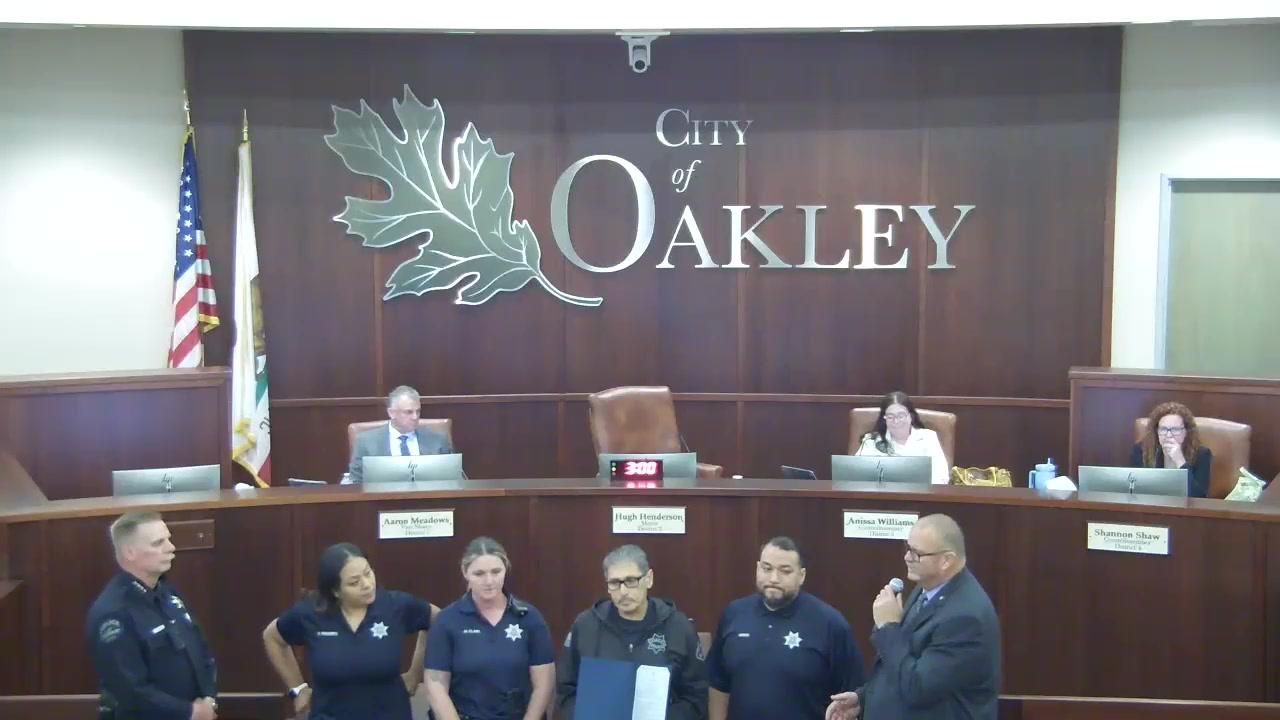
- Police support staff honored: Nov. 9-13 was proclaimed Law Enforcement Records and Support Personnel Week. "This police department, any police department, does not work without the support of non-sworn staff behind them," said the Police Chief.
- Regional housing news: Williams reported that Gov. Newsom signed the Concord Naval Station sale bill, covering 12,272 housing units, 25% of them affordable.
- Closed session: The council adjourned to closed session on the city attorney's performance evaluation and one anticipated litigation matter.
Looking Ahead
Oakley on Ice holds its grand opening Nov. 21, and the downtown tree lighting is Dec. 3 at 5 p.m.