
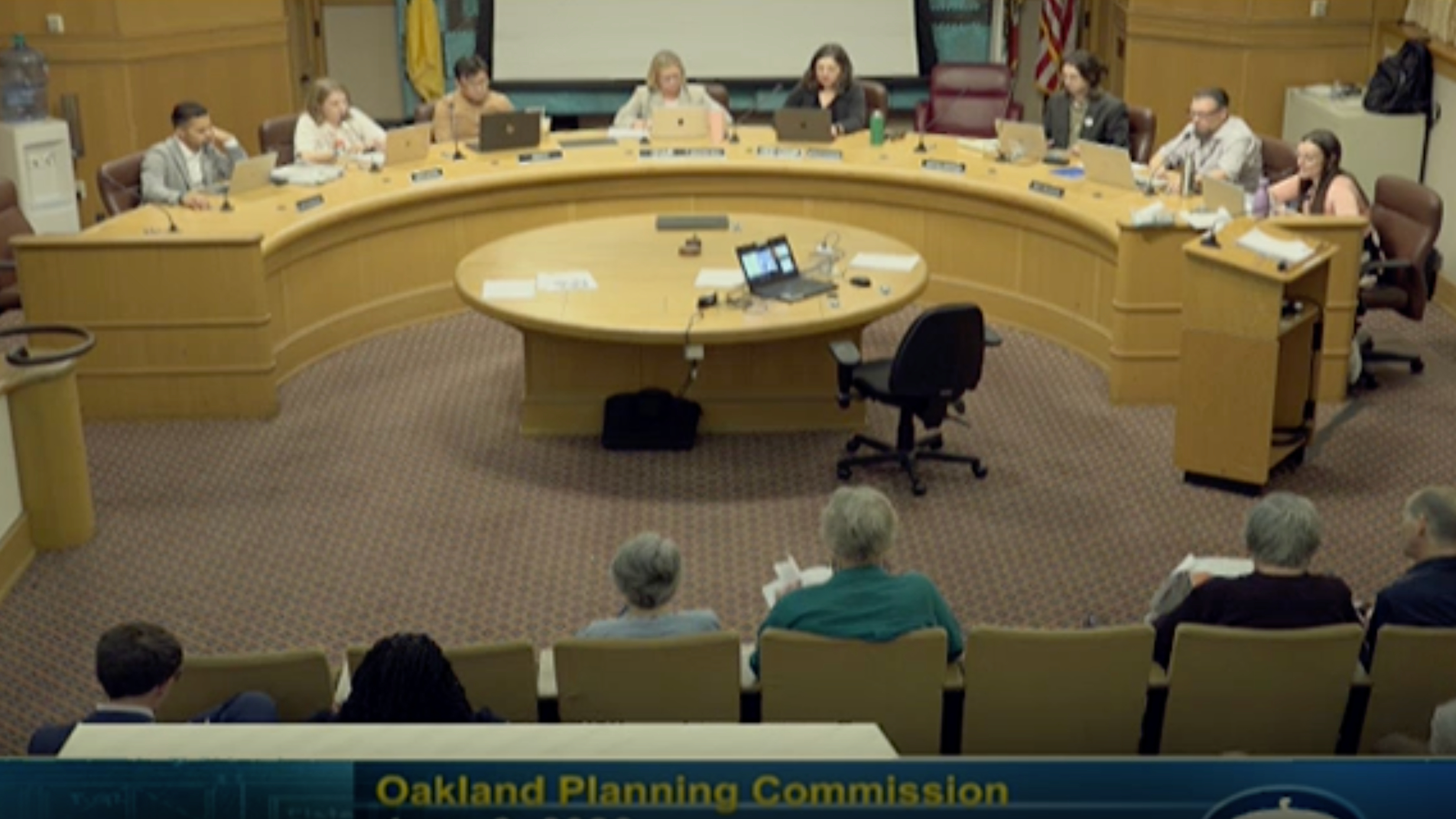
Planning Commission - Jun 03, 2026 - Meeting
Planning Commission • OaklandJune 3, 2026
Locunity is a independent informational service and is not an official government page for this commission.We use AI-assisted analysis and human editorial review to publish information.
Commission Approves Grocery Outlet Parking at Temescal Plaza After Heated Debate
Oakland's Planning Commission spent nearly the entire meeting wrestling with a deceptively simple question — can 15 parking spaces in a 155-space lot be reserved for one tenant? — and in the process reopened a 30-year-old covenant, divided neighbors, and set a precedent that could reshape how shared commercial lots work across the city.
Temescal Plaza parking rules rewritten for the first time in 30 years as Commission votes 4-1 to let Grocery Outlet reserve 15 spaces at the former Walgreens site, with new conditions on hours, bike parking, and signage
Small business owners and the original 1995 deal negotiator warn that dedicating spaces to a single tenant undermines a hard-won public benefit and hurts surrounding shops
New leadership elected as Commissioner Josie Ahrens becomes Chair and Alex Randolph becomes Vice Chair, replacing outgoing Chair Jennifer Renk and Vice Chair Natalie Sandoval
15 Spaces, 30 Years of History, and a Neighborhood Divided
The biggest fight at the Oakland Planning Commission's June 3 meeting wasn't about a tower or a housing project — it was about a parking lot. Temescal Property Management asked to revise Condition of Approval #14 of the 1995 Planned Unit Development for Temescal Plaza, the commercial complex at 5055 Telegraph Ave., to allow Grocery Outlet to reserve 15 of 155 free public parking spaces at the former Walgreens storefront, a 14,500-square-foot space that has sat vacant.
The basics: The 1995 Planned Unit Development (PUD) explicitly stated that no parking space shall be dedicated to any particular tenant — a condition negotiated between the city, the property owner, and surrounding businesses when the plaza was built. Under current Oakland code, the site sits near major transit and would require zero minimum parking if approved as a new project today.
Why it matters: This is the first time the 30-year-old parking covenant has been modified, and the decision could establish a template for other tenants in shared commercial lots across Oakland seeking their own dedicated spaces.
The Applicant's Case
Mark Loper, an attorney with Reuben, Junius & Rose representing Temescal Property Management, framed the request as modest — just 10% of the lot — and essential to landing a tenant for a space that has proved difficult to fill. He told commissioners the deal hinges on parking.
"If Grocery Outlet doesn't get 15 spaces, then they don't have to move in," said Loper. "So it's my client's obligation to be here to secure these 15 spaces in order for Grocery Outlet to move in and open and provide fresh and affordable groceries for the entire community."
Loper added that Grocery Outlet typically seeks at least 50 dedicated spaces and had already significantly compromised to request only 15. Alexia Rotberg, Oakland Planner, recommended approval while noting the site's proximity to transit and the absence of any parking minimum requirement under current code.
Neighbors Draw the Line
Eight public commenters testified, and the room split sharply. Opponents argued that carving out spaces for one business — no matter how popular — violates the spirit of a deal that took years to negotiate and disproportionately hurts the small shops that depend on shared parking.
Kesete Yohannes, owner of Asmara Restaurant since 1985 and one of the original negotiators of the 1995 PUD, read directly from the resolution's language prohibiting tenant-dedicated parking. He said the real problem is that employees park in customer spots and enforcement has been nonexistent for decades. He urged the Commission to reject the proposal outright.
Sarita Waite, a 40-year property owner across the street and developer of Temescal Alley, said her block has only four parking spaces and her 16 small first-time businesses depend on the plaza lot. She argued that exclusive parking rights are effectively ownership and would harm surrounding businesses.
Emmanuel Singh, a small business tenant in Temescal, said his 350-square-foot shop draws 4,000 unique visitors a year, many driving from outside the area. He questioned why the lease was signed before the Commission had approved the parking change.
Brian Charles Brooks, a 30-year neighborhood resident, noted the city had already removed roughly 40 on-street parking spaces six years ago for a road redesign, leaving fewer options for everyone.
Supporters countered that the community needs an affordable grocer and the parking rules have never been enforced anyway. Shawn Granberry, president of the Temescal Telegrap Business Improvement District, called the new tenant "a blessing" given that most closed Walgreens locations nationwide remain vacant. Morris Holmes, an 18-year security guard at the plaza, said he doesn't see 15 spaces as a significant issue in a 150-plus-space lot and emphasized elderly shoppers' need for convenient parking. Joe Tanner, an entitlement manager for Grocery Outlet, described the company's independent operator model where a local partner runs the store.
Commissioners Wrestle With Precedent
The debate among commissioners was extensive, touching on enforcement, precedent, and the tension between preserving old agreements and filling empty storefronts.
Commissioner Josie Ahrens was the most skeptical.
"If we're looking at updating it now to the planning context of today, this, if it were a new project, would not have any required parking minimums. And so that's what is the sticking point for me," she said.
Ahrens also expressed discomfort that the landlord had promised the spaces to Grocery Outlet before obtaining Commission approval and noted that no enforcement plan had been presented.
Commissioner Owen Li compared the situation to a developer trying to reclaim a public park decades after it was required as a condition of approval.
"If a developer gets to build a high rise and as a condition of approval they have to create a public park, they can't come back 30 years later and say, well, we own this park, we're going to take back some of it," he said.
Still, Li supported tying the restriction to grocery use so it wouldn't persist if a different type of business replaced Grocery Outlet.
Commissioner Alex Randolph zeroed in on the contradiction in the testimony.
"If everybody says there's no enforcement and nobody cares, then why are we here to make restrictions for something that's not going to be enforced or nobody cares about?" he asked.
He also raised the prospect of other plaza tenants — like Sutter Health or USPS — seeking their own dedicated spaces.
Vice Chair Natalie Sandoval voiced similar precedent concerns:
"I worry a little bit about the precedent that this would set to allocate the 15 parking spaces to a single tenant"
But Sandoval was also motivated by the neighborhood costs of a vacant storefront.
"I'm a little less concerned about the enforcement and more concerned that this might remain empty," she said. "Just thinking about how empty retail spaces really impact neighborhoods."
Chair Jennifer Renk cautioned that adding a grocery-use restriction could make it harder to attract future tenants given the lengthy approval process.
The Deal: Five New Conditions
Randolph ultimately crafted the motion, adding five conditions beyond staff's recommendation:
Operating hours only: Dedicated parking restricted to the grocery tenant's hours of operation.
Grocery-only use: The dedication is tied to a grocery store or general food sales use — if the tenant changes, the restriction reverts.
Bike parking: Install short-term bike parking meeting current code for the grocery store use.
Signage and striping: Update striping and signage across the entire lot to be consistent with current approvals, with each stall marked for its time restriction.
Private enforcement: Reaffirm that the property owner shall enforce both parking duration limits and customer limitations.
The applicant agreed to all five conditions. Sandoval seconded the motion.
Decisions: The motion passed 4-1-1 (For: Randolph, Li, Sandoval, Renk; Against: Ahrens; Absent: Robb). The commission maintained that existing turnover was sufficient and no credible enforcement plan had been presented. The decision is appealable within 10 days.
What's next: Grocery Outlet can now proceed with its lease for the former Walgreens at 5055 Telegraph Ave. The 10-day appeal window will determine whether the decision reaches the City Council. The added conditions — particularly tying the dedication to grocery use and limiting it to operating hours — will serve as the benchmark if other plaza tenants seek similar arrangements.
New Leadership Takes the Gavel
The Commission unanimously elected Commissioner Josie Ahrens as its new Chair and Commissioner Alex Randolph as Vice Chair, effective in July. Both votes passed 5-0 with Commissioner Robb absent.
Outgoing Chair Jennifer Renk noted she would be rolling off the commission, and Vice Chair Natalie Sandoval is also departing. Randolph nominated Ahrens for the chair, thanking Renk for her service. Commissioner Owen Li seconded. Ahrens then nominated Randolph for vice chair; Renk seconded. Renk said she would hand over the ceremonial gavel in July.
Why it matters: The new leadership team will guide the Commission's hearings and set its tone as Oakland navigates post-pandemic retail vacancies and evolving transportation and land use priorities.
Minor Items
Minutes approved: May 20, 2026 meeting minutes were approved unanimously by voice vote.
No Director's Report, informational reports, committee reports, consent calendar items, or correspondence were presented.
Commissioner Ahrens asked staff about the status of a mini-storage appeal to City Council; staff indicated they would follow up.