
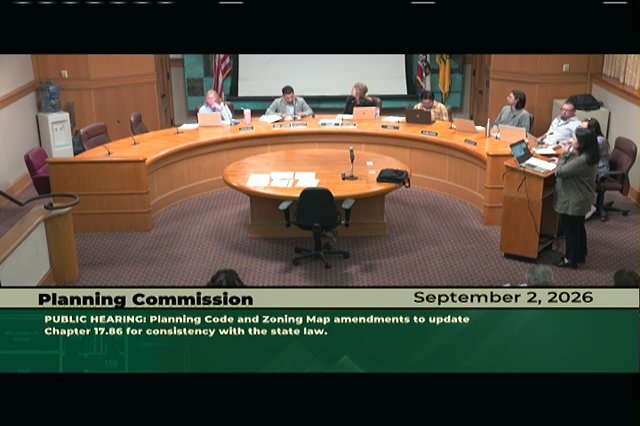
Planning Commission - Sep 02, 2026 - Meeting
Planning Commission • OaklandSeptember 2, 2026
Locunity is a independent informational service and is not an official government page for this commission.We use AI-assisted analysis and human editorial review to publish information.
Commission Advances SB 79 Zoning Fixes as Rockridge Residents Fight Senior Housing
Oakland's Planning Commission unanimously sent state-mandated zoning amendments to City Council, reclassifying parcels near transit to comply with California housing law — while residents packed the meeting to challenge a proposed 200-unit senior care facility in Rockridge and a commissioner flagged a regulatory blind spot on data centers.
SB 79 zoning amendments advance unanimously, reclassifying open space and industrial parcels near transit stops to bring Oakland into compliance with state housing law
Rockridge neighbors mobilize against 6230 Claremont senior housing project, armed with 2,500-signature petition challenging density calculations, building height, and traffic safety
Vice chair flags missing zoning category for data centers, with 7,000+ petition signatures opposing AI infrastructure projects across Oakland
Three vacancies now sit on the seven-member commission after formal farewell to Commissioners Sandoval and Robb
State Housing Law Forces Oakland to Reclassify Transit-Adjacent Parcels
The commission's main business was a set of amendments to Oakland's planning code Chapter 17.86 — the S-8 combining zone — to bring the city into compliance with SB 79, the state law enacted in October 2025 that permits higher density, height, and floor area ratios in transit-oriented development areas.
The basics: Oakland adopted a local exclusion ordinance in March 2026 that temporarily carved out certain parcels from SB 79 coverage using three categories based on existing zoning capacity and historic resources. In June, the California Department of Housing and Community Development found the ordinance non-compliant.
Why it matters: The core problem was straightforward but consequential. Oakland had classified open space and industrial parcels that allow some commercial uses as ineligible for SB 79 coverage. HCD disagreed. "The state HCD considers any parcels with zoning that allows residential or commercial use alongside with another use to be a mixed use zone, making it subject to SB 79 standards," said Kelly Cha, staff planner. "Before, the ordinance actually considered open space and industrial parcels ineligible. So we had to make them eligible, basically."
Where things stand: The amendments remove those zones from the ineligible list, redesignate them as excluded or covered depending on location, correct a clerical error regarding the AC Transit Tempo 20th Avenue stop, align Oakland's map with MTC's regional SB 79 map, and add four new transit stops from the Uptown Transit Center. Staff recommended excluding industrial parcels near the Coliseum BART station and 14th Avenue stop from immediate SB 79 coverage to allow comprehensive review through the alternative plan process.
Commissioner Jennifer Renk confirmed that staff had verified these changes directly with HCD.
Density Bonus Stacking and the General Plan Connection
Vice Chair Alex Randolph pressed staff on whether Oakland has flexibility to adjust how SB 79 densities interact with state density bonus law: "Is it always the best to go as high as you can, or is there flexibility for Oakland to adjust that, or is it just because it's a state law now, there's not a lot for us to do?"
City Attorney Michael Branson clarified the mechanics: SB 79 explicitly permits density bonus projects on top of SB 79 allowances, but with guardrails. "Under SB 79 you can ask for height waivers, but it's restricted only so that you can't ask for a height waiver if it's in excess of the local height limit," he said.
Staff member Laura Kaminski connected the amendments to the bigger picture: the General Plan Phase 2 land use and transportation element, expected in draft form in early January 2027, proposes eliminating detached residential as a land use category and creating higher densities. The SB 79 alternative plan — which would allow Oakland to redistribute density allowances across the city — would be formulated through that process, with potential adoption by fall 2027.
The other side: Public commenter Jack Gerson of Rockridge Neighbors for Sensible Housing used his time during the SB 79 hearing to draw connections to his neighborhood's fight, calculating that the Trader Joe's site qualifies for 415 units under CN2 zoning and, with the gross-to-net conversion factor, could theoretically reach over 550 feet. He urged the commission to adjust densities downward citywide if the conversion factor is deemed valid.
Chair Josie Ahrens acknowledged the tension. "I think there is some sensitivity that we need to have in different parts of Oakland, especially around gentrification and displacement and the flip side of that process of exclusion that we have seen," she said.
Decisions: The commission voted 4-0 to recommend the amendments to City Council (For: Renk, Li, Randolph, Ahrens; Against: none; Absent: none). The CED Committee hearing is scheduled for Sept. 22, with City Council action anticipated Oct. 6–20.
Rockridge Residents Draw Line on Senior Housing Scale
Five speakers used Open Forum to challenge the proposed senior care facility at 6230 Claremont Avenue, a project that has become a flashpoint for how Oakland calculates density and manages neighborhood transitions.
Why it matters: The 200-plus-unit, eight-story project tests how the city applies density bonus calculations and gross-to-net conversion factors — tools that, if validated here, could set precedent for development scale along College Avenue and near BART stations citywide.
Where things stand: Jack Gerson of Rockridge Neighbors for Sensible Housing, representing a petition with nearly 2,500 signatures, laid out the central technical dispute: "We think planning staff has overestimated the planned number of allowed units by a huge margin, more than 75%. That's because staff applied a gross-to-net conversion factor and a mixed use factor, neither of which the application should receive."
Gerson warned the calculations would set a broader precedent: "What will they mean going forward if these are allowed, especially the gross to net? If it's ridiculous, there's no basis for it."
Tanya Pampilloni, a resident two blocks from the site, said she is not opposed to senior housing in principle but objected to the building's relationship to the existing neighborhood — an eight-story structure next to single-story homes. She noted that $13,000-per-month rents do not qualify as affordable senior housing and requested fewer stories, step-backs, ample parking, and design that reflects neighborhood character.
Michael Mayer, a 35-year neighbor, said the developer asked for significant height and setback waivers while claiming consistency with the land use framework — and refused to explain whether the project could pencil out with one fewer floor.
Traffic Safety as a Condition of Approval
Ellen Kohler, a 55-year neighborhood resident, shifted the argument to life-and-death stakes, citing two recent pedestrian fatalities on Claremont Avenue — in July 2025 and February 2026 — near the project site. "This isn't a theoretical risk, it's a proven pattern. We're proposing to place a large population of seniors, including those in a memory care wing, directly into a high-speed traffic environment that is already failing to protect pedestrians," she said. Kohler urged the commission to require a binding traffic safety mitigation plan with daylighting, protected crossings, and speed reduction as a condition of approval.
Paul Friedman, an attorney and nearby resident, challenged the legal foundation for the density bonus, arguing that an administrative zoning bulletin — essentially a single city employee's opinion — cannot have binding legal effect.
What's next: Staff confirmed the application is still under review, a completeness letter has been sent, and a CEQA document is being prepared in administrative draft form. The project did not come in as an AB 130 application.
Data Centers Land on Oakland's Radar — Without a Rulebook
A growing community backlash against data center development found its way to the Planning Commission from two directions: public comment and a commissioner's formal request for regulatory action.
Why it matters: Oakland has no specific zoning use category for data centers, meaning the city cannot adequately track proposals, impose tailored conditions, or assess environmental and community impacts — including noise, water consumption, energy demand, air quality, and power grid strain.
Where things stand: During Open Forum, Connor of the No Data Center Oakland Coalition reported that "a petition was launched by the No Data Center Coalition that right now has reached over 7,000 signatures." He cited the Bering Company's announced plans for a downtown Oakland data center and two AI infrastructure announcements in West Oakland, framing the issue as community self-determination versus tech industry interests.
Another public commenter, Khalid, took a different approach, arguing that if data centers are inevitable, the city should extract community benefits including life skills classes, job training, and practical education for underserved communities and youth.
During commission business, Vice Chair Alex Randolph delivered extended remarks revealing how deep the regulatory gap runs. Existing data centers in Oakland operate under various industrial, commercial, or laboratory permits — none specific to the use. "It is not clear to me currently if there's really an existing category or zoning code that captures the concept of what a current-day use of a data center actually is," he said.
Randolph connected the issue to Oakland's environmental justice priorities: "I know we have a really strong environmental justice component to all of our codes and overall priorities, and I don't want that to be lost when it comes to these data centers coming into our communities."
He formally requested that staff bring an informational item to a future meeting exploring how to create a specific zoning category. Staff indicated they would take the request forward.
Minor Items
Commissioners Sandoval and Robb honored. The commission formally recognized departing Commissioner Natalie Sandoval and Commissioner Maurice Robb for roughly three years of service each. Chair Ahrens praised Sandoval's transparency and Robb's architectural expertise on the design review committee. Three vacancies now exist on the seven-member body.
July 15, 2026 meeting minutes approved unanimously, 4-0.
Sept. 16 meeting canceled; next session is a special meeting on Sept. 23.
No Director's Report, informational reports, committee reports, or City Attorney report were delivered.