
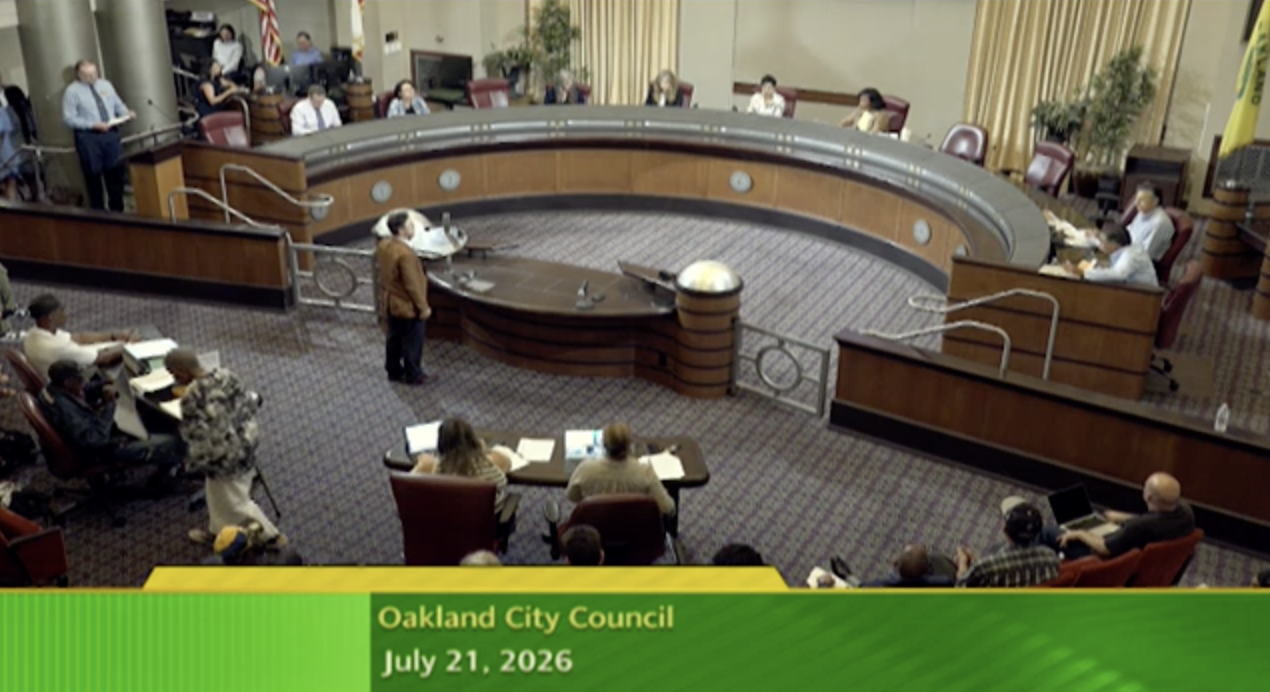
Oakland City Council - Jul 21, 2026 - Meeting
Oakland City Council • OaklandJuly 21, 2026
Locunity is a independent informational service and is not an official government page for this commission.We use AI-assisted analysis and human editorial review to publish information.
Oakland Council Passes Sanctuary Ordinance, Directs $50M to Pension Debt, and Demands Local-First Procurement Before Recess
The Oakland City Council packed its final meeting before summer recess with historic votes and heated debates over where the city's money goes — and who gets left out. The council codified its 40-year-old sanctuary city protections into enforceable law for the first time, steered $50 million from the Coliseum sale toward crushing pension debt, and blocked millions in vehicle repair contracts from leaving Oakland after learning local body shops were never told about the bidding process.
- Council passes historic City of Refuge ordinance recognizing harms to Black residents excluded from sanctuary protections since 1986
- $50M from the Coliseum arena sale directed to CalPERS to chip away at Oakland's $2 billion-plus pension liability
- $7M in collision repair contracts restricted to Oakland vendors after councilmember exposes certified local shops were never notified of the bidding process
- Coliseum sale finalized as 15-plus arts advocates rally for the 6% ticket revenue share to rebuild Oakland's zeroed-out cultural funding
- Surveillance tech reports approved minus ALPR section; critics warn Flock cameras contradict the sanctuary ordinance passed the same night
- Council backs SB 954 to restore CEQA environmental review stripped by state trailer bill, with 100-plus organizations in support
Houston Demands $7M in Vehicle Repairs Stay in Oakland
Why it matters: Certified Oakland small businesses were excluded from the bidding process for routine city vehicle repair contracts — exposing systemic failures in the city's own procurement outreach.
Where things stand: Staff presented a $7 million multi-vendor collision repair contract, but the Public Works Committee had already narrowed approval to only Quality Body and Fender, the sole Oakland-based bidder. Councilmember Ken Houston, District 7, drove the fight, arguing that the city's purchasing department never notified multiple local body shops — including several with the city's own Small Local Business Enterprise (SLBE) certification — that the work was available.
"I have a problem with spending $7 million outside of the city of Oakland," said Councilmember Houston.
Councilmember Charlene Wang, District 2, backed Houston, pointing out the depth of the notification failure: "If you go down International Boulevard, many, many auto body shops — I've learned that a number of them actually have the city's SLBE certification and they did not get the invitation."
The owner of Turbo Auto Body, a public commenter identified as Enoch, testified that his Oakland shop has operated for 36 years and holds SLBE certification but was never contacted. He described devastating losses — a car crashing into his building, staff reductions from 32 to 14 — while city contracts went to shops outside Oakland.
The other side: Councilmember Zac Unger, District 1, supported the compromise approach, emphasizing the need to keep vehicle repairs going during the summer recess. The council added Mueller Brothers, a San Leandro shop, back to the contract solely to cover $280,000 in outstanding invoices already owed.
Decisions: The amended item passed 6-0 (Fife excused, Jenkins absent). Only Quality Body and Fender and the limited Mueller Brothers authorization were approved. All remaining contract awards were deferred.
What's next: Staff committed to working with the Purchasing Department over the summer to conduct broader local outreach. The council expects a new proposal in September that gives Oakland's SLBE-certified body shops a fair shot at the work.
Council Codifies Sanctuary Protections, Recognizes Black Community for First Time
The basics: Oakland declared itself a sanctuary city in 1986 but never codified those protections into a single enforceable municipal code chapter. The City of Refuge ordinance consolidates scattered resolutions, prohibits city resources from being used for federal immigration enforcement, and bars cooperation with civil immigration detainers.
Why it matters: For the first time in 40 years, the ordinance explicitly recognizes harms to Black Oakland residents — a community Councilmember Houston argued was excluded from the original sanctuary framework during an era of extreme violence.
"So I appreciate you accepting my revisions of bringing in a refuge and a sanctuary for my Black residents. Because we were left out for so long. And this is historic. 40 years," said Councilmember Houston, who recounted the era's toll — 175 homicides in 1992 and the murder of Huey P. Newton in 1989.
Councilmember Wang connected the two threads: "A true city of refuge must acknowledge both the contributions of the Black community as well as a lot of the ways that the Black community has been disinvested, has been subject to systemic discrimination and blocked from opportunities."
Multiple Faith in Action East Bay leaders turned out in support. Corina Gomez spoke in Spanish urging passage, emphasizing that the ordinance protects civil and human rights regardless of citizenship. Moose, an IBEW electrician and Faith in Action leader, recounted his Black son being stopped by ICE agents who demanded his birth certificate, arguing that immigration enforcement is about creating a police state. Arlington Tugwell, James Wood, and Elsa Stevens also spoke in support.
Decisions: The ordinance received final passage on the consent calendar, approved 6-0 (Fife excused, Jenkins absent). Councilmember Noel Gallo, District 5, and Councilmember Wang were credited alongside Houston for shepherding the amendments.
$50M From Coliseum Sale Goes to Pension Debt Over Housing Objections
Why it matters: Oakland carries more than $2 billion in unfunded pension liabilities with CalPERS. The Finance Department argued that applying $50 million from the Coliseum arena sale before the summer recess would maximize investment returns and reduce future annual pension bills.
Finance Director Brad Johnson framed the urgency in simple terms: "I would liken this to paying down the bill on a high-interest credit card. The sooner you make a payment, the lower the payments you will make over time."
Chair Janani Ramachandran, District 4, confirmed the fiscal rationale, asking Johnson directly about the scale of the city's pension exposure. Johnson responded that the city has over $2 billion in CalPERS liabilities.
The other side: David Peters of the West Oakland Cultural Action Network objected, citing a 2014 council policy that directed net proceeds from city property sales to the Affordable Housing Trust Fund. Peters argued the current council was breaking that commitment. Gene Hazard cautioned that Coliseum redevelopment would take eight to 10 years and warned against unrealistic expectations.
Decisions: The urgency finding and the $50 million allocation both passed 6-0 (Fife excused, Jenkins absent).
Arts Community Makes Organized Push for Coliseum Ticket Revenue
The basics: The second amendment to the Coliseum sale agreement received final passage on consent, restructuring the deal into separate arena ($50 million lump sum) and stadium ($60 million seller-financed) transactions with African American Sports and Entertainment Group (AASEG). The amended agreement includes a 6% gross ticket revenue sharing arrangement.
Why it matters: Oakland's Cultural Affairs general fund budget was eliminated at the end of 2024, leaving the city's arts grants program at effectively zero. The new 6% gross ticket revenue from arena and stadium events represents the first potential dedicated arts funding source in years — and roughly 15 speakers showed up to make the case.
Cultural Affairs Commission Chair Vanessa Huang cited a University of Indiana study showing arts and culture comprise 4.4% of U.S. GDP — greater than construction, transportation, or agriculture. Commissioner Alana Lipset noted Oakland's arts grants budget is effectively zero. Roberto Bedoy, the former Cultural Affairs manager, urged the council to create a dedicated revenue stream. Roni Stratton of Oakland Art Murmur, J.K. Fowler of Nomadic Press, Jyoti Singh, Ted Russell, Daniel Galvez, Natalia Naida of Emerging Arts Professionals, Jamal Truelove of Bay Area Film Night, and others echoed the call, pointing to cities like Columbus, Portland, and Seattle that use ticket fees for cultural infrastructure.
The other side: AASEG co-founder Kareem Muhammad asked the council to pull and continue the item, citing a pending arbitration dispute between AASEG entities. No action was taken on that request. David Peters called for a Coliseum history museum recognizing Black cultural contributions.
Decisions: The ordinance passed 6-0. Councilmember Wang logged support for dedicating a portion of the revenue to arts and culture: "I did want to just log some support for a portion of the revenue going to arts and culture, especially when I think about this vision that we have around the Coliseum and it positioning Oakland to be a music city."
What's next: The council did not vote on how to allocate the 6% revenue. That debate is expected when the council returns from recess.
Surveillance Reports Pass, but Critics Link Flock to Sanctuary City Conflict
Why it matters: The same night the council codified sanctuary city protections, it approved OPD's annual surveillance technology reports — minus a controversial section on automated license plate readers (ALPRs). Critics argued the contradiction was unavoidable.
The ALPR section was struck due to a legal posting issue discovered by OPD — not a deliberate policy decision, as Councilmember Wang clarified: "There was some misinformation. I think we should have worthwhile debates about Flock. I also think there's been some misinformation posted around how there was a deliberate intention" to remove the section.
Public commenter Jennifer Finley drew a sharp line, arguing that a vote supporting Flock cameras is "a polar opposite to a yes vote on a sanctuary city," citing the Flock CEO's statements that the company has no opinion on immigration and that states can use the technology for enforcement purposes. Madeline Stacy argued ALPRs provide indiscriminate location data without a warrant. Blair Beekman questioned why the Flock contract remains unsigned months after receiving urgency approval.
Decisions: The surveillance tech reports were approved on the consent calendar, 6-0, with the ALPR section removed.
Encampment Sweeps Draw Sharp Criticism, Full Debate Deferred
Councilmember Houston noted the encampment management report was supposed to be a non-consent item and pledged to bring it back for full council discussion in September.
Public commenters challenged the city's approach from multiple angles. Charlotte described sweeps as euphemistic evictions where people lose RVs, documents, and medication. Madeline Stacy cited statistics showing 64 of 78 EMAT operations this year — 82% — were closures. Armando cited a UC Berkeley study finding that since the Supreme Court's Grants Pass decision, sweeps have pushed encampments deeper into Black and brown neighborhoods, contradicting the city's equity goals. Blair Beekman and David Peters offered differing perspectives — Peters argued a racial equity analysis must also account for the impact of out-of-control encampments on historic Black neighborhoods.
The informational report was received on consent. Substantive debate is expected when the council returns.
Police Commission Nominees Pulled for Incomplete Background Checks
The administration requested withdrawal of two Police Commission nominees — Ricardo Garcia-Acosta and Joey Harrison — after discovering the selection panel had not reviewed required background checks before submitting names. Staff explained that under Oakland's municipal code, the 60-day clock for council action cannot begin until the panel completes that review.
Public commenter Assata Olubala raised concerns about Omar Farmer, a veteran participant in public safety processes, being excluded from the 10 finalists out of 45 applicants.
The withdrawal passed 5-0 (Brown, Fife, and Jenkins absent or excused).
Minor Items
- Police Chief contract approved: Police Chief James Beere's employment agreement at $411,295 annual compensation was approved via urgency finding before the summer recess.
- SB 954 (CEQA reform) supported: The council backed a resolution supporting SB 954 (Blakespear), which would restore CEQA environmental review for advanced manufacturing projects — including data centers and battery recycling facilities — after a 2025 trailer bill exempted them. Laura Walsh of Save the Bay and Dan Kalb, representing a coalition of 100-plus organizations including Clean Water Action, Sierra Club, Alameda Labor Council, and the State Building and Construction Trades Council, urged passage. Councilmember Wang sponsored; Councilmember Rowena Brown co-sponsored.
- City Hall signage contract continued: Item S6.40, a professional services agreement with Barretto, Co. for signage and wayfinding, was continued to Sept. 15. Councilmembers Unger and Wang registered no votes.
- Parking garage contracts flagged: Chair Ramachandran noted the finance committee had "deep reservations about the performance of these contracts" for parking garage management.
- Children's Hospital concerns raised: Humberto Retana of the UPD union spoke during general public comment about UCSF moving services from Children's Hospital Oakland to San Francisco, raising concerns about Measure C funds.
- Public comment time limits criticized: Madeline Stacy argued that reducing public comment to one minute at every meeting prevents the public from fully voicing concerns.
- 50-plus consent items approved, including planning code ADU updates, a $20.9 million Broadway streetscape contract, workforce development funding, and multiple commission appointments.