
Oakland City Council - Jun 02, 2026 - Meeting

Oakland City Council - Jun 02, 2026 - Meeting

Oakland City CouncilOaklandJune 2, 2026

Sources:

Locunity is a independent informational service and is not an official government page for this commission.We use AI-assisted analysis and human editorial review to publish information.

Charter Reform Advances 5-3 as Council Splits Over Strong Mayor

Oakland's most consequential governance debate in decades moved forward Tuesday night, with the City Council voting to advance a charter reform ballot measure to a second hearing despite deep divisions over whether to concentrate executive power in the mayor's office. The marathon session also produced a contentious 5-3 vote to approve the city's violence reduction spending plan — unlocking tens of millions in voter-approved public safety funds before a June 30 deadline.

  • Charter reform measure advances 5-3 to June 16 second hearing, splitting council between strong mayor supporters and council-manager advocates

  • Violence reduction plan approved 5-3 after Wang's push to delay pending Measure E election results fails; $45-47M/year in Measure NN funds unlocked

  • Master Fee Schedule passes first reading 6-1 with 3% baseline increase; Wang votes no over fee burden on small businesses

  • Hazard mitigation plan adopted unanimously, maintaining FEMA grant eligibility and positioning Oakland for zero post-disaster cost share

  • Disability commission chair warns ADA understaffing costs city millions in litigation annually, calls for two additional positions

  • Consent calendar clears 8-0 with $28.4M Lincoln Recreation Center contract, WIOA workforce funding, and West Oakland recycler relocation directive


The Fight Over Who Runs Oakland

The council's longest and most heated debate centered on a proposed charter amendment that would fundamentally restructure how Oakland's government operates — giving the mayor chief executive authority, creating a mayoral veto with a two-thirds council override, establishing an independent budget and legislative analyst office, and granting council members confirmation power over the directors of Finance, HR, Transportation, and Public Works.

The basics: The proposal emerged from a six-month working group co-facilitated by the League of Women Voters and SPUR, with more than 750 resident participants. If the council ultimately places it on the November 2026 ballot and voters approve, it would be Oakland's most significant governance overhaul since the Jerry Brown era.

Why it matters: The reform would settle an ongoing structural question about who residents should hold accountable when city services fail — the mayor, the city administrator, or the council — by clearly placing operational authority with the mayor.

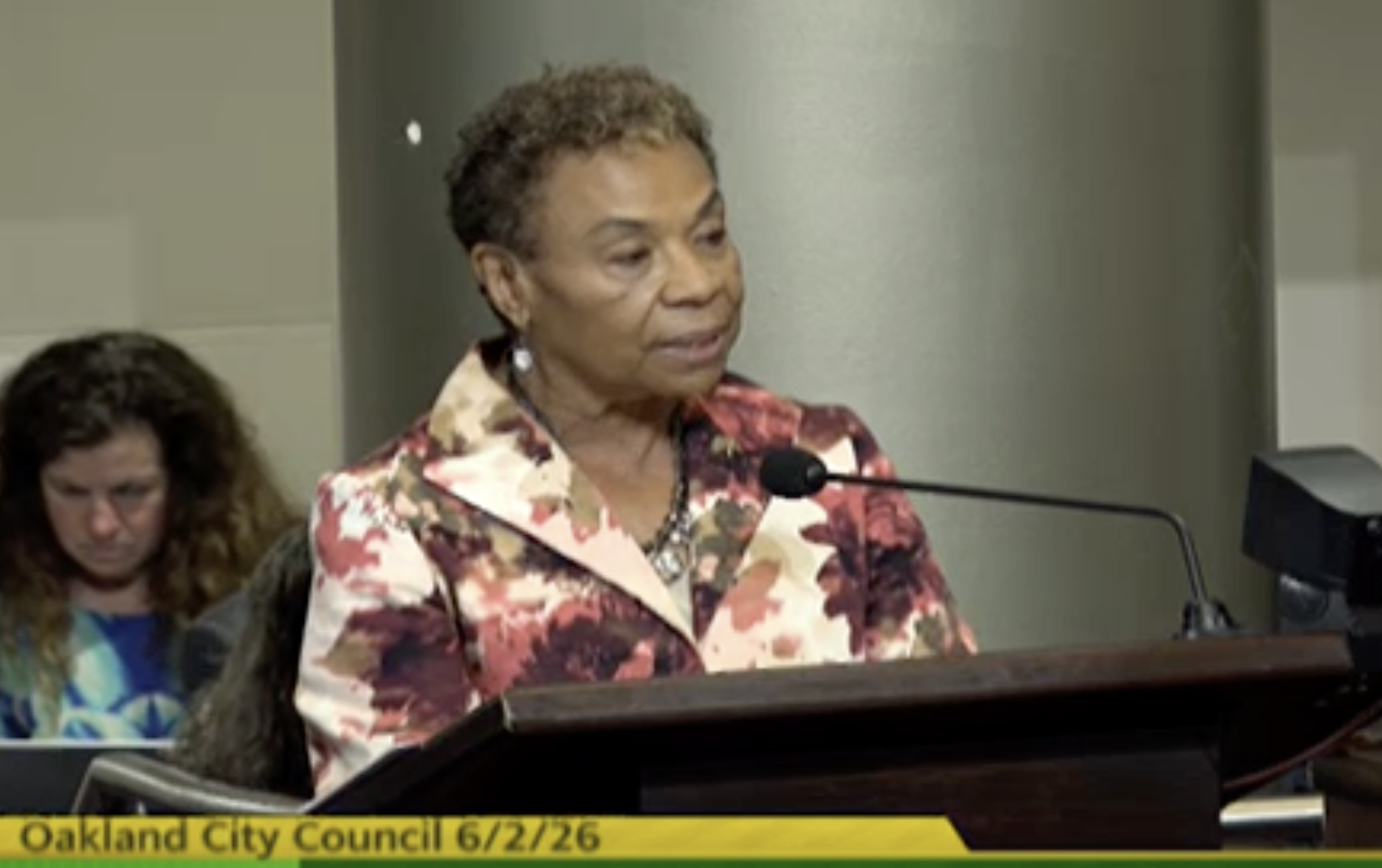
Where things stand: Mayor Barbara Lee framed the proposal around accountability, not power.

"Residents across our city are asking three fundamental questions about their government. Who is responsible when something goes wrong? Who has the authority to act? And who should voters hold accountable at the ballot box," she said.

Lee also addressed racial dynamics head-on:

"There's a long history in this country of describing Black leaders, particularly Black women leaders seeking executive authority or structural reform as dangerous or unqualified. We should be honest enough to recognize when rhetoric begins to echo those patterns."

The mayor's Deputy Chief of Staff Preston Kilgore announced three amendments coming at the second hearing: removing a council liaison requirement in Section 218A, adding "shall not have the power to" language to Section 218D's non-interference clause, and clarifying that the Public Ethics Commission can seek outside consultants at its discretion. Public Ethics Commission Executive Director Suzanne Doran said the commission unanimously supports the salary-setting provisions but wants enforcement of Section 218 limited only to the non-interference subsection.

Councilmember Charlene Wang was the strongest council supporter, arguing the current system is broken.

"I think we need to empower a mayor to be a real change maker and to break through red tape and the bureaucracy. And we need to empower them to make change," she said.

Wang also pushed for additional guardrails around department head appointments.

The other side: Three council members voted no, preferring a council-manager system. Councilmember Zac Unger warned that a strong mayor structure would shift power to a minority of the council by giving the mayor veto authority.

"Instead of a majority of the council making decisions under strong mayor, a minority of the council could make those decisions," he said.

He cautioned against expecting any structural fix to solve Oakland's problems:

"For every complicated question there is an easy answer that's usually very neat and tidy and also wrong."

Councilmember Carroll Fife expressed deep reservations but ultimately voted to continue the item.

"We don't have the trust right now to invest in a single leader because of all of the ups and downs that Oakland has faced," she said, adding that she wanted voters to have the chance to weigh in.

Councilmember Noel Gallo and Councilmember Janani Ramachandran also voted no. Councilmember Rowena Brown voted to advance while expressing a preference for council-manager government.

Public comment drew roughly 18 speakers. Gail Wallace of the League of Women Voters of Oakland urged the council to move forward. Nicole Neditch of SPUR Oakland said the proposal balances power between branches. Richard Fuentes, AFSCME Council 57 PAC chair, said residents want someone to hold accountable for unfilled potholes. On the opposing side, Ben Gould of the Oakland Charter Reform Project warned that giving mayors authority over department heads is risky given most lack management experience.

Decisions: The measure was continued 5-3 to the June 16 meeting (For: Brown, Fife, Houston, Wang, Jenkins; Against: Gallo, Unger, Ramachandran; Absent: 0). Amendments are due by June 11 at 4 p.m.

What's next: The second hearing on June 16 will be the critical vote on whether to place the measure on the November 2026 ballot. The three announced amendments will be formally introduced, and council members may bring their own.


Violence Reduction Plan Clears Council Over 911 Spending, Timing Objections

The council approved the 2026-2030 Community Violence Reduction Plan on a 5-3 vote after a sharp dispute over whether to delay action pending the outcome of the Measure E election.

The basics: Measure NN, approved by 71% of voters in 2024, requires the city to adopt a violence reduction plan before any of its $45-47 million in annual funding can flow to the Oakland Police Department (OPD), Oakland Fire Department, and community violence prevention organizations. The plan, developed by the Public Safety Planning and Oversight Commission, includes 12 strategies across three departments: ceasefire and crime reduction teams, emergency response equipment, wraparound services, and CBO grants for gender-based violence services. Its seven goals include reducing homicides by 10% through 2030, improving 911 answer times to 90% within 15 seconds, and maintaining 700 sworn police officers and 480 firefighters.

Why it matters: Without approval by June 30, the Measure NN funds would have been frozen — cutting off a major revenue stream for police staffing, fire services, and community-based violence prevention programs.

Where things stand: Councilmember Charlene Wang, who chairs the Public Safety Committee, moved to continue the item to await Measure E election results, arguing the plan needed stronger 911 dispatch spending provisions and more innovation from OPD.

"I want to see the department to be more creative. I've seen a lack of innovation at times. I really think this department could do better," she said.

Councilmember Ken Houston passionately described the toll of violence in his district.

"That's my district to starve and is dying. We killing each other because of what? No, opportunity, economics. It's about money and opportunity," he said.

However, Houston deferred to Wang as committee chair and voted no on the substitute motion to approve.

A public commenter from Building Opportunities for Self-Sufficiency (BOSS) raised concerns about geographic equity in the Department of Violence Prevention's funding allocations, specifically noting that deep East Oakland appeared underrepresented. Council President Kevin Jenkins clarified that issue would be addressed at a June 9 Public Safety Committee meeting.

Decisions: Councilmember Carroll Fife made a substitute motion to approve the plan immediately, praising the commission's work.

"I think this team has done an amazing job under all kinds of obstacles," she said.

The substitute motion passed 5-3 (For: Brown, Fife, Gallo, Ramachandran, Unger; Against: Houston, Wang, Jenkins; Absent: 0).

What's next: The city can now begin disbursing Measure NN funds. Geographic equity concerns about DVP funding allocations are expected to be addressed at the June 9 Public Safety Committee meeting.


Fee Schedule Passes First Reading as Wang Pushes for Relief

Councilmember Charlene Wang cast the lone dissenting vote as the council approved the FY 2026-27 Master Fee Schedule on first reading, signaling ongoing pressure to reduce fee burdens on small businesses and residents.

Why it matters: The schedule includes a 3% general increase across departments to cover rising healthcare, workers' compensation, and Other Post-Employment Benefits (OPEB) expenses. Notable changes include a new Animal Services administrative citation fee, a 43% increase in neighborhood law attorney fees, reduced election filing fees, a new fire plan check processing fee, and increased parking garage rate maximums.

Wang highlighted her work with the Department of Transportation to create a new lower-cost minor encroachment permit — $400 versus the standard $1,994 — for small businesses installing storefront hardening. She challenged other departments to find similar opportunities. Councilmember Janani Ramachandran asked about the attorney fee increase and a new creek protection permit. Councilmember Zac Unger raised concerns about towing fees for stolen vehicles, which staff clarified are vendor fees addressed in the towing contract.

Decisions: Approved 6-1 on first reading (Wang voting no; Jenkins excused). Final passage is scheduled for June 16.


Hazard Plan Adopted, Unlocking FEMA Funding

The council unanimously adopted the 2026-2031 Local Hazard Mitigation Plan, which covers 72 mitigation actions and ranks earthquakes, severe weather, and wildfire as high-level hazards.

Why it matters: Compliance with AB 2140 positions Oakland to have the state cover its entire post-disaster cost share — potentially reducing it to zero percent. FEMA has already issued an approval-pending-adoption letter.

Oakland Fire Department emergency planning coordinator Veronica Cole presented the updated plan, which includes stronger equity emphasis, climate change integration into hazard profiles, and an updated risk methodology accounting for displacement and economic impacts. Outreach reached approximately 300 individuals through multilingual meetings in West Oakland, Chinatown, Fruitvale, and East Oakland.

Decisions: Approved 7-0 (Jenkins excused).


ADA Staffing Crisis: "We're Paying Millions in Lawsuits"

Mayor's Commission on Persons with Disabilities Chair Anwar Peruti made an impassioned case for additional ADA Programs Division staffing, describing being personally injured walking into improperly parked construction equipment on a sidewalk.

The division has only two of four needed employees per a 2016 consultant assessment. Peruti cited the cost of inaction:

"A quick look at the city attorney's annual reports demonstrates 3 to 18 million dollars that we're paying per year in litigations and settlements on infrastructure alone."

He noted that 25% of wheelchair users' trips end in failure due to obstructions.

The commission requested the council work with the City Administrator and Finance to fund two additional FTEs using a cost-sharing method across departments. The report was received and filed 8-0.


Minor Items

  • East Oakland Arts Center change order approved 6-0 (Jenkins, Fife excused): Contract with CWS Construction Group increased from $1.785M to $2.784M — a 56% increase — due to major vandalism including theft of HVAC and kitchen equipment. City pursuing insurance reimbursement.

  • COLA property tax adjustments for nine voter-approved measures (M, N, C, NN, D, Q, AA, Y, MM) approved 8-0 on first reading; increases range from 2.2% to 6.4%, generating $186.6M total including $9.4M from the adjustments. Councilmember Wang questioned whether existing measure funds are being fully spent before raising rates.

  • LLAD assessments confirmed 7-0 (Jenkins excused) at rates unchanged since 1993. Finance Director Brad Lee Johnson noted that Measure Q is absorbing costs the LLAD can no longer cover.

  • $200M tax and revenue anticipation notes authorized on final passage 8-0 — standard annual borrowing to cover cash flow before tax revenues arrive.

  • Consent calendar approved 8-0, including the $28.4M Lincoln Recreation Center construction contract (a project 30 years in the making), $1.6M in creek improvement funding, $2.65M in WIOA workforce contracts, a resolution supporting SB 1095 (immigration data privacy), and a directive to relocate industrial recyclers from West Oakland. Jeff Levin of East Bay Housing Organizations flagged a $240M unfunded affordable housing pipeline frozen without new Measure U funding. Carla Guerrera of the Unity Council criticized the one-time WIOA allocation for the Latino community amid compounding federal funding cuts. Richard De Howard of the Oakland Private Industry Council noted workforce services demand increased 35% in one year.

Charter Reform Advances 5-3 as Council Splits Over Strong Mayor | Oakland City Council | Locunity