
Oakland Pauses Data Center Approvals as Labor Tensions Simmer
Oakland City Council • OaklandOctober 6, 2026
Locunity is an independent informational service and is not an official government page for this commission. All information is sourced from public footage and an analysis of official agendas with the aid of responsible, fact-checked AI. to report an error or omission.
The Oakland City Council on Oct. 6, 2026 put an immediate stop to new data center approvals. It did so with no votes to spare: the urgency ordinance needed seven yes votes, and exactly seven members were present. The same consent vote also gave final passage to police raises, while civilian workers and firefighters packed the chamber to say they are still waiting on fair contracts.
Urgency data center moratorium passes 7-0 after hours of mostly supportive public testimony.
City workers and firefighters demand cost-of-living raises during Mayor Barbara Lee's State of the City.
Police salary ordinance wins final passage on consent, with Councilmember Carroll Fife voting no.
Auditor reports 71% of recommendations implemented or closed, but police overtime tracking slips to 2031.
Greenway contract cap rises to about $10.6M on a 6-1 vote, with Councilmember Charlene Wang opposed.
SB 79 zoning fixes introduced to satisfy state housing regulators. Final passage is set for Oct. 20.
Data Center Pause Clears With Zero Margin
Why it matters: Item 6.15, an interim urgency ordinance sponsored by Councilmember Carroll Fife, District 3, halts land-use entitlements for data centers. Supporters warned these facilities drive up water use, electricity demand, pollution and PG&E bills.
Where things stand: Urgency ordinances require a supermajority. With Councilmember Ken Houston, District 7, excused, Council President Kevin Jenkins reminded colleagues repeatedly that losing one vote would sink the measure. "This takes 7 affirmative votes," said Jenkins.
Mayor Lee backed the pause in her address. "I support a moratorium as the city engages with community members to have input on this important issue," said Mayor Barbara Lee. "I'm in full support of this moratorium," said Councilmember At Large Rowena Brown.
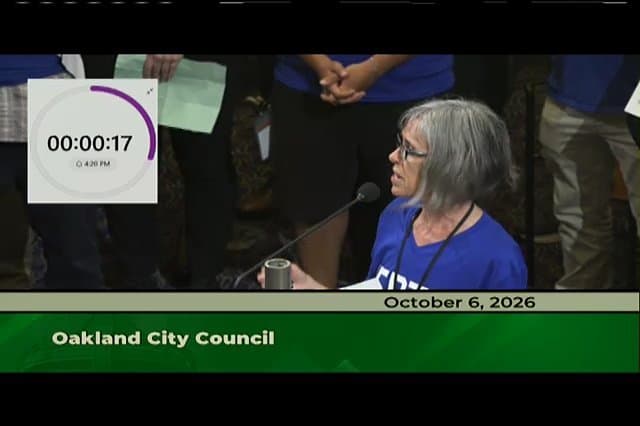
Speaker time was cut to one minute because of the heavy turnout. The supporting coalition was broad:
The Laney College Poor People's Campaign cited water and electricity use in West and East Oakland.
Gustavo Gutierrez, organizer, Communities for a Better Environment, urged passage to protect health in East and West Oakland.
Colin Logan, organizer, Reclaim Our Power, warned that data centers would raise PG&E bills. "Data centers are a massive threat to Oaklanders," said Logan.
Many supporters wanted the council to go further. "We'd really like to see a ban on data centers," said Kwana Parker Brightman, executive director, United Native Americans. Others pushed for transparency. Public commenter Bailey Hurley sought "a ban on NDAs, required public disclosure when any plans to create or expand data centers are submitted, and mandated environmental reporting."
The other side: A smaller group argued the city is turning away jobs and investment. "Data centers will bring jobs," said public commenter Sharon Taylor. "We need the data centers," said public commenter Andrea Ingram, who argued industry could help fund worker raises. Public commenter K. Abdul Mahid gave conditional support, saying the pause should be used to educate residents and prepare them for local jobs. "I believe 45 days is a reasonable time frame," said Mahid.
Decisions and stakeholder impacts: Fife moved the consent calendar, including the moratorium, and Ramachandran seconded. It passed with For: 7 (Brown, Fife, Gallo, Ramachandran, Unger, Wang, Jenkins), Against: 0, Absent: 1 (Houston). Environmental justice groups and flatlands residents won an immediate pause. Prospective developers, including those behind a downtown facility that speakers named repeatedly, now face a freeze. Jackie Cabasso of the Western States Legal Foundation backed Wang's proposed amendments for added analysis and community engagement. The record does not show whether those amendments were adopted.
What's next: Fife announced a community conversation on data centers at Beth Eden Baptist Church, 1183 10th Street.
State of the City Meets the Bargaining Table
Why it matters: Mayor Lee used her address to make the case for her administration's record. Organized members of Local 21, SEIU 1021 and the Oakland Firefighters used public comment to argue that record is not reaching city workers' paychecks.
Where things stand: Lee reported several gains:
Burglaries fell 26% and violent crime fell 17%.
Homelessness dropped 20% between 2024 and 2026.
"After 23 years, federal oversight of OPD has ended," said Lee.
She cited $9.2M for an illegal dumping strategy, $334M in bonds, 30 miles of paving, speed cameras, and $50M for affordable housing in the coming year. She also acknowledged a structural deficit and federal cuts. "We have a structural deficit. You know that. It's coming down, but we have it," said Lee. On labor, she said her administration is "working very, very hard, not just to get a contract, but to get a fair contract."
The other side: Workers described six to eight months of bargaining and no cost-of-living adjustment in 18 months. They noted neighboring cities have given 4% to 5% COLAs.
"Her administration is offering 7% over 3 years, which is well below the 15% over 5 years offered to OPD," said Kirby Olson, member, Local 21.
"Over 20% of civilian positions sit vacant at the city," said Chase Fowler, OakDOT civil engineer and Local 21 member. Fowler tied the deficit to unmonitored police overtime.
"We've been out of contract for 4 months, and we've been negotiating for 8 months," said Seth Dolyer, president, Oakland Firefighters. Dolyer cited a 12% vacancy rate and extra 24-hour shifts.
Decisions and stakeholder impacts: The council took no action on bargaining. It received and filed the report with For: 7, Against: 0, Absent: 1 (Houston), on a motion by Gallo seconded by Unger.
Police Raises Advance as Overtime Audit Lags
The basics: City Auditor Michael Houston, who is not related to the councilmember, presented the sixth semiannual follow-up report. It covers 329 recommendations from 50 audits and launches a new online dashboard.
Where things stand: "Overall, 234 audit recommendations, about 71%, have been implemented or closed," said City Auditor Michael Houston. The sticking point is 13 recommendations from a 2019 audit of police overtime. They depend on a tracking system now projected for February 2031.
"It is pretty eye popping," said Councilmember Charlene Wang, District 2, of the timeline. Wang asked whether any interim overtime-tracking methods exist. She also asked about the status of the Flock camera audit and about controls on contract change orders. The auditor said he would not prescribe solutions.
The other side: Public commenters linked the audit directly to Item 6.5, the salary ordinance enacting raises under the Oakland Police Officers' Association (OPOA) agreements.
David Boatwright said audits lack enforcement.
Millie Cleveland and Ann Jenks urged turning on GPS in patrol cars. Jenks said the city could implement GPS by working with the OPOA alone.
Ethan Cambridge argued the council should not approve the agreement while 13 police audit items remain open.
"It's going to take 5 years? That's absolutely outrageous," said Kathy Leonard, board chair, Golden Gate Community Association. Leonard also questioned the ordinance's retroactive effect to July 1, 2026, and its funding source. "It is regrettable that this is not the way that this council approaches other issues that are very impactful to the city, such as the police union contract," said Jenks, contrasting the debate on the data center moratorium with how the council handled the police contract.
Decisions and stakeholder impacts: The audit report was received and filed with For: 7, Against: 0, Absent: 1 (Houston). The police raises passed within the consent calendar. Fife registered the lone no vote on 6.5. Police wage increases are now locked in while civilian talks remain open.
What's next: Wang said the auditor will publish a Flock report by January, and that the report does not depend on contract execution.
Greenway Costs Climb to 165%
Why it matters: The 19th Street BART to Lake Merritt project's construction contract with Gallagher & Burk now has a cap of about $10.6M. The project is funded by Measure U and transportation impact fees.
Where things stand: Amit Silvan, Principal Civil Engineer, Department of Transportation, said unidentified underground utilities and other field conditions caused delays. Those delays pushed completion from June 2023 to December 2026. The project's design reduces travel lanes from two in each direction to one. Silvan said a 25% contingency has already been used. "The remaining 40%, we have not negotiated, we have not executed those change orders because we need authorization from the City Council," said Silvan.
The other side: Wang objected that "this contractor is getting 165% of the funding that they originally proposed." She asked about rebidding and urged the city to pilot design-build contracts. "I would just really encourage we look at that model as a way to do better cost containment around these contracts," said Wang.
Fife raised concerns about equity in contracting. "I'm concerned about us not reaching the goals that were suggested in the disparity study," said Fife. Staff said federal funding preempts local small-business requirements. Public commenter Tushia Crystal pointed to the project's location. "Bike lanes and paved roads disappear once you leave the lake," said Crystal.
Decisions and stakeholder impacts: The amendment passed with For: 6 (Brown, Fife, Gallo, Ramachandran, Unger, Jenkins), Against: 1 (Wang), Absent: 1 (Houston). Unger moved the item and Fife seconded.
What's next: Fife plans to bring a mentor-protégé program item to the Life Enrichment Committee.
SB 79 Fixes Answer State Regulators
The basics: "Senate Bill 79 is a state law encouraging denser housing around transit stops," said Kelly Cha, city staff. The law took effect July 1, and Oakland adopted a local exclusion ordinance in March.
Where things stand: The state Department of Housing and Community Development (HCD) and the Metropolitan Transportation Commission (MTC) commented on Oakland's March ordinance. In response, staff made three changes:
Removed open-space and industrial zones from the ineligible list. The state treats those zones as mixed-use where commercial uses are allowed.
Excluded all industrial parcels within SB 79-eligible areas, citing land-use compatibility and environmental concerns.
Added four Tier Two transit stops.
The Planning Commission and the council's Community and Economic Development (CED) committee both backed the changes unanimously. Gallo pressed for an inventory of publicly owned land held by the Port of Oakland, Alameda County and the Oakland Unified School District. Staff pointed to the housing element sites inventory and a forthcoming land use and transportation element, and committed to a briefing.
The other side: Public commenter Asada Olabala said the amendments accommodate certain communities but none address gentrification.
Decisions and stakeholder impacts: Brown moved to close the hearing and introduce the ordinance, and Unger seconded. The vote was first tallied at six ayes after a parliamentarian noted that members must vote from near their seats. Fife then cast her aye from her seat, and the vote was recorded as 7 ayes with Houston absent.
What's next: Final passage is scheduled for Oct. 20.
Minor Items
Encroachment permit: Approved 7-0 for doors and planters at 1021 45th Ave., leaving 9.5 feet of usable sidewalk.
Black Panther Party Boulevard: Broadway from 14th to 17th streets receives a commemorative name for the party's 60th anniversary.
ABAG reappointments: Fife, Ramachandran and Unger reappointed to the Association of Bay Area Governments through June 2028.
Waste ordinance: Stricter disposal and subscription rules advanced with a staff language fix.
Scott's Seafood: The council honored the Jack London restaurant's 50th anniversary.
Looking Ahead
The SB 79 ordinance returns for final passage Oct. 20. The auditor's Flock camera report is expected by January. Fife's community conversation on data centers will be held at Beth Eden Baptist Church.