Oakland City Council - Jul 13, 2026 - Special Meeting

Oakland City Council - Jul 13, 2026 - Special Meeting

Oakland City CouncilOaklandJuly 13, 2026

Sources:

Locunity is a independent informational service and is not an official government page for this commission.We use AI-assisted analysis and human editorial review to publish information.

Oakland Advances $110M Coliseum Sale on 6-1 Vote

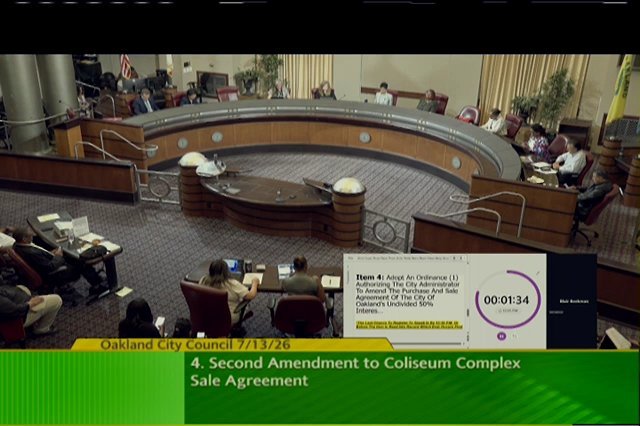
The Oakland City Council took the biggest step yet in a five-year effort to unload the city's half-interest in the 112-acre Coliseum Complex, voting 6-1 on first reading to split the property into two simultaneous transactions — a $50 million all-cash arena sale and a $60 million seller-financed stadium deal — while locking in a perpetual 6% cut of all future ticket revenue. The vote ends a roughly $6 million annual taxpayer subsidy and directs the arena proceeds straight to the city's pension debt.

  • Council votes 6-1 to advance restructured $110M Coliseum sale on first reading, with final passage set for July 21

  • $50M in cash from the arena sale will pay down Oakland's unfunded CalPERS pension liabilities, reducing ongoing retirement obligations

  • A perpetual 6% gross ticket revenue share from the arena, stadium, and any future venues is estimated to generate roughly $3M annually at the outset

  • Twenty-one public speakers turn out overwhelmingly in support, but the Oakland United Coalition pushes for a community-driven benefits agreement covering both parcels — not just the stadium site

  • Councilmember Gallo casts the lone no vote, questioning the revenue share rate, the absence of a formal appraisal, and whether all AASEG founding members were consulted


The Deal: Two Sales, One Closing

The basics: The ordinance authorizes the Second Amendment to the Purchase and Sale Agreement for the city's undivided 50% interest in the Coliseum Complex at 7000 Coliseum Way. The buyer is OAC (Oakland Acquisition Company), affiliated with the African American Sports and Entertainment Group. The restructured deal splits the property into two simultaneous transactions: an all-cash $50 million sale of the roughly 9-acre arena parcel — which OAC would immediately transfer to the Oakview Group — and a $60 million seller-financed sale of the remaining 103-acre stadium parcel, with installment payments tied to development approvals over five to seven years at 5% interest. Total consideration remains $125 million, including $15 million in post-closing milestone payments, plus the new perpetual 6% gross ticket revenue share. A $5 million deposit already held by the city would be credited toward the purchase price.

Why it matters: Oakland has been spending approximately $6 million a year to subsidize Coliseum operations — money that the city could redirect to services for residents. The $50 million arena proceeds go directly to the city's unfunded CalPERS pension liabilities, which run close to $2 billion. The perpetual ticket revenue share creates a new ongoing income stream estimated at roughly $3 million annually to start. And the deal requires at least 25% affordable housing on the 103-acre stadium site, making it one of the largest community benefit commitments tied to a single development in Oakland's history.

Where things stand: Brendan Moriarty, Director of Real Estate and Special Projects at the City of Oakland, walked the council through the protections built into the seller-financed side: the city would hold a recorded deed of trust on the stadium parcel allowing foreclosure if OAC fails to pay. "The city could foreclose and either take the property back or cause it to be sold to some other buyer if the obligations under the contract are not satisfied," he said. OAC must also maintain minimum enterprise value, and a third-party guarantor or payment bond is due by January 2027 — with $100,000-per-month penalties for delays.

Bradley Johnson, Director of Finance at the City of Oakland, laid out the fiscal logic. "$50 million of the city's arena sales will be used to pay down the city's unfunded accrued liability for retirement benefits under CalPERS, which will reduce the city's ongoing retirement obligations and is consistent with your best practices under your consolidated fiscal policy," he told the council. He added that the deal eliminates the $6 million annual operating subsidy, saving an estimated $3 million in the current fiscal year alone.

Council Drills Into Risk — and Reward

Councilmember Zac Unger (District 1) pressed staff on worst-case scenarios. If OAC defaults on the seller-financed stadium payments, what happens? The answer: Oakland takes the property back through foreclosure — without having paid operating costs in the interim. "So the biggest risk on the stadium parcel is that we end up right back where we are now," Unger concluded.

Councilmember Rowena Brown (At Large) detailed the community benefit framework baked into the agreement. "The agreement requires the city and OAC to negotiate broader community benefits, including local hiring, workforce training, labor standards, small business contracting, living wage, public Oakland spaces, sustainable development, transportation access, anti-displacement protections, housing protections as well," she said. She highlighted the affordable housing floor: "At least 25% of any residential unit developed on the site must be affordable housing."

Councilmember Ken Houston (District 7) described personally flying to Beverly Hills to secure commitments from arena buyer Irving Azoff of the Oakview Group to continue community advisory board programs, scholarships, and youth mentoring — even though the arena parcel carries no legal obligation for community benefits. He also clarified the foreclosure mechanics: "The public has to remember that the stadium is gone, right. So we gonna get our 50 million, the county gonna get their 50 million and that's done."

Councilmember Carroll Fife (District 3) affirmed her commitment to community benefits and pushed back against any suggestion she was new to the fight. "I'm not new to this. I'm true to this. So I understand the ground on which you fight, and I will continue to advocate for those community benefits because I understand the struggle," she said, noting her opposition to the Floyd Kephart-led Coliseum City proposal as far back as 2015.

Councilmember Ramachandran (District 4) emphasized the deal's multi-layered revenue potential. "I'm excited that this is not just one-time money, that there is the real potential of ongoing money through ticket revenue sharing, through taxes that generate over the years, and perhaps most importantly, the savings to our general fund for a property that's currently operating at a loss," she said.

Gallo Objects: Revenue Share, Appraisals, Consultation

Councilmember Noel Gallo (District 5) cast the sole dissenting vote, raising a series of pointed objections. He questioned why the city settled for a 6% ticket revenue share rather than pushing higher. "How did we arrive at 6%? Whatever takes place at the arena, entertainment, whatever Oakland generates 6%. Why didn't we generate 10%? Why don't we go to 15%?" he asked.

Moriarty responded that the city engaged third-party real estate consultants to benchmark the rate. "We have on-call real estate consultants that we engaged to do market survey of these kinds of arrangements in other cities, some comparable to us, some larger, some smaller. And we concluded ultimately that where we arrived is consistent with the market," he said.

Gallo also raised concerns that certain AASEG founding members — including Robert Bobbitt and Shonda Scott — had not been consulted on the amended terms. "My conversation with some of the members last night and today, they have not been consulted and yet they're being included with the AOC," he said. He additionally noted that Alameda County had not yet approved a binding agreement on its side of the deal.

Community Turns Out in Force

Twenty-one public speakers addressed the Coliseum item — overwhelmingly in support, but with a clear through-line of demands for stronger community benefits.

Multiple speakers from the Oakland United Coalition — including representatives from Youth Spirit Artworks and East Bay Housing Organizations — called for a community benefits agreement negotiated directly between the community and OAC, not just between the city and the developer. Delilah Aviles of Youth Spirit Artworks recommended that the arena parcel should also carry community benefits since it is public land and noted that housing organizations near the site need displacement protections. Damian Scott of East Bay Housing Organizations cited a survey of hundreds of Coliseum-area residents who prioritized affordable housing, jobs, environmental protections, and youth development.

Vanessa Riles of the Oakland United Coalition raised a specific concern: community benefits apply only to the stadium parcel, leaving arena workers without collective bargaining protections — though she noted that Ray Bobbitt of AASEG had assured her that worker agreements would be upheld by the arena buyer.

John Jones III, an AASEG member, corrected the record that the deal originated in 2020, before a previous city administrator's tenure, and invoked Oakland's redlining history to argue for the importance of Black-led development. Paul Cobb, publisher of the Oakland Post, recounted advising AASEG to buy the Coliseum outright rather than serve as a minority subcontractor.

Not all voices were celebratory. Damien Rainey questioned whether the Coliseum's operating losses actually stemmed from 1995 bond decisions rather than true operations, and asked whether selling an irreplaceable public asset was preferable to retaining ownership — citing the Oakland Army Base and Oaknoll as cautionary examples.

Ray Bobbitt, AASEG founder, thanked the city and explained that the arena sale to the Oakview Group was always contemplated to ensure competitiveness with Chase Center. He noted the group has worked through five mayors and three city administrators and pledged not to disappoint.

Decisions

Council President Kevin Jenkins framed the stakes before the vote, noting the $6 million annual subsidy could instead serve seniors, children, and the unhoused. He committed that Councilmember Brown would lead community benefits negotiations with East Oakland and Black-led organizations at the forefront.

A technical amendment moved Section 3 — the CalPERS pension payment appropriation — from the ordinance to a separate resolution for the July 21 meeting. Councilmember Houston moved to introduce the ordinance as amended; Councilmember Fife seconded.

The vote: Passed 6-1 (For: Brown, Fife, Houston, Unger, Wang, Ramachandran; Against: Gallo; Absent: Jenkins, excused).

What's next: Final passage of the ordinance is scheduled for the July 21 council meeting. The separate resolution directing $50 million in arena proceeds to CalPERS pension liabilities will also come before the council on that date. OAC must secure a third-party guarantor or payment bond by January 2027.


Minor Items

  • Mayor Barbara Lee addressed the council after the vote, noting the deal began before her tenure and she was proud to help push it to the finish line.

  • Irving Azoff of the Oakview Group spoke briefly during the open forum portion, underscoring the group's commitment to the arena.

  • Open forum speakers raised additional topics including arts and culture funding, the preservation of sports history as a community benefit, and concerns about equitable investment across Oakland neighborhoods — including West Oakland.

Oakland Advances $110M Coliseum Sale on 6-1 Vote | Oakland City Council | Locunity