Oakland City Council - Jun 01, 2026 - Special Meeting
Oakland City Council • OaklandJune 1, 2026
Locunity is a independent informational service and is not an official government page for this commission.We use AI-assisted analysis and human editorial review to publish information.
Oakland Receives $2.27B Balanced Budget With Zero Housing Dollars as Advocates Demand Action
Mayor Barbara Lee's first budget preserves every sworn position and restores key services, but the absence of any new affordable housing construction money drew a rare united front of over a dozen housing organizations demanding at least $50 million before the council votes June 30. Meanwhile, city workers warned of possible strike action, the Budget Advisory Commission flagged potentially inflated revenue projections, and 190 shelter beds hang in the balance ahead of a parcel tax vote.
Housing advocates unite to demand $50M from Measure U bonds after the proposed budget includes zero for affordable housing construction - with multifamily acquisition costs at a generational low of $100,000 per unit
190 shelter beds face closure this summer if voters reject Measure E on June 2; a $5 million state funding gap compounds the threat
Local 21 workers mobilize against city contract proposal that denies cost-of-living raises, raises healthcare costs, and eliminates telework — with members citing whispers of a strike
Budget Advisory Commission warns sales tax and utility tax projections may be overestimated by $15–20 million, creating mid-year risk
Council eyes exit from 23-year federal police oversight but critics say $450,000 for a new policing advisor should fund the underfunded Inspector General instead
Council members push for felony-level illegal dumping prosecutions through hazmat training for enforcement officers
A Moral Document With a $50 Million Hole
Mayor Barbara Lee presented her first budget to the Oakland City Council at a June 1 special meeting — a $2.27 billion all-funds package with an $812.9 million general purpose fund, roughly $44 million less than projected in the initial biennial budget. The budget is balanced, uses dramatically less one-time money for ongoing services, and includes no layoffs.
Why it matters: The budget preserves all sworn police and fire staffing, restores illegal dumping cleanup, extends senior center hours to four days a week, restores library branch funding, and expands the mayor's summer jobs program. But it allocates nothing for new affordable housing construction — the single issue that dominated more than an hour of public testimony and drew warnings from every corner of the housing development community.
"I have always said and believe that a budget is a moral document that reflects the values and priorities of those who rely on our government services," said Mayor Lee. She framed the budget against a backdrop of at least $24 million in lost or delayed federal funding and a $5 million state gap in homelessness funding.
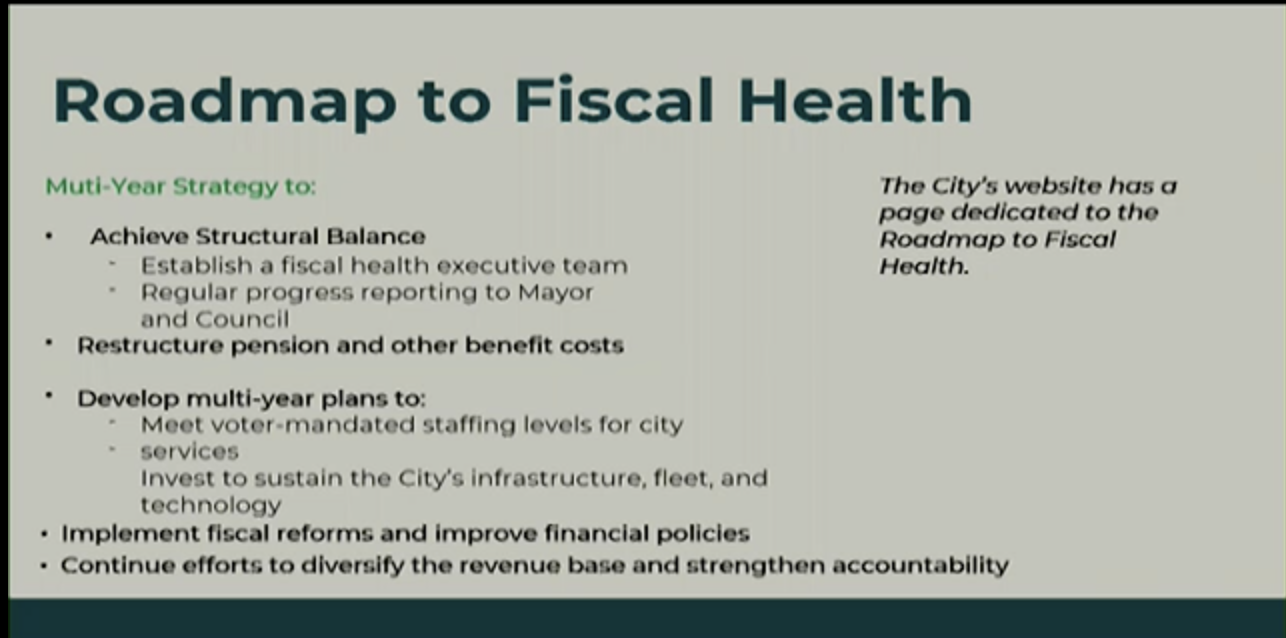
Finance Director Brad Johnson contextualized the numbers within Oakland's persistent structural deficit, noting that expenses — driven by pensions, medical benefits, and personnel costs — grow faster than revenues. The city's Roadmap to Fiscal Health serves as a long-term corrective strategy, but the immediate picture remains constrained.
Acting City Administrator Betsy Lake walked council members through specific service areas, describing the midcycle budget as primarily about preservation and restoration rather than new initiatives.
Decisions: The council received and filed the budget report on a 7-0 vote (Councilmember Unger excused). Budget amendments are due June 8 for a June 12 vote, with final adoption required by June 30.
The $50 Million Question: Housing Advocates Draw a Line
The most emotionally charged segment of the meeting came during public comment on the budget, as a united front of affordable housing organizations — Eden Housing, Midpen Housing, Unity Council, Mercy Housing, All Home, East Bay Housing Organizations, the Nonprofit Housing Association of Northern California, and Rooted — each urged the council to allocate at least $50 million from Measure U's third bond tranche.
The basics: Measure U is Oakland's voter-approved bond for affordable housing. The first two tranches ($100 million and $80 million) have been fully sold and awarded. Director of Housing and Community Development Emily Weinstein confirmed that without additional funding, no new awards could be made until late 2027 or early 2028. The proposed budget includes zero dollars for affordable housing construction.
Why it matters: Local dollars are a prerequisite for competing for state tax credits and county Measure W funds. Speakers repeatedly warned that Oakland's pipeline of more than 1,000 shovel-ready units will stall, and the city has already been forced to return money and lose eligibility for outside funding.
A Generational Market Window
Jack Woodruff of Rooted/Oaklands Fund told the council that multifamily acquisition costs have plummeted. "CoStar data showing multifamily costs at $100,000 per unit, down from $400,000 pre-pandemic," he said — framing the current market as a once-in-a-generation buying opportunity.
Matt Schreiber of Eden Housing reported the organization had already returned $1.5 million to the Regional Center of the East Bay and lost eligibility for county Measure W funds without a local match, jeopardizing a 67-unit senior housing project at Williams Chapel in District 2.
Alex Regala of Midpen Housing urged the allocation for the organization's 88-unit Wood Street project in West Oakland, noting that local funds are now critical for competing in a reformed state financing system.
Karla Guerra of the Unity Council urged at least $50 million from Measure U to launch a $30 million notice of funding availability this fall, positioning projects for 2027 tax credits.
Ali Kashani, a public commenter, reminded the council that Oakland secured $140 million in Homekey funds creating 600 units and argued every local dollar leverages three to four times that amount in state funds.
Jeffrey Levin of East Bay Housing Organizations cited $250 million in unfunded pipeline projects and the unique opportunity to acquire properties while Oakland's real estate market is soft.
Timothy Dunn of Mercy Housing noted his organization's 96-unit senior housing project in Uptown was only possible because funds were available last year.
Tano Trachtenberg of the Nonprofit Housing Association of Northern California warned Oakland's competitive edge erodes without local dollars.
Council Response
Councilmember Rowena Brown announced she would bring a budget amendment to add affordable housing funding. "I'm deeply concerned about the lack of funding for affordable housing. We have a unique opportunity to take advantage of this moment," she said.
What's next: The amendment process opens a narrow window — amendments are due June 8 for consideration at the June 12 council meeting.
190 Shelter Beds on the Brink
Why it matters: Despite a 20% reduction in the point-in-time count, Oakland still accounts for 58% of Alameda County's unsheltered population. If voters reject the Measure E parcel tax on June 2, 190 shelter beds will close this summer.
Councilmember Charlene Wang pressed staff on conditions in her district. "In spite of the point-in-time count, at least the homelessness is not getting better in my district. It's gotten way worse, actually," she said, warning that a park in her district is at risk of becoming unmanageable.
Director Weinstein explained that the next wave of county Measure W money would primarily increase daily bed rates at existing shelters rather than create new beds. Capital funding for new transitional facilities is expected in the fall.
Mayor Lee stated Oakland should receive approximately 64% of county Measure W funds based on its share of the unsheltered population, but the Office of Homelessness Solutions director confirmed that county gap funding to replace the $5 million state shortfall is not guaranteed.
Councilmember Ken Houston highlighted the 77th Avenue safe parking site in District 6 as a ready-to-go project awaiting county Measure W funds.
What's next: The June 2 Measure E vote is the immediate inflection point. If it fails, the city must find alternative funding or close beds.
City Workers Sound Strike Alarm
Multiple members of IFPTE Local 21 addressed the council in an organized show of force, protesting a city bargaining proposal they described as bad faith.
Treva Hatton, a Local 21 member, reported the city proposed changes that deny cost-of-living adjustments, increase healthcare and retirement contributions, and eliminate telework — all presented on the last possible bargaining day.
Cody Meshberger, a Local 21 member working in the Department of Transportation, said the administration rejected a no-cost telework proposal and reported that 25% of Local 21 positions are vacant. "There's been whispers of a strike," he told the council.
Colin Py, a Local 21 member, highlighted a coworker who left for the City of San Ramon for higher pay and drew a stark comparison: OPD's $55 million overtime budget exceeds the city's entire paving budget. Elliot Goodrich, another Local 21 member, translated that figure differently — equivalent to 300 public works staff who could be cleaning streets.
Chase Fowler of Local 21 demanded restoration of three frozen Citizen Police Review Agency positions critical to civilianization efforts, noting that last year's council directive for a civilianization task force and timeline by June 30 has produced no visible results.
Multiple speakers urged council members who received labor endorsements to demonstrate solidarity through action.
NSA Exit Strategy or Inspector General Shortchange?
The basics: Oakland has been under the Negotiated Settlement Agreement — a federal consent decree governing police practices — for 23 years. The city recently achieved its first-ever full compliance finding.
Where things stand: The budget includes a $450,000 constitutional policing administrator position that Mayor Lee described as instrumental in developing the strategy behind that compliance milestone. "We've been under the negotiated settlement agreement for 23 years, and for a lot of reasons, we have not been able to exit it, which of course costs the city quite a bit of money," Lee said.
Police Chief James Beer confirmed the position coordinates across city departments rather than supervising the police chief.
The other side: Councilmember Noel Gallo questioned why additional administrators are needed when the police chief should handle constitutional compliance. Millie Cleveland of the Coalition for Police Accountability argued the $450,000 duplicates Inspector General functions without transparency safeguards.
Council President Kevin Jenkins identified a deeper problem, citing Oakland Municipal Code Section 245100: "The city shall allocate sufficient budget for the OIG to perform its functions and duties set forth in section budgeting. One full time staff position comparable to the position of police program and audit supervisor." Those mandated positions are not funded in the proposed budget.
What's next: Jenkins suggested the council should consider funding OIG positions as a budget amendment, particularly as the city approaches NSA exit.
Felony Teeth for Illegal Dumping
Councilmember Houston pushed for hazmat training for environmental enforcement officers, arguing it is essential for building prosecutable cases. "We need to have them trained so they can collect the data to show hazardous contamination. So when it's documented and goes to the District Attorney's office, the District Attorney can actually prosecute, not throw it out," he said.
Public Works Director Liam Garland confirmed the budget unfreezes one environmental officer position, moving from seven to eight authorized, and that hazmat training is planned once vacancies are filled.
Councilmember Gallo pressed on the franchise fee collected from waste management — roughly $35–36 million — demanding to know if it is being reinvested in cleanup operations. Finance Director Johnson confirmed the majority flows to the comprehensive cleanup fund (Fund 1720) supporting illegal dumping operations, environmental enforcement, and street sweeping.
Acting City Administrator Lake mentioned an active strike force with OPD, Public Works, and the mayor's office pursuing illegal dumping prosecutions with the District Attorney.
Budget Commission: Revenue Numbers Don't Add Up
The Budget Advisory Commission delivered a detailed review of the midcycle budget, flagging several areas where fiscal assumptions may not hold.
Why it matters: If sales tax revenue continues its post-Measure A decline and utility taxes stay flat, the city could face a $15–20 million shortfall mid-year with no contingency plan in place.
BAC Commissioner Ben Gould warned that projections are aggressive: "Sales tax is projected to grow 12% year over year or about $10 million. And the utility consumption tax projected to grow about 7% year over year or about $5 million." Actual revenue has declined since Measure A's adoption, and utility consumption tax has only realized $70 million against a $75 million projection.
BAC Vice Chair Mike Petehoff highlighted $1.5 billion in retail leakage — Oakland wealth flowing to surrounding cities — and proposed linking economic development with public safety strategies. "Our retail leakage is about $1.5 billion of Oakland wealth that's going to surrounding cities," he said.
Key BAC Findings
The commission found the budget fully funds library requirements (Measure C/D) and the City Auditor for the first time since 2013, but falls short on Measure NN sworn officer requirements (678 budgeted versus the 700 required, with only 607 actual and 520 deployable). Additional red flags included $37 million in contracts and grants lacking identified purposes — a repeat finding from last year — potential misallocation of $1 million in Measure NN funds to fire equipment rather than direct services, and a $1.9 million Measure Q shortfall for parks.
Long-term recommendations emphasized a comprehensive asset maintenance plan, improved voter-approved measure transparency dashboards, better performance metrics tied to budget decisions, and workforce development as a crime-reduction strategy.
Decisions: The council received and filed the BAC report on a 7-0 vote (Councilmember Unger excused).
Minor Items
Senior centers restored to four-day-per-week operation with full-day hours, up from three days; Mayor Lee expressed a goal of reaching five days pending resources.
Libraries receive full Measure C/D funding for the first time since 2013; a safety pilot was added at Main and MLK branches.
Oakland Animal Services staffing restored; public commenter Kelsey Caldwell described the Miranda's Rescue scandal where dogs sent to a transfer partner were being killed, urging adequate OAS funding.
Film rebate program restored, highlighted by Councilmember Brown.
Parking enforcement remains with OakDOT; public commenter Kevin Daly urged restoration of parking enforcement dispatch positions and evening/weekend enforcement for ADA consent decree compliance.
Library Commission Chair Chie Azuma praised the restored funding enabling more staff, materials, and the safety pilot.
Graffiti vandalism raised by Councilmember Houston, who noted the city has only two abatement workers citywide while spending millions annually on cleanup.
Open Forum: Public commenter Carmen Salazar called for more accessible public services, interpreter availability, reduced parking fees, and better engagement for Spanish-speaking residents. Millie Cleveland suggested the police chief search process should include a public candidates forum. Assada Olabala cited 23% unemployment among Black men ages 20–24 and called for stronger violence prevention and workforce development.