
Oakland City Council - Jun 12, 2026 - Special Meeting
Oakland City Council • OaklandJune 12, 2026
Locunity is a independent informational service and is not an official government page for this commission.We use AI-assisted analysis and human editorial review to publish information.
Oakland Passes Austerity Budget, Declares Fiscal Emergency for Fourth Straight Year
The Oakland City Council on June 12 adopted its FY 2026-27 midcycle budget on a 6-2 vote, approving roughly $72 million in amendments while once again suspending voter-approved mandates on police staffing, Democracy Dollars, and other programs. The marathon special meeting — stretching past three and a half hours — drew dozens of public speakers who clashed over police oversight funding, senior services, affordable housing, worker pay, and human trafficking enforcement, exposing the widening gap between what Oakland residents have demanded at the ballot box and what the city says it can afford.
Council approves $72M in budget amendments including $50M in Measure U bonds for affordable housing, $2.4M for fire engines, $2.4M for emergency shelter beds, and $1M for pension liability paydown
Fiscal emergency declared for the fourth consecutive year, suspending voter-mandated spending on 700 sworn officers (Measure NN) and Democracy Dollars (Measure W)
Fife demands OPD budget deep-dive after council declines to restore a civilian police oversight investigator position, winning commitments from colleagues for a Public Safety Committee review
Seniors win $200K boost as Council President Jenkins redirects OUSD water fountain funding to senior wellness, but five-day-a-week center access remains out of reach
Unions warn of worker exodus after city employees received 0% cost-of-living raises last year, with 40% of Local 21 members earning below a comfortable Oakland living wage
Wong votes no after her traffic safety amendments for quick-build projects and a red light camera pilot are excluded without explanation
Human trafficking fine enforcement funded — a new position to collect $4,000 civil fines from johns could generate $1.2M annually for exit services
A Budget Built on Band-Aids
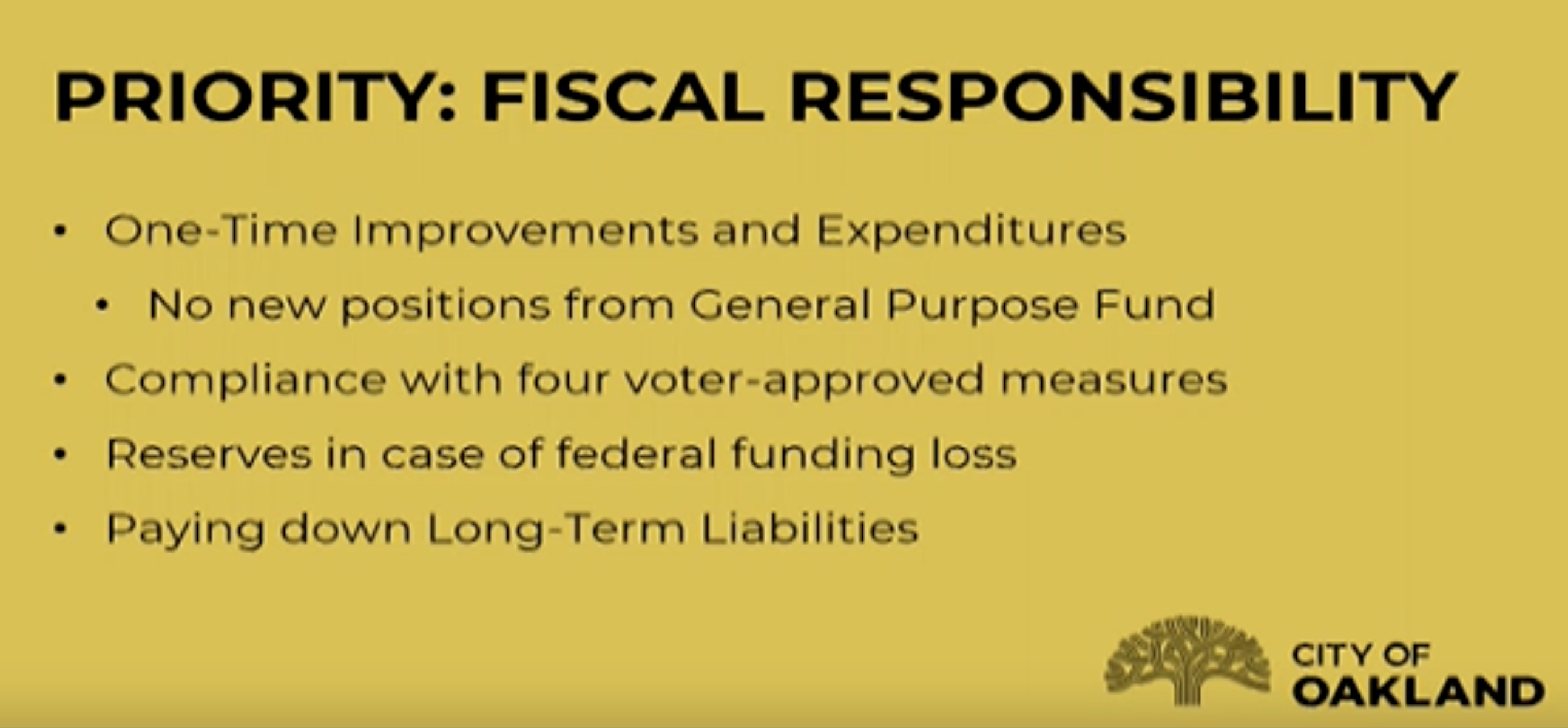
The basics: Oakland's midcycle budget process adjusts the second year of a two-year spending plan. This year's amendments totaled approximately $72 million, sourced primarily from $50 million in accelerated Measure U bond proceeds for affordable housing, increased parking revenue projections, salary savings from more than 700 funded but unfilled positions, and existing fund balances. The budget team emphasized a core discipline: no one-time revenues funding recurring expenses.
Why it matters: For the fourth year running, Oakland is declaring "extreme fiscal necessity" to override what voters told the city to do. Measure NN's requirement for 700 sworn police officers, Measure W's Democracy Dollars program, and Public Ethics Commission funding are all being suspended — again. The city did achieve compliance with four of six voter-approved measures (C, D, X, and Q), and a friendly amendment removed Measure Q from the fiscal necessity declarations entirely after the budget team's parks spending brought the city into compliance.
Where things stand: Councilmember Janani Ramachandran, who leads the council's budget team, framed the amendments as fiscally disciplined.
"We are now in compliance with four out of six of those voter-approved measures — Measures C, D, X, and Q," she said. She emphasized the team was "not using anticipated one-time money to fund recurring expenses."
Councilmember Zac Unger echoed that message, calling the budget reasonable:
"We added no new employees to the general fund in our council amendments. We funded no recurring expenses out of one-time revenues. We brought four voter-approved measures out of fiscal emergency and into full compliance with voter mandates."
The other side: Councilmember Noel Gallo was the lone dissenter on both votes, pressing the administration on why 838 funded positions remain vacant.
"How many vacancies do we have? We have 839 vacancy positions that we budgeted the previous year. Where's the money for those 839 positions we never filled?" he asked.
Gallo cited unresolved union negotiations and called for $50 million in additional police funding and $40 million for public works.
Councilmember Charlene Wang voted no on the main budget after her traffic safety amendments were excluded.
Decisions: Item 5 — the fiscal necessity declarations and maintenance-of-effort waivers — passed 7-1 (For: Ramachandran, Jenkins, Brown, Unger, Wang, Houston, Fife; Against: Gallo; Absent: none). Item 4 — the budget itself — passed 6-2 (For: Ramachandran, Jenkins, Brown, Unger, Houston, Fife; Against: Gallo, Wang; Absent: none).
What's next: The structural deficit that drives these annual emergency declarations remains unresolved. The budget team included funding for an HR vacancy strike force and a compensation survey, but the underlying tension — voter mandates the city cannot afford to honor — will return next budget cycle.
$50M Affordable Housing Bet
Why it matters: The budget's single largest line item accelerates $50 million in Measure U bond proceeds — Tranche 3 — to fund Oakland's affordable housing pipeline in the current fiscal year. Multiple organizations testified that shovel-ready projects are waiting for local matching dollars that would unlock state tax credits and private investment.
Where things stand: Representatives from Local Initiatives Support Corporation (LISC), East Bay Housing Organizations, East Bay Asian Local Development Corporation (EBALDC), MidPen Housing, the Unity Council, and the Housing Accelerator Fund all testified in strong support. Damion Scott of East Bay Housing Organizations told the council the funds would enable the city's Housing and Community Development department to launch a $30 million new construction NOFA in fall 2026, timed for 2027 tax credit rounds. Bryant Duong of LISC noted the organization supports more than 15 Oakland projects representing 750-plus affordable homes, with 500-plus still in the pipeline. Omar Rivera of EBALDC highlighted pipeline projects at Lake Merritt BART that depend on local matching dollars.
Councilmember Charlene Wang added a floor amendment to include interim shelter as an eligible expense under Measure U, broadening the funding's reach.
What's next: The city's Acquisition and Conversion program pipeline is nearly fully subscribed. Whether Oakland can move fast enough to capture upcoming state tax credit cycles will determine how many of these units actually get built.
The Fight Over Who Watches the Police
Why it matters: With federal court oversight of OPD potentially ending by September, the question of who provides independent police accountability is urgent. Civilian oversight bodies — the Commission for Inspector and Police Review of Accountability (CIPRA), the Inspector General, and the Police Commission — are operating well below previous budget levels, and multiple positions remain frozen.
Where things stand: A coordinated wave of public commenters from the Coalition for Police Accountability, Anti Police-Terror Project (APTP), and Showing Up for Racial Justice demanded full funding for eight Inspector General positions, seven CIPRA investigators, and an end to staffing freezes on the Police Commission. Millie Cleveland of the Coalition for Police Accountability pointed to OPD's $31 million overtime overspend while oversight bodies operate at a fraction of prior budgets. Michelle Monterrosa of APTP, who described being personally impacted by police violence, urged full funding, noting federal oversight could end by September.
Councilmember Carroll Fife proposed restoring one CIPRA investigator position using vacancy savings and made civilian oversight a condition of her vote.
"Residents voted overwhelmingly to pass Measure LL and establish CIPRA to investigate police misconduct. And freezing investigator positions is going against the will of the voters," she said.
The other side: Council President Kevin Jenkins opposed using one-time funds for what would be a recurring position, noting CIPRA has never hired all its budgeted positions. "If we're going to fund CIPRA, we should fund them. We should find the funding source to absolutely fund CIPRA. I absolutely agree with you," he told Fife, but argued the mechanism was wrong.
After extended debate, Fife extracted commitments from Councilmembers Jenkins, Wang, and Houston to conduct a deep review of the OPD budget and civilian oversight at the Public Safety Committee.
"If y'all want my vote today, then I need a commitment from everyone around this dais that we're going to dive deep into the Oakland Police Department budget to figure out what we need to do different," Fife said.
A separate flashpoint emerged over the civilianization of a public information officer position from the Inspector General's office to OPD. The OPD chief confirmed during questioning that the transfer was operationally feasible, contradicting a City Administrator's memo that suggested otherwise.
What's next: The Public Safety Committee is expected to conduct a comprehensive OPD budget review. The timeline for the end of federal oversight — potentially by September — adds urgency.
Seniors Plead for Five-Day Access
Why it matters: Oakland's senior population is growing rapidly, with nearly 40% economically insecure. Senior centers serve as critical lifelines against social isolation, hunger, and health decline — but they are currently open only four days a week, and 10 part-time senior aides in the Assets employment program face cuts.
Where things stand: Representatives from senior centers across Oakland — East Oakland, Downtown, West Oakland, North Oakland, and Grand Avenue — along with the Senior Services Coalition, Mercy Brown Bag, and SOS Meals on Wheels all testified. Celeste Neal of the East Oakland Senior Center detailed the vital role centers play in combating isolation. Wendy Peterson of the Senior Services Coalition urged five-day-a-week access and unfreezing senior aide positions, noting the extra fourth day was achieved only by eliminating 10 part-time aide positions costing $174,000.
Going to five days would cost an additional $800,000 — funding the council could not identify.
Decisions: Council President Kevin Jenkins redirected $200,000 from an OUSD water fountain grant to senior wellness programs.
"I want to change the allocation of the sugar-sweetened beverage from $250,000 to OUSD to $50,000 going to OUSD and $200,000 going to support our seniors," he said.
He also directed the city administrator to explore funding for expanded hours.
What's next: Councilmember Ken Houston received commitments that exploration of additional senior center funding would continue. The West Oakland Senior Center remains closed longer than expected.
City Workers Sound the Alarm
Why it matters: With more than 700 funded but unfilled positions, Oakland faces an institutional knowledge drain that undermines its ability to deliver basic services — from park maintenance to illegal dumping enforcement to building permits.
Where things stand: Local 21 and SEIU 1021 members painted a stark picture. Elliot Goodrich of Local 21 told the council that 40 percent of its members earn "less than a comfortable Oakland living wage" and one in 10 live below the poverty line. Jennifer Foster, Local 21 chapter president, criticized the lack of any cost-of-living adjustment last year amid inflation and warned of proposed healthcare and pension cost shifts. Jason Tubbs, a Parks Department garden crew leader and SEIU 1021 officer, reported 12 vacant park positions and an inability to hire permanent staff because management lacks an HR analyst. Amaka Watson of SEIU 1021, a 24-year city employee in environmental enforcement, described chronic understaffing and high turnover.
Councilmember Zac Unger acknowledged the crisis directly:
"Our non-sworn employees did not receive a raise last year. 0%. We are losing valuable, talented workers because of this."
What's next: The budget includes funding for a compensation survey and an HR vacancy strike force — steps designed to diagnose and begin addressing the staffing crisis, though union negotiations remain unresolved.
Wong's Trafficking Enforcement Wins; Traffic Safety Loses
Human Trafficking Fine Enforcement
Councilmember Charlene Wang secured inclusion of a one-year position to enforce the city's $4,000 civil fines against johns and traffickers — fines authorized by an ordinance that passed 111 days earlier but have never been collected.
"In the 111 days since that ordinance has passed, there have been 94 arrests of johns. If that was coupled with that $4,000 civil fine that we all passed, that would have represented $1.2 million a year," Wang told colleagues.
Natisia of Love Never Fails, a trafficking survivor, and Dr. Aisha Mays of Dream Youth Clinic — the first mobile clinic for sex-trafficked youth in the country — both testified in strong support. The Neighborhood Law Services Corps is ready to help enforce the ordinance.
Traffic Safety Amendments Excluded
Wang also proposed three floor amendments: $500,000 for quick-build traffic calming pilot projects from the state gas tax fund, a red light camera program pilot from the traffic safety fund, and the human trafficking position. Only the trafficking position made it into the final motion. Wang cited 190 to 200 severe and fatal crashes annually, mostly in equity communities, and noted New York City is quadrupling its red light camera program. The budget team did include $500,000 for speed camera program management and a DOT project manager — but Wang's broader traffic safety package was not addressed, leading to her no vote.
Film Incentive Reaches $750K
Councilmember Carroll Fife championed a $250,000 floor amendment for a contract with Make It Bay to administer Oakland's film incentive program — a program she originally proposed in 2024 but that has been stalled by fiscal emergencies. Combined with $250,000 from the mayor and $250,000 from the budget team, total film incentive funding reached $750,000. Jamal Trulove of Bay Area Film Night testified in support. Councilmember Rowena Brown credited Fife as a pioneer in the effort. The budget also restored $150,000 for the Cultural Affairs Division.
Minor Items
$2.4M for fire engine replacement included in budget team amendments as a one-time capital expenditure.
$2.4M for emergency shelter beds and $1.7M for safe parking and hotel vouchers added to address homelessness.
$1M set aside for a federal/state grant loss reserve to cushion against potential funding disruptions.
$1M directed to pension liability paydown, addressing Oakland's long-term OPEB obligations.
Community garden food pilot program ELD positions adopted through Councilmember Fife's floor amendment.
Library fully funded including the $14.5 million Measure C maintenance of effort, as noted by Fatima Yousuf of OPL Advocates.
Oakland Chinatown Chamber urged greater investment in commercial corridor revitalization and graffiti prevention.
Budget Advisory Commission member Ben Gould raised concerns about using existing Measure Q fund balances rather than general purpose funds to meet maintenance-of-effort requirements, warning about structural sustainability.