
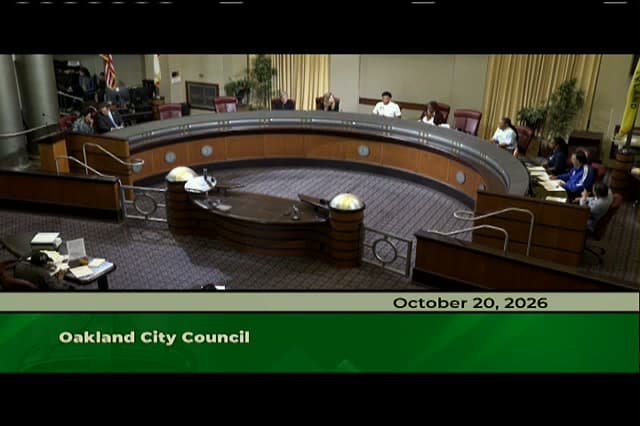
Council Rejects Police Commission Slate 8-0 After Nominee Eligibility Snag
Oakland City Council • OaklandOctober 20, 2026
Locunity is an independent informational service and is not an official government page for this commission. All information is sourced from public footage and an analysis of official agendas with the aid of responsible, fact-checked AI. to report an error or omission.
Oakland's search for a new police commissioner is back at the selection panel. On Oct. 20, 2026, the City Council voted 8-0 to reject a two-person slate after one nominee withdrew, then tried to un-withdraw, amid an eligibility question. The same night, the council advanced a tenfold increase in nuisance fines, received a critical audit of roughly $300M in capital spending, and heard how a World Cup hotel-tax deal paid off.
- Police Commission slate rejected 8-0 so the panel can resubmit after a nominee eligibility dispute
- Nuisance fine cap would jump from $1,000 to $10,000 a day under an ordinance introduced 8-0
- Auditor flags weak controls over about $300M in capital projects and bond funds
- World Cup hotel-tax deal paid Oakland Roots $300,000 as June hotel tax revenue rose 28%
- Peter Smith confirmed to Planning Commission despite displacement concerns from public commenters
Police Commission Slate Sent Back to Panel
The basics: The Police Commission oversees the Oakland Police Department. Under the city charter, the council must accept or reject a selection panel's nominees as a slate. It cannot pick just one.
Where things stand: Council President Kevin Jenkins moved the item to the top of the agenda. Staff said nominee Nicholas O'Brien-Kovari withdrew after disclosing that his law firm represents parties suing Oakland, then asked to rescind his withdrawal. Municipal Code 2.45.025 bars attorneys with pending or recently resolved claims against OPD. Staff offered no recommendation. The City Attorney's Office advised rejecting the slate to reset the clock.
Councilmember Zac Unger (District 1) and Councilmember Ken Houston (District 7) asked whether a single-nominee slate was possible. The answer was no: the charter requires a slate, and changing that would take a charter amendment.
Quan makes her case: The other nominee, former Mayor Jean Quan, framed her bid around independence. "I don't have anything to lose. I can't be bullied," said Jean Quan, Police Commission nominee.
Houston pressed her on the commission's vehicle pursuit policy. "Can you identify one specific policy or decision the commission has approved that you disagree with?" he asked. Quan said she would need the data first: "But until I see the data, I don't really have a strong opinion whether that was a good choice." Asked whether she would change the policy if it caused harm, she replied, "Yeah, I would change it. I would ask to change it."
The other side: Public comment split. Stuart Chen, a public commenter, backed Quan. Josephine Wee, Vice President, Taishan Family Association, translated for Chinatown patrol leader Joe Ma, who also supports Quan. Asada Olabala, a public commenter, opposed Quan, citing her strained relations with police leadership and the police union when she was mayor. Jesse Rosemore and Gene Hazard, both public commenters, criticized council interference in the independent selection process, pointing to the earlier non-reappointment of Omar Farmer. Ann Jenks, a public commenter, argued the panel had created separate slates, so Quan could still get a vote.
Decisions and stakeholder impacts: Councilmember Charlene Wang (District 2) told Quan she would support her appointment. Councilmember Carroll Fife (District 3) voiced a worry shared by Quan's backers: "I just hope that when this next slate comes back, Jean Quan doesn't somehow end up not on it." Jenkins moved to reject, and Councilmember Rowena Brown (At-Large) seconded. The motion passed 8-0 (For: 8, Against: 0, Absent: 0).
What's next: The selection panel can resubmit Quan with a replacement or the other nominee once eligibility is resolved. No return date was set.
Nuisance Fines Could Rise Tenfold
Why it matters: The ordinance targets chronic violators who treat fines as a cost of doing business. Its impact depends on thinly staffed code enforcement.
Where things stand: Unger, the author, argued the current cap is a relic. "We set the maximum penalty for breaking our laws at $1,000 a day, and we set it back in 1968," said Unger. He stressed that compliance, not revenue, is the goal: "This is not a moneymaker." Violators would face escalating fines and a chance to fix the problem first.
Wang confirmed the ordinance raises the overall cap, with code enforcement doing the enforcing. Laura Lane of the City Attorney's Office said the administrator sets a fine schedule within the cap: "It's not anticipated that every violation would result in a $10,000 penalty." Jenkins asked about inflation adjustments and noted the change makes liens easier to pursue.
The other side: Councilmember Noel Gallo (District 5) questioned enforcement capacity. "So I can ask you for a million, but who's going to go and collect the million?" he said. Unger countered: "I don't think that the argument that we don't have enough people to collect fees suggests that we should keep our fees at a level that is 50 years out of date."
Houston wanted to go further. "So I wish it was $20,000, $25,000," he said. He also pushed for hazmat-trained enforcement officers and prosecution by the district attorney. The City Attorney's Office said those ideas fell outside the item's public notice.
Neighbors weigh in: Residents focused on Suprema Meats. Kathy Leonard, Board Chair, Golden Gate Community Association, described years of violations and more than $1M owed. Matthew Lifson, a neighbor of a Suprema property, and Kim Lucas, who described loud 3 a.m. operations, urged passage. Olabala said a culture of disrespect means fines won't deter. Rosemore questioned enforcement, citing a sex trafficking law he said brought in $0.
Decisions and stakeholder impacts: Unger moved, Wang seconded, and the ordinance passed on introduction 8-0. Neighbors near repeat violators stand to gain leverage. Property owners with chronic violations face steeper exposure.
What's next: Final passage comes at a later meeting.
Audit: Capital Projects Lacked Basic Controls
Why it matters: "The city spent about $300 million on capital projects" over three years, said Michael Houston, City Auditor. Most of that money came from Measure KK and Measure U bonds, and officials are eyeing another bond in 2028.
Where things stand: The audit made four findings:
- Public Works and OakDOT never adopted or followed the Construction Management Manual. Change orders averaged 79 days.
- On-call contracts made up 41% of spending, or $105M, without guidance.
- High vacancies undermined the separation of financial duties, and the city has no centralized project system.
- The city provided inadequate oversight of bond funds, conducted no annual bond audits, and has had no multi-year capital plan since FY23.
Public Works Director Liam Garland walked back one deadline. "I think the November 2026 date there — that is a little overly ambitious," he said, adding that January 2027 is accurate.
Council reaction: Wang called the on-call findings "particularly alarming" and asked about limits and qualifications-based procurement. Councilmember Janani Ramachandran (District 4) asked about overspending: "What happens if it happens again? Like, what's the consequence for it?" The auditor said there largely weren't consequences. Gallo demanded a timeline. Fife asked who ensures follow-through: "We could stop passing laws today and have enough work to do just following up on all of the recommendations from audit findings."
Jenkins asked about remaining bond capacity ahead of a possible 2028 bond. The finance director said transportation and housing funds will likely be spent by then.
Decisions and stakeholder impacts: Rosemore tied the vacancies to stalled city worker contract talks. Olabala questioned Measure U spending on the Lincoln Rec Center and urged a Hoover-Durant library. Councilmember Houston moved to receive the report, Gallo seconded, and it passed 8-0. The findings give voters and labor groups leverage before any new bond ask.
World Cup Hotel-Tax Bet Pays Out
The basics: State law (Government Code 53083) requires a public hearing on subsidies of $100,000 or more. A May 12, 2026, agreement gave Oakland Roots and Soul up to $300,000 of June 2026 hotel tax revenue above a June 2025 base of about $1.36M.
Where things stand: The club hosted Australia's national team, the Socceroos, who stayed at the Claremont Hotel. "The Oakland Roots and Soul Soccer Club successfully met all performance targets outlined under the agreement," said Ashley Cannatt, Director, Economic & Workforce Development Department. Oakland collected about $1.7M in June, a 28% gain. Occupancy rose from about 67% to 73.6%, and the average daily rate climbed from $128 to $147. The city kept the base plus about $80,000.
Lindsay Behrens, President, Oakland Roots and Soul SC, said the club "hosted 21 watch parties for more than 15,000 fans, all free." A Jack London waterfront improvement district speaker also praised the partnership.
The other side: Hazard noted the Claremont is in Berkeley and questioned the return on the subsidy. Olabala asked why Oakland contributed $700,000 to the facility remodel when Berkeley gave nothing, and tied the deal to his no vote on Measure EE. Houston asked, "Why weren't they staying in D6 and 7 where we can have that revenue?" Gallo urged staff to study Miami's model for the Coliseum, the arena and professional sports.
Decisions and stakeholder impacts: The council opened the hearing 8-0, then received the report 8-0. The vote to close was moved by Brown and seconded by Ramachandran. The results will serve as a test case for future sports-related incentives.
Smith Confirmed to Planning Commission
Where things stand: Preston Kilgore, Deputy Chief of Staff to Mayor Barbara Lee, presented Peter Smith as a former Planning Commission chair with 35 years of legal experience. On displacement, Smith said, "I think that's an issue that the Planning Commission can have a role in the discussion, even though it's not our primary jurisdiction." Asked by Houston about streamlining, he blamed "overregulation of many parts of the planning process" and cited inclusionary zoning as a tool. "I just ask that you be a fierce advocate for more housing," Wang told him.
The other side: Rosemore opposed Smith over his displacement remarks and alleged ties to Harmeet Dhillon. Olabala said the city isn't addressing displacement of Black residents. Hazard said he likes Smith.
Decisions and stakeholder impacts: Gallo moved and Unger seconded. Smith was confirmed 7-0, with one member excused. David Newton was confirmed on consent and later told the council, "My appointment as a planning commissioner is not for me." The commission's makeup matters ahead of the General Plan update next spring.
Minor Items
- $4.8M ready-mix concrete contract passed on consent. Fife voted no over its border wall and sanctuary contracting waivers.
- Items 6.5–6.7 delayed to Nov. 10 because required notices weren't published. The items include the SB 79 transit housing zoning ordinance, salary ordinance title changes and waste disposal rules.
- $75,000 abandoned vessel (SAVE) grant won an urgency finding 7-0. The council struck the local small business waiver.
- Consent calendar passed 6-0 with Gallo and Jenkins excused. It advanced Measure U housing allocations and endorsements of Props. 1 and 43.
- Love Life Week recognized. Donald Lacy, on the anniversary of his daughter Loishe's murder, asked for ongoing support for his youth foundation.
Looking ahead: The council takes up the continued ordinances Nov. 10. The nuisance ordinance returns for final passage, and a new Police Commission slate is expected. Fife announced District 3 town halls on data centers and illegal dumping, with dates to be announced.