
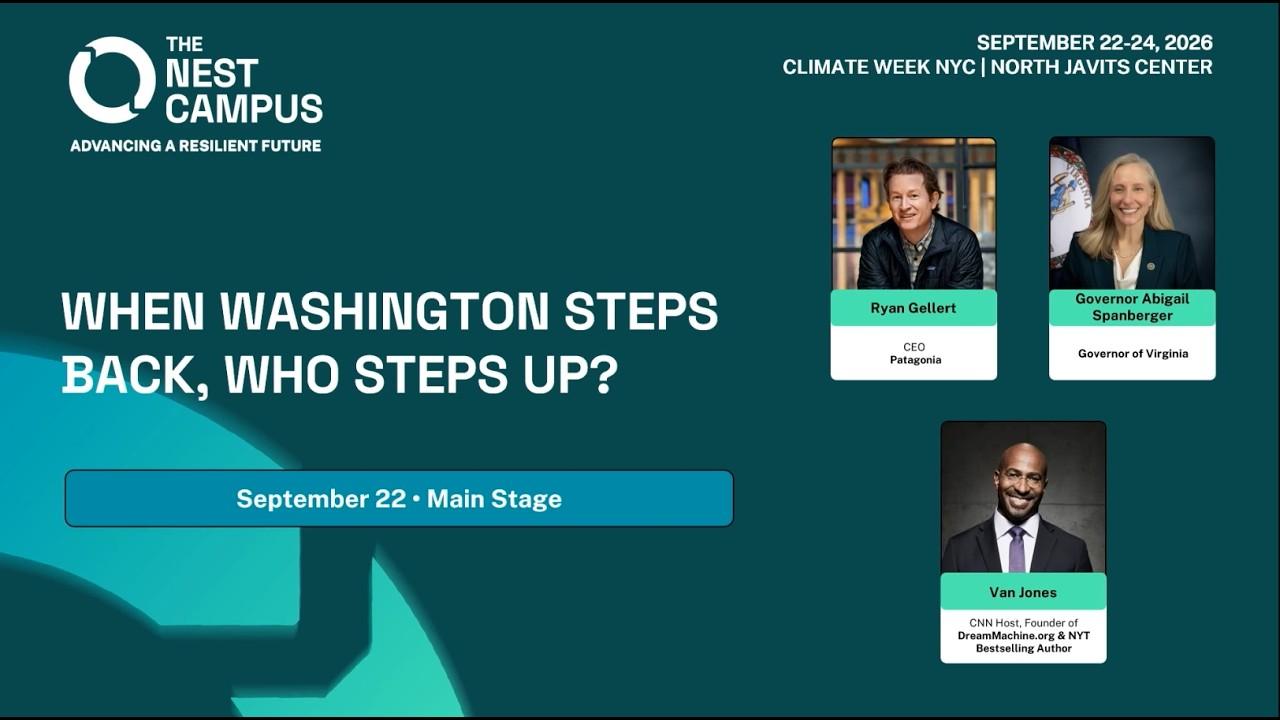
Virginia Governor and Patagonia CEO Champion State-Level Climate Action Amid Federal Retreat
Nest Campus • United NationsSeptember 23, 2026
Locunity is an independent informational service and is not an official government page for this commission. All information is sourced from public footage and an analysis of official agendas with the aid of responsible, fact-checked AI. to report an error or omission.
Virginia's governor and the CEO of Patagonia made a forceful case for state and corporate climate leadership during a wide-ranging panel discussion, unveiling new data center regulations, announcing a fresh lawsuit over Bears Ears National Monument, and detailing an intervention in a $67 billion energy merger. The conversation — held at the Nest Campus on Sept. 23, 2026 — laid bare how climate policy in America is increasingly being driven from state capitals and corporate boardrooms as the federal government steps back.
- Virginia unveils first-in-the-nation data center accountability framework, including limits on behind-the-meter natural gas generation and requirements that data centers pay for new transmission infrastructure
- Patagonia files second lawsuit against Trump administration after Bears Ears National Monument boundaries were again reduced in July 2026
- Governor intervenes as legal party in $67 billion NextEra-Dominion Energy merger, demanding ratepayer protections, job guarantees, and clean energy commitments
- 11.2 million self-described environmentalists didn't vote in the last presidential election, prompting expanded corporate voter mobilization
- Both leaders push plain-language climate messaging tied to jobs, costs, and health to build durable support across the political spectrum
Virginia Takes on Data Centers With Sweeping New Framework
Why it matters: Virginia hosts more data centers than any other state, and the AI-fueled explosion in demand is straining the grid, consuming water, and raising electricity costs for millions of residents. The state's regulatory choices are effectively setting a national template.
Where things stand: Governor Spanier, Governor of Virginia, announced a comprehensive data center accountability framework that he described as the first of its kind. The package combines executive orders with planned legislation for the upcoming General Assembly session and addresses five areas: transparency, community control over siting, environmental protections, cost allocation, and grid resiliency.
On transparency, data center developers would be required to disclose environmental and water-usage impacts to local governing bodies. On emissions, the framework includes what the governor called a national first.
"We're the first state in the country that would be putting limitations on behind-the-meter natural gas," said Governor Spanier, Governor of Virginia.
The behind-the-meter provision is significant because data center operators have increasingly turned to on-site natural gas generation to bypass grid capacity constraints — effectively sidestepping the state's clean energy mandates. Virginia is already the nation's largest net energy importer, making energy affordability a persistent concern for families.
On cost allocation, the governor was blunt: "If there is new transmission infrastructure being put in place because of data centers, then data centers should pay for that transmission cost infrastructure." The State Corporation Commission created a new rate class for data centers in December, separating their costs from residential ratepayers for the first time.
The framework also envisions requiring data centers to make their battery storage available for grid resiliency and to modulate their electricity draw during periods of peak demand — effectively turning the state's largest energy consumers into potential grid assets.
What's next: The governor plans to pursue legislative components of the framework during the upcoming General Assembly session, building on the executive orders already in place.
Patagonia Sues Again Over Bears Ears, Targets 11 Million Non-Voting Environmentalists
The basics: Bears Ears National Monument in southeast Utah was declared by President Obama in 2016 after years of advocacy by local tribes and conservation groups, including Patagonia. In 2017, the Trump administration reduced the monument's boundaries by 90%, prompting the company's first lawsuit. The Biden administration restored the boundaries, but in July 2026, the monument was again reduced.
Where things stand: Ryan O'Brien, CEO of Patagonia, confirmed the company has filed a second lawsuit.
"We're suing the Trump administration," he said, framing the recurring reversals as evidence of a structural problem in American conservation. He described it as a fight where conservationists need to win every day while developers only need to win once.
O'Brien also took aim at corporate peers who have retreated from climate positions, invoking Winston Churchill: "You can always count on them to do the right thing once they've exhausted every other option."
The panel moderator praised the company's persistence: "Patagonia didn't fold, didn't run, and we appreciate you."
Voter mobilization: Separately, O'Brien described Patagonia's expanded efforts to mobilize environmentalists at the ballot box, citing data from the Environmental Voter Project showing "11.2 million self-described environmentalists didn't participate in the last presidential election."
Patagonia has closed all of its stores on Election Day since 2016 so employees can vote. In 2018, the company co-founded Time to Vote with Levi's and PayPal, a coalition that now includes more than 2,000 companies. O'Brien said employees have expanded their participation beyond voting to poll-working and volunteering.
"A healthy planet, thriving communities depends on a functioning democracy. I never thought I would say this in my life, but that's in play right now," said O'Brien.
Why it matters: If even a fraction of those 11 million environmentalists were mobilized, it could reshape outcomes on climate-related ballot measures and candidate races across the country. The Bears Ears case, meanwhile, continues to test whether conservation designations made by one president can survive the next.
Governor Steps Into $67 Billion NextEra-Dominion Energy Merger
Why it matters: NextEra Energy's proposed $67 billion acquisition of Dominion Energy would combine America's largest energy company with Virginia's dominant utility, affecting electricity costs, jobs, and clean energy plans for millions of ratepayers across the Southeast.
Where things stand: Governor Spanier said he made the unusual decision to intervene as a legal party in the merger case before the State Corporation Commission, rather than simply submitting comments. He identified three core concerns: affordability for ratepayers, protection of Virginia jobs, and maintenance of the state's clean energy trajectory — including the Virginia Clean Economy Act and what he described as "the largest offshore wind project in America that when it's finished will power 660,000 homes."
The governor acknowledged that NextEra has improved its filings since the intervention, increasing promised ratepayer rebates, making written job commitments, and providing additional clean energy documentation. But he expressed skepticism about post-approval enforcement.
"You can make a lot of promises, a deal gets approved, and then what happens?" said Governor Spanier.
What's next: The SCC is expected to issue a decision in January. North Carolina, South Carolina, and federal regulators must also approve the deal.
Making Climate Policy Stick Across Political Cycles
Why it matters: Climate policy that only survives one administration is no policy at all. Both panelists spent significant time discussing how to build durable support that transcends partisan swings.
Governor Spanier described tailoring climate language to different audiences — discussing sea level rise and national security in coastal Virginia, drought and hay emergencies for cattle farmers in rural areas — while delivering the same substantive message. He pointed to conservation practices such as rotational grazing, cover crops, carbon sequestration, and stream exclusion that simultaneously lower farmer input costs, improve soil health, and protect the Chesapeake Bay.
"I just declared a hay emergency, and this is all part of that climate conversation," said Governor Spanier. He added: "Those practices also lower input costs for farmers."
"I always say the same things to everyone I talk to," the governor said, emphasizing that the language changes but the substance does not.
O'Brien argued that the only way to make conservation policy durable is to root it in community engagement. He pointed to Albania, where a national park was created along the Vjosa River but then undermined by government policy, sparking mass protests. "The people of Albania have taken to the streets for over 100 straight days fighting for their land," he said. "You've got to work with local communities if you want public policy to be durable."
O'Brien also pushed back on the perception that environmentalism is elitist, citing the backlash when Sen. Mike Lee of Utah pursued a proposal to sell off public lands. "People across America, coast to coast, top to bottom, across the ideological spectrum said, no way, not on our watch," he said. He highlighted Patagonia's documentary This Is Not a Drill, which features grassroots activists Justin Pearson in West Memphis, Roycia in Louisiana, and Sharon in Texas fighting to protect their communities. He also cited Patagonia's free repair program and buyback resale at lower prices as evidence the company is trying to make sustainability accessible.
The moderator framed the overarching takeaway as "work, wealth, and health" — the three concerns that resonate universally — arguing that the green agenda is the best solution for all three. "Most people are not concerned about big issues. They're concerned about work, wealth, and health," the moderator said.