Nest Campus - Sep 23, 2026 - Meeting
Nest Campus • United NationsSeptember 23, 2026
Locunity is an independent informational service and is not an official government page for this commission. All information is sourced from public footage and an analysis of official agendas with the aid of responsible, fact-checked AI. to report an error or omission.
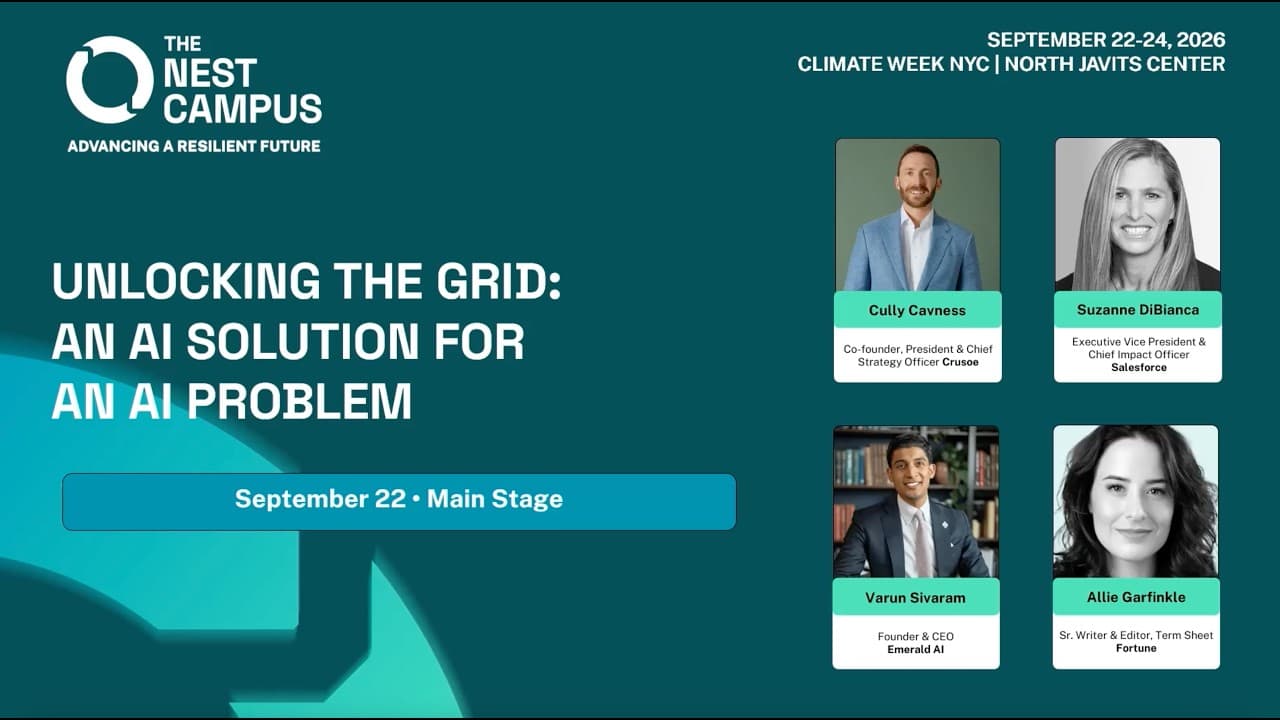
Tech Leaders Pitch Flexible Data Centers as Grid Saviors at UN Nest Campus
Executives from AI infrastructure companies Emerald and Crusoe used a United Nations Nest Campus panel to make their boldest case yet: data centers don't have to be power hogs — they can be the grid's best friend. The discussion, which followed apparent audience protests earlier in the event, laid out a technology-and-investment playbook that could shape how cities and utilities negotiate the next wave of AI facility permits.
- Emerald, NVIDIA and Google launch the AI Energy Management Alliance to set "good citizen" standards for data centers
- 100-megawatt power-flexible AI factory announced in Manassas, Virginia — billed as world's first at that scale
- Crusoe demonstrates off-grid, 100% solar data center running on second-life EV batteries
- Panelists cite $20M in local food spending, $10M/day in wages, and $100M+ in school revenue from data center projects
- Industry executives dismiss audience protesters, questioning whether critics actually live near data centers
The 'Good Citizen' Pitch: Flex Down, Not Black Out
Why it matters: As AI companies race to build power-hungry data centers, the question of who pays for grid upgrades — and who suffers when the lights flicker — has become a flashpoint in communities across the country. This panel offered the industry's most detailed public answer yet.
Where things stand: Varun, CEO of Emerald, argued the core problem is perception, not physics. The U.S. grid, he said, is dramatically underused.
"Our grid today is horribly underutilized. It's used less than 50% of the time on average. Think about a superhighway — it's got 5 lanes, and only 2 times a month does that superhighway really hit peak rush hour," said Varun, CEO of Emerald.
His claim: 100 gigawatts of new data center load could plug into the existing grid without building new generation capacity — if facilities adopt Emerald's flexibility technology, which orchestrates workload reduction or geographic shifting at what he described as "the speed of light." Varun cited demonstrations in London, Phoenix, Virginia and Chicago, including one that showed a data center reducing power during the famous British halftime tea-kettle surge — a one-gigawatt spike — to help stabilize the grid.
The headline announcement: Emerald, NVIDIA and Digital Realty are launching a 100-megawatt power-flexible AI factory in Manassas, Virginia.
"We're launching a 100-megawatt facility later this year in Manassas, Virginia. And we're excited because it's going to be the world's first power-flexible AI factory," Varun said.
Separately, Emerald announced the AI Energy Management Alliance, co-founded with NVIDIA and Google, to promote grid-flexibility standards across the industry.
The other side: Varun framed the stakes in blunt economic terms for municipal utilities. Driving data centers off the public grid, he warned, would backfire on the very communities opponents claim to protect.
"The public power grid is deprived of what is the greatest economic opportunity in history. And data centers that are willing to pay their fair share and bring revenue onto the system. Without that revenue, the public power system puts more burden on the backs of all of us ordinary ratepayers who pay our bills," Varun said.
What's next: The Manassas facility is expected to launch later this year. If the power-flexibility model performs as advertised at commercial scale, it could become the template utilities and regulators use when evaluating data center applications nationwide.
Clean Energy Gambit: Solar, Batteries and Nuclear Bets
Kali, a representative of Crusoe, pushed the conversation further, arguing data centers are not just grid-compatible but could be the fastest accelerant for clean energy deployment.
"We've demonstrated an off-grid, 100% solar-powered data center using second-life electric vehicle batteries that we're repurposing as a large battery system paired with a large solar deployment to show that we can do 100% renewable even off the grid," Kali said.
Crusoe is also piloting small modular nuclear reactors and novel battery technologies. Kali described himself as a "pragmatic environmentalist," acknowledging that natural gas turbines are needed today but envisioning them transitioning to peaker-plant roles as renewables scale.
On the persistent claim that data centers drive up electricity rates, Kali offered a counterintuitive rebuttal:
"Many studies show that where you have the largest penetration of data centers you actually have rates falling or rising more slowly than markets without because you have a bigger denominator. The fixed costs of the grid are spread over more kilowatt hours."
Show Me the Money: Community Benefits and Sharp Words for Critics
Why it matters: The economic impact of data centers on small and midsize communities is central to local permitting debates. Panelists provided the most granular figures of the session — but also struck a combative tone toward opponents.
Kali rattled off numbers for Crusoe's operations: $20 million in food purchases in Abilene in a single year, 15,000 employees company-wide, roughly $10 million per day in wages, and projected tax contributions amounting to 25–30% of the entire city and county budgets where Crusoe operates. He cited one analysis showing a school district receiving more than $100 million from data center tax revenue and referenced Louisiana parishes where teachers received $50,000 bonuses.
"In Abilene, for example, we've purchased $20 million of food for our workforce there this year so far. And if you own the barbecue restaurant, this is a very good thing for you and for your workers and for your families and for your community," Kali said.
He then turned directly to the audience protesters:
"I would guess that few, if any, of the people that stood up and shouted at us actually live near a data center."
Suzanne, an investor who indicated she has invested in both Crusoe and Emerald, urged a more conciliatory approach. Drawing an analogy to the positive international sentiment shifts during the World Cup, she argued that concrete community engagement — jobs, school subsidies, visible local investment — matters more than rhetoric.
"I think that we have to take that analogy to the communities in which these data centers are currently operating, the jobs that are being provided on the ground, the subsidies, the tax subsidies that are being provided for schools. And so I think that it's about doing the work, not about talking about the work," Suzanne said.
The AI Case: Cancer, Climate and College Applications
Panelists also made a broader argument that AI's potential societal benefits justify the energy demands of the infrastructure buildout. Kali pointed to breakthroughs in cancer treatment, materials science and energy storage. Suzanne offered a concrete example: College Possible, a nonprofit mentoring organization, used AI tools to enable its AmeriCorps volunteers to serve roughly 10 times more students during one college application season.
"When they were able to empower them with AI tools, these volunteers were able to 10x their workload. They were able to serve about 10x students this college season versus last college season — because AI can work all night and AI can help these students figure out what geography they want to go to school and what they want to study," Suzanne said.
She framed the central question as one of execution, not existence: "I think the question isn't about data center. Should we develop or not develop more data centers in this country?" The answer, she argued, is already settled — the real work is in deploying them responsibly.
The moderator closed by acknowledging the tension between misinformation concerns and free expression: "Misinformation and slander I cannot abide. And thoughtful discourse is all we have, really, as we look to the future."
Minor Items
- Audience protests: Protesters disrupted the event before the panel began; panelists referenced the disruption throughout but no details on the protesters' specific demands were captured.
- Talley's Law: Kali referenced his written work on the intersection of energy, the environment and the economy, directing attendees to read it for his full policy framework.