
State Budget Cuts Threaten 80% of Muni's Climate-Funded Programs
Municipal Transportation Agency Board of Directors • San FranciscoAugust 4, 2026
Locunity is an independent informational service and is not an official government page for this commission. All information is sourced from public footage and an analysis of official agendas with the aid of responsible, fact-checked AI. to report an error or omission.
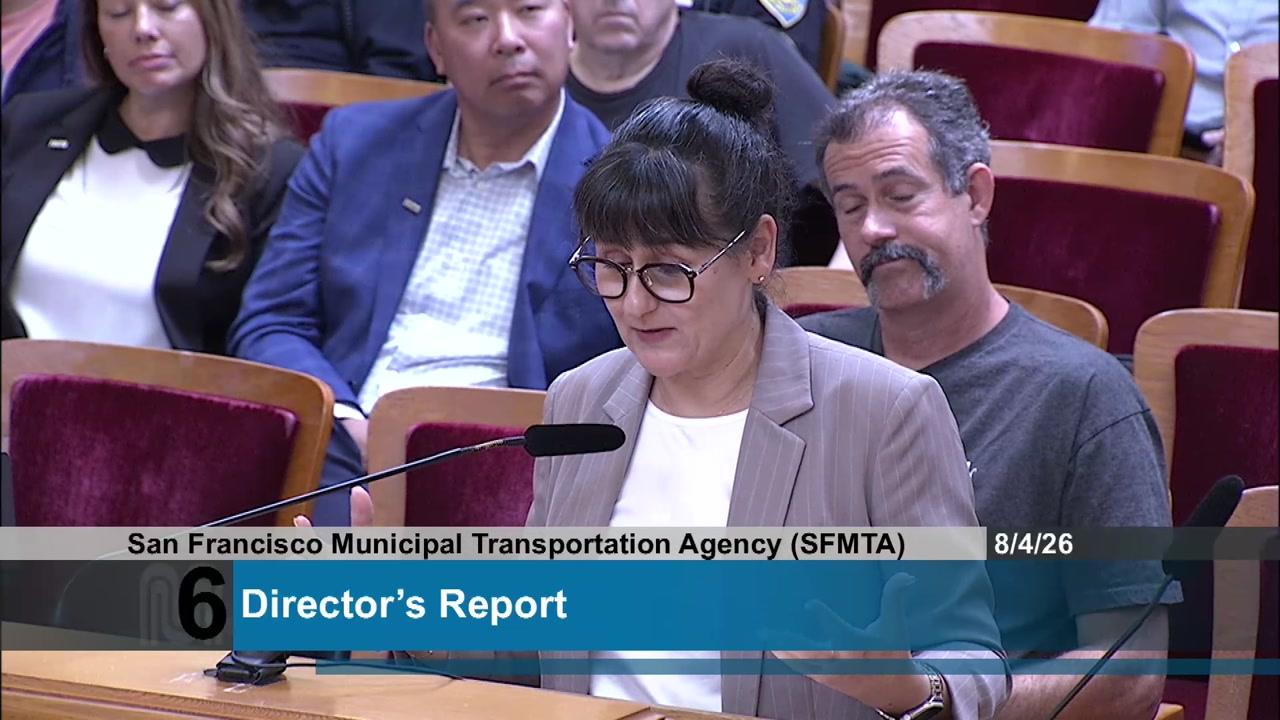
The SFMTA Board of Directors convened Aug. 4 with an agenda spanning staff heroics and signal upgrades, but the meeting's most consequential revelation came from Director of Transportation Julie Kirschbaum: California's restructured Cap and Invest program could slash 80% of the climate funds that bankroll Muni's low-income fare programs and major capital projects. Meanwhile, a six-month street safety review delivered a sobering split — fewer crashes overall, but no decline in the collisions that kill and seriously injure people.
- State climate-fund overhaul threatens Muni fare subsidies and capital projects; a transit coalition is lobbying Sacramento for a one-year reprieve before the Legislature adjourns in late August
- Street safety data shows severe injuries and fatalities holding steady despite an overall drop in collisions; Walk San Francisco criticizes the oversight committee for lacking substance and a regular schedule
- Cost-neutral back-to-school service changes bring a new one-seat ride for Visitacion Valley students, frequency boosts on the N Judah and 1 California, and speed limit reductions at six schools
- Board unanimously approves a $5.7M bridge security contract with Allied Universal to prevent disruption during a competitive rebid
- T3 Muni Metro signal upgrades cut SOMA travel times by 37%, saving riders up to two minutes per direction
- Public commenters demand answers on the $12 million Castro station elevator, now quietly delayed to fall 2026
Sacramento's Budget Knife Reaches Muni's Bottom Line
Why it matters: SFMTA counts on Greenhouse Gas Reduction Fund dollars — classified as Tier 3 under the state's restructured Cap and Invest program — to subsidize low-income and reduced Muni fares and to fund capital projects including the Train Control Upgrade and Muni Forward improvements. Those programs now face an 80% cut.
The basics: The California Air Resources Board recently adopted amendments to the Cap and Invest program. Combined with the new state budget, programs categorized as Tier 3 — which support affordable housing, public transportation, clean air, safe drinking water, and climate resilience — will be cut by roughly 80%.
Where things stand: "Together with the new state budget that was enacted after the Air Resources Board approved the changes to the Cap and Invest program, the Tier 3 programs will be cut by 80%," said Director of Transportation Julie Kirschbaum. A coalition led by the California Transit Association — including SFMTA, other transit agencies, local governments, and labor unions — has written to the governor and Legislature requesting a one-year solution to honor prior funding commitments while longer-term fixes are developed. "A coalition led by the California Transit Association has sent a letter requesting that the governor and Legislature support a one-year solution to honor the state's previous funding commitments while we work on solutions for future years," Kirschbaum said.
Vice Chair Stephanie Cajina pressed on when riders would feel the impact if Sacramento fails to act by the end of the legislative session. "Curious to understand when would riders and folks feel the impacts if, come end of August, either no decision has been made or the posture has not moved," Vice Chair Cajina said. Kirschbaum responded that no public-facing changes would be implemented until the agency reviews how the cuts fit into its broader financial picture and brings a recommended strategy to the board, expected in a late September quarterly report. "We would not implement any changes to the public until we review how this change would fit into our larger financial picture and then would bring a recommended strategy to the board," she said.
What's next: The legislative session ends in late August — the deadline for any reprieve. SFMTA staff plan to present a financial strategy to the board during a quarterly report expected in late September.
Fewer Crashes, but Fatalities Won't Budge
Why it matters: Six months into the city's Street Safety Initiative, the data reveals a troubling paradox: overall collisions are declining, but the crashes that maim and kill are not.
Where things stand: Board Member Fiona Hinze, who chairs the Street Safety Committee, reported the committee reviewed crash data for the first half of the year. "Overall collisions are on the decrease, but severe injury and fatality collisions are holding steady unfortunately," Board Member Hinze said. Topics covered at the committee meeting included an E-Device and E-Safety working group being convened by the Mayor's office (not yet formed), a Community Quarters program portal expected to launch later in summer or fall, collaboration with Public Works on repaving projects, and a street design manual being co-developed with the fire department.
The other side: Sam Greenberg, Advocacy Director at Walk San Francisco, used public comment to deliver a pointed critique. "We were frustrated that very little new information was shared on progress and also by just the short duration and depth of discussion, given it was an important six-month update," Greenberg said. He also called attention to a vacancy: "We also hope that a third member of this body will step up soon to fill the empty seat on the committee." Greenberg argued the committee is the only public forum for substantive updates on traffic safety and urged it to adopt a regular meeting schedule.
What's next: The one-year anniversary review of the Street Safety Initiative is expected before year-end. The committee's third seat remains unfilled.
Back-to-School Muni Changes Come at No Extra Cost
Why it matters: With San Francisco schools opening Aug. 17, SFMTA is rolling out a package of transit and safety improvements — frequency boosts, new routes, and speed-limit reductions — without adding to the budget. The agency achieved this through creative fleet management, not new dollars, a detail that drew scrutiny given two SFMTA tax measures headed to voters in November.
Where things stand: Effective Aug. 29, the changes include Muni School Trippers providing extra afternoon buses on school routes; a new one-seat ride from Visitacion Valley to Francisco Middle School, eliminating a transfer from the 8 Bayshore; a new 28R 19th Avenue Rapid stop at Eucalyptus Drive for Lowell High School students; speed-limit reductions around six schools; upgraded school-zone crossings at 40 locations; daylighting at more than 2,300 school intersections; and the Mission Bay Quick Build project bringing traffic calming near the new Mission Bay Elementary School.
Beyond schools, riders on the 1 California and N Judah will see cost-neutral frequency increases, larger buses return to the 5R Fulton Rapid, and peak-time capacity grows on the 22 Fillmore, 29 Sunset, 38 Geary Rapid, and 49 Van Ness Mission. Board Member Hinze asked how these changes stay cost neutral. Kirschbaum explained that as the Potrero maintenance facility gained confidence with 60-foot buses, the agency could shift 40-foot buses to other routes. "In the case of the 5 Fulton, for example, when we closed Potrero, we initially started with a modest number of 60-foot buses on the route and more 40-foot buses because our maintenance teams were going to be maintaining them in a temporary facility and we didn't want to overextend that operations," Kirschbaum said.
The other side: Griffin Lee of Connected SF questioned the financial transparency. "When you're asking for not one but two tax measures to pass this November, I think every item should come with financials," Lee said. Vice Chair Cajina urged the agency to ensure multilingual outreach reaches Visitacion Valley families, noting that the neighborhood has many monolingual households. Staff said follow-up details would be provided.
$5.7M Bridge Contract Avoids a Repeat Security Scramble
Why it matters: The SFMTA Board unanimously approved a short-term, sole-source transition contract with Allied Universal Security Services to prevent the kind of operational disruption the agency experienced during its last major contract changeover.
The basics: Contract No. SFMTA-2027-02-LOC covers an initial three-month term starting March 31, 2027, with an option for up to three additional months, not to exceed approximately $5.7 million. The contract ensures seamless security coverage at transit facilities while a competitive RFP is finalized.
Where things stand: Kirschbaum framed the item as a lesson learned. "When we brought you the parking app contracts last year, we did not have a transition contract in place and it really took a lot of work between the contractor and our Streets Director Victoria Wise to set up the needed transition space," she said. Board Member Dominica Henderson asked about the timeline for a full competitive bid. Kirschbaum said the agency hopes to bring the full RFP to the board by June 2027, with the new contract structured as a three-year deal with options for two additional years. "Do you anticipate this also being the similar kind of maybe five years plus some extensions, or is it a longer period that you're able to bid this service out for?" Board Member Henderson asked. Kirschbaum confirmed the three-plus-two-year structure.
Decisions: The board approved unanimously, 5-0 (For: Tarlov, Henderson, Hinze, Cajina, Felder; Absent: Heminger, Chen). No public comment was received.
T3 Signal Upgrades: Two Fewer Minutes Stuck in SOMA
The SFMTA celebrated a tangible win during the Director's Report: signal timing improvements on the T3 Muni Metro line, which serves more than 25,000 daily riders through equity neighborhoods from Chinatown to Bayview Hunters Point.
Staff from Muni Forward, the traffic signal shop, Transit Division maintenance, and communications collaborated to adjust traffic and transit signals, giving Muni more green lights and reducing delays when other vehicles are turning. "In SOMA, for example, we are saving up to two minutes in each direction. That is a 37% reduction in travel time," said Streets Director Victoria Wise. Mission Bay and Dog Patch riders are saving about 1.5 minutes. Assistant Engineer Jasper Lee spoke on behalf of the team and noted a Phase 2 targeting the Bayview segment is planned.
Paint Shop Worker Saves a Life, Inspires a Team
Streets Director Wise also recognized Michael Rath of the SFMTA paint shop for performing life-saving CPR on his colleague Laurent, who suffered cardiac arrest while the two were refueling a truck in the Bayview in May. First responders confirmed Laurent would have faced a very different outcome without Rath's immediate action. The two had worked together for more than 20 years, and Rath regularly visited Laurent in the hospital afterward.
"The amazing part here is that Michael's act of courage really inspired the whole team. Everybody in the paint shop saw the importance of CPR training, and they took it upon themselves to find training and do it themselves. So the entire team is now 100% trained in CPR and they're certified," Director Wise said.
Minor Items
- Consent calendar approved unanimously (5-0): Routine traffic modifications, SFPD parking authorization near Central Station, $15 million in engineering services contracts, and approximately $471,000 in state TDA Article 3 funds for the Folsom Streetscape project.
- July 21 meeting minutes approved (4-0): Vice Chair Cajina had not yet joined the meeting; Heminger and Chen absent.
- Castro Muni elevator delay: Public commenter Michael Petrellis criticized SFMTA for quietly pushing the $12 million elevator opening from February to July and now to fall 2026 with no public explanation. "Handicapped people, parents with strollers, we are all put at a disadvantage because SFMTA is saying nothing about why the delay in opening this $12 million elevator," Petrellis said.
- Unannounced parking changes on Castro Street: Resident Mitchell Schoenbrunn, a 49-year San Francisco resident, told the board he woke up to find six residential parking spots on his block replaced by four meters and a modified blue zone with no prior notice. He requested a review.
- SFMTA summer internship program: A video highlighted paid high school interns fabricating signs and installing meters in SFMTA shops, run in partnership with SF Unified School District and the Japanese Community Youth Council.
- Meeting transparency complaints: Petrellis urged the agency to post the Director's written report online before meetings. Secretary Silva clarified that all meeting materials are available at sfmta.com/board.
- Closed session: The board entered closed session unanimously, settled items 3A and 3B, and voted 5-0 not to disclose the discussions.