
Board Approves $55M AI Bus Lane Cameras as Muni Pivots to Growth
Municipal Transportation Agency Board of Directors • San FranciscoNovember 17, 2026
Locunity is an independent informational service and is not an official government page for this commission. All information is sourced from public footage and an analysis of official agendas with the aid of responsible, fact-checked AI. to report an error or omission.
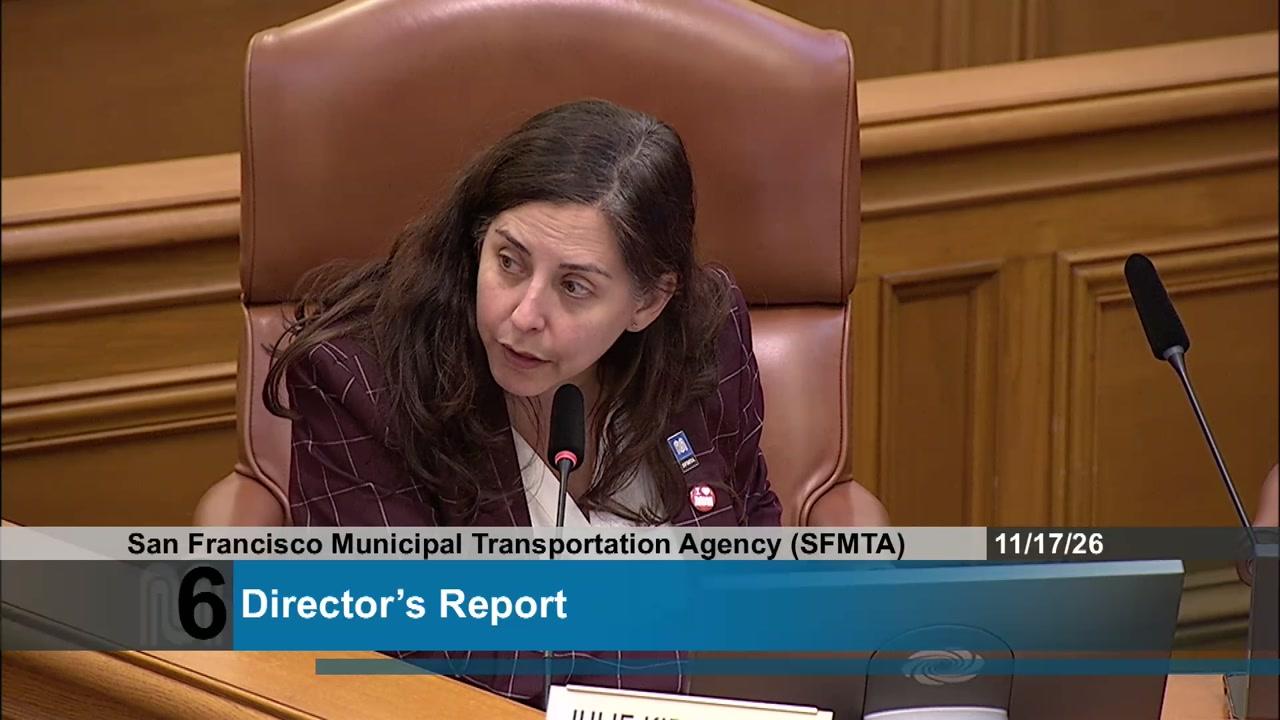
The San Francisco Municipal Transportation Agency Board of Directors voted 6-0 on Nov. 17, 2026, to approve a roughly $55M contract with Hayden AI Technologies that puts enforcement cameras on 212 Muni buses. The contract still needs Board of Supervisors approval. It came as directors moved from deficit triage to spending new money: voters had just approved two transit funding measures, and the board also backed a protected Cesar Chavez Street bikeway and previewed the first service boosts.
- $55M Hayden AI contract approved 6-0; camera enforcement of bus lanes and stops heads to the Board of Supervisors
- Measure RTM and Prop H passed, bringing Muni about $305M a year; advocates call it a mandate
- Cesar Chavez protected two-way bikeway approved 6-0, with construction phased across 2027 and 2028
- 20-plus group coalition demands car-free Market Street return after a fatal August crash
- Service boosts on five crowded lines start Jan. 30, 2027, while riders push to restore 2025 cuts
- Director Steve Heminger will leave the board Dec. 31 after seven years
Cameras on Buses: Board Bets $55M on Automated Enforcement
Why it matters: Cars parked in bus lanes and at stops slow service and block wheelchair users at the curb. The contract replaces a manual system with automated detection and expands enforcement to transit stops for the first time.
Where things stand: SFMTA has run camera enforcement since 2008. Staff said the current system issues 6,000 to 8,000 citations a year and requires staff to retrieve and review video by hand. "We are continuing to use proven technology that strengthens our impact," said Streets Director Viktoriya Wise.
The new system records only potential violations and blurs bystanders and license plates. Parking control officers still review each case, and the appeals process stays in place. The system must comply with the city's surveillance technology and AI ordinances. "The data cannot be mined by the vendor," said Daniel Wu, project manager, Technology Division.
The contract terms:
- About $55M over a three-year initial term, with three one-year options
- Capped monthly fees
- Cameras on 212 vehicles, about 25% of the fleet
- A 60-day warning period, with a review of fine levels expected
Directors probe the limits: Director Alfonso Felder asked whether the system could ticket moving violations. "Would it require state legislation for us to have that?" he asked. "It would require a change to state law for us or any other California jurisdiction to be able to enforce moving violations," replied Michael Rhodes, Acting Director, Muni Forward.
Director Steve Heminger raised the backlash against Flock Safety license plate readers. "Can you give us some insight as to whether we've had any kind of blowback of that scale?" he asked. "We have not had that kind of blowback as it relates to SFMTA license plate readers, which we do have in multiple areas of our work," Wise said. Charlie Torito of Hayden AI said the company's "systems are only capturing the license plates of vehicles that are parked illegally either blocking a transit bus in a bus lane or at a bus stop." Hayden's representative also said the city owns the data.
Vice Chair Stephanie Cajina pressed for independent oversight of the vendor. "I would encourage staff to consider ... non-trust-based sort of tools that you all could use to assess if they are indeed working in compliance," she said.
The other side: Griffin Lee of Connected SF asked for a cost-benefit analysis of the contract. Marie Harabiel, also of Connected SF, said she had mixed feelings, questioned the cost and urged more parking. Jaime of SF Transit Riders supported the contract but warned about the optics of partnering with an AI company. He also backed higher fines for companies like Waymo.
Decisions and stakeholder impacts: The motion passed (For: 6, Against: 0, Absent: 0), with Heminger seconding. Disability advocates gain the most. "This is an outstanding opportunity to invest in accessibility in our public transportation system," said Eli Gelardin, Director, Office on Disability and Accessibility. Dylan Fabris of SF Transit Riders supported the contract and asked that fare-evasion fines drop if parking fines do. Barry Toronto of the Taxi Workers Alliance urged faster approval and more white zones near hotels and restaurants where drivers double-park.
What's next: Under Charter Section 9.118, the contract goes to the Board of Supervisors in February 2027. Staff's timeline calls for a two-bus pilot in March 2027, warnings in May and citations in July 2027.
Voters Deliver a Windfall, and a Mandate
Why it matters: Muni's budget debate has shifted from survival to what service riders get back.
Where things stand: "Voters overwhelmingly supported 2 public transit funding measures," said Director of Transportation Julie Kirschbaum. Measure RTM, a regional sales tax, won 79% in San Francisco and 63% regionally. Prop H, a San Francisco parcel tax, passed with more than 74%.
The projected revenue:
- RTM: about $155M a year for Muni
- Prop H: about $150M a year, plus about $10M for service quality
Heminger said the agency has "now got $1.2 billion a year that we didn't used to have, and it's continuous revenue." Staff said cost-reduction work to close the deficit continues.
Riders want results: "I really urge you all to treat this like a mandate, act boldly, and deliver the results that San Franciscans proved on Election Day that they want," said Fabris, community policy manager, SF Transit Riders. Cyrus Hall pointed to crowding on the 38, 1, 22 and 14 lines.
Senior and Disability Action members asked that Prop H's service-quality money fund wheelchair securement on Metro trains, shelters with seating and less crowded buses. "Seniors and disabled people need a seat and the time to take it," said Erica Wang, who uses a wheelchair and described being unable to secure it on the K train. A Woods Division operator asked that some of the money improve operator schedules and restroom access.
The other side: Connected SF, which opposed the measures, backed continued cost-cutting and cautioned against more red lanes without better planning. Harabiel said the group had identified $238M in non-service cuts. She called it "time to get serious about treating this as an actual agency that belongs to the public and not as a jobs program."
A departure at a pivotal moment: "I'm leaving the board as of December 31st," Heminger announced. He said seven years on the MTA and Caltrain boards was enough and credited Mayor Daniel Lurie for the funding measures. Streets for All, SF Transit Riders, Market Street Railway and TWU Local 258 thanked him. Lee objected to Heminger's joke about being tempted to stay on to spend the new money. Board Chair Janet Tarlov said she accepted the resignation very reluctantly.
What's next: The board will recognize Heminger at its Dec. 15 meeting.
Cesar Chavez Gets a Protected Bikeway
Why it matters: "It is on our high injury network, which sees a disproportionate share of severe and fatal traffic injuries," said project manager Gabe Ho. The corridor carries heavy truck traffic and has no parallel east-west route.
Where things stand: Today the street has painted bike lanes on both sides. The project replaces them, between Kansas and Illinois streets, with a two-way Class IV bikeway on the south side. A Class IV bikeway is physically separated from car traffic.
The design includes:
- Concrete K-rail barriers and floating parking lanes
- Separate turn signals and smart signals
- A new signal at the Interstate 280 off-ramp free right turn
- A lane reduction between Third and Illinois streets
"I think it's really important to make sure that everything from an 18-wheeler to a stroller can make it through this area safely," said Director Dominica Henderson. Directors asked about funding, durability during flooding, 23rd and 25th streets, and planning for Illinois Street. They also asked about coordinating with Caltrans on the Hairball, a tangle of freeway ramps and paths. "I think this is a great project," said Director Fiona Hinze.
The other side: Connected SF stayed neutral on the project but strongly opposed an exemption allowing cyclists to turn on red. Harabiel asked how bicyclists would be routed away from trucks.
Decisions and stakeholder impacts: The project passed (For: 6, Against: 0, Absent: 0). Kate Bloomberg of the Potrero Hill and Dogpatch Neighborhood Association said the current street was the scariest place she had biked. Robin Pam of Streets for All called the project a model for closing gaps in the bike network. The SF Bicycle Coalition flagged lighting, debris and blocked paths at the Hairball.
What's next: Phase 1 on the east end could begin in early 2027 as a quick-build project. Most of the work starts in 2028 alongside a Public Works repaving project, funded through the Quick Build program.
Coalition Wants Cars Off Market Street Again
Why it matters: The Keep Market Street Moving Alliance, which includes more than 20 organizations, says a year-old pilot allowing commercial passenger vehicles on Market Street has produced no public update.
Where things stand: During general public comment, speakers from the SF Bicycle Coalition, SF Transit Riders, Walk SF and the Taxi Workers Alliance spoke in coordination. Clara Mobley, Director of Advocacy, SF Bicycle Coalition, cited rising bike and Muni ridership. Sam Greenberg of Walk SF cited a street sweeper collision and the August death of Yemin Kim. Fabris said luxury SUVs and government vehicles crowd the corridor. Speakers said city data place three of the city's top five severe-injury intersections on Market Street.
"We are asking the board today to put Market Street on the agenda for a future hearing and to immediately restore Market Street's car-free status," Toronto said. He listed four safety measures:
- Dedicated space for bikes and scooters
- Tests of flangeway fillers in the rail tracks
- Limits on government vehicle parking
- More enforcement
What's next: The board took no action. The coalition's request for a hearing remains pending.
First Service Boosts Arrive Jan. 30
Where things stand: Senior planner Sandra Padilla presented the Winter Service Update, the first service improvements since the measures passed. The changes take effect Jan. 30, 2027:
- New short-line patterns on the 1 California and 38R Geary
- The 44 O'Shaughnessy every 8 minutes
- The 5 Local and 5 Owl extended to Salesforce Transit Center
- Two-car M Ocean View trains on weekends
- Muni Forward 29 Sunset Phase 2 and schedule realignments
Staff said the changes would be absorbed within the current budget and warned of hard trade-offs ahead.
The other side: A Cole Valley resident asked staff to restore the 9 San Bruno terminus, the 31 Balboa, the 6 Haight-Parnassus and the 21 Hayes. Staff said the summer 2025 service changes saved $7M. Felder defended shifting buses to high-demand lines, saying "we still do have very real budget constraints." No vote was taken.
- Consent calendar passed 6-0. It included TWU Local 250A labor agreements through 2031, 20 mph speed limits on Eddy, Divisadero and Fulton, the gift of Blackpool Boat Tram 226 and higher City Attorney settlement authority.
- Bayview Shuttle amendment approved 6-0: $2.5M added to the Nomad Transit/Via contract, bringing it to about $6.9M, fully funded by a state CARB STEP grant.
- Hayes Street closure renewal is due in two weeks. Hayes Valley Safe cited 101 weeks of permit non-compliance; Connected SF urged the board to review sales tax data first.
- Citizens' Advisory Council recommends the 2027 legislative program, which returns to the board at its next meeting.
- Closed session: The board announced approval of items 3A and 3B and voted not to disclose the discussion.
Looking ahead: The Street Safety Committee meets Nov. 24, and the board meets Dec. 1. Embarcadero Connectivity Plan open houses are set for Dec. 8 and 9, with an informational item at the board on Dec. 15. Kirschbaum urged riders to sign up for AlertSF ahead of El Niño storms.