
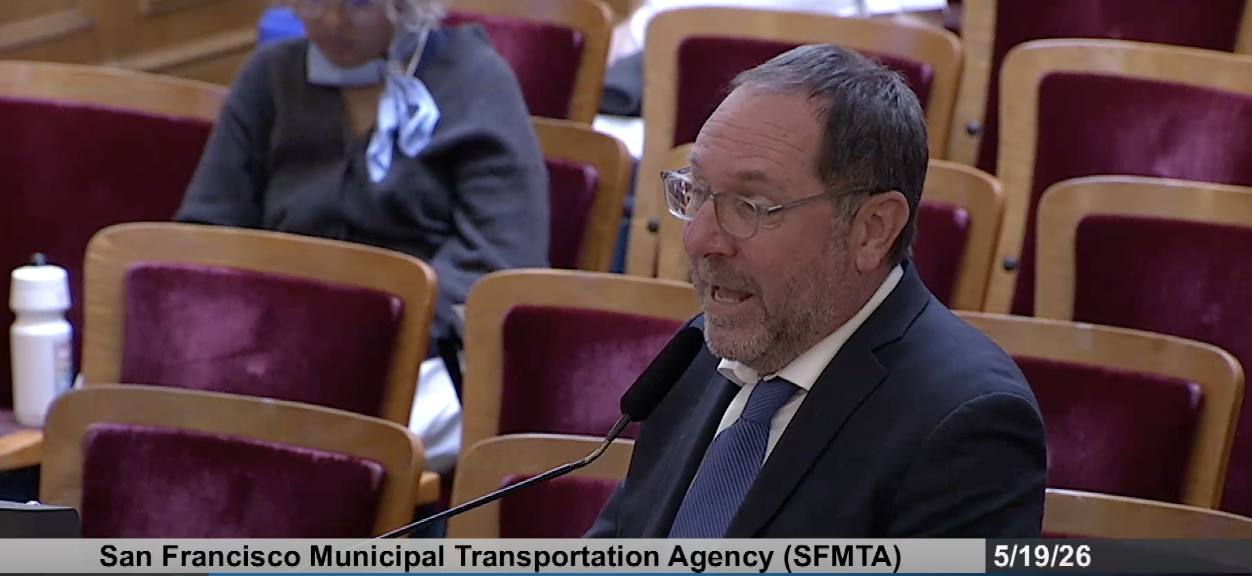
Municipal Transportation Agency Board of Directors - May 19, 2026 - Meeting

Municipal Transportation Agency Board of Directors - May 19, 2026 - Meeting

Municipal Transportation Agency Board of DirectorsSan FranciscoMay 19, 2026

Sources:

Locunity is a independent informational service and is not an official government page for this commission.We use AI-assisted analysis and human editorial review to publish information.

Board Approves 29 Sunset Bus Upgrades, Orders Review of San Bruno Bike Lanes

The SFMTA Board unanimously greenlit Phase 2 of the 29 Sunset Improvement Project — one of the city's most ambitious crosstown bus overhauls — but not before cannabis dispensary workers, bike advocates, and high school students lined up to argue over two contested blocks on San Bruno Avenue. The board attached a 90-day directive requiring staff to return with alternative designs before any work begins at the disputed intersection, setting up a summer showdown over bike lanes, loading zones, and small business survival in the Portola.

  • 29 Sunset Phase 2 approved 7-0, consolidating 21 bus stops, adding 14 transit bulbs, and reducing lanes on San Bruno and Gilman — with a 90-day review ordered for the contested San Bruno/Paul intersection

  • Independent SB63 review validates $250M+ in SFMTA operating savings since 2020; early action policies head to the board June 16

  • Agency on budget as transit fares and parking meter revenue each beat projections by $14 million

  • Citizens' Advisory Council pushes for protected bike lanes on 9th and 10th Streets in SOMA, targeting a High Injury Network gap

  • Vision Zero subcommittee renames itself the Street Safety Committee, asks staff to identify policy barriers to bolder safety goals


29 Sunset Overhaul: Faster Buses, Fewer Stops, and a Fight Over Two Blocks

The basics: The 29 Sunset is a crosstown route connecting the Sunset, Excelsior, Portola, and Bayview — four equity neighborhoods — without going anywhere near downtown. Phase 2 covers the south side of the line, roughly 5.7 miles from Junipero Serra to the Bayview, consolidating approximately 21 of 87 bus stops, adding 14 transit bulbs and two boarding islands, and introducing pedestrian safety upgrades including marked crosswalks, solar-powered stop lighting, and transit signal priority. Phase 1 quick-build changes already cut peak travel times by up to 10%.

Why it matters: The route carries about 18,000 daily riders — roughly 90% of its pre-pandemic total — yet average speeds are in the single digits. "It's a crosstown route. It doesn't go anywhere near downtown. All it does is connect neighborhoods. Despite that, it has very high ridership," said Steve Boland, SFMTA Muni Forward Program staff.

Where things stand: Two lane reductions anchored the most intense debate. On San Bruno Avenue northbound, staff proposed narrowing from two lanes to one at a location with documented sideswipe collisions involving Muni buses. On Gilman Avenue westbound near an elementary school, a similar reduction would create a safer double-parking bypass. The project removes approximately 36 parking spaces across the entire corridor, with the largest single-location loss at four spaces.

The San Bruno Avenue/Paul Street intersection in the Portola became the flashpoint. Employees and contractors of the Bloomerang cannabis dispensary testified that losing their white loading zone would jeopardize cash and product deliveries in a neighborhood they described as unsafe, and argued that wider lanes created by the lane reduction would actually increase speeds for drivers exiting Highway 101. Kevin Martin, a retired SFPD officer working Bloomerang security, raised concerns about parking loss for seniors and disabled clients. Kathy, the Bloomerang manager and Portola resident, said the business had lowered neighborhood crime by 90% since opening in 2020 and had already suffered a 20-25% revenue drop during recent construction.

The other side: Bike and transit advocates pushed back hard. Clara Mobley, San Francisco Bicycle Coalition director of advocacy, called the two blocks between Mansell and Paul "the most protected option for traveling from the Excelsior to the Bayview by bike" and noted they sit on both the agency's North Star bike network and the High Injury Network. Robin Pam of Streets for All San Francisco urged the board to direct staff to bring back protected bike lane options, warning that wider lanes without bike infrastructure could increase vehicle speeds.

Scott Feeney, a transit rider and cyclist, cited a serious injury crash in 2022 and a fatal crash in 2023 on that stretch, calling it "the most harrowing part of a 10-plus mile ride from the Mission to South San Francisco."

Students from the Lowell High School Transit Club testified in support of the broader project, describing overcrowding, inconsistent wait times, pass-ups, and bus bunching after school — problems they said discourage student ridership.

Herbert Weiner argued stop consolidation is cruel to seniors and disabled riders who may have to walk up to a quarter mile to reach a relocated stop, urging the agency to add more buses instead of removing stops.

Boland acknowledged the bike lane deferral was a product of timing, not opposition: "We're not trying to walk away from the bike lanes. Unfortunately, I don't think we were able to talk to some members of this particular neighborhood until too late in the process."

Decisions: Director Alfonso Felder brokered the compromise. "I'd be prepared to put forward a motion that approves this plan as-is, with an important caveat — with the expectation that within 90 days the MTA come back to us with alternative designs for that intersection that address the small business concerns we've heard, while also addressing opportunities to quickly add bike lanes on San Bruno Avenue," he said. Director Steve Heminger seconded. The vote was 7-0 (For: Chen, Heminger, Henderson, Hinze, Cajina, Felder, Tarlov; Against: 0; Absent: 0).

The 29 Rapid Question

Several directors used the item to press for something bigger: a 29R Rapid overlay route. Director Heminger asked Boland for a cost estimate and pushed for the agency to treat rapid service as a formal program. "I'm trying to remember the last time we talked about the rapid program, sort of as a program," he said. Boland estimated a 29 Rapid would cost $15-20 million annually, largely because SFMTA doesn't dramatically cut local service when adding rapid overlay. Acting Director of Transportation Victoria Wise confirmed staff have plans and ideas ready to share.

Director Dominica Henderson connected the dots to regional access: "What this route in particular tells me is that people have a need to go across town, but not necessarily go downtown. And maybe what a lot of people are trying to do is also get to BART."

What's next: Staff will return in approximately 90 days — before any San Bruno Avenue implementation — with alternative intersection designs and a bike lane analysis. A scheduled repaving project on San Bruno in 2027 creates a natural deadline.


$250 Million in Savings Validated, With a Push to Loosen the Electric Bus Mandate

Why it matters: Under SB63 (the Connect Bay Area Act), independent consultants reviewed the financial efficiency of four Bay Area transit agencies. Approval of the findings is a statutory prerequisite for regional transit funding. The review validated approximately $250 million in SFMTA operating cost savings since 2020. Across all four agencies, savings ranged from $76 million (Caltrain) to $516 million (BART).

Where things stand: Director Heminger presented the findings and identified the biggest remaining opportunity for bus operators: loosening or deferring the California Air Resources Board's zero-emission bus mandate. "The trade-off here is if we were to reduce or defer that requirement, it would save us a bunch of money because we're getting precious little for very significant cost in terms of acquiring these electric buses," he said, noting San Francisco already runs largely clean buses. For BART, the opportunity is developing its property holdings. For Caltrain, the opportunity lies in capturing additional benefits from its diesel-to-electric conversion, including potentially selling excess power.

What's next: The SB63 Independent Oversight Committee meets May 22 to consider final report approval. The SFMTA Board will vote June 16 to adopt early action policies. Phase 2 of the study is contingent on voter approval of a regional revenue measure.


Agency on Budget: Fares and Parking Meters Each Beat Projections by $14M

Why it matters: In a $1.4 billion budget, the SFMTA is projected to end FY 2025-26 with a $4 million surplus — strong enough that the better-than-expected revenue was already baked into the recently approved two-year budget, reducing the severity of planned cuts.

Where things stand: CFO Bree Ma Horter reported transit fare revenue exceeded projections by $14 million, driven primarily by single-ride fares reflecting changed post-pandemic commute patterns — more occasional riders, fewer monthly passholders. Parking revenue also beat budget by $14 million, fueled by neighborhood meters rather than downtown garages, another post-pandemic behavioral shift. Advertising revenue is also growing.

On the expense side, slight labor overspending (partly from special events overtime in January) was offset by savings in non-personnel services. The CFO described a deliberate hiring strategy: "If 10 people leave, we hire eight, and over throughout the year that's been slowly bringing us" into line on labor costs — a process underway for three years.

She flagged risks from inflation, geopolitical uncertainty around the Strait of Hormuz gas supply, and reduced international tourism. "There's just a little bit of distaste for traveling in the United States right now, and that is showing up in some of our passenger fare revenue," she said, noting visitor and cable car revenue dipped accordingly.


Citizens' Advisory Council Targets Bike Lane Gaps on 9th and 10th in SOMA

Why it matters: Both streets sit on the High Injury Network in one of the city's most rapidly densifying neighborhoods, and the agency has new GO bond and Prop L funding available for bike and safety improvements.

Where things stand: CAC Chair Leifer presented a recommendation for the agency to evaluate protected bidirectional bike lanes on 9th and 10th Streets in SOMA. Director Felder pressed on the safety implications of bidirectional lanes on one-way streets, raising concerns about motorist confusion and signal timing complications. Acting Director Wise responded that best practices depend on context and involve trade-offs with parking, transit boarding islands, and bus service.

Director Chen raised whether the agency has considered converting one-way streets to two-way in SOMA, citing research suggesting safer speeds and better throughput. Wise pointed to existing progress: the Folsom Bikeway completion at month's end, 2024 GO bond funding for hardening the 5th Street bike lane, and Prop L funding for the SOMA Arterial Traffic Project.


Street Safety Committee Digs Into Speed Cameras, Asks Staff to Identify Policy Barriers

Director Fiona Hinze reported that the Vision Zero subcommittee reviewed High Injury Network methodology, quick-build project lists, and one-year speed safety camera data. The committee asked staff for deeper intersection-level crash analysis and plans for streets where crashes happen off the High Injury Network. It voted to rename itself the Street Safety Committee to align with the city's Street Safety Initiative.

Vice Chair Stephanie Cajina flagged the most consequential request: "The committee did ask staff to bring forth at our next meeting some more information about different policies that perhaps are acting as a hindrance or could help us be a little bit more aggressive with our goals." That request could seed future legislative proposals.

The committee plans to meet quarterly, with a late summer session focused on six-month action metrics.


Minor Items

  • Consent calendar approved 7-0, including claims warrants, routine parking and traffic modifications, and a parking space for the SF Adult Probation Department on 6th Street.

  • May 5 meeting minutes approved unanimously.

  • New parking payment apps Park Mobile and Hotspot are replacing Pay By Phone, which will be phased out in late May; both apps send expiration reminders.

  • Online parking garage reservations expanded to most city-owned garages, building on a successful pilot at the Performing Arts Garage.

  • Fix It Week ran May 18-21, closing the Market Street subway between Embarcadero and West Portal at 9:30 p.m. for overhead wire replacement, station repairs, and work supporting the future Train Control Upgrade project.

  • AAPI Heritage Month cable car decorated with an inaugural ride May 20 from Hyde and Beach Streets.

  • Retiring employees recognized: Suzy Nakhichung (nearly 30 years, Safety Division) and Rita Donahue (two decades, Safety Division), presented by Acting Safety Director Oliver Guida.

  • Public commenter Richard Johnson (HV Safe) alleged the shared spaces closure on the 400 block of Hayes Street has been non-compliant for 75 consecutive weeks and requested permit revocation.

  • Pete Wilson, TWU Local 250A president, alleged SFMTA dispatchers and managers are discouraging overtime requests in violation of a 2017 settlement resolution tied to the $8 million Darrell Stitt v. SFMTA case.

  • Board entered closed session, settled a legal matter, and voted unanimously not to disclose the information discussed.

Next SFMTA Board meetings: June 2 and June 16.

Board Approves 29 Sunset Bus Upgrades, Orders Review of San Bruno Bike Lanes | Municipal Transportation Agency Board of Directors | Locunity