
E-Scooter Injuries Double as SFMTA Board Questions Scooter Share's Future
Municipal Transportation Agency Board of Directors • San FranciscoOctober 6, 2026
Locunity is an independent informational service and is not an official government page for this commission. All information is sourced from public footage and an analysis of official agendas with the aid of responsible, fact-checked AI. to report an error or omission.
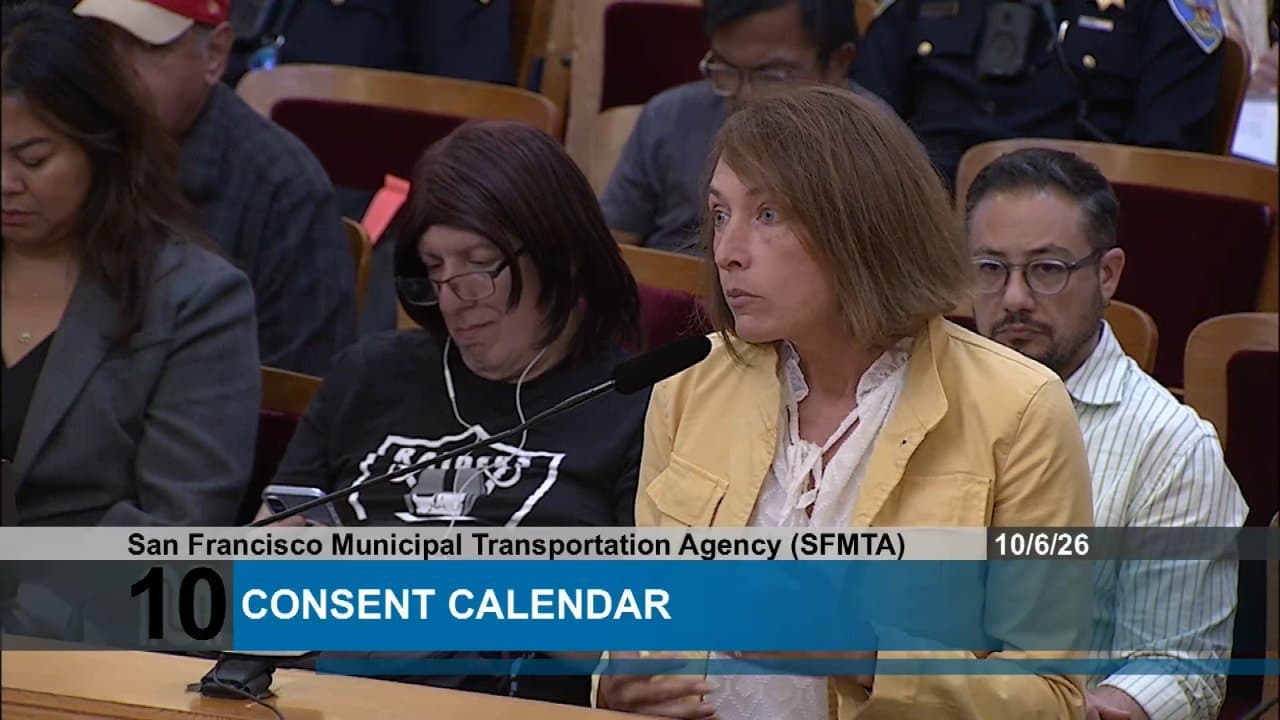
Injury crashes involving stand-up powered devices have doubled in a year. At the SFMTA Board's Oct. 6 meeting, one director suggested San Francisco consider ending its scooter-share program, as Paris did. The board took no action on e-devices but approved, 6-0, the conversion of two underused transit lanes to general traffic, signaling a more flexible reading of "transit first."
- E-device injury collisions doubled year over year; a new mayoral working group aims to deliver recommendations by spring 2027.
- Board Member Steve Heminger floated scrapping scooter share and dismissed voluntary safety technology.
- Idle First Street bus lane becomes a general traffic lane, 6-0, to ease Bay Bridge backups that block Market Street.
- Three Sansome blocks open to private cars, 6-0, over transit advocates' objections.
- SFMTA rebids its security contract, which will cost about $65M against a $59M estimate.
- Inner Richmond residents demand fast fixes on Arguello after an 80-year-old pedestrian was killed.
1 Big Thing: The City Confronts Its E-Device Problem
Why it matters: Overall injury collisions are falling, but severe injuries are rising. Injuries on stand-up powered devices doubled in a year, according to Street Safety Lead Christy Osorio of SFMTA Livable Streets. The policy response could reshape scooter-share permits, delivery apps and sidewalk enforcement.
The basics: State law and the DMV largely govern privately owned devices. SFMTA's strongest leverage covers only its permitted scooter share, which uses fleet caps, geofencing, GPS sidewalk detection and $500 parking fines. Response times to 311 parking complaints fell from about six hours in 2023 to an hour or less. Class 1-3 e-bikes can reach 28 mph, scooters are capped at 15 mph, and mopeds and e-motorcycles are barred from bike lanes.
Where things stand: Alex Sweet, Assistant Chief of Infrastructure, Climate, Mobility in Mayor Daniel Lurie's office, said shared scooters carried nearly 2.5 million trips in 2025, double the 2023 total. He cited the new state law SB 1167, which separates legal e-bikes from higher-powered e-motos and improves crash data. He also noted that the Embarcadero's protected bikeway cut riding on the promenade from 47% to 14% at the morning peak.
The working group includes city agencies, riders, operators, disability advocates, retailers, delivery workers and legislators. It is still interviewing stakeholders and has no meeting date set.
"Crashing on an electric scooter is the equivalent of an NFL running back coming at you at full speed," said Osorio.
The other side: Public comment was long and personal.
- A 69-year-old broke three ribs tripping over a scooter in Union Square.
- Public commenter Max Ventura, who is blind, said many blind residents fear going out.
- Senior and Disability Action's Mia Satya called for all e-devices off sidewalks and prosecution of illegal-device sellers.
- Walk San Francisco urged infrastructure and company regulation, cautioning that enforcement is limited.
- The San Francisco Bicycle Coalition sought cease-and-desist letters to illegal sellers.
- Lime's Julia Stevens touted its 15 mph cap and AI sidewalk detection.
- Retailer The New Wheel reported about 40% sales growth.
Directors split on carrots versus sticks: Board Member Dominica Henderson prefers industry adoption of geofencing. "I hope that we don't have to get to the point where we have to legislate it," she said.
Heminger went further. After SFMTA staff confirmed Paris had ended its program, he urged the board to "go back to first principles, at least on the scooters, and consider whether, like Paris, we ought to just say it's not working and we can't figure out a way to make it work." On voluntary geofencing, he added: "We don't have voluntary state driving laws."
Board Member Alfonso Felder said "my biggest hesitation around this topic is when I see mopeds and electric motorcycles in our bike lanes." Board Member Fiona Hinze urged DoorDash to adopt speed governors and sidewalk detection. Vice Chair Stephanie Cajina sought crash data broken out by device type.
Board Chair Janet Tarlov prioritized seniors, disabled people and children. "I believe that any education for those folks, the cost of that education should be shared with those businesses," she said.
What's next: No vote was taken. The Department of Public Health expects to break out hospital data by device type around year's end.
First Street Bus Lane Opens to Bay Bridge Traffic
Why it matters: Staff say a one-block pinch point on First Street between Market and Mission backs up Bay Bridge traffic. Those queues block crosswalks, cyclists and Muni service on Market Street.
Where things stand: Muni stopped using the left-side bus/taxi lane in 2019, when the 5, 7 and 38 lines moved to Beale Street. Three lanes crossing Market narrow to two. The plan repaves and restripes the block as a general lane and rescinds a left-turn-only restriction.
Senior Transportation Planner Dustin White said Golden Gate Transit supports the change and gains lane width. He added that "we're hoping to add a red lane to that segment as soon as potentially next month," referring to Beale Street.
Muni operator Anthony Ballister said buses frequently get stuck at First and Market.
The other side: Jaime Veloria, Organizing and Outreach Manager at San Francisco Transit Riders, opposed the change. Veloria urged using the lane as designed, called the Beale bus deck confusing and inaccessible, and sought offsetting red lanes such as on Ocean Avenue. Ventura warned that added capacity induces driving.
Decisions and stakeholder impacts: "The continued existence of the transit lane that is not regularly being used by transit is actually creating major issues for transit and for pedestrians in the area," said Felder.
Heminger praised the reversible approach, noting the city is "sort of out a can of paint and not a lot else." He also took aim at the Salesforce Transit Center: "This is a $2 billion bus terminal, and we ought to be getting more out of it than we are."
Director of Transportation Julie Kirschbaum pledged that "we will make sure that we prioritize wayfinding and signage in the plaza." Tarlov said "getting cars safely out of the city, I think, should be a priority."
Vote: For: 6 (Felder, Heminger, Henderson, Hinze, Cajina, Tarlov), Against: 0, Absent: 0.
What's next: Heminger requested a board briefing on Transit Center wayfinding.
Sansome Street Opens to Cars at Merchants' Request
Why it matters: The vote reverses a 2016 Muni Forward contraflow lane in the Jackson Square Historic District. Advocates read it as a retreat on red lanes.
Where things stand: Since 2016, a southbound lane between Broadway and Washington has been limited from 6 a.m. to 8 p.m. to transit, taxis and commercial vehicles. The change opens it to private cars, which will still be forced off at Washington. It also nets about 10 metered spaces from underused loading zones.
"We've heard from merchants in the Jackson Square Historic District that the presence of 3 blocks of commercial loading is not a good fit for their needs and for their customers," said White.
White estimated the cost at "probably just a few thousand dollars." He said Muni routes and stops are unchanged.
Asked by Hinze about the 12 Folsom, he said: "We're somewhat confident the impacts would be negligible, partly because the southbound restriction will still be in place at Washington Street."
The other side: Veloria said the 12 Folsom is at 117% of pre-pandemic ridership. Veloria warned that dropping the lane signals the suspended 10 Townsend won't return. Satya and rider Lisa Platt echoed that concern. Platt said losing the 10 stretched her commute from 30 to 45 minutes. Connected SF called the change a positive iteration.
Decisions and stakeholder impacts: Kirschbaum said restoring the 10 Townsend "is something that we could consider if the parcel tax is successful." She noted it would compete with downtown crowding and the 29 Rapid.
Tarlov said the board could revisit the change if analysis shows harm to the 12. Felder said "we are absolutely a transit-first city, we are not a transit-only city."
Merchants gain parking and car access. Riders on the 12 bear the risk.
Vote: For: 6, Against: 0, Absent: 0.
What's next: Staff will track 12 Folsom travel time, reliability and ridership. They will also weigh transit priority tweaks during a Public Works repaving next year.
Security Contract Rebid Aims to Rein in Costs
Why it matters: This is the first of SFMTA's three highest-spend contracts to be rebuilt under its cost-control push.
Where things stand: The current contract began in April 2020 and has been extended to March 30, 2027. "The original estimate was to be $59 million over 6 years. We're right about $65 million at the end of this contract," said an SFMTA staff presenter.
Deputy Chief Security Officer Theresa Sisem and Contracts Director Julia Friedlander presented a rewritten RFP covering:
- Guard services
- Security operations center functions
- Local business enterprise subcontractor management
The RFP adds performance metrics on reliability, incident response and billing accuracy. It sets a three-year term with a two-year option. "We are contracting for the future, not for the past," staff said.
Felder asked about expected bidders. Staff cited 15 responses to an earlier request for information.
Decisions and stakeholder impacts: Approved 6-0 with no public comment. A blackout policy routes all proposer contact through a single procurement point of contact.
What's next: Staff said the RFP would be released this week.
Richmond Neighbors Press for Arguello Safety Fixes
Why it matters: An 80-year-old pedestrian was killed Sept. 28 at Arguello Boulevard and Anza Street. The site is steps from Rossi Playground and near Roosevelt Middle School.
Where things stand: Residents Gene Natoli and Ethan Ensler and Walk San Francisco Advocacy Director Sam Greenberg said the Arguello Safety Project has stalled. The project has been planned since 2023 and has $1.2M in designated funding. They asked for quick daylighting and bulb-outs, followed by protected bikeways.
Greenberg called it the 13th pedestrian death of the year. He said pedestrians account for more than 70% of traffic fatalities.
What's next: The board did not respond, as the comments addressed an item not on the agenda.
- Embarcadero escalators: Consent calendar approved, 6-0, up to about $8.87M to BART for four escalators.
- Civic Joy Fund gift: Board retroactively accepted about $24,000 in Gamble Park improvements, 6-0; Tarlov suggested revisiting the $10,000 approval threshold.
- West Portal results: Kirschbaum reported injury crashes down 60% and sales tax outpacing the citywide average.
- Charles Drain retires: The chief maintenance officer was honored; his Fix It Week program helped cut Muni Metro delays.
- In memoriam: Meeting adjourned in memory of former board members Will Din and Leona Bridges.
Looking ahead: Connected SF will hold an e-bike safety meeting Oct. 26. The E-Mobility Working Group targets final recommendations by spring 2027.