
SFMTA Board Locks In Raises, No-Layoff Deal Ahead of Ballot Vote
Municipal Transportation Agency Board of Directors • San FranciscoOctober 20, 2026
Locunity is an independent informational service and is not an official government page for this commission. All information is sourced from public footage and an analysis of official agendas with the aid of responsible, fact-checked AI. to report an error or omission.
San Francisco's transit board voted Monday, Oct. 20, 2026, to fix labor costs and job protections for three unions through mid-2031, before voters weigh in on two November ballot measures tied to the agency's finances. The 4-0 vote approved four-year contract extensions with 12% raises and layoff protection through June 2029, and a fourth deal covering Muni operators returns for a vote next month. Elsewhere, staff reported a dramatic drop in speeding at camera sites, while speakers warned about surveillance and fare enforcement.
- Three union contracts extended through June 30, 2031, on a 4-0 vote, with 12% raises
- Muni operators' deal with TWU Local 250A disclosed; vote expected Nov. 17
- Speeding 10+ mph over the limit down more than 80% at 33 camera sites
- Speakers press on license plate reader surveillance; board offers no response
- Riders challenge fare inspectors ordering passengers off vehicles
Board Buys Labor Peace Through 2031
The SFMTA Board of Directors approved amended contracts with the Municipal Executives Association, SEIU Local 1021 and TWU Local 200 as a single motion. Staff said the deals were publicly disclosed Oct. 5 and ratified by union members.
The basics: A memorandum of understanding, or MOU, is the city's labor contract with a bargaining unit. Before the board can vote on one, the agreement must first be publicly disclosed.
Where things stand: "The current agreements were set to expire on June 30th, 2027, and so these negotiated amendments are for 4-year extensions through June 30th, 2031," said Shayna Dines, Senior Employee and Labor Relations Manager. The deals carry 12% wage increases from 2027 through 2031 and layoff protection through June 30, 2029.
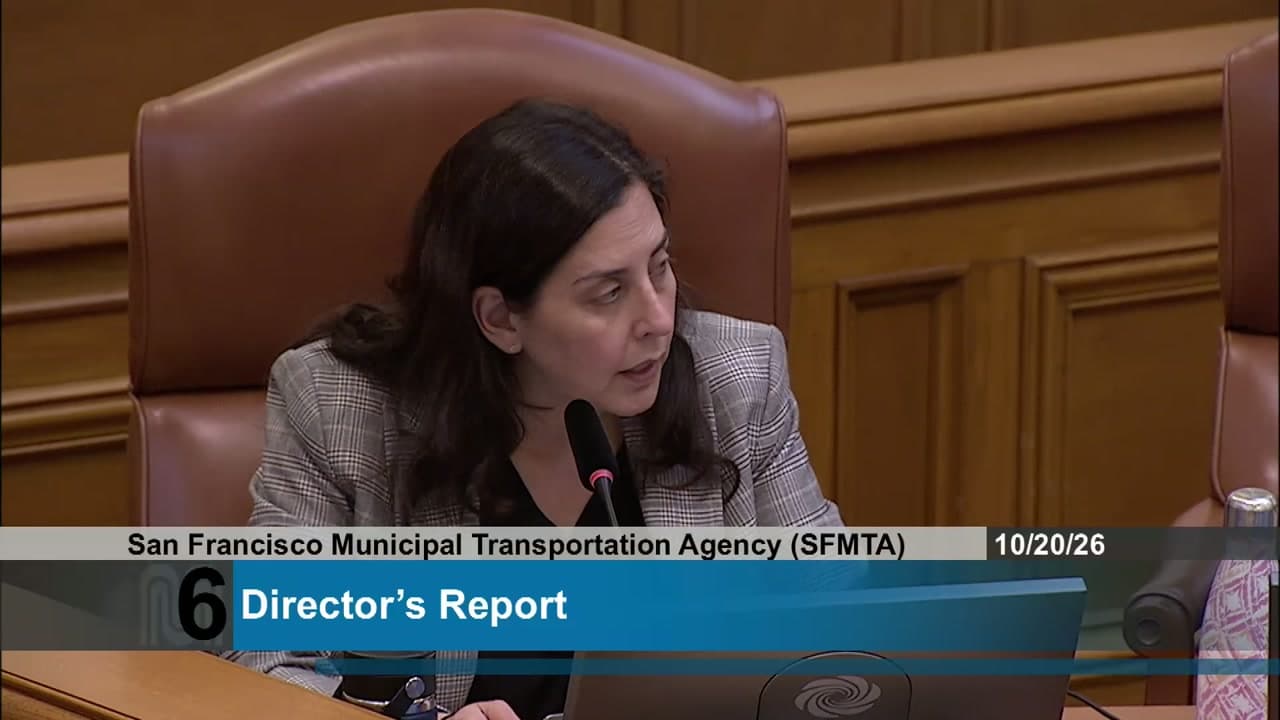
Vice Chair Stephanie Cajina asked the key question: "How do these agreements relate to any potential impacts of whether or not these pass?" Director of Transportation Julie Kirschbaum said uncertainty about the measures drove labor partners to support the agreements. She said that if the agreements are approved, "we would then use other tools to reduce costs, which would lead to similar service impacts. And that would include shrinking with attrition, overtime controls, and also likely deferring some capital investments."
Why it matters: The board committed to raises and no layoffs without knowing whether voters will approve new revenue. If budget cuts come, staff signaled they would fall on unfilled positions, overtime and capital projects rather than current workers.
The other side: Connected SF led the opposition, citing a $1.5 billion deficit, absenteeism and overtime. "We politely urge the board to either reject the labor contracts or at the very least direct them back to staff for revisions," said Griffin Lee, representative, Connected SF. Public commenter Alan Frame questioned promising no layoffs before the ballot results are known. Earlier, Richard Brandy, vice president of the Greater West Portal Neighborhood Association, who said he was speaking for himself, argued that an agency with a $1.5 billion budget and 7,000 employees is overstaffed.
Union members urged approval, though without much enthusiasm. "We would have liked to have gotten the same percentage raise that the firefighters and the police got, but considering the $300 million deficit, we're fortunate that no one was laid off," said Joel Camisher, union representative on the crossing guards' bargaining team. Erica Wright, member at large, Local 200, said two years of layoff protection feels short but added: "On behalf of our union, we want to say we were appreciative that this offer was even made to us. We hope that you guys pass it."
Several speakers backed workers but pushed the board to look for new revenue. Ellen Murray, a retired Muni driver, urged the board to re-examine the transit impact development fee and said downtown corporations don't pay their fair share. Heather Alicia DeBest of San Francisco People's Transit urged taxing wealthy tech companies. David Lyons, a retired AC Transit driver, blamed federal spending priorities. Michael Lyon of the San Francisco Transit Alliance said raises mean little without schedule changes that give drivers breaks.
Decisions and stakeholder impacts: The motion passed (For: 4, Felder, Hinze, Cajina, Tarlov; Against: 0; Absent: 2, Heminger, Henderson). Workers in the three units gain predictable pay and job security. Riders and capital programs absorb the risk if revenue falls short. Fiscal watchdogs like Connected SF lost this round.
What's next: Kirschbaum disclosed a parallel deal with TWU Local 250A, which represents transit operators. "The negotiated amendment is for a 4-year extension through June of 2031," she said. It includes 12% raises and layoff protection through June 30, 2029. "You will have the opportunity to vote on that on, I believe, November 17th," said Susan Cleveland Knowles, Deputy City Attorney.
Speed Cameras Deliver Results and Draw Scrutiny
Eighteen months after launching cameras at 33 locations, SFMTA says they are working. "The share of drivers speeding 10 miles an hour or more above the speed limit is down more than 80% across camera locations compared to before the cameras were installed," Kirschbaum said.
Where things stand: Kirschbaum said most drivers who receive a citation do not receive another, and that preliminary research from UC Berkeley's SafeTREC aligns with the agency's findings. Staff also highlighted a Geneva camera location with a 90% slowdown.
Why it matters: The cameras are a flagship safety program. Critics, however, framed them as part of a broader surveillance problem, and those concerns went unaddressed from the dais.
The other side: Supporters still had questions. Lee of Connected SF backed the cameras but asked: "What is the cost to operate, and what is the revenue we've seen, or the agency has seen, since the implementation of the cameras?" No answer was given at the meeting. Public commenter Herbert Weiner flagged an enforcement gap: "They can detect license plates of vehicles, but they can't detect bicycles that commit violations."
During general public comment, opponents focused on automated license plate readers. "I am very concerned about these cameras and the dystopian surveillance that they're subjecting us to," said Wind Kaufman, a retired City College instructor. Public commenter Guido Reichstatter called the readers mass surveillance. Jacob, a member of DSA, PSL and the Sunrise Movement, alleged misuse and ties to billionaire funding. Jeanette, a longtime rider, opposed mass data collection. Connected SF, by contrast, supported the readers.
Decisions and stakeholder impacts: No action was taken, and board members made no recorded comment. Safety advocates have strong numbers to point to. Privacy advocates have no answers yet on data use or cost.
What's next: Watch whether staff return with the operating cost and revenue figures speakers requested.
Riders Challenge Fare Inspector Removals
A smaller group of speakers targeted the practice of ordering riders off vehicles. DeBest of San Francisco People's Transit said a court ruled in her favor after an inspector misread her pass. She said staff told her inspectors may ask riders to leave only for safety reasons, and argued the policy is applied inconsistently, affecting elders and disabled riders.
Lyon of the San Francisco Transit Alliance argued that removing riders makes situations more dangerous and called the safety rationale a pretext. Jeanette alleged that SFMTA employees harass riders, and Kaufman urged free Muni.
Why it matters: The speakers describe uneven enforcement that could erode rider trust. No staff or board response was given.
Minor Items
- Ridership: August weekday trips averaged 525,000, or 81% of pre-pandemic levels, with weekends at 99% and rail up 13% year over year.
- Bus electrification: Alex Landsberg of the San Francisco Electrical Construction Industry urged a full alternatives analysis, estimating diesel hybrids add $110M–$150M in fuel costs over the life of 93 coaches.
- Consent calendar: Routine parking and traffic changes (items 10.1A–C) passed 4-0 without public comment.
- Closed session: The board met with counsel for nearly three hours, reported a settlement vote without clearly identifying the items, then voted 4-0 not to disclose the discussion.
- Recusal question: Weiner asked whether directors who belong to the Bicycle Coalition should recuse themselves and requested a legal opinion.
Looking ahead: The TWU Local 250A operators' contract is expected back before the board Nov. 17, as voters decide two November ballot measures that will shape how much of Kirschbaum's cost-cutting plan becomes reality.