
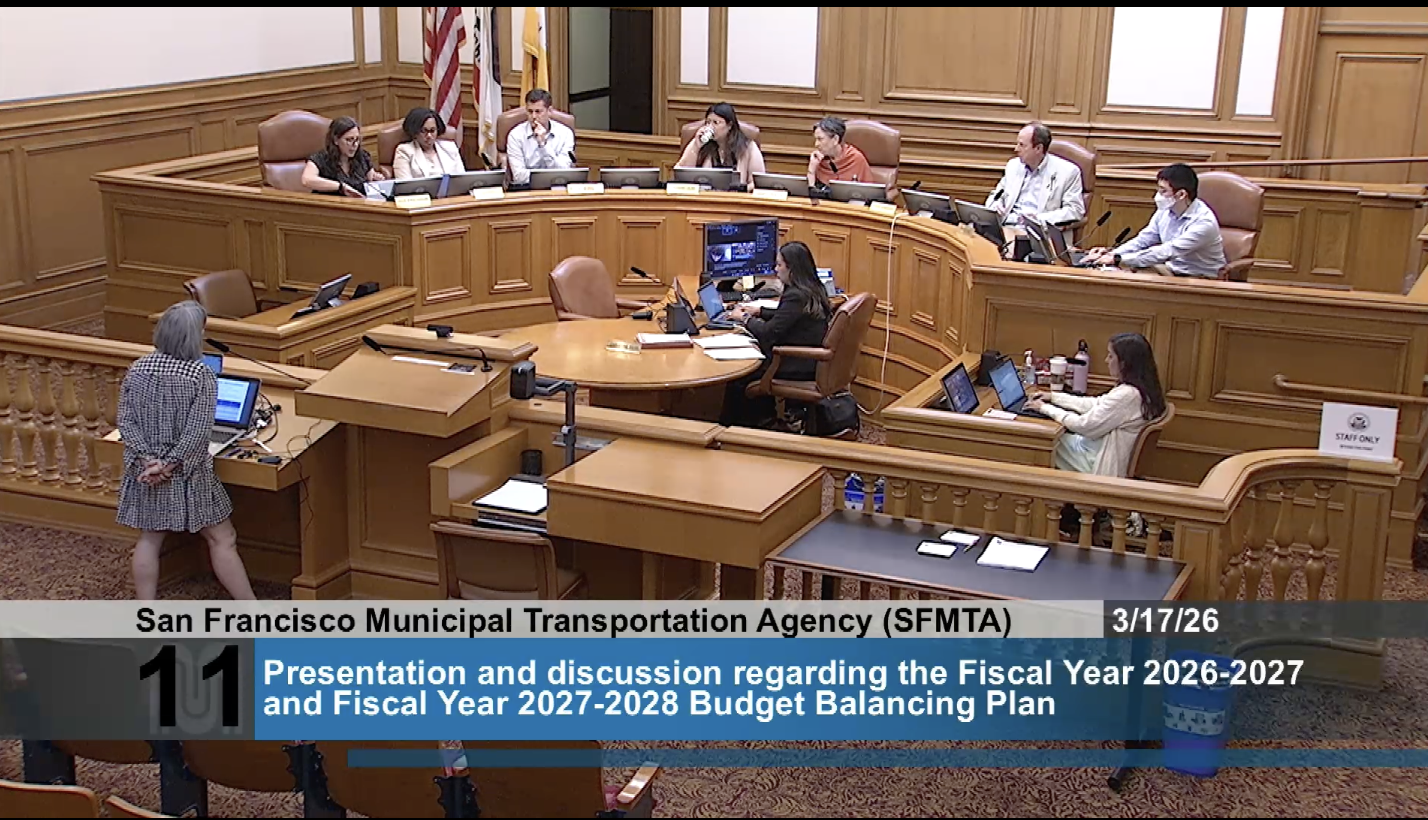
Municipal Transportation Agency Board of Directors - Mar 17, 2026 - Meeting

Municipal Transportation Agency Board of Directors - Mar 17, 2026 - Meeting

Municipal Transportation Agency Board of DirectorsSan FranciscoMarch 17, 2026

Sources:

Locunity is a independent informational service and is not an official government page for this commission.We use AI-assisted analysis and human editorial review to publish information.

Board Wrestles With Cable Car Fares as $1.56B Budget Takes Shape

The SFMTA Board of Directors spent the bulk of its March 17 meeting hashing out the financial architecture of a two-year budget that must close a $307 million deficit — and discovered that the humble cable car fare may be the thorniest policy call of the cycle. Separately, the agency celebrated completing safety upgrades at all 925 high-injury intersections citywide, even as recent pedestrian deaths cast a long shadow over the progress.


  • Board coalesces around an $18 cable car "plus" pass with two free youth riders, but defers final decision to April 7

  • $1.56B budget closes $307M gap with new taxes, a $200M state loan, and $74M in reserves — all hinging on two unproven November ballot measures

  • All 925 high-injury intersections upgraded, but citywide injury trends remain flat and recent fatalities drive calls for speed camera expansion

  • Equity transit routes match or beat system averages on reliability and crowding, though Bayview residents still face 60-plus-minute trips to much of the city

  • Bay Wheels bike share hits 3.9 million trips, up 30% year-over-year, with contract extended to 2032


Screenshot 2026 03 19 at 8.54.59 PM

The $18 Cable Car Question

The cable car fare consumed roughly 90 minutes of board time — more than any other single topic — and exposed a fault line between directors who want bold simplification and those wary of sticker shock.

The basics: Cable cars currently cost $9 per ride and roughly $20 per ride to operate, meaning the agency loses money on every passenger. Staff presented five fare options ranging from a $15 cable car "plus" pass to an $18 cable car "plus" with two free youth riders. The recommended option pairs a $12 single ride with the $18 cable car plus — an all-day pass that includes unlimited Muni access and two free youth fares — projecting $1.1 million in new revenue in year one and $2.2 million in year two.

Where things stand: Board Member Alfonso Felder emerged as the most forceful advocate for scrapping the single ride entirely and going straight to $18.

"If we maintain the two free youth per $18 fare, I think you can look at a family of four with two children, and they will then end up paying at $36, the same rate per person as the current cable car fare," he said, arguing the value proposition sells itself. He added that higher cable car revenue would reduce the agency's reliance on its fund balance: "If we can increase revenue by a few million dollars, which I think we can do through a revised approach on the cable car fare, then our reliance on that fund balance goes down."

The other side: Board Member Steve Heminger pushed back, cautioning that perception matters as much as math. "People don't look at numbers just as numbers. And in this case, it would be doubling from 9 to 18. And I think that may strike some people as a little bit of gouging," he said, floating a three-year phase-in of $12 to $15 to $18.

Chair Janet Tarlov expressed enthusiasm for the cable car plus concept's marketability and proposed keeping the $12 single ride in year one but sunsetting it in year two. Board Member Fiona Hinze was open to increases but wanted ridership data before committing. Vice Chair Stephanie Cajina supported staff's recommendation while signaling openness to the $18-only approach. A hospitality stakeholder focus group including SF Travel, the Chamber of Commerce, and the Union Square Alliance appreciated simplification but shared Heminger's concern about the magnitude of the jump. CFO Breema Horder noted that if ridership drops 10%, staff would return to the board for reconsideration.

What's next: The board directed staff to consult the city attorney on phased pricing authority, develop rider-type scenario analysis, and gather additional hospitality stakeholder feedback before returning April 7 with a refined recommendation. The formal budget vote is set for April 21.


Closing a $307M Gap: Taxes, Loans, and a High-Wire Reserve Strategy

Why it matters: The two-year budget plan rests on revenue sources that don't yet exist — a regional sales tax and a local parcel tax, both headed to the November ballot — making the agency's one-time bridging strategy a defining fiscal gamble.

Where things stand: CFO Breema Horder laid out the challenge plainly: "We started this cycle with quite a daunting task. It was a $307 million deficit in 2627 that grows over time to 434 because expenditures grow faster than revenue." Expenditures rise at roughly 4% annually (driven by cost-of-living adjustments and inflation) while revenue grows at only 2%.

The deficit is closed through three pillars: new revenue (the regional sales tax, local parcel tax, and a $200 million state loan on a 12-year term with two years of interest-only payments); efficiency savings and improved forecasts ($35 million in additional transit and parking revenue, $30 million from better general fund projections); and one-time bridging ($74 million in agency reserve in year one, $32 million in fund balance in year two). Horder explained the sequencing logic: "The choice to do agency reserve before fund balance is really driven by the fact that the fund balance is our most flexible source of funds. And with so much uncertainty in the world, it seems wise to hold that back and use it last."

But the gains were partially offset by forces beyond the agency's control — a $25 million annual decline in state transit assistance (STA) funds and $40 million to $60 million in additional citywide healthcare and retirement costs loaded by the controller. Board Member Heminger didn't hide his frustration: "We work like dogs to come up with some efficiencies and revenue and another city department comes up with an estimate, which I have no reason to doubt, but which takes all the effort out of what we've done."

Revenue policy highlights: The plan eliminates the Clipper discount, indexes fares in year two, introduces daily fare capping (after two taps, rides are free the rest of the day), implements demand-based parking meter pricing with a 25-cent floor increase in year two, and reduces select parking fines to restore gradation. A $20 million pot of capital funds was set aside in a reserve account with identified projects but not allocated, pending the November election results.

The other side: Chris Arvin, Citizens Advisory Council vice chair, presented the CAC's unanimous recommendations: continue efficiency gains, reduce reliance on the state loan, maintain state-of-good-repair maintenance, charge for metered parking on Sundays, and reject bus and rail fare increases. "Adding a third and fourth fare increase as potentially proposed in the budget, which would make the local bus fare here the highest in the nation, is not something that we support," he said. Dylan Fabris of San Francisco Transit Riders praised daily fare capping and parking meter adjustments but echoed the opposition to fare hikes. During general public comment on the budget, Richard Johnson of HV Safe urged the agency to pursue road usage fees on rideshare and delivery companies.

What's next: Staff returns April 7 with the refined cable car recommendation. The board votes on the full budget April 21, with submission to the mayor by May 1.


Screenshot 2026 03 19 at 8.55.27 PM

All 925 Intersections Upgraded — but Fatalities Linger

Why it matters: Completing safety treatments at every intersection on the High Injury Network is a milestone years in the making, yet a string of recent pedestrian deaths — including a toddler in Mission Bay — underscores that infrastructure alone has not bent the citywide injury curve.

Where things stand: Streets Director Victoria Wise opened with acknowledgment of recent fatalities before turning to the data. "We committed to improving safety for people at all 925 intersections on the high injury network with this toolkit. And I'm happy to tell you that we have completed that work," she reported. The agency's Safe Streets Evaluation Report found a 49% reduction in close calls, 32% reduction in pedestrian collisions, and 15% reduction in bicycle collisions at evaluated project sites — with no substantial increase in vehicle travel time. Geneva Avenue saw its lowest injury collisions since 2014; Fulton Street saw a 53% reduction. But citywide injury trends remain essentially flat.

Board Member Heminger zeroed in on enforcement technology. "I think we found a silver bullet and our old pal Jeff Tumlin was a real crusader for it, and that is the speed cameras," he said, asking for more board visibility on fatality data. Wise committed to emailing the board whenever a fatality occurs and sharing monthly Department of Public Health fatality reports.

Advocacy groups pressed for more urgency. Jodi Medeiros, executive director of Walk San Francisco, cited a report that "San Francisco leads the nation in one grim traffic statistic — the share of fatal crashes that kill pedestrians" and demanded outcome-based metrics and ambitious targets. Rachel Clyde of the San Francisco Bicycle Coalition urged implementation of the Biking and Rolling Plan and argued the agency undercounts bike trips.

During general public comment, a Mission Bay parent with young children thanked the agency for quick-build safety improvements near the site of the recent toddler fatality and asked for continued support as Mission Bay Elementary prepares to open.

Vice Chair Cajina requested the board receive quarterly automated speed enforcement data and DPH fatality reports through the secretary, and asked staff to include goal denominators on future infrastructure slides.

Bike-share boom: Wise also reported Bay Wheels set a single-day record of 16,000 trips and hit 3.9 million trips in 2025. "That's 30% more than the year prior," she said. The contract with Lyft/MTC has been extended to 2032.

What's next: A new High Injury Network map is expected soon and will reset the agency's safety project pipeline. Staff plans eight quick-build projects over the next 18 months, plus an EV curbside charging code amendment, new parking payment apps (Park Mobile and Hotspot replacing PayByPhone), and Muni Forward outreach on the Fillmore, N-Judah, and California corridors.


Equity Routes Performing Well, but Bayview Access Gaps Persist

Service Planning Manager Jessica Garcia presented the 10th-anniversary update of the Muni Equity Strategy, rooted in the board's 2014 Muni Equity Policy. The strategy targets nine neighborhoods with high concentrations of affordable housing, people of color, low-income households, and limited private vehicle access.

Why it matters: These equity principles will govern where new service hours go if the November parcel tax passes — making the performance data a preview of future investment priorities.

Data analysis showed equity routes performing at parity or better than non-equity routes on service delivery, crowding, and headway adherence. But travel-time analysis revealed that Bayview residents face 60-plus-minute trips to reach large portions of the city via Muni alone. Vice Chair Cajina pressed on the finding, asking staff about tools — including community shuttles — to improve Bayview access.

Staff implemented cost-neutral improvements on 11 equity routes, including additional PM peak trips on the 29 Sunset, route changes on the 48 Quintara, and a new stop on the 15 Hunters Point Express at Union Square. Capital improvements benefited 17 equity routes. A reconvened Muni Equity Working Group that includes SF Transit Riders is developing a system-wide service evaluation framework combining performance and demographic data. Dylan Fabris of SF Transit Riders, a working group member, praised the effort but noted more resources are the real path to transit equity.

What's next: The full equity report comes to the board for approval April 7.


Minor Items

  • Minutes approved for the Feb. 3 and March 3 meetings (For: 4, Against: 0, Absent: 3 — Heminger, Cajina, and Henderson).

  • Consent calendar approved unanimously (For: 5, Against: 0, Absent: 2 — Cajina and Henderson), including eight transit boarding bulbs on the 8 Bayshore line in Visitacion Valley, routine parking and traffic modifications, claim warrants, and a CalPERS agreement.

  • Director of Transportation Julie Kirschbaum announced San Francisco was the only North American city recognized by the Breathe Cities coalition for reducing fine particulate pollution and nitrogen dioxide by nearly 25% since 2010. "San Francisco was the only North American city to have achieved this reduction in air pollution," she said, crediting the century-old electric fleet and the city's Climate Action Plan. During public comment, Richard Johnson of HV Safe challenged the claim, noting his Hayes Valley neighborhood is designated an environmental hotspot, with no SFMTA-specific air quality studies conducted.

  • Kirschbaum marked Transit Employee Appreciation Day (March 18) and highlighted Women's History Month programming, including the agency's Taken With Transportation podcast.

  • Bob Feinbaum, president of Save Muni, urged the agency to explore public-private partnership revenue streams using its property assets and suggested a dedicated budget line item.

  • Richard Johnson of HV Safe detailed 66 weeks of documenting compliance issues with the Hayes Valley weekend street closure permit and reported the permit holder has initiated legal action against community monitors.

  • The agency was not selected as a finalist for the Bloomberg pilot grant, Director Kirschbaum confirmed in response to a question from Vice Chair Cajina.

  • 311 requests to the Streets Division hit a new high of 2,311-plus in 2025.

  • Super Bowl prep included repainting 120-plus downtown crosswalks using 56,000 pounds of thermoplastic paint.

Board Wrestles With Cable Car Fares as $1.56B Budget Takes Shape | Municipal Transportation Agency Board of Directors | Locunity