Municipal Transportation Agency Board of Directors - Apr 21, 2026 - Meeting
Municipal Transportation Agency Board of Directors • San FranciscoApril 21, 2026
Locunity is a independent informational service and is not an official government page for this commission.We use AI-assisted analysis and human editorial review to publish information.
Board Approves $4.3B Budget That Hinges on Two November Ballot Measures
The SFMTA Board of Directors unanimously approved a two-year operating and capital budget balanced only by assuming San Francisco voters will pass both a regional sales tax and a local parcel tax in November — a high-stakes bet that, if it fails, could mean cutting 20 Muni routes and ending regular service at 9 p.m. In a marathon session, the board also extended contracts for the popular Bayview Community Shuttle, heard pleas from taxi medallion holders facing foreclosure, and confronted a hiring slowdown that has dropped new hires to a third of 2023 levels.
$4.3 billion two-year SFMTA budget approved 7-0, balanced only if voters approve two new taxes in November; without them, up to 20 Muni routes could be cut and service could end at 9 p.m.
Bayview Shuttle contracts extended through January 2028 with CARB grant funds after community groups warn against letting the 69,000-trip service lapse
Taxi medallion holders plead for transparency as the board enters closed session on a settlement with SF Federal Credit Union; 300 drivers have lost medallions to foreclosure
Hiring at one-third of 2023 levels, with transit fare inspectors, stationary engineers and parking meter repair units exceeding 20% vacancy rates
New Climate Action Plan targets 25% reduction in vehicle miles traveled by 2030
A Budget Built on a Promise Voters Haven't Made Yet
The basics: The SFMTA's consolidated FY2627 and FY2728 budget — roughly $1.5 billion and $1.6 billion in operating costs, plus a $2.5 billion five-year capital improvement program — passed 7-0 after nearly 10 budget workshops stretching back to November. The agency entered the process facing a $307 million deficit in year one and $344 million in year two.
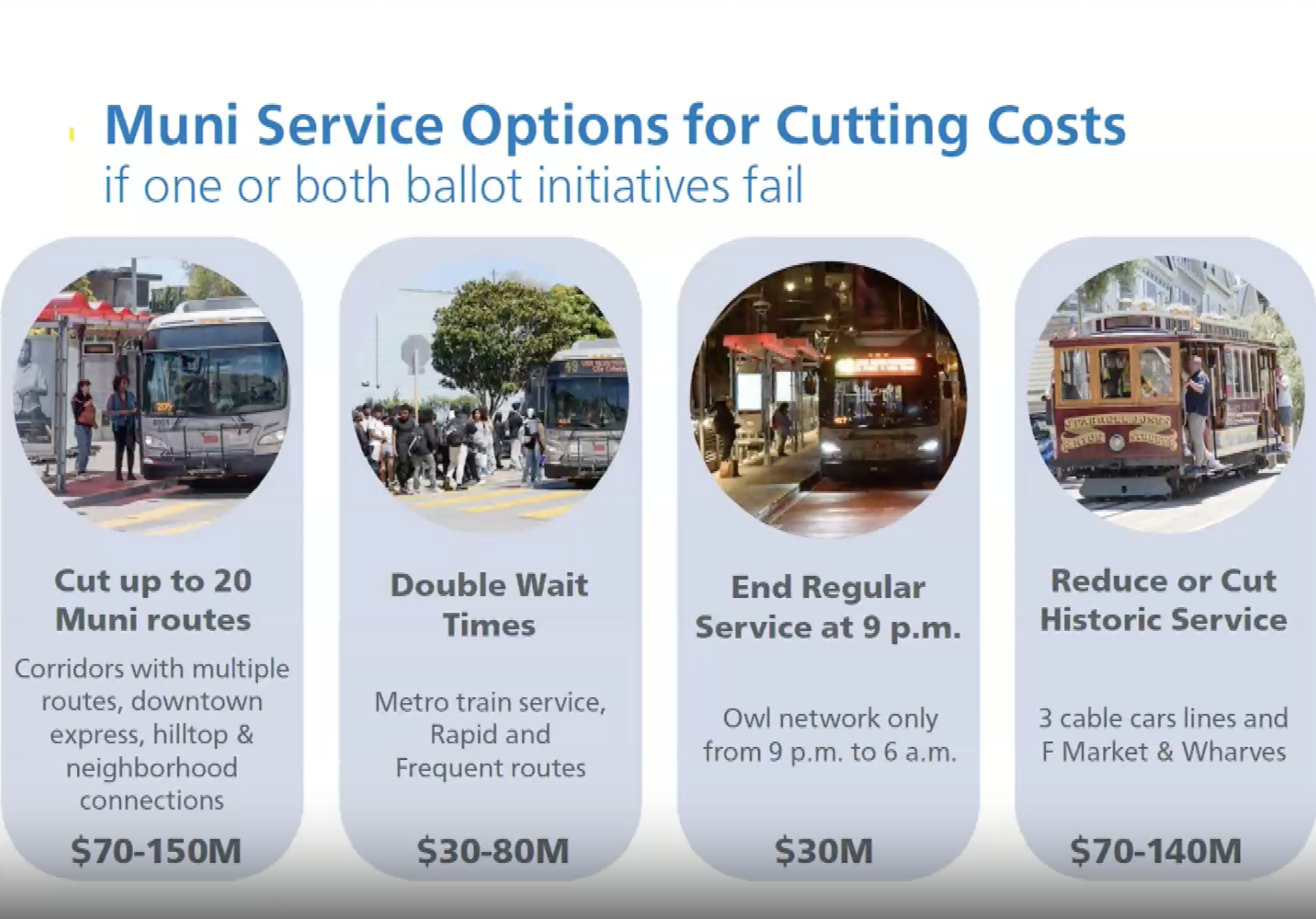
Why it matters: The entire spending plan rests on what staff call a "three-legged stool": a regional half-cent or full-cent sales tax, a local parcel tax, and internal efficiencies. If either ballot measure fails, the consequences for riders are severe — the agency could cut up to 20 Muni routes, double average wait times to 14–20 minutes, end regular service at 9 p.m., and potentially eliminate cable car and F-Market historic streetcar service.
Where things stand: Positive revenue developments since the March draft dramatically improved the picture. Chief Financial Breema Horder told the board the agency now needs just $17 million in one-time funding in year one and zero in year two — down from $106 million previously projected.
"There are no changes to either Muni or paratransit services in terms of service quality," she said.
Revenue policy choices totaling $45 million over two years include simplifying cable car fares to a $12 single ride with a new $18 Cable Car Plus Pass, eliminating the Clipper discount, implementing fare capping, raising parking meter rates by 25 cents, and increasing late penalties by 10%. A state loan bridges year one, requiring roughly $30 million per year in repayment over 10 years after two interest-only years. On the expenditure side, 89 additional vacant positions were deleted — on top of 529 cut last cycle — and $20 million in materials and supplies savings were identified.
Director Steve Heminger pressed on the structural imbalance lurking beneath the surface: expenditures grow 4% in year one and 7% in year two, while revenues grow roughly 3%. He called efficiencies the hardest commitment to sustain.
The other side: Public commenters staked out sharply different positions. Dylan Fabris of San Francisco Transit Riders praised service preservation and fare capping but urged the board to keep the base fare at $3 rather than $3.10 and to let all children ride cable cars free. Rachel Clyde of the San Francisco Bicycle Coalition supported capital preservation for street safety projects. Griffin Lee of ConnectSF acknowledged the improved one-time cost picture but challenged the board to pursue deeper non-service cuts, arguing the agency's per-hour operating cost is the second highest nationally.
On the skeptical side, Carol Yenny, a 35-year Noe Valley business owner, argued SFMTA should recognize a permanent post-COVID ridership loss and stop prioritizing transit-first projects over small businesses. Deborah Murphy, president of the Coalition for San Francisco Neighborhoods, warned the agency should not assume the ballot measures will pass, demanding at minimum the 5–7% internal cuts previously promised.
Director Dominica Henderson raised concerns about the equity implications of the enforcement-side revenue increases, asking that parking fine enforcement "not feel like it's the agency's goal to increase revenue using that lever" in certain communities. Director of Transportation Julie Kirschbaum called this the most challenging financial crisis in her time at the agency.
"We could need to cut up to 20 Muni routes, which would mean essentially going back to the level of service that we saw during COVID," she warned.
Multiple board members characterized the approved budget as "conditionally balanced" — a frank acknowledgment that November's voters hold the real power over San Francisco's transit future.
Decisions: Approved 7-0 (For: Chen, Heminger, Henderson, Felder, Hinze, Cajina, Tarlov; Against: none; Absent: none).
What's next: The two ballot measures head to voters in November. If either fails, staff will return with service-reduction scenarios. The state loan repayment schedule begins after two interest-only years.
Bayview Shuttle Wins Extension, but What Happens After the Grant Runs Out?
Why it matters: The Bayview Community Shuttle — an on-demand microtransit service launched in November 2024 to fill a critical transit gap in a neighborhood isolated by Highway 101, steep terrain, and decades of disinvestment — has completed more than 69,000 trips with a 4.9 out of 5.0 rider rating and 141% quarterly ridership growth. But the $10.5 million CARB STEP grant funding it expires in November 2027, and no long-term funding source has been identified.
Where things stand: The board unanimously approved two contract amendments extending community partnerships through January 2028: an additional $249,300 for the Community Youth Center of San Francisco (total $663,300) to run the Transportation Resource Center, and $224,670 for the San Francisco African American Arts and Cultural District (total $360,070) for outreach, community governance, and a new youth-led tour program. Both are 100% grant-funded. The Via operator contract amendment will come before the board later this summer.
Project Manager Javaun Garcia reported the shuttle has hired 21 local workers, 11 of them Bayview residents. The 24th Street BART station is the top destination. The current cost per trip averages $23.69 following a June 2025 service expansion, compared to a $15–20 national benchmark for optimized on-demand services.
Director Dominica Henderson called the shuttle "one of the highlights" since she joined the board and the premier example of SFMTA listening to community needs. Directors Mike Chen, Fiona Hinze, and Vice Chair Stephanie Cajina all pressed on what happens after 2027. Director of Transportation Julie Kirschbaum was candid:
"We do at the current cost provider, see this as needing to be a grant funded service."
Community organizations turned out in force. April Spears-Mays, executive director of the SF African American Arts and Cultural District (AAACD), testified that the shuttle connects long-term residents to corridor businesses and provides safe transportation for seniors avoiding traditional transit. Dylan Fabris of San Francisco Transit Riders urged the board to begin planning now for post-2028 sustainability, warning that allowing the program to lapse "would turn a major win into another disappointment" Sharif, a Bayview resident and SF Bicycle Coalition coordinator, noted the shuttle will be especially critical during upcoming Islais Creek Bridge construction disruptions.
Decisions: Approved 7-0 (For: Chen, Heminger, Henderson, Felder, Hinze, Cajina, Tarlov; Against: none; Absent: none).
What's next: The Via operator contract amendment comes to the board this summer. The grant expires in November 2027, giving the agency roughly 18 months to find a sustainable funding path.
Taxi Drivers Plead for a Seat at the Table as Board Enters Closed Session
Why it matters: Approximately 700 San Francisco cab drivers purchased taxi medallions — most at $250,000. Roughly 300 have lost them to foreclosure, and another 300 carry an average loan balance near $140,000 with no medallion sales in a decade.
Where things stand: Mark Gruberg of the San Francisco Taxi Workers Alliance and Green Cab urged the board to delay entering closed session on what he described as a pending settlement between SFMTA and the San Francisco Federal Credit Union over taxi medallions.
"Some 700 San Francisco cab drivers bought taxi medallions, most of them for $250,000. 300 of them have lost their medallions to foreclosure," he told the board.
Gruberg argued that the drivers with the most at stake have no seat at the negotiations. The alliance's attorney, Dan Wheeler, submitted a public records request.
Decisions: The board voted 7-0 to enter closed session, provided direction to staff, and subsequently voted 7-0 not to disclose the substance of the discussion.
Hiring Freeze Strains Key Positions
Why it matters: As the SFMTA confronts its most difficult budget cycle in years, a strategic hiring slowdown has cut new hires to roughly a third of 2023 levels — raising questions about whether critical frontline and revenue-generating roles can be adequately staffed.
Where things stand: Chief People Officer Kimberly Ackerman presented the annual AB 2561 vacancy report required before budget adoption.
"In 2023, we hired 1,143 employees. So far, year to date, we've hired 220 employees," she reported.
Three bargaining units exceed the 20% vacancy threshold: Local 250A transit fare inspectors (22% vacant, 17 of 76 positions), Local 39 stationary engineers, and Teamsters 856 parking meter repair workers (27% vacant). The agency maintains eligibility lists and pipeline programs, including pre-apprentice automotive mechanics and youth ambassadors.
Director Mike Chen asked about time-to-hire improvements. Vice Chair Stephanie Cajina suggested merging this report with racial equity action plan metrics in future presentations to give the board a fuller picture of workforce equity.
Minor Items
Minutes approved: April 7, 2026, regular meeting minutes passed 7-0.
Consent calendar approved 7-0: Includes parking and traffic modifications across multiple commercial corridors and Transportation Code amendments transferring transit-only lane parking violations to state Vehicle Code for stronger enforcement. Chair Janet Tarlov highlighted the merchant walkthrough program, which Director of Streets Victoria Wise said has expanded to roughly 10 corridors — including Castro, Noe Valley, Bayview, and Union Street — adjusting loading zones and metered parking to match post-COVID business needs. Mid Polk and Upper Fillmore are next.
Climate Action Plan: Director Kirschbaum used Earth Day week to highlight the city's new Climate Action Plan, which targets a 25% reduction in vehicle miles traveled by 2030 and 100% zero-emission vehicles by 2040. Muni generates just 0.01% of climate emissions with the greenest fleet in North America.
19th Avenue repaving: SFMTA and Caltrans compressed a repaving project between Lincoln and Holloway from 40 days to 10, spread across three long weekends beginning April 24. Muni routes will be rerouted and parking control officers will direct traffic.
Chestnut Street parking concerns: Patricia Vaughn, a Marina and Chestnut Street merchant advocate, used public comment to request a collaborative meeting with agency leadership about the loss of 178 parking spaces on Lombard and Chestnut, proposing a prototype approach for red zone compromises.