
Municipal Transportation Agency Board of Directors - Jul 21, 2026 - Meeting
Municipal Transportation Agency Board of Directors • San FranciscoJuly 21, 2026
Locunity is a independent informational service and is not an official government page for this commission.We use AI-assisted analysis and human editorial review to publish information.
SFMTA Board Confronts July 4th Transit Meltdown, Greenlights Chinatown Improvements
The SFMTA Board of Directors spent much of its July 21 meeting reckoning with the agency's worst transit failure in recent memory — a July 4th gridlock that stranded tens of thousands of riders as stalled autonomous vehicles and a flood of private cars overwhelmed city streets. The board also unanimously approved a closely watched Chinatown project that restores 23 parking spaces for merchants while giving the high-ridership 1 California bus a full-time transit lane.
- July 4th transit crisis prompts public apology as Muni reports 41,000 more riders than the prior year but 90-minute delays caused by traffic, stalled Waymos, and cars in transit lanes
- Mayor Lurie's letter to state regulators on autonomous vehicles gets board attention; advocates demand geofencing and accountability
- Chinatown wins 23 new parking spaces and full-time transit lane for the 1 California, which serves 20,000 daily riders and averages as slow as 3 mph
- School zone speed limits approved under AB 382, closing a decade-old safety gap on multi-lane streets
- Turk Street parking ban upgraded to no-stopping zone at SFPD's request to combat persistent criminal activity
- Board acknowledges Director Mike Chen's resignation and nomination to the Planning Commission, creating a vacancy
July 4th: 100,000 Revelers, Stalled Waymos, and a System in Crisis
The 250th anniversary fireworks on the Golden Gate Bridge drew an estimated 100,000 attendees on July 4th — and exposed deep vulnerabilities in San Francisco's transit system. What should have been a showcase for Muni turned into a debacle that dominated the board's discussion and drew sharp criticism from the public.
Why it matters: The agency publicly apologized for a service failure that left riders stranded for hours, and the fallout has now reached the state level, with Mayor Lurie writing to regulators about autonomous vehicle oversight.
Where things stand: Judson True, SFMTA Chief of Staff, reported that Muni carried 41,000 more riders than on the previous July 4th — a 13% increase — but the system was overwhelmed. Shuttles that were supposed to take minutes reportedly took 90 minutes. Private vehicles invaded transit-only lanes, a car crash blocked a key intersection, and autonomous vehicles — most of them Waymos — stalled in roadways and compounded the gridlock.
"We know the Muni system as a whole carried 41,000 more people than on the previous July 4th. That's about a 13% increase, which is well beyond even the 2 or 3% increase we've seen in weekend ridership since then," said True. He acknowledged that "the autonomous vehicles, and I believe to reports most were Waymos that were stopped in roads, did contribute to some of the challenges with the congestion, although the sheer volume of traffic was also a huge factor."
Board Chair Janet Tarlov pressed True on the mayor's recent letter to state regulators, asking for comment on "the mayor's letter a few days ago to state regulators regarding autonomous vehicles and how that impacts congestion and traffic." True confirmed the city is coordinating on collaborative oversight.
The other side: Public commenters were unsparing. Barry Toronto, a frequent commenter, urged immediate action including geofencing for autonomous vehicles, arguing AVs are not capable of navigating unusual conditions. Jaime Viloia of San Francisco Transit Riders argued the crisis proves the need for more transit-priority infrastructure and sustainable funding. Griffin Lee of Connected SF demanded accountability, asking how many staff were assigned, what the event cost the agency, and how much revenue was lost.
Pete Wilson, a Muni operator at the Presidio Division, urged the agency to consult frontline operators on event planning — a sentiment that echoed throughout the meeting's public comment periods.
What's next: SFMTA is conducting a lessons-learned analysis and has publicly committed to accountability. The mayor's letter to state regulators could accelerate discussions about geofencing authority and local oversight of autonomous vehicles.
Chinatown Balances Merchant Parking With Transit Priority
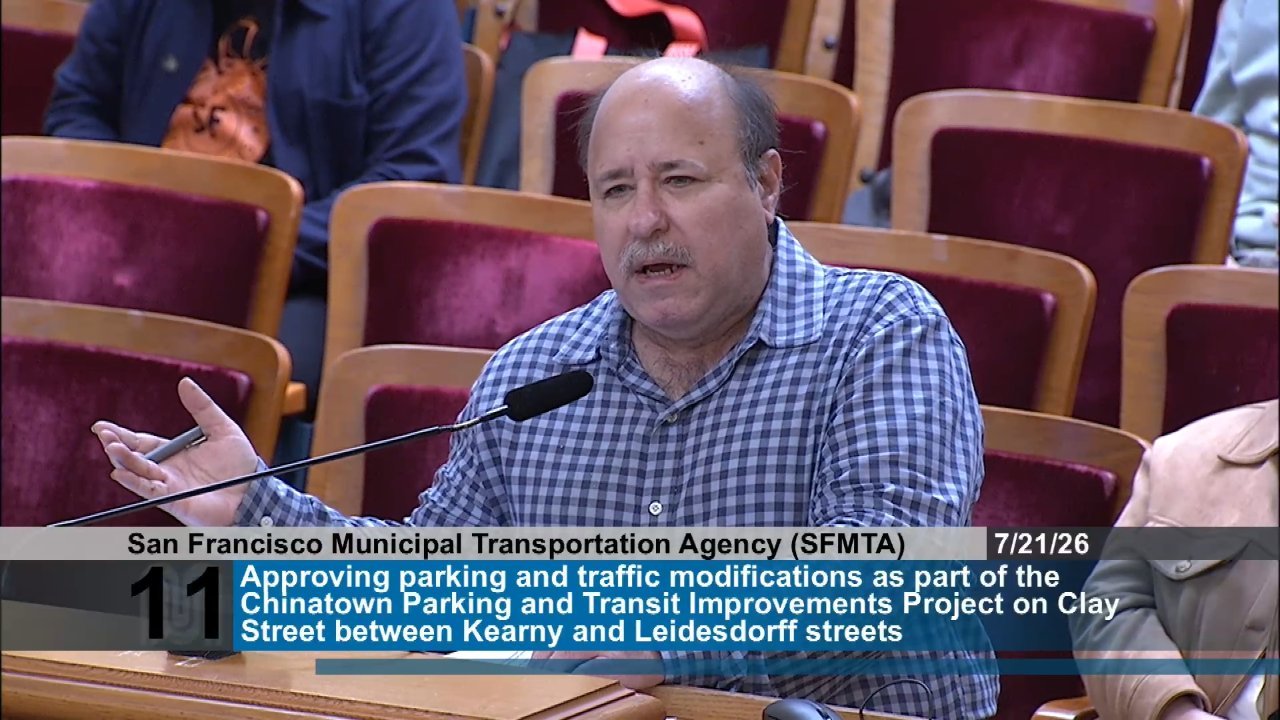
The board unanimously approved the Chinatown Parking and Transit Improvements project, a carefully negotiated package that adds 23 all-day parking and loading spaces on Clay and Sacramento Streets while converting a general traffic lane on Clay Street into a full-time transit lane for the 1 California bus.
The basics: The 1 California is one of Muni's busiest lines, connecting the Richmond District to Chinatown and downtown. The project responds to years of merchant requests for more curb access near Portsmouth Square.
Why it matters: Three major construction projects — the Portsmouth Square renovation, a Public Health Center, and the Chinatown Public Library — are set to begin disrupting the neighborhood in summer 2026. The parking and transit changes are designed to stabilize access for merchants and riders before that upheaval.
Where things stand: On Clay Street between Kearny and Leidesdorff, part-time tow-away restrictions are removed to restore 11 all-day parking and loading spaces, and the middle lane becomes a full-time transit lane. On Sacramento Street between Powell and Stockton, the PM tow-away restriction is eliminated, adding 12 all-day parking spaces without affecting the existing transit lane. Staff found excess roadway capacity in their traffic analysis.
"The 1 California serves 20,000 daily riders. It's a very important line that connects the Richmond District to Chinatown and downtown. It is one of Muni's busiest routes and some buses average as slow as 3 mph," said Jessica Kuo, Transportation Planner, Transit Priority Team.
Director Alfonso Felder called the project "a real win-win here where we're able to have a situation where we're delivering some good news to merchants in the community in terms of being responsive to their needs while also improving transit reliability by extending the hours of the lane."
Director Fiona Hinze, attending remotely, asked about enforcement of the new full-time transit lane, learning that camera enforcement on buses is technically possible but currently requires manual review — a potential bottleneck.
The other side: Public commenters from SF Transit Riders, Connected SF, and Barry Toronto all supported the project but pressed for post-implementation evaluation. Jaime Viloia of SF Transit Riders specifically requested data on transit speed improvements and merchant business impact. Pete Wilson, a Muni operator, complained that neither he nor his union representative were consulted about the project and flagged signal timing issues at Sacramento and Stockton that delay the 1 California.
Emma Wu, Community Liaison at SF Public Works, described bilingual community engagement including an upcoming town hall related to the construction projects.
Decisions: Approved 5-0 (For: Tarlov, Henderson, Hinze, Cajina, Felder; Absent: Heminger, Chen).
School Zone Speed Limits Close a Decade-Old Safety Gap
The board approved lower speed limits at schools on multi-lane streets, implementing AB 382 to address a gap that state law had previously prevented the city from closing.
Why it matters: Since 2011, San Francisco has maintained 15 mph school zones at over 200 schools, but state law prohibited lowering limits on streets with more than two lanes — precisely where wider lanes tend to encourage higher speeds.
Sam Greenberg, Advocacy Director at Walk San Francisco, spoke in support, citing the death of paraeducator Andrew Zieman outside Sherman Elementary as a direct consequence of the gap. He urged the board to act.
Decisions: Approved unanimously as part of the 10.2 package (5-0; Absent: Heminger, Chen).
Turk Street Gets No-Stopping Zone to Fight Crime
The board approved converting a no-parking zone to a no-stopping zone on the north side of Turk Street between Mason and Taylor, at SFPD's request, with plans to install physical delineators along the parking strip.
Why it matters: The change gives SFPD a new enforcement tool at a persistent trouble spot. But board members pressed hard on whether the agency had done enough outreach and whether police would actually follow through on enforcement.
Vice Chair Stephanie Cajina questioned the outreach approach and pushed for direct, proactive contact with the handful of businesses on the block. "Notices sometimes aren't enough to let folks know that these types of changes are coming. So I'm just curious to know if we wanted to be surgical about our outreach and engagement," she said.
Director Dominica Henderson raised a broader concern about using transportation infrastructure to solve social problems, asking whether SFPD would commit to increased enforcement. "I hope that we can also rely on them to do some of the enforcement and help us with that, especially given our limitations on staffing," she said.
Judson True committed to post-implementation business outreach: "We will absolutely, once we implement this, if it's approved today, we will go to each of those businesses and make sure that they have a way to give feedback, let us know how it's going."
Public commenters Barry Toronto and Pete Wilson raised practical concerns about deliveries and hotel pickups on the block, and questioned whether SFPD would enforce the new restriction given its track record.
Decisions: Approved 5-0 (Absent: Heminger, Chen).
Bayview Business Owners Expose Gap in Vehicle Towing Law
During general public comment, Salah Chandler and business partner Kenyatta Brian told the board their commercial truck has been repeatedly towed from in front of their warehouse on Ingalls Street in the Bayview. They said the large-vehicle parking restriction enacted Nov. 1 was aimed at RVs but its language does not distinguish between recreational and commercial vehicles — catching legitimate businesses in its net.
The speakers proposed a commercial vehicle permit program modeled on residential parking permits. They said Supervisor Shamann Walton directed them to bring the issue to the board. Judson True acknowledged staff awareness and said a colleague would follow up.
Hayes Valley Group Demands Shared Spaces Permit Revocation
Richard Johnson, co-founder of Hayes Valley Safe, told the board his organization has documented 84 consecutive weeks of operational non-compliance on the 400 block of Hayes Street shared spaces permit. He said the group has submitted weekly reports, public records requests, formal complaints, and a formal administrative complaint — and is demanding permit revocation. Johnson criticized what he characterized as political favoritism in the permitting process.
Minor Items
- Vision Zero Committee renamed to the Street Safety Committee as part of the consent calendar.
- $173.5 million funding request authorized: Board approved the Director of Transportation to request state and regional transit operating assistance from MTC for FY 2026-27, drawing from TDA, STA, AB 1107, and Regional Measures 2 and 3.
- San Jose substation contract modified, reducing the amount by $133,000.
- Shared spaces permits approved for street closures in the Financial District and near Columbus Avenue.
- Fire department parking established on Pixley Street.
- Service planning team recognized: Chief Maintenance Officer Charles Durane honored the six-member team led by Service Planning Manager Jessica Garcia for coordinating the Potrero Yard closure in roughly eight months while maintaining system capacity. Garcia noted the team's resilience through COVID service changes, service reductions, and the yard closure during a period of ridership growth.
- T3 Fix It Weekends: The first of two maintenance weekends on the T Third line was completed in the Bayview, with work including restriping, signal upgrades, lighting repairs, and deep cleaning. The second weekend was scheduled for July 25-26. Chair Tarlov highlighted concerns from Bayview merchant leaders about the condition of SFMTA facilities as a first impression for neighborhood visitors. Director Henderson asked staff to use the experience as a test case for the longer Islais Creek Bridge closure.
- Director Mike Chen resigned from the SFMTA Board after being nominated by the mayor to serve on the Planning Commission. Chen previously served on the Citizens Advisory Council. The board plans to recognize him at a future meeting, leaving the seven-member board with two vacancies (Chen resigned; Heminger absent).
- Closed session: The board voted to settle a legal matter and voted unanimously not to disclose details (5-0; Absent: Heminger, Chen).