
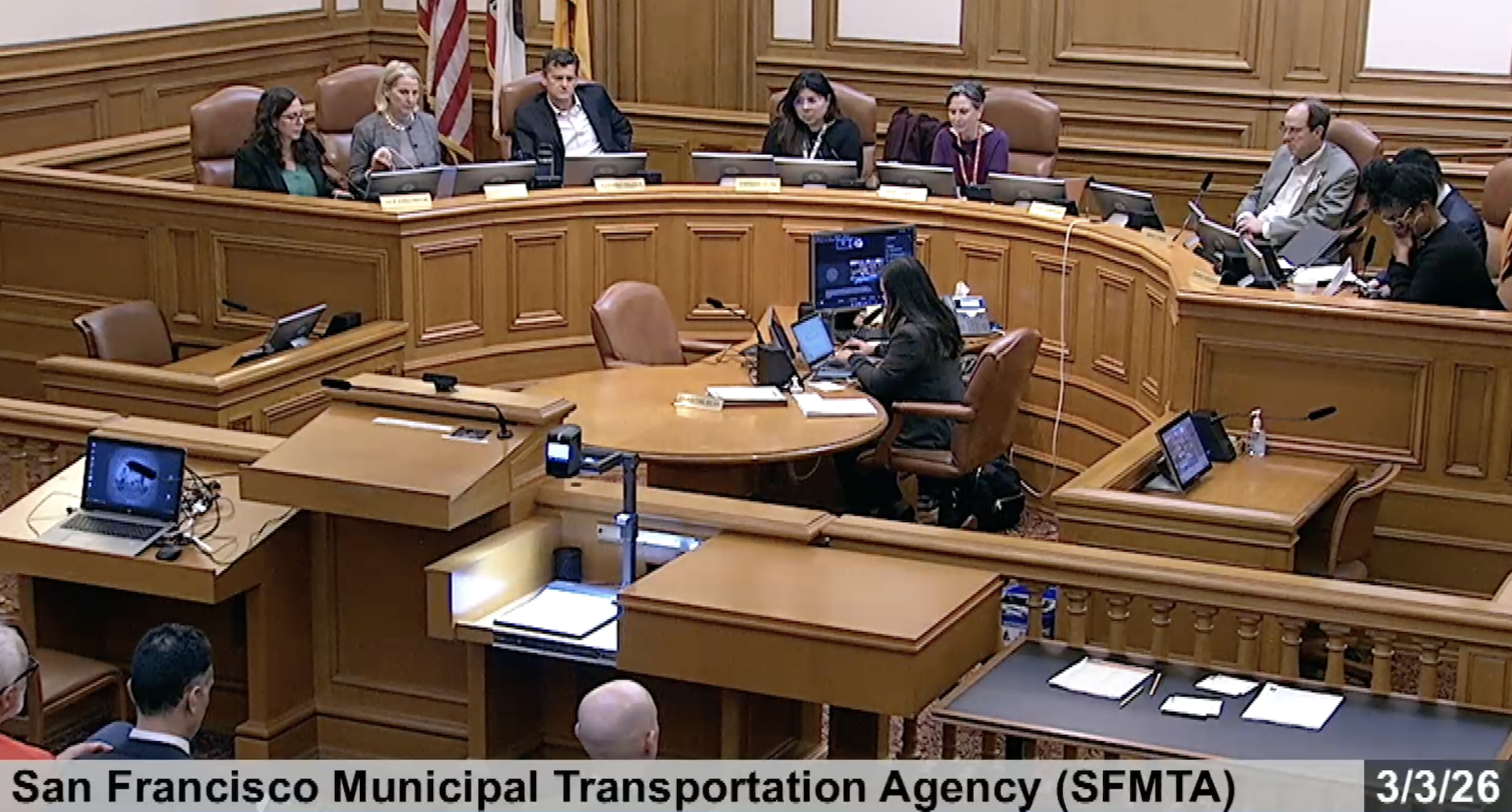
Municipal Transportation Agency Board of Directors - Mar 03, 2026 - Meeting
Municipal Transportation Agency Board of Directors • San FranciscoMarch 3, 2026
Locunity is a independent informational service and is not an official government page for this commission.We use AI-assisted analysis and human editorial review to publish information.
Board Greenlights $1.4B Potrero Yard Rebuild After Fierce Housing Fight
The San Francisco Municipal Transportation Agency (SFMTA) board's March 3 meeting was defined by a single, wrenching question: Can San Francisco modernize its crumbling bus infrastructure without breaking promises to communities that need affordable housing most? The board answered 6-1, advancing the agency's largest-ever capital project while acknowledging that 365 planned housing units on public land are gone — for now. Elsewhere, record Muni rider satisfaction, a new state transit loan, and a near-balanced budget offered rare good news for an agency staring down a $307 million deficit.
Board approves $612M Potrero Yard bus facility rebuild 6-1, cutting planned housing from 465 units to roughly 100 after $70M podium eliminated for cost overruns
Vice Chair Stephanie Cajina casts lone dissent, citing broken promises to Mission and Bayview communities and an 82% reduction in housing element commitments
Muni riders report highest satisfaction in 25 years — 78% rate service excellent or good, with double-digit gains in the Excelsior and Bayview neighborhoods
Governor signs $590M state transit loan for Bay Area agencies, buying SFMTA time to avoid service cuts next fiscal year
Treasure Island gets metered parking on every new street at $1/hour — 850 spaces for a planned 8,000-unit development
Agency nearly on budget at midyear, with transit fare revenue up $16M and parking up $7M; draft plan to close the $307M gap due March 17
Potrero Yard: A $1.4 Billion Deal and 365 Missing Homes
The Potrero Yard Modernization Project consumed more than two hours of testimony and board deliberation, exposing a fault line between the agency's urgent infrastructure needs and its commitments to affordable housing on public land.
The basics: The 110-year-old bus maintenance yard at Potrero, built in 1915, serves routes that carry roughly 100,000 daily boardings — about a quarter of all Muni ridership. The approved project agreement with PRG Potrero Properties LLC (a Plenary/PNC nonprofit entity) authorizes a $612 million facility rebuild that will expand capacity from 146 to 246 buses. Over 30 years of availability payments, the total not-to-exceed cost is approximately $1.4 billion. Construction by WebCorp is set to begin in summer 2026 after financial close in April.
Why it matters: The project was originally designed to deliver not just a bus facility but 465 housing units — 247 affordable, 218 workforce — built on a podium above the yard. When the project came in 30% over its $560 million estimate, the $70 million podium was eliminated. What remains is approximately 100 affordable units on an adjacent Bryant Street parcel, developed under a separate lease agreement. The workforce housing component was eliminated entirely.
A Communication Breakdown
Director of Transportation Julie Kirschbaum acknowledged the reduced scope and apologized for how the news reached the community.
"I want to fully acknowledge that the scope of the overall project is reduced from the original vision of the bus yard with housing on top of it n order to reach an affordable price. And I want to apologize up front for the expectations that this well intentioned vision created...By their nature, these types of long term development projects are impacted by many factors that are outside of our control, but we must do better about highlighting those risks to the board and the community and describing how they might impact the final project."
Chief Planning and Delivery Officer Sean Kennedy presented the financial structure, which includes a $65 million payment at financial close, a $250 million milestone payment at substantial completion in late 2030 or early 2031, and annual availability payments of approximately $33 million for 30 years starting in 2032. The deal includes a project labor agreement and transfers construction timeline risk to the developer.
The Community Pushback
The public comment period drew a sharp divide. Building trades unions — Carpenters, IBEW Local 6, Operating Engineers, Sprinkler Fitters Local 43, Insulators Local 16, Elevator Constructors Local 8, and Iron Workers — lined up in support, emphasizing job creation and the need to move forward on aging infrastructure.
Housing advocates pushed back forcefully. Joanna Hernandez of the Latino Task Force described years of community engagement and said the affordable units represent hope for families facing displacement. Roberto Hernandez, a Potrero Yard Neighborhood Working Group member, expressed frustration that staff members involved have not been there for the entire eight years, while he and other community members have.
Scott Feeney, an eight-year working group member, argued the $70 million proposed savings was a relative bargain, and they were unlikely to acquire land for that small amount on which they could build the equivalent number of houses. Feeney urged the board to find the $70 million rather than permanently cancel 360 affordable units.
Rudy Gonzalez of the San Francisco Building and Construction Trades Council offered a nuanced view and urged the agency to identify land for replacement affordable housing:
"This isn't like a binary. It's not like either or and you either have affordable housing or you don't... What we're talking about is a scaled down version of that and I think we can all support the SFMT identifying other land for a non-profit houser to deliver that," said Gonzalez.
Peter Papadopoulos, representing Mission Economic Development Agency and the Tabernacle Community Development Corporation, the Potrero Yard Affordable Development Team (the affordable housing development team), expressed pride in the surviving 100-unit project while lamenting the loss of the full vision.
"We feel this joint development with the MTA provides an important model... We know that for our low income families, the reliability, the availability of public transit is critical... And when public transit is coupled with significant affordable housing, this provides stability economic mobility and it strengthens the entire ecosystem."
Dylan Fabris of San Francisco Transit Riders urged the board to approve the project because Potrero Yard is "critical" to SFMTA's transit infrastructure, but asked staff to investigate using other agency properties — parking lots, garages — for additional affordable housing.
The Board Weighs In
Vice Chair Stephanie Cajina delivered the most detailed analysis, cataloging the losses:
"This reduction represents close to 82% of the housing originally included in our housing element. Close to 78% of the entitled housing units on the site."
She introduced an amendment to the housing agreement adding a "whereas" clause memorializing the 465 previously entitled units — accepted as a friendly amendment — then cast the lone dissenting vote.
"The most important partnership and the most important community that we strung along in this process was the Mission community and the Bayview community," Cajina said.
Board Member Steve Heminger framed the dilemma bluntly:
"I'm afraid this is one of the projects for me where the perfect is the enemy of the good. And I'm going to vote for the good, because the perfect is just not possible with this project today."
Board Member Dominica Henderson voted yes but signaled the work isn't done:
"It's unfortunate too that six months can erase the good of eight years. And so I just, I hope that we are able to continue the discussions about where potentially we can help the city add 365 more affordable housing units using our MTA property, parking lots, whatever it is, or partnering with another city agency to be able to create a transit-centered housing development that also has commercial retail and, you know, fits within the neighborhood and has this level of support."
Board Member Alfonso Felder identified the core failure as communication, not policy:
"I think that in terms of this project, we've got to really stick to our core mission as an agency and make sure that we handle that well... I think what's unfortunate is that the good project is probably not as appreciated by the community because there was a breakdown in communication."
Board Member Mike Chen cited the agency's fiduciary duty to transportation, noting the community had rejected a market-rate housing alternative, and pointed to the joint development program approved last year as the path forward for future housing at other SFMTA sites.
Decisions: The combined motion covering the project agreement (Item 11A) and the amended Lease Disposition and Development Agreement (Item 11B) passed 6-1. For: Tarlov, Chen, Felder, Heminger, Henderson, Hinze. Against: Cajina.
What's next: The project goes to the Board of Supervisors Budget and Finance Committee on March 11, the full Board of Supervisors on March 17, then to the mayor for signature, with financial close anticipated in April 2026.
Record Muni Satisfaction Masks a $307M Budget Cliff
Why it matters: A new rider survey — the highest satisfaction score in 25 years — arrives just as the agency faces its deepest financial crisis, creating a tension between proven service quality and the cuts that may be needed to balance the books.
Where things stand: Director of Transportation Julie Kirschbaum reported that 78% of riders rated Muni service as excellent or good, a 6-point jump from the already historic 2024 result. Trip time, reliability, cleanliness, and safety all improved. The highest-rated category was access for people with disabilities, at 84% excellent or good.
Equity gains were notable: satisfaction among Excelsior and Bayview riders improved by 10 percentage points, and Richmond and Sunset riders saw a 9-point gain. Vice Chair Stephanie Cajina requested that upcoming budget open houses be held in those neighborhoods to maintain good faith.
But the financial picture looms. Governor Newsom signed a bill on Feb. 19 authorizing $590 million in state loans to AC Transit, BART, Caltrain, and the SFMTA — funded from state transit capital dollars awarded but not yet allocated by the California Transportation Commission. The loan buys time to avoid major service cuts next fiscal year. Kirschbaum credited Mayor Lurie, State Senator Scott Wiener, the Bay Area Legislative Caucus, transit advocates, and the Metropolitan Transportation Commission.
Separately, a citizen group has taken the SFMTA's proposed parcel tax structure and submitted it as a ballot initiative to the Department of Elections, with signature collection now underway.
What's next: The $590 million loan will be incorporated into a budget balancing plan to be presented March 17. Three public budget open houses are scheduled: March 7 at the SF LGBT Center (11 a.m.–1 p.m.), March 11 at the Richmond Senator Milton Marks Library Branch (5:30–7:30 p.m.), and a virtual session March 12 (5:30–7:30 p.m.).
Every Street Gets a Meter: Treasure Island's Transit-First Experiment
The basics: Treasure Island is being rebuilt under a 2011 development agreement that envisions 8,000-plus housing units but only about 850 on-street parking spaces, constrained by a single Bay Bridge on-ramp and off-ramp.
Why it matters: The board unanimously approved paid metered parking on every newly constructed street on Treasure Island and Yerba Buena Island — seven days a week, 9 a.m. to 10 p.m., starting at $1 per hour. With roughly 15 future residents for every parking space, metered parking is a core demand management tool alongside planned ferry, bus, and shuttle service.
Where things stand: Kiah McCarley of the Treasure Island Development Authority presented the transit-first framework. Andy Thornley of the SFMTA Streets Division noted the precedent set by Mission Bay and Pier 70, where all parking was metered from inception. A temporary reduced-rate parking lot will be available for below-market-rate housing residents for at least five years. Parking on legacy Navy-era streets will remain free until those areas are redeveloped.
The other side: A Treasure Island resident named Carrie opposed metered residential parking as unusual for San Francisco, noting that meters are typically used to create turnover in commercial zones, which Treasure Island does not have. She requested a residential parking permit zone, ADA-accessible curb spaces, and a pause on enforcement. Vice Chair Stephanie Cajina asked about recourse for residents and was told the parking structure could be reevaluated as the neighborhood develops. Board Member Alfonso Felder compared the situation favorably to Mission Bay.
Decisions: Approved unanimously, 7-0.
Agency Nearly on Budget as Fare Compliance Surges
Why it matters: At the six-month mark of fiscal year 2025-26, the SFMTA projects only a $2 million deficit on its $1.5 billion budget — down from a $5 million projection three months ago — providing a stronger foundation as the agency builds its plan to address next year's $307 million gap.
Where things stand: Chief Financial Officer Bree Mawhorter reported that transit fare revenue is up $16 million and parking revenue is up $7 million over projections.
"I'm really happy to report that we're showing higher than expected revenue, especially in transit, but also in parking," she said.
Approximately $6 million of the fare increase reflects improved fare compliance — more riders are paying — rather than ridership growth alone. Growth is concentrated in single-ride fares rather than monthly passes, reflecting post-pandemic travel patterns.
Parking revenue gains were driven by the parking optimization program and growing downtown demand, with neighborhood garages in Japantown and Fillmore outperforming downtown locations. On the spending side, active hiring controls and non-personnel management kept expenditures slightly under budget despite $3 million in salary and fringe overspend.
What's next: The agency's three-pronged approach to the $307 million deficit includes a regional sales tax, the local parcel tax, and continued efficiency and revenue measures. A draft balancing plan will be presented to the board on March 17.
Minor Items
Consent calendar approved unanimously, including routine parking and traffic modifications and two roadway shared space applications for 37th Avenue between Ortega and Pacheco and Mark Lane between Bush and Harlan.
Hay Street closure complaint: A public commenter said a 64-week-old unresolved street closure is costing approximately $70,000 annually in lost revenue, including inability to tow illegally parked vehicles due to missing no-parking signs. Griffin Lee of Connected SF corroborated the complaint, noting two more stores have closed.
Route 8 bus service: A commenter named Kelsey asked the agency to restore the 8 bus to its original path through Sunnydale and Visitacion Valley, saying a reroute forces elderly, student, and disabled riders to walk 10 minutes despite construction having ended.
Worker morale: Sienna Dunn of TWU Local 200 and Pete Wilson of TWU Local 250A urged the board to address low morale among fare inspectors, parking control officers, and operators, arguing that employee satisfaction is essential to building public support for the parcel tax.
Board member updates: Directors flagged Clipper 2.0 rollout delays and noted a Board of Supervisors hearing on a December Waymo disruption. Director Kirschbaum announced her appointment as chair of the Clipper Executive Board.