
Solar Repairs Begin Dec. 1 With 60% of District Inverters Down
Governing Board • Mt. Diablo Unified School DistrictNovember 18, 2026
Locunity is an independent informational service and is not an official government page for this commission. All information is sourced from public footage and an analysis of official agendas with the aid of responsible, fact-checked AI. to report an error or omission.
About 60% of the solar inverters at Mt. Diablo Unified schools are not working, and consultants told the Governing Board on Nov. 18, 2026, that the district loses more than $1 million a year in power it should be generating. Repairs start Dec. 1 under a $119,100 contract, on a night when the board also renewed a charter school, faced a resignation demand aimed at one trustee and said goodbye to its longest-serving member.
- Solar repairs start Dec. 1 as consultants estimate $1M-plus a year in lost generation
- Pledge dispute reaches the dais: Trustee Keisha Nzewi rejects a call to resign
- Eagle Peak Montessori charter renewed 5-0 through June 30, 2032
- Trustee Linda Mayo honored after 29 years before she leaves the board in December
- Superintendent reports exit from state intervention, a Moody's upgrade and 11 self-harm incidents
Broken Inverters, Rising Bills
The basics: Inverters convert the direct current that solar panels produce into usable power. When an inverter fails, the panels behind it stop offsetting the electricity the district buys from PG&E.
Why it matters: Failed equipment quietly drives up utility bills across 55 schools. District figures show more than $1 million a year in lost generation against a repair cost of roughly $400,000. That points to a fast payback, but monitoring and long-term upgrades remain unresolved.
Where things stand: This was staff's third progress report on the issue. "We identified that about 60% of our Solar inverters were non-operational," said Melanie Koslow, district staff.
Chuck Shinneman of Capital Engineering, the district's consultant, put a price on the outages. "We're looking at $1 million-plus a year loss in generation due to this," he said. He told trustees that ongoing monitoring is essential.
Koslow said the first repair contract was "a not-to-exceed contract of $119,100, which is public bid threshold." Staff expect a further contract in December or January. Repairs are prioritized at seven sites, and staff expect that number to reach nine.
The data problem: Consultants are working through about 12 million data points from PG&E. Applying for access through Green Button, PG&E's customer energy-data platform, can take up to 120 days. Per-inverter metering, which would flag individual failures, would cost about $600,000. The board has not decided whether to fund it.
The other side: Trustees pressed on baselines, monitoring and timelines. Trustee Thomas McDougall asked whether the proposed solution would let the district track actual solar production.
Trustee Brian Lawrence asked for a public dashboard showing "here's how much energy we're generating via the solar, and here's how much we are paying PG&E."
Superintendent Dr. Adam Clark asked the presenters to stay focused on the original questions. "This project can't just keep growing and growing and growing," he said.
Decisions and stakeholder impacts: The board took no vote; the item was informational. Taxpayers and school budgets stand to benefit most if repairs restore generation. Facilities staff face pressure to show measurable results to the public.
What's next: Repairs begin Dec. 1. Staff expect to return with an update in three to four months.
Pledge Dispute Spills Onto the Dais
Why it matters: A public comment over a civic ritual turned into a broader board debate about political speech from the dais.
Where things stand: During public comment, Phil Otto, a public commenter, cited Education Code Section 52720. He asked Trustee Keisha Nzewi to consider resigning because she does not recite the Pledge of Allegiance.
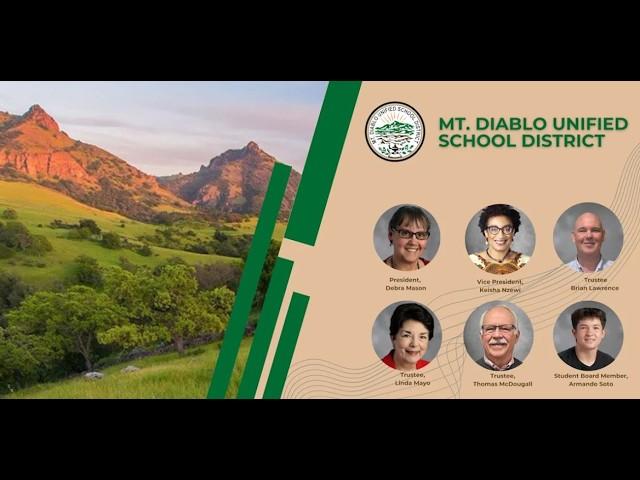
Nzewi answered later during board member reports. She cited her family's military service and her oath to the Constitution. "I will not be quitting this board," she said. Another speaker thanked Nzewi for her bravery.
The other side: Trustee McDougall raised a point of order. "Robert's Rules of Order does not allow us to discuss political issues like that," he said.
Board President Debra Mason pushed back: "Well, we also don't have the purview of listening to what you do in your personal life, but we listen to it every meeting."
Decisions and stakeholder impacts: No action was taken. The exchange exposed open friction among trustees over what belongs in board reports. That tension carries into a board that will change composition in December.
Eagle Peak Montessori Wins Five More Years
Why it matters: The renewal keeps a district-authorized charter serving about 280 to 290 students open from July 1, 2027, through June 30, 2032.
Where things stand: Staff recommended renewal after reviewing academics, finances and governance. Their review found:
- CAASPP state test results above state averages
- Growth on STAAR assessments
- 32 students with individualized education programs (IEPs)
- $74,355 in Local Control Funding Formula supplemental funds
- Reserves over $2 million
- Governance reviewed through interviews
Principal Michelle Hammons thanked the board for 26 years of partnership. Trustees asked no questions, and no public comment was recorded.
Decisions and stakeholder impacts: Trustee Lawrence moved Option 1, which grants renewal. Trustee McDougall seconded. The motion passed (For: 5, Against: 0), with the student trustee also voting yes. Eagle Peak families gain stability through 2032, and the district keeps oversight of the school as its authorizer.
Mayo Leaves After 29 Years
Why it matters: Trustee Linda Mayo, the board's longest-serving member, leaves in December. Her exit takes a deep store of institutional memory with her.
Where things stand: Superintendent Clark presented a plaque recognizing her service from 1997 to 2026. Jenny Vargas, president of the Diablo Managers Association, shared stories from administrators and presented a memory book.
A Walnut Creek council member, former trustees, current trustees and the student trustee also spoke. Speakers praised Mayo's attention to detail, ethics and focus on students. Dorothy Weisenberger thanked her for being open to questions about systemic issues. Her daughter, Lauren Ebert, spoke of her pride in her mother's public service.
Mayo urged the incoming board to follow its governance handbook and listen to all constituents. "I changes to we because it's only through the action of the entire board that the district can move forward," she said.
What's next: Trustee Nzewi closed the meeting by adjourning in Mayo's honor.
Clark Touts Turnaround, Flags Student Crises
Where things stand: Superintendent Clark said the district is moving out of intervention by the CCEE (California Collaborative for Educational Excellence). He also cited a Moody's credit upgrade. "Our finances are top-notch," he said.
His goals include:
- 5-point growth in English language arts
- Higher A-G eligibility, the course sequence required for University of California and California State University admission, now at 40%
- A focus on underperforming student groups and schools
Clark also reported 31 incidents, including 11 involving self-harm. He said the district did not pursue a bond because board support was not unanimous.
Why it matters: These numbers frame future budget and bond decisions. The incident count adds urgency to student mental health services.
- Closed session: The board reported 5-0 votes on a separation agreement, a settlement, direction to its real estate negotiator, an upheld complaint decision under Board Policy 4030 and a declined appeal under Board Policy 4344.
- Student discipline: The board approved, 5-0, an expulsion with suspended enforcement for one student. Conditions include Glenbrook coursework, drug testing and academic and attendance requirements. A separate 5-0 vote corrected the record on another student's placement.
- Sequoia cameras: Glynnis Bellaguen, president of the Sequoia Middle School PFC, questioned a $3,814.13 camera quote from Precision West Technologies. She noted it includes $3,430 in labor with travel and per diem, and asked whether local contractors were considered.
- Hidden Valley field: Katie Delabora, a Hidden Valley Elementary PFC board member, said the school's unfenced field next to a public park cannot be used for recess or PE. She asked the district to work with the City of Martinez on fencing.
- Paraeducator training and routine votes: Union representative Kim Montano asked each school to send one or two paraeducators to the March 9-11, 2027, state conference. Separately, the consent agenda and revisions to AR 3512, Exhibit 3512-E, AR 3542 and AR 3440 each passed 5-0.
Looking ahead: Solar repairs begin Dec. 1, with a further contract expected in December or January and a staff update due in three to four months. Trustee Lawrence asked for a staff presentation at a near-future meeting on the district's reading and literacy programs. Accounts of the Measure J committee conflicted: the superintendent said it would meet, while Mayo reported a meeting canceled for lack of quorum.