
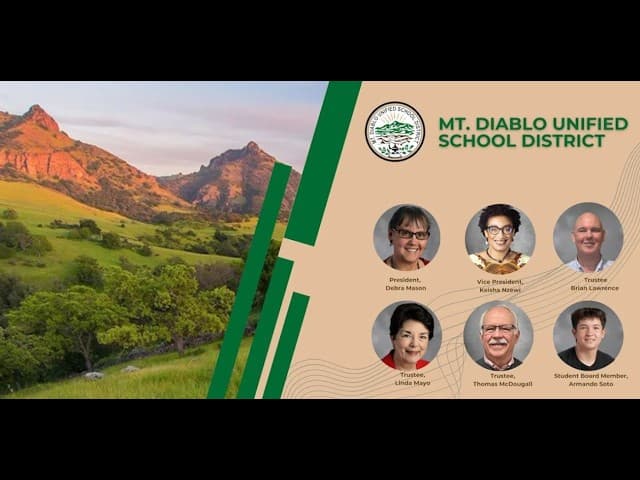
Eagle Peak Charter Renewal Hearing Draws Only Supporters Before Nov. 18 Vote
Governing Board • Mt. Diablo Unified School DistrictOctober 29, 2026
Locunity is an independent informational service and is not an official government page for this commission. All information is sourced from public footage and an analysis of official agendas with the aid of responsible, fact-checked AI. to report an error or omission.
Eagle Peak Montessori Charter School came to the Mt. Diablo Unified Governing Board on Oct. 28, 2026, seeking a five-year renewal, and every public speaker urged trustees to grant it. No vote was taken; the board will decide on Nov. 18. The meeting also produced a 4-1 split on revised board policies, an approved solar repair contract and new dashboard data that trustees used to push back on critics who call the district "failing."
- Eagle Peak renewal hearing draws eight supportive speakers; the board decides Nov. 18
- English learners and graduation move to green on the 2026 California School Dashboard; ELA and math stay orange
- Board policy revisions pass 4-1 after an objection over parental notification
- AI sustainability resolution passes 5-0 as staff pitch "screen value" over minute caps
- SunUp Solar inverter contract approved 5-0 despite questions about tracking savings
Eagle Peak Makes Its Case for Five More Years
Why it matters: The board must grant or deny the charter by Nov. 18. The board originally approved Eagle Peak in 2000, and the requested term runs from July 1, 2027, through 2032.
The basics: AB 1505, the state's 2019 charter law, sorts charter schools into performance tiers for renewal. Eagle Peak sits in the middle tier.
Where things stand: Board President Debra Mason opened the hearing and noted that no deliberation or action would occur. District staff findings are due by Nov. 3.
Michelle Hammonds, executive director of Eagle Peak Montessori Charter School, pointed to a diversifying student body and growth on cohort assessments. She also acknowledged a gap for Hispanic students on CAASPP, the state's standardized test. Her bottom line on the school's tier status was direct: "This indicates a recommendation of 5-year renewal," said Hammonds.
A united front: Eight commenters spoke, all in favor. Together they represented the school's alumni, parents and staff:
- Harper Hallquist, a Northgate High School student and Eagle Peak alumna, cited the independence she built and a teaching internship at the school.
- Hannah Williams, an alumna who now teaches at Mount Diablo High School, said the school taught responsibility and work ethic.
- Rachel Halliquin, an MDUSD educator, Eagle Peak parent and former Eagle Peak board member, urged renewal of what she called a 26-year partnership.
- Jennifer Lee, a 23-year Eagle Peak teacher, emphasized staff community and low turnover.
- Chris Riffle, whose daughter has Down syndrome, described partnership meetings, multi-age classrooms and year-long projects.
- Laura DeSaltes said the school helped her struggling son thrive.
- Megan Dowdy, a parent and secretary of the school's Community Foundation, read her daughter's account of individualized learning.
- David Eliezer, a retired teacher and Eagle Peak grandparent, cited high staff morale and the school's past political support for the district.
One trustee praised the school's community feel.
Decisions and stakeholder impacts: The hearing created no formal record of opposition, which leaves the district's staff analysis as the main counterweight. Families and staff want stability. The district's interest lies in the tier framework and in how staff weigh the Hispanic achievement gap Hammonds acknowledged.
What's next: Staff findings are due Nov. 3. The board votes Nov. 18, 2026.
Dashboard Gains Fuel Pushback on "Failing" Label
Why it matters: The 2026 California School Dashboard is the state's public scorecard for districts. Trustees used this year's results to argue the district is making progress, even where proficiency still lags.
Where things stand: Educational Services staff reported several gains:
- English learners and long-term English learners moved to green.
- The graduation rate reached 93.5%.
- College and career readiness hit 50.3%.
- Chronic absenteeism fell to 16.8%.
ELA and math remained orange. Staff said ELA improved 1.4 points, to 9.8 points below proficiency. Because the "maintained" level covers changes of roughly plus or minus 3 points, that gain did not register as improvement on the color scale. Suspensions were 3.0%, compared with a 2.7% state figure.
The other side: Trustees questioned the dashboard's labeling and the penalties tied to test participation. Board Member Brian Lawrence rejected the "failing district" characterization outright. "I view that as an insult to our students, to our teachers, our staff, our families, our community," said Lawrence.
Board President Mason stressed the limits of the data: "What doesn't show is what kid spent the night at a hospital because their parent was sick, what families didn't have food so their kid couldn't eat," said Mason.
Decisions and stakeholder impacts: The item was informational, and no action was taken. The results give the district a counter-narrative on English learners and graduation. Orange ELA and math scores keep core academics under pressure.
Board Weighs 'Screen Value' as AI Resolution Passes
Why it matters: National pressure to limit classroom devices is reaching local boards. Mt. Diablo's staff argued against fixed minute caps.
Where things stand: District presenter Aaron Vallejo said minute totals don't show learning value. He cited Lightspeed data showing students average 48 minutes of in-school screen time per day, and he outlined four district wellness metrics. "I would just encourage us to look at from minutes to meaning, looking at screen value as opposed to screen time," said Vallejo.
Vallejo said the district is moving away from standalone adaptive platforms such as IXL and iReady. It will also hold three family "micro PDs," or short training sessions, with Common Sense Media.
Board Member Linda Mayo emphasized technology's benefits: "We just need to determine what is the screen time value and move forward with that," said Mayo.
A trustee asked about blocked educational websites. Vallejo said teachers can file a help-desk ticket to request that a site be unblocked.
The other side: Earlier, during debate on Resolution 26/27-30, Board Member Thomas McDougall raised concerns about overuse. "I ask that this AI task force look into our potential overuse of the technology," said McDougall.
Decisions and stakeholder impacts: Resolution 26/27-30, moved by Mayo, commits the district to weigh environmental impact as its AI task force develops frameworks. It passed (For: 5, Against: 0). Families gain new training resources, while vendors of standalone adaptive platforms face a shrinking role.
Policy Revisions Pass 4-1 Over Parental Notification
Why it matters: This was the night's only split vote. It touched on parents' rights and student privacy.
Where things stand: Mayo moved approval of Board Policies 5145.3, 6142.91 and 6145.2, along with Administrative Regulations 5145.3 and 6145.2. The objection centered on language that conditions parent notification on fears of reprisal, which bears on notifying parents when a student is transitioning.
The other side: The dissenting trustee argued that the revisions, based on wording from the California School Boards Association (CSBA), restrict a recent Supreme Court decision on parents' right to know. "I feel it is not up to the district to usurp the parents' authority on this," said McDougall, who appeared to lead the objection.
Decisions and stakeholder impacts: The revisions passed (For: 4, Against: 1), with the student trustee's assent. The member who cast the no vote was not identified by name. The split signals that parental notification remains a live fault line on the board.
Solar Repair Contract Clears After Pointed Questions
Where things stand: A trustee pulled Item 14.15 from the consent agenda, and the board took it up as Item 15.1. The SunUp Solar inverter repair agreement's first phase costs $119,000. District staff said repairing all inverters will cost "upwards of about $400,000."
The other side: McDougall questioned whether projected savings can be verified. "Until the district can track solar production alongside the electricity it purchases from PG&E, it cannot accurately determine whether it is realizing the savings that Schneider Electric projected," said McDougall.
Staff said a PG&E Green Button data option is under review. Dr. Clark, superintendent, objected to unannounced questions: "It's 9 o'clock at night and I'm not going to have people coming in and cold calling these questions on these items," said Clark. A point of order also challenged a third question as not germane.
Decisions and stakeholder impacts: Board Member Keisha Nzewi moved the agreement and Lawrence seconded. It passed (For: 5, Against: 0). Taxpayers are funding the first phase of a roughly $400,000 fix, but the district has not yet shown it can track the savings.
What's next: Staff will report on the Green Button option at the next meeting.
Minor Items
- Resolutions: Resolution 26/27-28 marks November as National Native American Heritage Month, and Resolution 26/27-29 recognizes National Homeless Youth Awareness Month. Both passed 5-0. The homeless youth resolution cites 208 homeless students in 2025-26 and 63 identified so far this year.
- Routine approvals: The board approved the Oct. 14 minutes, the agenda, the consent agenda (minus Item 14.15) and Concord High School's 2026-27 School Plan for Student Achievement, all 5-0.
- Public comment: Teacher Linda Ortega asked why educators hear there is no money for supplies despite reserves above 3%, and she urged a yes vote on Prop 3. Parent Heather Hollis said problems at her daughter's high school remain unresolved after a year and asked the board and district to step in.
- German exchange: Twenty students from the Stuttgart area visited Northgate High School through the German-American Partnership Program. The program is partly funded by the German federal government and the U.S. State Department.
- Board reports: Mayo relayed the message from a CSBA Region 7 legislative meeting: "We want full funding of Prop 98 and we don't want any more deferrals, period." Reports also noted that a Budget Advisory Committee meeting lacked a quorum.
Looking Ahead
District staff findings on Eagle Peak are due Nov. 3, and the board will grant or deny the renewal on Nov. 18, 2026. The solar Green Button update is expected at the next meeting.