
Commission - May 27, 2026 - Meeting
Commission • Metropolitan Transportation CommissionMay 27, 2026
Locunity is a independent informational service and is not an official government page for this commission.We use AI-assisted analysis and human editorial review to publish information.
MTC Authorizes $590M State Loan to Avert Bay Area Transit Service Cuts
The Metropolitan Transportation Commission moved to prevent a fiscal cliff at the region's four largest transit agencies, unanimously approving a $590 million state loan that buys time until voters decide a regional sales-tax measure in November. Commissioners also loosened transit-oriented development rules for billion-dollar rail projects, pressed for legal action against the Clipper fare system's troubled vendor, and previewed an MTC budget clouded by inflation and Sacramento policy uncertainty.
- $590 million state transit loan authorized to bridge an $800 million deficit at BART, Muni, AC Transit, and Caltrain through FY 2027
- Transit-oriented development rules relaxed for major rail extensions like BART Silicon Valley Phase 2, with a late-2027 progress review added
- Commissioners demand June closed session on legal recourse against Clipper vendor Cubic over persistent defects and missed deadlines
- Draft MTC budget shows $1.4 million deficit tied to accounting timing, not structural gap; cap-and-invest uncertainty flagged
- SB 63 efficiency review finalized, documenting $1 billion-plus in cost savings at four transit operators since FY 2019-20
- E-bike safety bill backed unanimously, supporting statewide speed and power standards for electric bicycles
$590 Million Lifeline for Bay Area Transit
Why it matters: Without bridge financing, BART, AC Transit, Caltrain, and SFMTA face service cuts beginning July 1. The loan buys the region roughly 18 months while voters decide whether to approve a permanent regional sales-tax measure under SB 63 this November.
Where things stand: CFO Derek Hansel presented Resolution 4782, authorizing MTC to borrow $590 million from the California State Transportation Agency and distribute it through four individually secured sub-loan agreements: $285 million to BART, $200 million to SFMTA, $55 million to AC Transit, and $50 million to Caltrain. Each sub-loan is backed solely by that operator's share of State Transit Assistance revenue — no cross-default, no cross-collateralization.
"Each sub-loan agreement is secured by that particular operator's share of the STA revenue-based funds. That ensures that repayment responsibility is clear and it's individual," said CFO Derek Hansel.
The loan is interest-only for two years, then amortizes over 10 years through June 2038 with prepayment flexibility.
Chair Sue Noack praised the clean legal structure: "It does what we needed to do, but it also, with the collateral there, ensures that nothing else is impacted by this."
The other side: Public commenter Roland Le Brun cautioned commissioners that the loan secures temporary operating revenues with operating revenues, urging them to consider what happens if SB 63 fails at the ballot in November. Transit agency officials, however, described the loan as essential. SFMTA Government Affairs Manager Monique Webster called it critical to closing SFMTA's budget deficit by July 1 and avoiding service cuts. Caltrain's Jason Baker said the loan is "among the most important things the commission does."
Decisions: The vote passed unanimously (For: 13, Against: 0, Absent: 6). Several commissioners had departed by this late-agenda item.
What's next: Repayment hinges on an independent signature drive to place the SB 63 regional sales-tax measure on the November ballot. Operators must also formally adopt cost-saving strategies identified in the now-finalized SB 63 financial efficiency review by July 1, 2026.
Rail Extensions Get More Flexible Path to Transit-Oriented Development
The basics: MTC's Transit-Oriented Communities policy requires jurisdictions near major transit investments to meet density, parking, and access standards — scored on a 100-point scale — to qualify for discretionary funding. Projects below an 85-point threshold are currently ineligible.
Why it matters: Billion-dollar rail projects like BART Silicon Valley Phase 2 may struggle to meet the existing standards, despite being designed around transit-oriented development principles. The amendments give large transit extension projects more flexibility while preserving the overall policy framework.
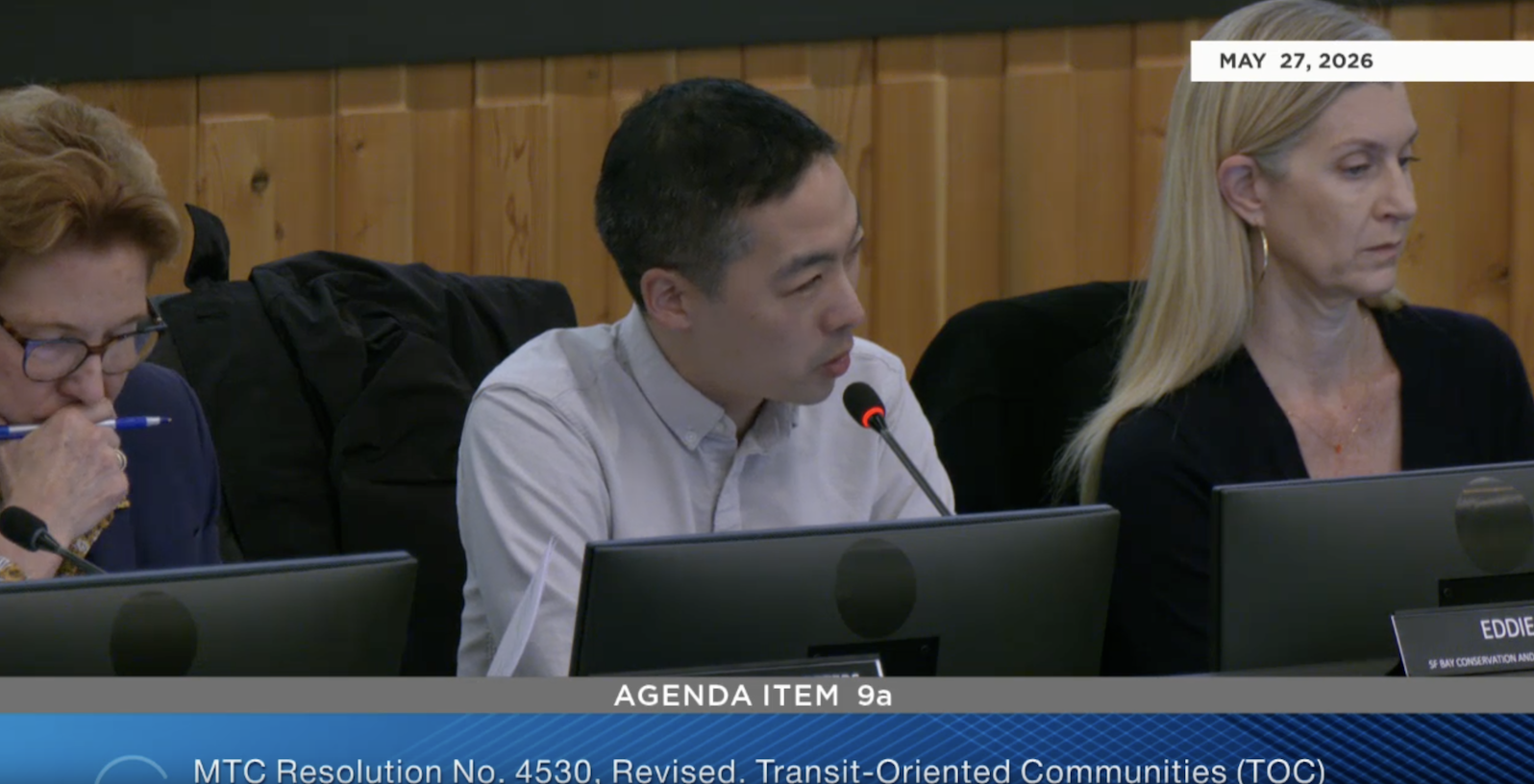
Where things stand: Commissioner Eddie H. Ahn, presenting as Planning Committee chair, moved approval of Resolution 4530 Revised. He defended the 85-point threshold as a hard-won compromise: "Recognizing how much time went into the TOC policy and its creation prior, we have continually held at the point of compromise at 85 points."
Commissioner Margaret Abe-Koga, who opposed the original policy in February, offered a friendly amendment requiring a detailed progress report. Staff proposed a late-2027 timeline, and Abe-Koga accepted. She cited persistent structural concerns: "It doesn't adequately account for local context and real-world constraints, including existing agreements, market conditions, and the impacts of state law and other regulations on our tightly resourced jurisdictions."
Commissioner Pat Burt raised specific cases: "In San Jose, there's a great concern over whether the BART Silicon Valley Phase 2 extensions will really qualify under these criteria. Even though the BART extensions in Silicon Valley have been models of transit-oriented development, and yet they may not qualify." He also flagged that Palo Alto's commercial floor-area-ratio requirement undermines housing incentives and that parking maximums don't match developer realities for townhome projects.
The other side: Emily Wheeler of Public Advocates urged the commission to reject the amendments, arguing that reducing compliance from 100% to 85% permanently undermines equity provisions. She warned that partial compliance advances private developer interests rather than equity goals.
Public commenter Roland Le Brun recounted the history of VTA overriding the Milpitas city council to build parking structures instead of housing near the BART station, resulting in roughly 3,000 mostly empty spaces. He also described Diridon station design changes that led Google to relocate.
Decisions: Passed unanimously (For: 16, Against: 0, Absent: 3) with the friendly amendment requiring a comprehensive status report by late 2027.
What's next: The late-2027 progress report will be the first major test of whether flexibility translates into actual TOC compliance at BART Silicon Valley Phase 2 and other extension corridors.
Clipper Frustrations Boil Over; Commissioners Push for Legal Action
Why it matters: The next-generation Clipper fare system is approaching a critical mass — 45% of trips and 1.7 million cards migrated — but persistent vendor defects threaten to undermine the rollout just weeks before FIFA World Cup transit operations begin.
Where things stand: Chief Deputy Executive Director Alex Bockelman reported that Cubic committed to fixing remaining critical defects by May 30 and that MTC will reassess the bulk migration timeline after system updates later in the week. Call wait times are under five minutes and average handle time under 12 minutes.
But commissioners were not reassured. Commissioner Abe-Koga requested a closed session at the June meeting to discuss legal recourse: "I'm concerned that they had put in deadlines by when they would have all of the issues resolved, and that continues to get pushed out. I'm hearing now June 19; we had concerns that it would coincide with FIFA."
Commissioner Burt supported the request, citing Caltrain's specific problems: "My understanding from Caltrain is that there's still significant issues with the fare inspection devices not being operable and severely limiting our ability at Caltrain to spot check fares." He suggested a third-party review of Cubic's performance.
Public commenter Alita Dupree noted that more than half of users are still on the legacy system and raised concerns about how to migrate riders who lack internet access without overwhelming the call center.
What's next: Staff confirmed a closed session is planned for June, with coordination between closed and open session items to comply with the Brown Act. The Clipper Executive Board meets June 1.
Draft MTC Budget: $1.4M Deficit, Cap-and-Invest Questions
Why it matters: The draft FY 2026-27 MTC budget previews a 431-position agency navigating inflation, trade tensions, and a potential loss of low-carbon transportation funds that help operate the Clipper system.
Where things stand: CFO Derek Hansel walked commissioners through the numbers. Revenue assumptions include TDA revenue up 2.5%, a 3.3% interest yield (to be revised upward for the final proposal), a modest dip in federal grants from timing, and a significant drop in state grants as the REAP 2.0 program winds down. One new staff position is proposed for the TNC Access for All program, and the cost-of-living adjustment will be updated from 3.2% to 3.8% based on April CPI data.
Hansel was blunt about the headline number: "I didn't want you to walk away from today's discussion going, 'They're showing me a structural deficit of $1.4 million.' That's not the case." The gap is entirely attributable to indirect cost allocation plan carryover amortization. Operating reserves are projected at $78 million against a $38 million policy requirement.
Commissioner Burt pressed on the governor's cap-and-invest proposal before the California Air Resources Board the following day, asking how it might affect Clipper and other programs funded through low-carbon transportation revenues. Staff committed to delivering a post-CARB report to the commission.
Capital highlights include $1.4 million for an enterprise resource planning system, $120,000 for agenda management software, and $15 million for the West Oakland Link.
What's next: The proposed budget returns for adoption in four weeks with updated COLA and interest assumptions.
SB 63 Efficiency Review: $1 Billion in Transit Savings Documented
Chair Noack reported that the Financial Efficiency Review Independent Oversight Committee approved the final Phase 1 report on May 22, documenting more than $1 billion in operating cost savings implemented by AC Transit, BART, Caltrain, and SFMTA since FY 2019-20. The committee directed minor revisions and one additional early action strategy.
"The report documents more than a billion dollars in operating cost-saving measures implemented by AC Transit, BART, Caltrain, and SFMTA since fiscal year 2019-20," said Chair Noack.
Per SB 63 statute, the four operators must identify which strategies they will implement and formally adopt them through policy or budget actions by July 1, 2026 — a precondition for credibility ahead of the November ballot measure.
Minor Items
- Consent calendar (8a–8h) approved unanimously (For: 14, Against: 0, Absent: 5), including $50 million in Regional Measure 3 capital funds to Alameda CTC and TAM; $8.8 million in FTA World Cup transit funding; the FY 2026-27 Regional State Transit Assistance program; RM2 operating and marketing program; CARE participatory budgeting; and Transit Oriented Affordable Housing fund reprogramming.
- $61.3 million RM3 Operating Program (Resolution 4758) adopted unanimously (For: 15, Against: 0, Absent: 4) for FY 2026-27 bridge-toll-funded transit operations.
- TIRCP Cycle 8 endorsements approved unanimously (For: 15, Against: 0, Absent: 4), a prerequisite for Bay Area agencies seeking competitive state rail capital grants.
- SB 1167 (Blakespear) e-bike safety support position approved unanimously (For: 16, Against: 0, Absent: 3). The bill classifies e-bikes as devices not exceeding 20 mph throttle or 28 mph pedal-assist with motors of 750 watts or less. Public commenter Alita Dupree supported regulation but urged that throttle-based options remain available for people with disabilities.
- 2025 Bike Champions of the Year recognized across all nine Bay Area counties, with Vice Chair Stephanie Moulton-Peters presenting awards to 10 advocates for expanding safe cycling, leading inclusive rides, and running Safe Routes to School programs.
- Community Advisory Council report delivered by Vice Chair Diana Benitez, who urged climate change as a core organizing principle for Plan Bay Area 2060 and raised concerns that the Equity Priority Communities toolkit misses dispersed populations including people with disabilities, farmworkers, and undocumented residents.
The next MTC Commission meeting is June 24.