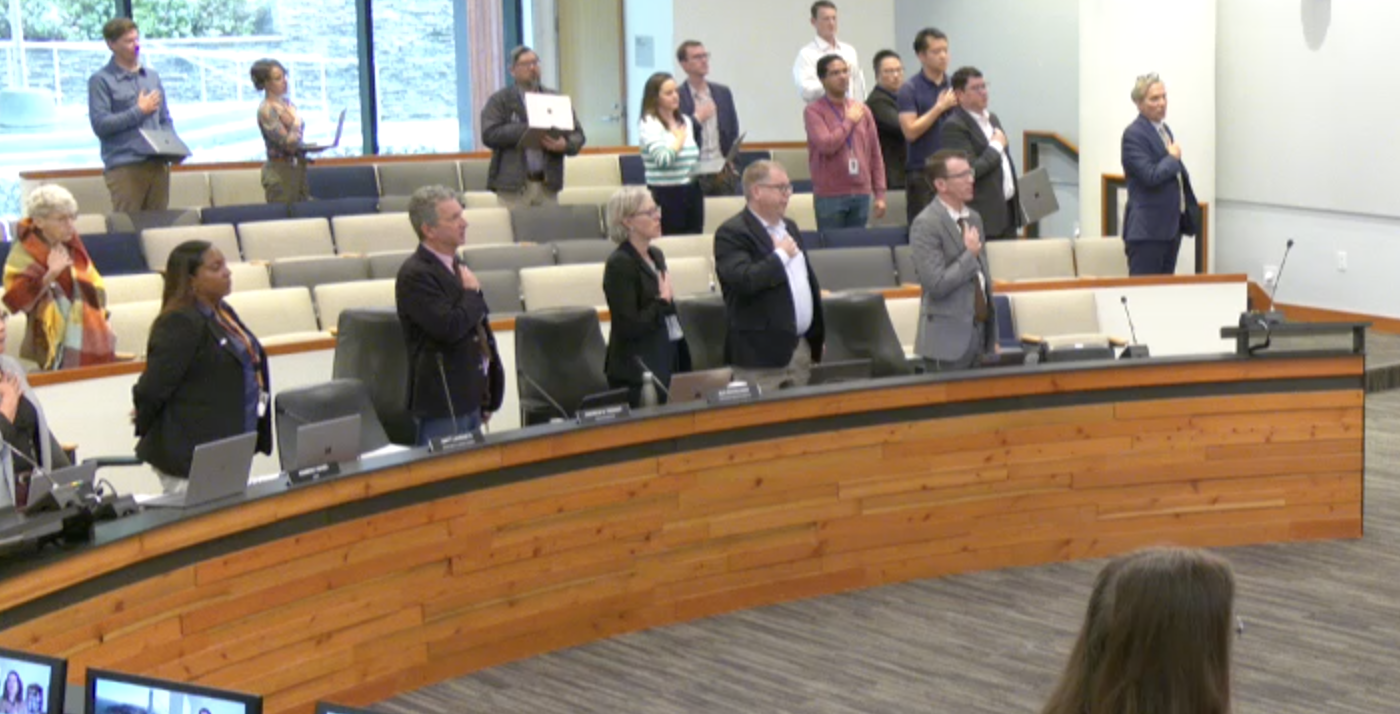
Commission - Apr 22, 2026 - Meeting
Commission • Metropolitan Transportation CommissionApril 22, 2026
Locunity is a independent informational service and is not an official government page for this commission.We use AI-assisted analysis and human editorial review to publish information.
MTC Backs Diridon CEQA Exemption, Moves to Double Disadvantaged Communities
The Metropolitan Transportation Commission moved on two fronts at its April 22 meeting: unanimously supporting legislation to fast-track the Bay Area's most complex transit hub and pushing to more than double the region's state-recognized disadvantaged communities — a change that could unlock billions in equity funding. The commission also programmed more than $100 million in transportation allocations, honored a departing mega-project funding architect, and adjourned in memory of former Commissioner Ron Diridon Sr.
- MTC backs CEQA exemption to accelerate Diridon Station rebuild connecting BART, high-speed rail, Caltrain, and VTA
- CalEnviroScreen 5.0 push would increase Bay Area disadvantaged communities from 122 to 263, influencing $2.26 billion in state equity programs
- $60M programmed for express lanes on I-680 and US-101 over transit advocates' objections
- Commission supports lifting the $500M cap on high-speed rail spending outside the Central Valley, with one dissenting vote
- Clipper 2 stabilizes with no outages since last meeting, but end-of-May bulk migration still carries "significant risk"
Diridon Station Gets CEQA Fast Track
Why it matters: The Diridon Station rebuild in San Jose is the Bay Area's most ambitious multimodal integration project — the point where BART's Silicon Valley extension, California high-speed rail, Caltrain, and VTA are all supposed to converge. Delays ripple across every one of those programs.
Where things stand: The commission unanimously supported SB 1375, authored by Sen. Cortese, which would exempt the integrated Diridon Station project from redundant CEQA review. Originally scoped to Diridon alone, the bill has been expanded to cover multimodal rail centers including Millbrae and the Salesforce Transit Center.
David Tran, speaking on behalf of Commissioner and San Jose Mayor Matt Mahan, thanked MTC for the partnership, saying the bill "helps streamline redundant CEQA processes for the integrated Diridon station project while upholding our environmental commitments."
Commissioner Margaret Abe-Koga connected the vote to the day's memorial for Ron Diridon Sr., noting her work on the VTA committee overseeing the station rebuild: "That's probably the one regret that we weren't able to get that done before for him to see it. But we will be sure to make it happen and double our efforts on that."
Decisions: Passed unanimously (For: 12, Against: 0, Absent: 9). Vice Chair Stephanie Moulton-Peters moved support; Commissioner Abe-Koga seconded.
What's next: SB 1375 continues through the state legislative process. The CEQA streamlining, if signed into law, could shave years off a project timeline that currently has no firm completion date.
Doubling the Bay Area's Disadvantaged Communities
The basics: CalEnviroScreen is Cal EPA's statewide tool for identifying disadvantaged communities. The designation determines eligibility for billions in Greenhouse Gas Reduction Fund dollars and shapes how Sacramento defines equity across legislation and policy.
Why it matters: Commissioner Eddie Ahn reported that MTC submitted comments before the April 1 deadline proposing an "either/or" methodology that would recognize areas with environmental burdens or socioeconomic disadvantages separately, rather than blending the two. The result: Bay Area disadvantaged communities would jump from 122 to 263 — more than doubling — bringing in neighborhoods like West Oakland, Richmond, Visitation Valley, East San Jose, and Redwood City.
Where things stand: Ahn framed the stakes bluntly: the tool "directly influences $2.26 billion worth of programs through GGRF dollars. And it's not just that — it influences a wide range of state policy and legislation as well, as it's seen as the de facto equity definition in Sacramento."
He outlined three action items: confirm Cal EPA's timeline for finalization (typically three to six months after release), bring the matter to the Joint Planning and Admin or Legislative Committee, and ask the Bay Area Legislative Caucus to weigh in. Ahn urged urgency: "I do think this is a situation where we don't just sit back and vaguely hope things to work out. This tool requires a lot of precision, requires a lot of direct advocacy."
Executive Director Andy Fremier confirmed staff are pursuing a meeting with the Cal EPA secretary and will release an online map for commissioner review.
What's next: Staff will circulate the draft map and schedule a committee discussion. Cal EPA typically finalizes the tool three to six months after public release.
$60M for Express Lanes Draws Transit Pushback
Why it matters: The commission programmed $60M from the RM3 express lane category for I-680 completion in Contra Costa County and US-101 express lanes (Phase 5) in Santa Clara County, with $33.9M allocated immediately to the Contra Costa Transportation Authority for I-680 northbound. The vote comes as Bay Area transit agencies face ongoing fiscal strain — a tension transit advocates seized on.
Where things stand: Commissioner Myrna Melgar, chair of the Programming and Allocations Committee, noted the committee had a "robust discussion" about how the express lane network fits with carpools and public transit. Staff will update the Express Lane Strategic Plan later this year and explore financing options to speed network development. The commission is also studying whether to refresh the 2016 Bay Area Shuttle Census, which surveyed private employer shuttles.
The other side: Abby from Transform opposed the allocations, arguing millions should not go to highway expansion when transit systems are struggling. She called for investing in affordable housing and transit instead, saying California should exemplify good policy rather than widen roads.
Decisions: Passed unanimously (For: 14, Against: 0, Absent: 7). Moved by Commissioner Melgar, seconded by Commissioner Abe-Koga.
What's next: The Express Lane Strategic Plan update and potential shuttle census refresh are expected later this year.
Lifting the High-Speed Rail Spending Cap
Why it matters: SB 1411, authored by Sen. Stern, would eliminate the $500M cap on Greenhouse Gas Reduction Fund expenditures outside the Central Valley's Merced-to-Bakersfield segment — the only operational stretch of California's high-speed rail project. Removing that cap would free up GGRF dollars for Bay Area "bookend" projects, including the Caltrain portal to the Salesforce Transit Center and Diridon Station integration.
Where things stand: The commission adopted a "support and seek amendments" position. The amendments target procedural hurdles, such as an Inspector General cost-benefit analysis requirement. Commissioner Abe-Koga asked for clarification, and staff confirmed the amendments do not seek to remove legislative notification requirements.
Decisions: Passed 11-1 (For: 11, Against: 1, Absent: 9). The specific nay voter could not be confirmed from the transcript.
What's next: SB 1411 continues through the Legislature.
Clipper 2 Stable — but Migration Risk Looms
Why it matters: The Clipper fare card is used by millions of Bay Area transit riders daily. A failed migration from Clipper 1 to Clipper 2 could disrupt fare collection across every major transit operator in the region.
Where things stand: Executive Director Andy Fremier reported that problems with muni ticket vending machines and customer service terminals have been resolved. "We have had no service interruptions since the last commission meeting," he said, crediting infrastructure scalability upgrades. But he cautioned that the bulk migration — the final step to decommission Clipper 1 — still carries "quite a bit of risk" as the contractor works toward an end-of-May target.
Commissioner Gina Papan pressed for specifics on customer call volumes, noting wait times of 14 minutes plus four minutes for handling. She called those numbers "deeply concerning" and demanded the full commission receive updates. Fremier pointed to the Clipper Executive Board's April 27 agenda item as the most thorough update, to be shared with commissioners after Brown Act posting.
Remembering Ron Diridon Sr.
The commission adjourned in memory of Ron Diridon Sr., who died April 3, 2026, at age 87. Vice Chair Moulton-Peters delivered remarks tracing Diridon's career: MTC commissioner representing Santa Clara County from 1979 to 1990, MTC chair from 1989 to 1991, and the only person to have led MTC, ABAG, and the Bay Area Air Quality Management District.
Diridon spearheaded the nation's first county transportation sales tax in 1976 — a model since replicated by 24 of California's 58 counties. He served as executive director of the Mineta Transportation Institute and chaired the California High Speed Rail Authority Board. The San Jose Diridon Transit Center was named for him after he helped restore it following the 1989 Loma Prieta earthquake.
Commissioner Abe-Koga spoke to his personal legacy: "He was so devoted to transportation, seeing the importance of connecting people to housing, to jobs, to where they needed to go — and really to opportunity."
Farewell to Mega-Project Funding Architect
The commission unanimously adopted MTC Resolution 4766 honoring Kenneth Folan on his retirement after 24 years leading the agency's Funding, Policy and Program section. Vice Chair Moulton-Peters read a resolution tracing his stewardship of the 2002 STIP, Caltrain electrification financing, BART railcar replacement, RM2, RM3, Cap and Trade investments, and the Major Project Advancement Policy adopted in 2022 — which sequences delivery of generational mega-projects.
Folan's departure removes deep institutional memory at a moment when BART Silicon Valley Phase 2, Valley Link, and the Salesforce Transit Center portal are all in active delivery.
Decisions: Passed unanimously (For: 11, Against: 0, Absent: 10). Moved by Commissioner Papan, seconded by Commissioner Abe-Koga.
Minor Items
-
SB 1087 clears committee: MTC co-sponsored legislation modernizing SB 375, the state's sustainable communities strategy law, passed the Senate Transportation Committee with bipartisan support and heads to Appropriations. Executive Director Fremier called it "a real true collaboration with not only our big MPO partners in the state, but with CalCOG, smaller MPOs, and then of course, all the stakeholders."
-
SB 1 competitive program strategy: Commission unanimously adopted regional prioritization principles for Bay Area nominations to three state SB 1 programs — Solutions for Congested Corridors, Trade Corridor Enhancement, and Local Partnership (For: 14, Against: 0, Absent: 7).
-
$19.3M in Cap-and-Trade transit funds: Approved distribution of $12.9M in population-based LCTOP funds and an estimated $6.4M in additional cycle B funds, plus competitive Transit Performance Initiative awards (For: 13, Against: 0, Absent: 8).
-
$23.6M in OBAG revisions: $11.6M to Caltrans for Resilient SR 37, $10M to MTC for the CARE participatory budgeting program, and $2M for pavement management (For: 13, Against: 0, Absent: 8).
-
AB 2561 workforce hearing: Mike Aycock, MTC HR, reported a healthy 8.9% vacancy rate across 427 budgeted positions, with average employee tenure of seven years. No labor representatives or public commenters participated.
-
Consent calendar (Items 9A-9I): Passed unanimously, including FY 2026 FTA apportionments update (For: 13, Against: 0, Absent: 8).
-
SB 79 maps released: MTC published preliminary draft maps on April 8 showing areas subject to new housing provisions after receiving HCD guidelines in March. Staff will return in May with a summary.
-
BAFA legislative pitch: Deputy Executive Director Daniel Saver will present six years of housing work to the Bay Area Legislative Caucus at the request of Sen. Josh Becker, while advocating for a $15M one-time state budget request.
-
Richmond-San Rafael Bridge: MTC received BCDC approval to continue third-lane work and is studying whether the lane could function as an HOV bus lane during peak operations.
-
Community Advisory Council report: New Chair Karina Liu reported the council's concerns about "reliance on federal data definitions that don't reflect the cost realities of the Bay Area," and called for better disability access, language equity, and accountability tracking in the CARE participatory budgeting program.