
MTC Approves $257.5M in Toll Funds Despite BART Silicon Valley Grant Doubts
Commission • Metropolitan Transportation CommissionAugust 26, 2026
Locunity is an independent informational service and is not an official government page for this commission. All information is sourced from public footage and an analysis of official agendas with the aid of responsible, fact-checked AI. to report an error or omission.
The Metropolitan Transportation Commission on Aug. 26, 2026, sent $257.5M in Regional Measure 3 toll revenue to three major projects. The largest share goes to BART Silicon Valley Phase 2, a project that has not yet applied for the federal grant it is counting on. The unanimous vote followed pointed questions on federal funding risk and BART rider safety, and the Commission also endorsed a statewide housing bond and heard demands for stronger local outreach before a key planning document is adopted.
- $257.5M in RM3 funds approved 16-0, including $192.5M for VTA's BART Silicon Valley Phase 2
- VTA confirms it has not applied for a federal full funding grant agreement but will keep building
- Commissioner raises BART security and outage concerns tied to the Transbay core capacity project
- Commissioners push back on draft Public Participation Plan, saying local governments feel dictated to; adoption is set for Sept. 23
- MTC formally backs Proposition 1, an $11.25 billion statewide housing bond, in a 16-0 vote
Building Now, Betting on Washington Later
The basics: Regional Measure 3 (RM3) is the voter-approved toll program that funds Bay Area capital projects. The Commission approved Resolution Nos. 4765, 4781 and 4787, allocating $192.5M to the Santa Clara Valley Transportation Authority (VTA) for BART Silicon Valley Phase 2, $50M to BART for the Transbay Corridor Capacity Project and $15M to the State Route 4 Bypass Authority for Vasco Road safety work.
Why it matters: The VTA allocation advances a project whose federal New Starts grant, roughly $5.1 billion, remains uncertain. VTA says delay costs more than $30M a month, which puts the region's toll dollars on the line either way.
Where things stand: Commissioner Marilyn Ezzy Ashcraft, mayor of Alameda, noted that $867M in state funds is contingent on the federal grant. "How certain are we that this grant will come through?" she asked.
Tom McGuire, VTA's chief mega projects officer, said the project holds a New Starts engineering award but has not filed for a full funding grant agreement. "We haven't put that application in right now," he said. VTA would apply no sooner than the end of this calendar year or the start of next. In the meantime, the project relies on local Santa Clara County sales tax revenue. McGuire said VTA has written pre-award authority from the U.S. secretary of transportation, which would allow reimbursement up to the 40% federal share. He added that "all the money is being used for construction as this is a project that is very much under heavy construction right now."
One commissioner argued that the project should move ahead, pointing to plans to get a tunnel boring machine in the ground and begin tunneling within 18 months. "The one decision within our control that will kill the project is pausing to wait for this administration to suddenly decide…" the commissioner said.
Safety on the core: Ezzy Ashcraft also pressed staff on BART security with shorter trains and on whether traction power substations would reduce outages. "How are these security concerns being addressed with this?" she asked. Alex Bockelman, MTC's chief deputy executive director, said BART runs 10-car trains at peak. He clarified that the $50M allocation is specific to communications-based train control, and he offered to arrange a BART presentation to the Commission. He called the effort "a generational project that has been in the works for quite a while."
The other side: Roland Lebrun, a public commenter, urged caution on the VTA money, citing the project's burn rate and suggesting the funds could instead serve as security for a possible BART loan. "You could keep the lights on in that hole in Santa Clara for four months," he said. "Please keep your powder dry." Alita Dupree, a public commenter, took the opposite view: "We have to stay the course with our BART to Silicon Valley project with this money." Representatives of the cities of San Jose and Santa Clara submitted written comments.
Decisions and stakeholder impacts: Commissioner Victoria Fleming, chair of the Programming and Allocations Committee, moved approval, and Ezzy Ashcraft seconded. The motion passed with For: 16, Against: 0, Absent: 2 (Commissioners Myrna Melgar and Nate Miley). VTA and South Bay riders keep the project on its construction track. BART gains capital for train control upgrades. East Contra Costa commuters get Vasco Road safety money. The region's toll payers carry the risk if the federal grant never materializes.
What's next: Staff offered to bring BART before the Commission for a briefing on security and reliability. VTA's grant application timing is the key date to watch.
Local Governments Want a Voice, Not a Directive
Why it matters: The Public Participation Plan sets the rules for how residents and local governments influence Plan Bay Area 2060 and other regional decisions. Commissioners signaled the draft still falls short with cities and counties.
Where things stand: Leslie Lara Enriquez, MTC's assistant director for engagement, legislation and public affairs, walked through the plan's federal and state basis, its 2023 overhaul and new elements. Those elements include Appendix C, covering Plan Bay Area 2060, and procedures for federal land management agencies. The 45-day comment period ran from June 8 through July 23. It included focus groups, Mineta Summer Academy discussions, advisory council sessions and a trilingual survey that reached more than 1,300 people.
Feedback themes were consistent. Participants asked MTC to close the feedback loop, meet people where they are, reduce barriers, use plain language and engage community-based organizations early.
The other side: Commissioners zeroed in on local governments. "Too many times we hear that MTC just comes in and tells them this is it and this is what you have to do," said Commissioner Gina Papan, who represents the cities of San Mateo County.
Commissioner Barbara Lee, mayor of Oakland, asked whether cities and counties can add their own requirements. She also asked whether organizations representing unsheltered people are included in the engagement framework. Commissioner Margaret Abe-Koga asked about tracking responses by geography. Commissioner Pat Burt asked about more deliberate efforts to educate local elected officials. Commissioner Doanh Nguyen asked what metrics would show whether engagement actually shapes decisions.
Decisions and stakeholder impacts: The item was informational, and no vote was taken. Community-based organizations stand to gain earlier involvement. Local governments are pressing for a two-way relationship before the plan becomes binding on Plan Bay Area outreach. Lara Enriquez said that after adoption, staff will evaluate the public engagement program for Plan Bay Area 2050+.
What's next: The draft goes to the MTC ABAG Community Advisory Council in September, then to the Legislation Committee on Sept. 11. Final Commission action is scheduled for Sept. 23.
MTC Goes on Record for Housing Bond
Where things stand: The Commission adopted a support position on Proposition 1, the Veterans and Affordable Housing Bond Act of 2026. The Joint MTC ABAG Legislation Committee referred the item after meeting Aug. 14. "This proposition would approve an $11.25 billion statewide housing bond to fund affordable housing and home ownership across California," said Commissioner Alicia John-Baptiste, San Francisco's chief of infrastructure, climate and mobility.
Decisions and stakeholder impacts: John-Baptiste moved the position, and Commissioner Belia Ramos, ABAG president, seconded. There were no commissioner or public comments. The motion passed with For: 16, Against: 0, Absent: 2 (Melgar, Miley). The endorsement puts the region's transportation agency behind state money for affordable housing and homeownership, reinforcing the link MTC draws between housing and transportation planning.
Minor Items
- New commissioner seated: Commissioner Doanh Nguyen of Caltrans Bay Area was named to five BATA, MTC and BAFA committees, approved 15-0. The meeting opened with a memorial to former commissioner Scott Haggerty.
- Consent calendar: Approved 15-0, including $4M for the Valley Link rail project, federal rural transit funds and updated Transit Capital Priorities criteria.
- Productivity plan: Resolution No. 4743 adds SB 63 early action strategies from AC Transit, BART, Caltrain and SFMTA. It passed with no opposition recorded.
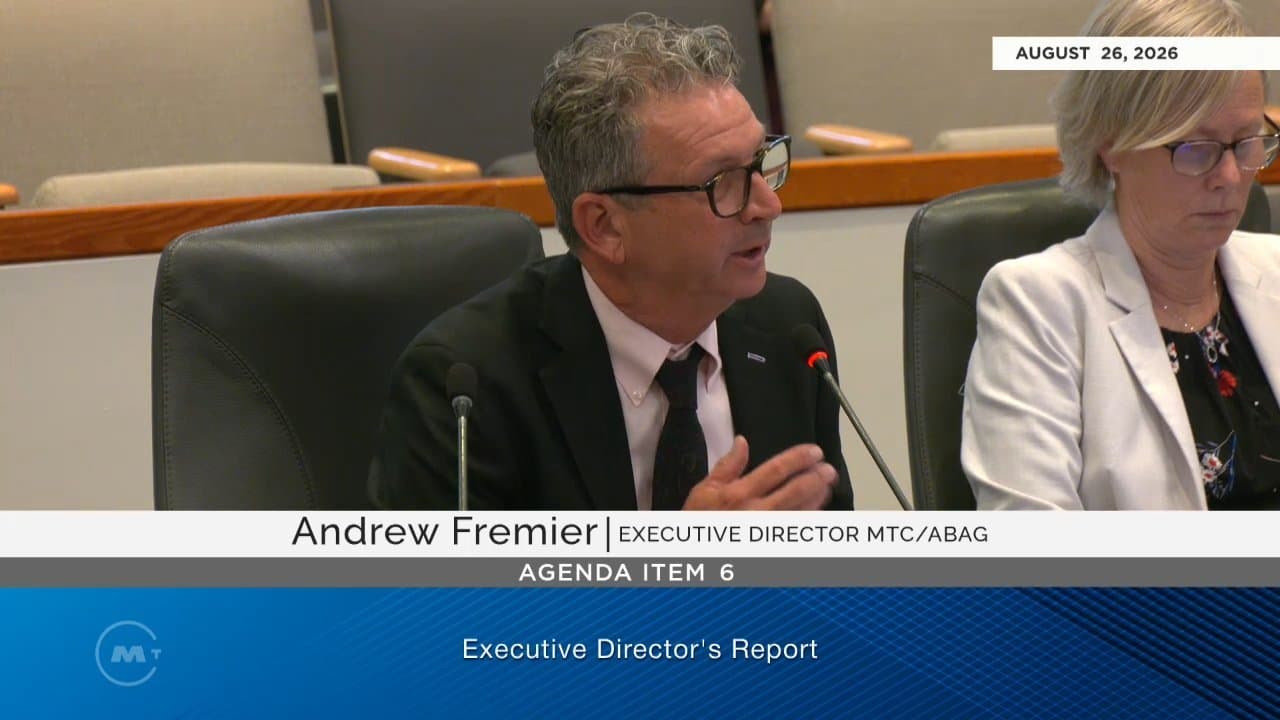
- Executive director's report: Executive Director Andrew Fremier said 60% of Clipper transactions now run on the new system. He also cited about $300M secured for State Route 37 congestion and flooding work.
- Advisory council: Chair Karina Liu backed paying residents for community planning work and refreshing the 2016 equity priority communities methodology.
Looking Ahead
The Commission meets next on Sept. 23, 2026, when final adoption of the Public Participation Plan is scheduled. Commissioners will hold a workshop Oct. 28–29.