
Hazardous Materials Commission - May 29, 2026 - Meeting
Hazardous Materials Commission • Contra Costa CountyMay 29, 2026
Locunity is a independent informational service and is not an official government page for this commission.We use AI-assisted analysis and human editorial review to publish information.
Commissioners Rally to Save 40-Year-Old HazMat Commission From Dissolution
The Contra Costa County Hazardous Materials Commission mounted a unanimous defense of its existence after learning that its own staff director had quietly proposed sunsetting the body — a 40-year-old citizen panel that brings together labor, business, environmental, and engineering voices on one of the state's most industrialized corridors. With the county's hazardous materials programs weeks away from transferring to the fire district, commissioners are now racing to prove their worth before the Board of Supervisors decides their fate.
Every commissioner who spoke rejected a staff proposal to dissolve the HazMat Commission, instead pushing for a retooled mission and formal advisory role
Cal EPA will hold a July 17 public hearing on transferring hazardous materials certification from Contra Costa Health to the fire district
Industrial Safety Ordinance revisions head to the Board of Supervisors on June 9
Commissioners pressed for a public hazardous materials map of the county's industrial corridors, but ADA compliance delays online access
The Fight to Save the Commission
On Tuesday, Director Nicole Heath took a proposal to the Board of Supervisors' Internal Operations Committee recommending that the Hazardous Materials Commission be sunsetted. Two days later, she stood before the commissioners she'd proposed eliminating and tried to explain.
Why it matters: The commission is the only citizen body in Contra Costa County that seats labor, business, environmental justice, engineering, and city representatives together to advise on hazardous materials policy — in a county with major refinery and industrial corridors. Dissolving it would eliminate that unique mix at a moment when the county's hazmat oversight structure is already being fundamentally reorganized.
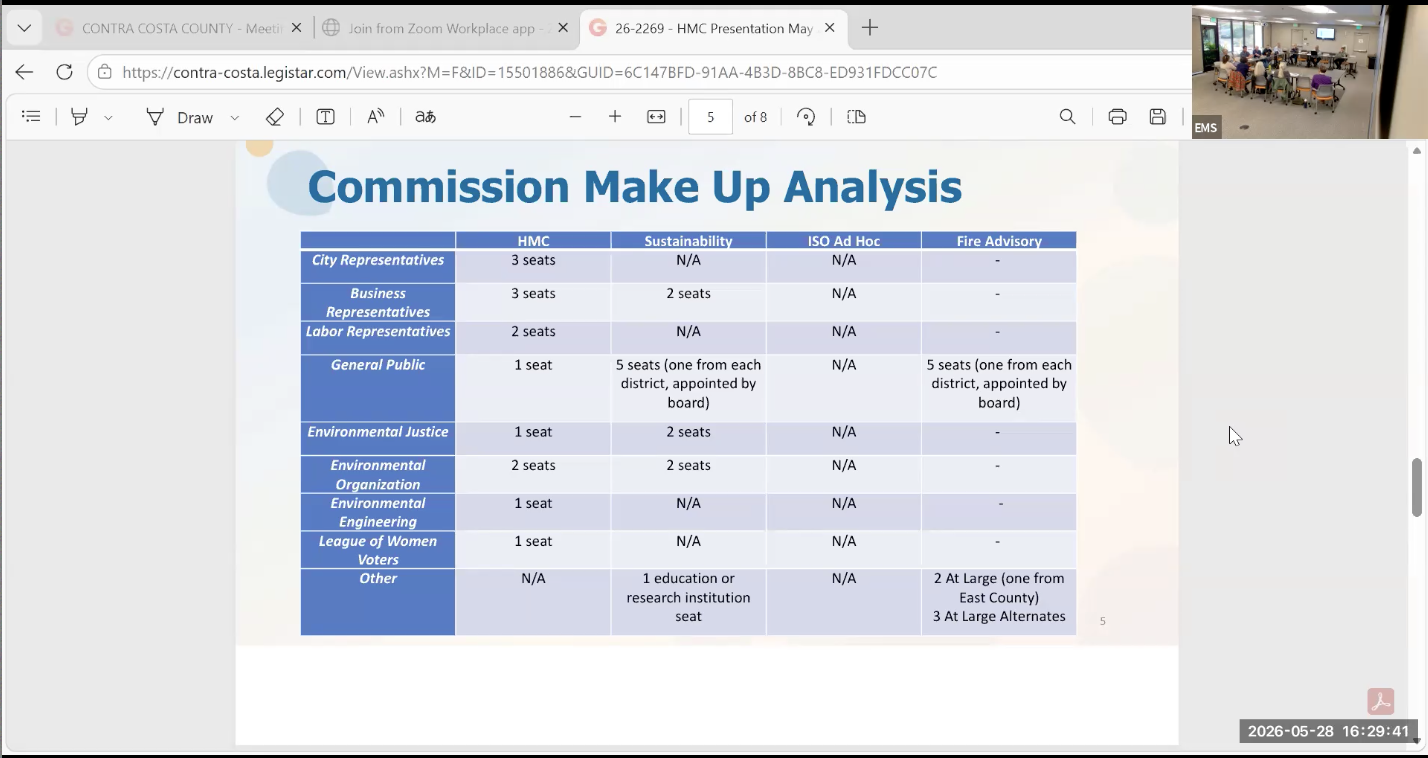
Where things stand: Heath told commissioners the proposal was not driven by the pending transfer of hazmat programs to the Contra Costa Fire Protection District. Instead, she said she had observed duplicative discussions across multiple county committees — the Industrial Safety Ordinance committee, Fire Advisory Commission, and Sustainability Commission.
"I, as the Director of Hazardous Materials Programs, took a proposal to the Internal Operations Committee meeting suggesting that we sunset the Hazardous Materials Commission," said Director Nicole Heath. "I think the impression that might have come upon from my presentation yesterday is that this was a result of the transition to ConFire. I do really want to clarify that."
She added: "This is not related to the transition. I don't want anyone to think that we're trying to solve this today to bring something by July 1. Take our time, really talk about and evaluate this."
The IOC directed staff to refine the proposal and return — giving commissioners a window to make their case.
The other side: Commissioners were not interested in gentle self-reflection. The response was swift, pointed, and personal.
Commissioner Soheila Bana, representing the Mayor's Conference of Contra Costa County, did not mince words: "I was offended. Not personally, but as representing the Mayor's Conference of Contra Costa County. How am I going to tell them? Zilch — we're annihilated." She demanded the commission be included in all future discussions about its own fate.
Commissioner Andrew Graham, representing the Contra Costa Taxpayers Association, delivered what may have been the most incisive critique — aimed at the commission itself. "In the four years that I've been on this commission, we've never advised them," he said. "We have fantastic presentations here. We have fantastic debates and conversations and technical expertise, but it all dies here." He urged the commission to start producing deliverables — a 200-word summary after each meeting sent to all five supervisors.
Commissioner Maureen Brennan, the environmental justice representative, pushed back hard against the "streamlining" rationale, listing concrete accomplishments: "I have to admit I'm getting tired of hearing this word streamlining. We are not a duplicative organization here. And I think we offer something really unique to the public." She cited the commission's work on PFAS-free utensils, no-drilling recommendations near sensitive sites, and brownfield development.
Commissioner Tim Bancroft offered institutional context, noting that housing CUPA programs under fire departments is standard across California. "CUPA programs underneath fire departments, in my opinion, is the norm," he said, adding that the four county committees in question serve distinct purposes and should not be conflated.
Sustainability Commissioner Shoshana Wexler, speaking during public comment, gave the commission a concrete path forward: "You guys need a formal role as advisors, I think, to the ISO committee, who is informing them, because an hour and a half long meeting on the kinds of subjects that you are steeped in — you take the deep dives, and yes, indeed, you should be able to be the official advisors to that committee."
Alternate Commissioner Madeline Kronenberg invoked the commission's origins: "The League honestly was a big part of founding this commission 40 years ago. It was a League member who fought for it, made it happen, and labor and those two by themselves being eliminated is a big surprise to me."
Chair Mark Hughes reported attending the IOC meeting alongside Supervisor Anderson. He said the supervisor was not concerned by the commission's 28% meeting cancellation rate, recognized that not all of the commission's work could be easily transferred to other bodies, and was struck by the unique expertise of the environmental engineering seat. "Dissolving the commission is probably not the right way to go," Chair Hughes said, summarizing the tenor of the IOC discussion. He suggested the commission hold a working session to identify what work is truly unique and what might live elsewhere.
Decisions: No formal action was taken. The commission agreed on next steps: Director Heath will consult with ConFire Chief McAllister, learn about the Fire Advisory Commission's structure, and report back at the June 25 meeting. Commissioners will begin crafting a formal response to the IOC, defining their core mission and identifying overlaps.
What's next: The commission's survival hinges on what happens before the IOC revisits the proposal. Commissioners signaled they will focus on producing regular advisory products for the Board of Supervisors and seeking a formal advisory role to the Industrial Safety Ordinance committee. The June 25 meeting will be the commission's first opportunity to present a unified counterproposal.
HazMat Programs Head to the Fire District
The county's Hazardous Materials Division is in its final weeks under Contra Costa Health before transferring to the Contra Costa Fire Protection District on July 1.
The basics: The transition moves hazardous materials oversight — including the CUPA (Certified Unified Program Agency) certification that authorizes the county to administer state environmental programs — from the health department to ConFire. The move requires Cal EPA approval of an amended CUPA application.
Why it matters: Contra Costa County is home to major refineries and industrial corridors. How hazardous materials regulation is housed affects emergency response coordination, regulatory enforcement, and the relationship between public health officials and first responders.
Where things stand: Director Nicole Heath reported that Cal EPA will hold a virtual public hearing on July 17 on the amended CUPA application. Industrial Safety Ordinance revisions reflecting the organizational change will go to the Board of Supervisors on June 9. Heath herself will become an assistant fire chief reporting to Deputy Fire Chief Dutter of Community Risk Reduction.
"All of our technical knowledge and expertise is going to be retained," Director Heath said. "I will be an assistant fire chief directly reporting to Chief Dutter, Deputy Fire Chief of Community Risk Reduction."
The Integrated Pest Management program will move to the Department of Agriculture. The Green Business Program stays under Environmental Health in Contra Costa Health. The hazardous materials ombudsperson position remains within Contra Costa Health under Dr. Lisa Rodello.
"The ombudsperson — not a hazardous materials programs employee — that's a Contra Costa Health employee," Director Heath clarified. "Even during the transition to fire, only hazmat employees are moving over. The ombudsperson position will stay in Contra Costa Health."
An MOU is being developed to maintain coordination between ConFire and the health department on public health aspects of hazardous materials incidents. Staff committed to providing an organizational chart showing current and future structures.
What's next: The Cal EPA public hearing on July 17 is the last regulatory gate before the CUPA transfer becomes official. Public comment there could influence conditions of approval. The ISO revisions go to the Board of Supervisors on June 9.
Commissioners Want a Public HazMat Map
Commissioner Bana raised the need for a public-facing hazardous materials inventory map following recent incidents in Los Angeles and Washington state. Staff confirmed an internal GIS map of facilities exists through the CERS (California Environmental Reporting System) database, which requires facilities above certain storage thresholds to report annually.
Staff member Adam Springer offered to display the facility map at the next meeting, showing the county's industrial corridors. Director Heath explained that ADA compliance requirements — with a deadline pushed to April 2027 — complicate putting the map on a public website. Commissioner Bancroft added technical context, noting that first responders use facility-specific response plans and that inventories are designed for per-facility use, not county-wide chemical searches. The air district permitting process also limits rapid changes to tank contents.
What's next: Staff will present the hazardous materials facility map at the next commission meeting, but broader public web access remains delayed by ADA compliance work.
Minor Items
April 23 meeting minutes approved unanimously by show of hands (For: 10, Against: 0, Absent: 0).
Operations Committee reported progress on revised interview policies for commissioner recruitment and student interns.
SB 959, mentioned during legislative updates, would allow fire chiefs to close schools during wildfires or hazmat emergencies without triggering attendance-based budget penalties.
Jennifer Kwolik, chief of staff to Supervisor Anderson, confirmed that supervisors should receive regular updates from their commission appointees and suggested other district staff attend future meetings.
Alternate Commissioner Amy McTigue called for better advertising of the commission's public forum to increase community participation.