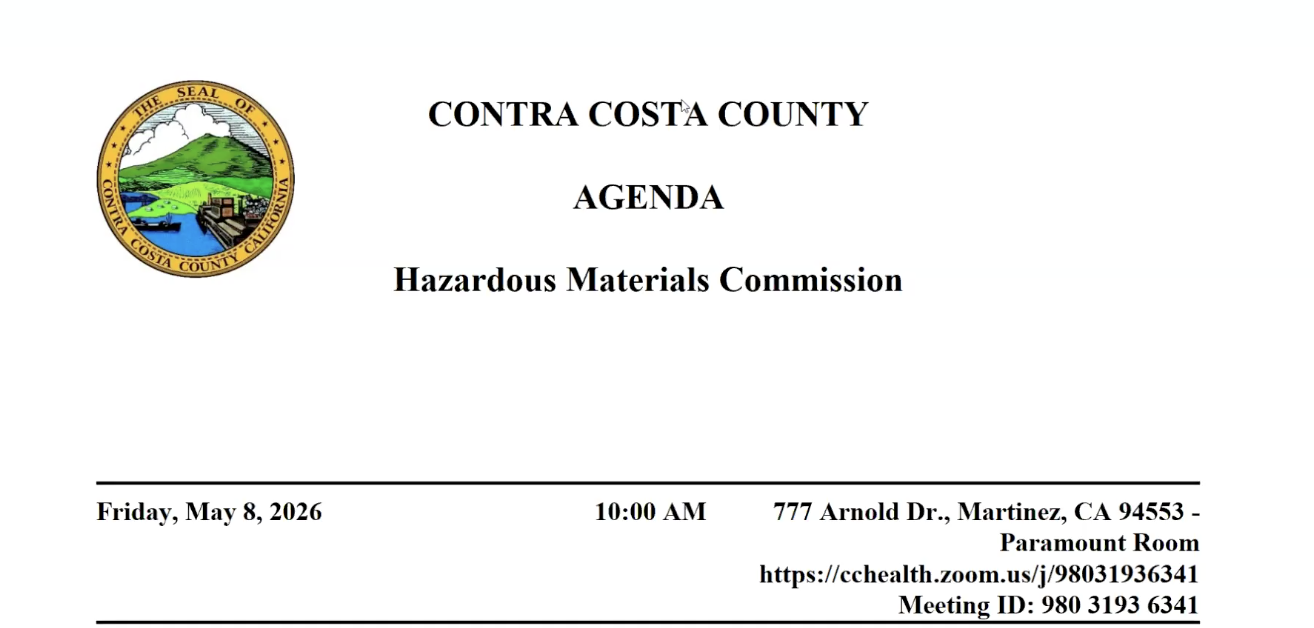
Hazardous Materials Commission - May 27, 2026 - Meeting
Hazardous Materials Commission • Contra Costa CountyMay 27, 2026
Locunity is a independent informational service and is not an official government page for this commission.We use AI-assisted analysis and human editorial review to publish information.
PFAS Alarm, CEQA Concerns and New Interview Rules Top Hazmat Commission Agenda
The Contra Costa County Hazardous Materials Commission's Operations Committee tackled a packed agenda on May 27, covering alarming water contamination data, a state bill that could weaken environmental review near refineries, and a lengthy effort to standardize how the commission fills its vacant seats. The meeting also surfaced emerging climate technology research and planning for an upcoming public forum.
Rodeo wastewater facility shows PFAS levels three times higher than any other plant in the nine-county Bay Area
Commissioners flag SB 954's CEQA exemptions for advanced manufacturing as a threat near refineries and green empowerment zones
Operations committee drafts step-by-step interview procedures for commissioner and intern candidates amid multiple vacancies
AB 2184 on nature-based climate solutions referred to Planning and Policy as alternative to industrial carbon capture
Richmond's living levee project stalled after Chevron pulled out over sea-level-rise attribution dispute
Rodeo's PFAS Levels Sound Alarm Across Bay Area
Why it matters: PFAS — the so-called "forever chemicals" linked to cancer and other health effects — are not yet regulated in wastewater, but Rodeo's contamination levels could force the issue for regulators and ratepayers across Contra Costa County.
Where things stand: Commissioner Aaron Winer, who represents the West County Council of Industries, reported extensive PFAS activity across Bay Area water agencies, including monitoring programs with BACWA (Bay Area Clean Water Agencies). "We've got a lot of stuff going on related to PFAS. A lot of it is on the horizon — for example, sampling, monitoring programs with BACWA," he said, committing to bring back a summary of the scope and agency responses.
Commissioner Maureen Brennan, the environmental justice representative, delivered the meeting's most striking data point: "We are three times as high as any other wastewater facility in the nine counties," she said, referring to the Rodeo wastewater plant's PFAS test results. She raised the question of whether the results should be reported to the regional water board, even in the absence of wastewater PFAS regulations.
Discussion also covered biosolids disposal liability, with the Contra Costa Water District working to secure exemptions from future PFAS liability for solids disposal. Zone 7 Water District was identified as a potential speaker on drinking water PFAS treatment.
Staff Adam Springer reported that the Department of Conservation and Development could provide a speaker on the county's $2 million EPA brownfields redevelopment grant. "We did get some information from DCD — Department of Conservation and Development — that they could provide a speaker given they're working on the EPA brownfields grant," he said. Commissioner Brennan noted the grant covers sites in Antioch, Pittsburgh, Pinole and Rodeo, and suggested the brownfields topic could anchor the commission's upcoming public forum.
What's next: Staff will schedule presentations from wastewater and drinking water agencies on PFAS, a brownfields grant briefing from the Department of Conservation and Development, and a separate speaker from ISO. Commissioner Winer will return with a framework for summarizing PFAS scope and agency preparedness.
CEQA Exemption Bill Raises Red Flags Near Refineries
The basics: SB 954 proposes CEQA (California Environmental Quality Act) exemptions for advanced manufacturing facilities — a category that encompasses electronics, pharmaceuticals, robotics, electric vehicles and solar panels.
Why it matters: Weakening environmental review for these facilities could have direct consequences in Contra Costa and Solano counties, where a green empowerment zone is being developed that would invite advanced technology into neighborhoods already adjacent to refineries.
The issue arose during approval of the April meeting minutes, which commissioners amended to explicitly reference SB 954 and its CEQA implications — ensuring the bill stays on the commission's radar.
"I think it's particularly important not to weaken the CEQA regulations because of the green empowerment zone that's being developed for this county and Solano County," said Commissioner Maureen Brennan.
Commissioner Jim Purcell, who holds the environmental organization seat, added that the concern is not hypothetical: "OpenAI has opened a robotics manufacturing facility along the shoreline, and it's currently in the Craneway," he said, noting that expansion or new entrants could benefit from such exemptions.
Decisions: The minutes were approved on a voice vote (For: 3, Against: 0, Abstain: 1). Commissioner Winer abstained because he was not present at the prior meeting.
Commission Builds Formal Playbook for Filling Vacant Seats
Why it matters: Multiple vacant or potentially vacant seats — including a public alternate, union seats and a mayor seat — threaten the commission's quorum. Without standardized procedures, past candidate evaluations have been inconsistent and hard to defend.
The operations committee spent the bulk of the meeting drafting step-by-step procedures for interviewing both commissioner candidates and student interns. The process they documented covers three phases:
Pre-interview: Staff posts the seat opening for at least 30 days, receives applications, verifies minimum requirements, redacts personal information and attaches redacted applications to the operations committee meeting agenda.
During interviews: Staff introduces commission responsibilities, meeting schedules and the specific seat. Commissioners introduce themselves to each candidate. Questions rotate among present commissioners, with a 1-to-5 scoring scale available as a guide. The committee chair asks if the applicant has questions.
Post-interview: Staff tallies rank-order votes — top three choices from each commissioner. The committee discusses and selects a seat holder and alternate. The recommendation goes to the full commission as a consent item (which can be pulled for discussion), then through the county's Internal Operations Committee to the Board of Supervisors.
Chair Marielle Boortz emphasized attendance expectations throughout the drafting: "We emphasize attendance now. In-person attendance, even if you're an alternate."
Commissioner Brennan flagged a fairness question about whether applicants sitting in on earlier interviews creates an advantage: "If there's several interviews in a row, the students can sit in and listen to it all," she noted.
Key procedural points debated included whether returning members must re-interview (they have the option to decline), in-person attendance expectations and whether commissioners can choose which committee to serve on — a question referred to the bylaws review.
For student interns, a parallel process was drafted with modifications: same interview form with a grading scale, selection of top two candidates, no Board appointment required but full commission approval needed, and different expectations including preparing and presenting research to the full commission.
Commissioner Winer reported that his proposed alternate, Dave Showenthal, is already moving through the county appointment process: "Dave Showenthal is my proposed alternate and it's running through whatever the process is."
What's next: The draft procedures will be finalized at the next operations committee meeting.
Commissioners Survey Emerging Climate Technologies
Commissioner Brennan asked the Planning and Policy committee to review AB 2184, a nature-based climate solutions bill, as an alternative to industrial carbon capture. "I'd like to see if Planning and Policy might take a look at this. It's AB 2184, nature-based climate solutions, mostly because it has to do with an alternate to carbon capture," she said, suggesting 10,000 trees as a starting point.
Chair Boortz reported reading Chevron's annual report, noting the company's carbon capture operations at an LNG terminal in Australia, its acquisition of acreage for lithium mining on the Texas-Arkansas border and cavern storage of hydrogen in Utah. "I actually read through the Chevron annual report, and they're doing — have been doing — carbon capture in Australia," she said.
Commissioner Purcell described urban algae forests being tested in China — large tanks that cycle air through algae to scrub carbon, with the algae skimmed off monthly for biofeed. He also recounted how Richmond's living levee project stalled after losing Chevron as a partner: "We also lost Chevron as a partner because the people who were doing it were unwilling to budge on the attribution of petrochemical refining as being a source of sea level rise."
Commissioner Brennan recalled former commissioner Howard Adams's proposal to use the Selby slag area for giant algae tanks near the Phillips 66 renewable diesel project, and shared an article about Scottish researchers creating hydrogen from breadcrumbs using a metal catalyst.
Minor Items
Forum logistics: Staff has not yet confirmed the IBEW hall reservation for the commission's upcoming public forum. Commissioner Purcell, who recently attended training at the facility, described the layout. Chair Boortz will share an updated planning checklist with staff. Detailed planning deferred to the next meeting.
Roll call: The operations committee convened after a delayed quorum. Present commissioners included Chair Boortz (League of Women Voters, Diablo Valley), Commissioner Winer (West County Council of Industries), Commissioner Brennan (environmental justice representative) and Commissioner Purcell (environmental organization seat). Adam Springer staffed the meeting.