Hazardous Materials Commission - Apr 21, 2026 - Meeting
Hazardous Materials Commission • Contra Costa CountyApril 21, 2026
Locunity is a independent informational service and is not an official government page for this commission.We use AI-assisted analysis and human editorial review to publish information.
Hazmat Commission Eyes Battery Fire Ban, CEQA Fix as Forum Planning Ramps Up
Contra Costa County's Hazardous Materials Commission Operations Committee used a sprawling work session to map its policy agenda for the months ahead — locking in a venue for its September public forum, flagging deadly lithium battery fires as a potential county legislative priority, and raising alarms about a state law that weakened environmental review for industrial projects near residential neighborhoods.
- Lithium battery fire safety emerges as potential county priority after fatal e-bike fires in San Francisco and San Jose prompt committee to explore legislation modeled on SF's proposed ban on uncertified batteries
- IBEW Union Hall secured for Sept. 17 public forum, with fee waiver requested as commission navigates zero-budget transition between county departments
- Commissioners flag SB 954, a bill to restore CEQA protections for advanced manufacturing weakened by last year's SB 131, as critical for Carquinez Straits industrial corridor
- Carbon capture, industrial safety, and PFAS remediation speakers lined up for upcoming general commission meetings
- Outreach overhaul planned for September forum after last year's low public turnout
Deadly Battery Fires Push Committee Toward County Action
The longest and most heated discussion of the morning centered on lithium-ion battery fires — a growing public safety and hazardous waste crisis that the committee spent nearly 35 minutes examining across multiple angles, including fire science, consumer regulation, disposal logistics, and building egress.
The basics: Lithium-ion batteries, found in everything from e-bikes to power tools, can cause catastrophic fires when cheaply manufactured units lack proper charging controls. A recent e-bike fire in San Jose killed a resident. In San Francisco, Supervisor Bilal Mahmoud has proposed legislation banning uncertified lithium-ion batteries with penalties up to $1,000.
Why it matters: The committee is weighing whether to recommend that Contra Costa County follow San Francisco's model — either through a countywide ban on uncertified batteries or, as a starting point, purchasing standards for county procurement.
Where things stand: Commissioner Tim Bancroft, who brings fire service expertise, walked through the battery quality grading system using a vivid analogy: "Your A is the top of the line. Beautiful tomato that's just perfect. And then there's B, C and D, which it might have a worm in it, might be rotten. You don't know. Same thing goes for batteries."
Bancroft explained that cheap, uncertified chargers are the primary culprit — devices that lack the circuitry to stop charging when a battery is full. He urged public education: "The biggest problem we're trying to do now is educate the general public — don't leave it plugged in the wall overnight. Plug it in for an hour or two and take it off, set a timer, unplug it."
Commissioner Lou Flores shared the San Francisco Standard article detailing Mahmoud's proposal, noting SF Fire Chief Dean Crispin's public support. "They're creating legislation. It says here violations would carry penalties of up to $1,000," Flores reported. "This article came out April 7, just a few days ago."
The other side: The disposal problem is nearly as daunting as prevention. Staff member Adam Springer told the committee that Contra Costa Fire District has been grappling with what to do with fire-damaged batteries after incidents: "We're kind of looking into that right now because there have been some recent fires where Contra Costa Fire District had to put out the fire and had to leave the batteries for the residents to deal with, dispose of." Springer noted that household hazardous waste facilities are currently the recommended option, but capacity and logistics remain unclear.
Commissioner Jamie Purcell raised a building safety dimension that hadn't been on the committee's radar: e-bike charging racks placed at apartment building exits, creating a situation where the most likely fire location blocks the primary escape route.
Purcell also framed the broader challenge: "I think the real problem is that almost everything is converting over to rechargeable batteries only."
What's next: Staff circulated the San Francisco article to the full commission. Chair Marielle Boortz suggested the commission could recommend the Board of Supervisors adopt purchasing standards banning uncertified batteries from the county budget as an initial step. The committee will continue tracking San Francisco's legislative progress.
Commission Locks In IBEW Hall for September Forum, Seeks Fee Waiver
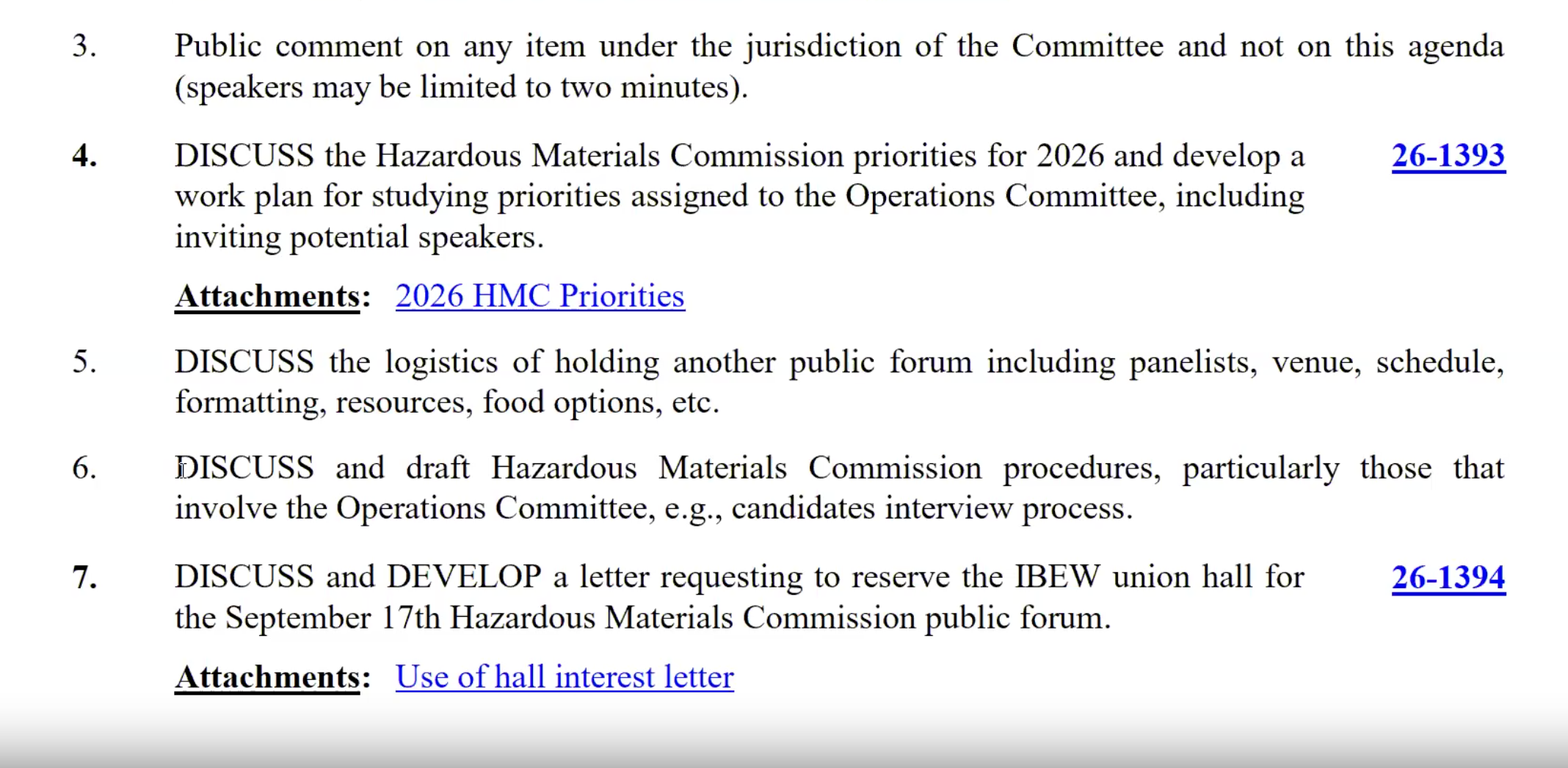
With one member needing to leave early and the quorum at risk, the committee moved this action item to the top of the agenda — and voted unanimously to direct staff to draft a letter reserving the IBEW Union Hall for its annual public forum on Sept. 17 from 6 to 8 p.m.
Why it matters: The commission operates without a dedicated budget during an ongoing transition of the Hazardous Materials Program from Health Services to Contra Costa Fire District (ConFire). The IBEW hall charges a $250 setup and janitorial fee with no rental charge, but even that modest cost is a burden.
Chair Marielle Boortz laid out the financial reality: "As we've been told previously by staff, we do not have a budget. And then we're under the hazardous materials program, which is in transition of going from one county department to another. And so it could be difficult for us."
Springer proposed requesting the fee waiver as part of the reservation letter. Commissioner Terry A. Baldwin, representing the Central Labor Council, volunteered to make the case directly to the IBEW board: "I'll be the advocate of saying please — we know the county's up against it financially anyway, so if we can help out in that, I will be the advocate for that."
Decisions: The motion passed unanimously. The IBEW board votes on the third Tuesday of each month, giving staff roughly a week to finalize and submit the letter. Boortz will review the draft before it goes out.
Commissioners Sound Alarm on CEQA Loophole for Industrial Projects
In an announcement segment that carried the weight of a policy discussion, Commissioner Lou Flores and Commissioner Maureen Brennan reported on a webinar about SB 954, a new state bill designed to repair damage done by last year's SB 131 — which created a sweeping CEQA exemption for "Advanced Manufacturing" projects.
The basics: CEQA (the California Environmental Quality Act) requires environmental review before major development projects. SB 131 exempted Advanced Manufacturing from that review. SB 954 aims to restore those protections.
Why it matters: The Green Empowerment Zone along the Carquinez Straits is expected to attract heavy industrial development to Contra Costa County. Without CEQA review, projects could be approved and built near residential areas with no prior assessment of toxic emissions or accident risk.
Brennan cited the cautionary tale of Atlas Radius Recycling, which received approval without adequate environmental review and later had a major fire releasing lead, cadmium, zinc, and other carcinogens into the surrounding neighborhood. "The new technique is you just settle. We give you permission to do whatever you want. But then when there's a fire disaster, a huge release — this was lead, cadmium, zinc and other carcinogens through the neighborhood. So they just settled for $1 million," Brennan said. "I think we should fix it on the front end."
Flores framed the legislative stakes simply: "I think that is the essence of it, is that 131 weakened CEQA completely."
The bill has support from both environmental organizations and the United Steelworkers and is relevant to Assembly District 14, which covers much of Contra Costa County. Staff noted this would be tracked as an ongoing policy item.
Carbon Capture, Industrial Safety Speakers Slated for Coming Months
The committee spent considerable time coordinating upcoming presentations that will shape the commission's policy positions on several fronts.
Carbon capture (April 23): Brennan confirmed that a speaker named Isabel will present virtually on carbon capture at the next general commission meeting. Brennan is also pursuing a co-speaker from the Pipeline Safety Trust to address CO2 pipeline safety, given California's moratorium on CO2 pipelines. "Carbon capture, a huge issue of it is the state legislature on pipeline safety and pipeline usage. There's been a moratorium on putting CO2 through pipelines. So I would like to hear an expert from the pipeline segment talk about carbon capture," Brennan said.
Both presentations must be submitted by April 16 for inclusion on the agenda.
Industrial Safety Ordinance (May): Brennan also secured David Lindsay from Solano County to present on their newly adopted Industrial Safety Ordinance at the May general commission meeting. The goal is a compare-and-contrast with Contra Costa's ISO, which governs refinery and tank farm safety. Staff noted the county's ISO has been revised recently but acknowledged the value of the external perspective, particularly since tank farms were added to the county's ISO.
Forum Outreach Strategy Takes Shape After Low Turnout
Acknowledging that last year's forum was well-organized but poorly attended, the committee devoted significant discussion to an outreach overhaul.
Why it matters: The annual public forum is the commission's primary tool for direct community engagement. Without stronger attendance, the commission's policy recommendations carry less public backing.
Key strategies include issuing a save-the-date on the website as soon as the venue and date are confirmed; getting county approval for promotional materials much earlier than last year; distributing flyers through supervisor newsletters; reaching out to high school science clubs; and leveraging building trades union newsletters through CEO Tim Sobrani.
Brennan pushed for school engagement: "Really hard hit the high schools around here. Some of them have science clubs. We have a new superintendent for John Swett that's very active and I see her once a month at our RMC meetings. I will suggest it to her."
Staff noted that social media posting was delayed last year because the county preferred posting close to events. The July transition to ConFire will bring a new public information officer who may have different practices. The committee agreed to create a mock-up flyer for the next meeting and to form an outreach subcommittee.
PFAS, Hydrogen, and Data Centers Round Out Policy Scan
The committee also tracked several emerging environmental issues:
PFAS remediation: Members discussed multiple treatment approaches, including Orange County's new drinking water PFAS treatment system that goes beyond reverse osmosis, Zone 7 Water District's recently installed PFAS treatment facility in the Pleasanton area, and mushroom-based remediation research that could break down removed PFAS rather than simply filtering it. Commissioner Aaron Winer of West County Wastewater was identified as a key contact but was absent. Staff will circulate the Orange County article.
Hydrogen and data centers: Brennan shared Scottish research on generating hydrogen from breadcrumbs — highlighting that organic feedstocks avoid toxic emissions from plastic incineration. Purcell noted the Raven facility already uses organic materials like dead branches. Discussion turned to data centers, with concern about a proposed Pittsburgh, Calif., facility that would burn methane rather than use renewable energy. The Phillips 66 solar farm along I-80 was cited as providing 15% of the refinery's energy needs.
Minor Items
- March committee meeting minutes approved unanimously by show of hands.
- No public comments were received on non-agenda items.
- OPS Committee began cataloging procedures requiring formal documentation — including the public forum planning checklist, intern selection and mentorship process, commission seat interview standards, candidate solicitation boilerplate language, and onboarding materials. No written intern procedures currently exist. Documents will be housed on the commission website.
- Jennifer Qualic from Supervisor Candace Anderson's office attended.