
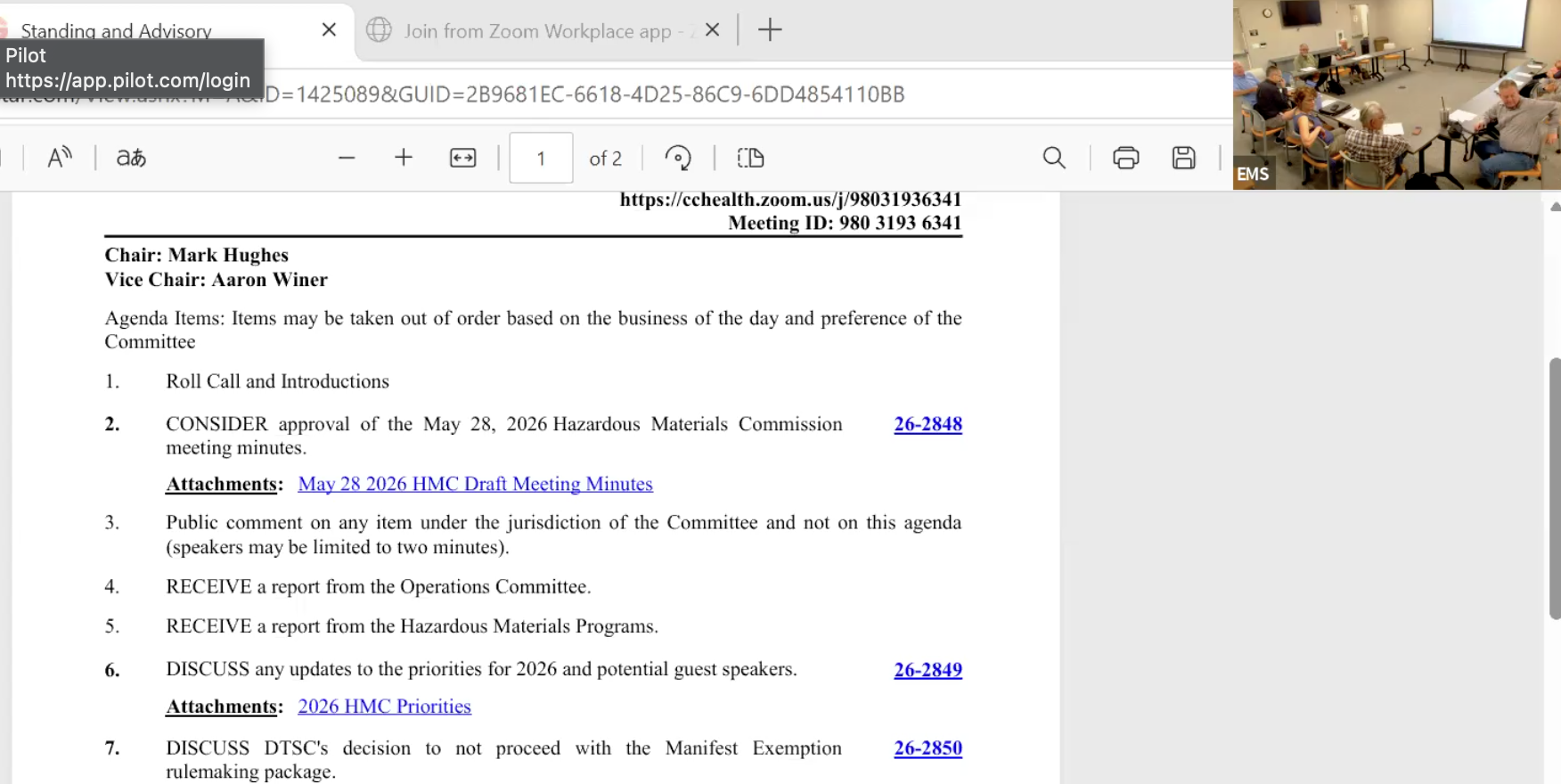
Hazardous Materials Commission - Jun 29, 2026 - Meeting
Hazardous Materials Commission • Contra Costa CountyJune 29, 2026
Locunity is a independent informational service and is not an official government page for this commission.We use AI-assisted analysis and human editorial review to publish information.
Marathon Refinery Safety Alarms Commission After 60-Day Strike
A striking refinery worker's testimony about unqualified replacement workers and uncontrolled flaring events at Marathon's Contra Costa County facility dominated the Hazardous Materials Commission's June 29 meeting, prompting commissioners to demand a formal staff investigation. The session also surfaced a 900-signature public petition calling for decommissioning bonds at the Martinez refinery, while commissioners grappled with uncertainty about the commission's own survival.
- Striking Marathon refinery worker warns of "doomsday flare" and unqualified replacement staff during 60-day strike; commission orders formal investigation at next meeting
- 900-signature petition demands PBF Energy post a decommissioning bond for Martinez refinery, naming the commission as a decision-maker
- CalEPA clears transfer of hazardous materials oversight from Health Department to Contra Costa Fire Protection District, affecting 4,000 facilities
- Commission's future remains in limbo as staff delivers no update on proposed elimination by Board of Supervisors
- 45-day public comment period opens on MRC fire audit, with community meeting set for July 1
- California rejects federal rule that would have allowed cross-property hazardous waste consolidation
Marathon Strike Puts Refinery Safety Under the Microscope
Why it matters: A 60-day labor dispute at one of Contra Costa County's major refineries has escalated beyond a standard contract fight — it is now a public safety question that the commission is treating with urgency.
Where things stand: Carl Smith, a USW Local 5 refinery worker at Marathon's facility, told the commission that workers have been locked out since the previous Sunday after 60 days on strike. He described replacement workers inside the facility as unqualified and reported alarming incidents visible from outside the gates.
"I'm a refinery worker over at Marathon Facility. We're currently on our 60th day of the strike and we are basically your eyes and ears inside of the plant. And we believe there are many unqualified workers in there," said Carl Smith, USW Local 5 refinery worker.
Smith described uncontrolled events the striking workers have witnessed from outside. "We've seen flaring. We call it the doomsday flare. And this is when there's uncontrolled events going on," Smith said.
Commissioner Maureen Brennan, Environmental Justice Representative, who said she has visited the picket line twice, drew a direct line between conditions at Marathon and the February 2025 fire at the nearby Martinez Refining Company — an incident attributed to inadequately trained contracted workers.
"The very reason that there was problems in the MRC with the fire, February 1st," Brennan said. She also expressed alarm about working conditions for replacement staff: "They're mandating 18-hour shifts. That's outrageous to anyone to stay awake and be functional."
The county's response: Adam Springer, Contra Costa County Hazardous Materials Program staff, confirmed the county has already acted. "We actually sent staff to the facility to audit them to make sure they're complying with all the regulatory standards having to do with these changes, the management change. We are going to look at it, into it further as well," Springer said. He added that the county is coordinating with Cal OSHA on training requirements and will send another inspection team the following week.
What's next: Commissioners requested that the Marathon strike situation be placed on the next meeting's agenda with a formal staff report detailing the county's regulatory authority under the Industrial Safety Ordinance. Chair Mark Hughes agreed to add the item.
900 Signatures Name Commission in Refinery Decommissioning Fight
Why it matters: A Change.org petition with more than 900 signatures is thrusting the Hazardous Materials Commission into a politically charged fight over refinery accountability — at the very moment the commission's existence is being questioned.
Where things stand: Commissioner Lou flagged the petition, which is directed at both the Board of Supervisors and the commission. It demands that PBF Energy, owner of the Martinez Refining Company, be required to post a decommissioning and remediation bond. The petition calls for funds that fully cover cleanup, a secure account to prevent bankruptcy evasion, and an independent environmental assessment.
"They actually name the board of supervisors each one of them and they also name the Contra Costa County Hazardous Materials Commission. So we may end up getting a petition from 900 plus people," said Commissioner Lou.
Commissioner Brennan noted the irony. "I found it very interesting that we as a commission have been elevated to decision makers," she said — a pointed remark given the Board of Supervisors is simultaneously considering eliminating the commission.
Existing safeguards: Springer clarified that current regulations already require facilities generating RCRA hazardous waste to be financially responsible for cleanup. "They're already financially responsible for cleanup of their facility. Whenever they decide to shut down, there's a process for cleanup. They have to leave the site cleaned up to regulatory standards," Springer said.
Commissioner Tim Bancroft, League of Women Voters, confirmed from his professional experience that treatment permit holders must demonstrate financial solvency. "Financial responsibility is part of the program. They have to be financially responsible and they have to file documentation to show that they are solvent or they have some other mechanism of payment that is available," Bancroft said. Still, he acknowledged the public's concern about bankruptcy scenarios.
What's next: Staff agreed to provide commissioners with a list of CalARP-regulated facilities — approximately 40 beyond the four refineries, including hydrogen plants, biotech companies, and renewable fuel facilities — and information on refinery cleanup obligations so commissioners can respond to community questions.
CalEPA Clears Hazmat Oversight Transfer to Fire District
Why it matters: The transfer of hazardous materials regulatory authority from Contra Costa County's Health Department to the Contra Costa Fire Protection District represents the largest restructuring of the county's environmental enforcement apparatus in years, affecting oversight of approximately 4,000 regulated facilities and nearly 40 staff members.
Where things stand: Springer reported that a CalEPA public hearing held the morning of the meeting received no oral public comments and only one written comment — in favor of the transfer. CalEPA's position is to support whatever the county decides, as long as functional requirements are met. The change takes effect July 1.
"The county then decides who administers the CUPA. The county then is what went in and decided to change who administers the CUPA for the county. They decided that it would be the Contra Costa Fire Protection District," Springer explained.
The basics: The county retains its CUPA authorization — the Certified Unified Program Agency designation that governs hazardous materials regulation. Only the administering division is changing. CalEPA will continue re-auditing the CUPA on a triannual basis. The Industrial Safety Ordinance is a separate program approved by the Board of Supervisors and is not affected by the CalEPA process.
Springer himself is transitioning to a uniformed position as Deputy Fire Marshal with ConFire effective July 1, with a pinning ceremony planned. Commissioners noted that support staff member Brianna will be moving to a different department, raising concerns about ongoing administrative support during the transition. Brianna confirmed she can continue supporting the commission at least through October.
Commission Presses On Despite Elimination Uncertainty
Why it matters: The commission's ongoing planning for its annual public forum and policy work faces an existential question: whether the Board of Supervisors will abolish the body as a cost-cutting measure.
Where things stand: Chair Hughes reported that when developing the meeting's agenda, he asked staff whether there was an update on the proposed elimination and was told there was none. Program director Nicole, who had taken input from both the Board of Supervisors and the commission at the previous meeting, was not present and had not reported back.
Commissioner Brennan voiced frustration directly. "How do we move forward in this kind of limbo? Because we're talking about a forum we're planning, and it's a big deal. It's a time suck for a lot of people. And why are we moving forward if there's not going to be a commission?" she asked.
Commissioner Jamie offered historical context, noting the pattern is familiar. "This is a discussion that has come up before in the past. Because there's always a moment when they're trying to do cost cutting, and so they will poke at every single thing to try and find some cost cutting. And that doesn't mean that it's going to get cut," Jamie said.
Commissioner Lou read the commission's mission statement aloud — "to provide and promote a forum for building consensus on environmental issues affecting Contra Costa residents related to hazardous materials and hazardous waste" — and suggested it should guide the commission's narrative to the Board of Supervisors.
Decisions: The commission resolved to press forward with all planned activities. Chair Hughes summed up the sentiment: "I think we just need to move forward, assuming that we're going to just continue to move on until somebody tells us not to and then we'll cross that bridge when we get to it."
What's next: The bylaws revision was assigned to the Planning & Policy Committee for the next month's meeting. Chair Hughes will add the organizational transition as an agenda item for the July 23 meeting and request Nicole's attendance.
MRC Fire Audit Enters Public Comment With July 1 Meeting
The Martinez Refining Company Oversight Committee held a meeting May 18 featuring a presentation by ERG on its third-party facility audit related to the February 1, 2025, MRC fire — an incident that injured six workers and forced a shelter-in-place.
"This is the public opportunity to comment on the third-party full facility audit associated with the fire at Martinez Refining Company MRC which occurred on February 1st, 2025. It starts the 45-day public comment period on the 23rd. It will close on August 7th," Springer said.
An in-person community meeting is scheduled for July 1 from 5-7 p.m. at the new office, with a Zoom webinar option. Staff will distribute the notice to the full commission. Discussion clarified the distinction between the MRC fire (February 2025) and a separate Marathon fire (November 2023) at a different facility.
California Blocks Cross-Property Hazardous Waste Consolidation
Commissioner Lou brought this item as a follow-up to prior commission discussion. Federal law already allows businesses with facilities across the street from each other to consolidate hazardous waste from both locations for a single shipment. California's Department of Toxic Substances Control considered adopting the same rule but backed off after receiving public comments expressing concerns about tracking and accountability.
Springer explained that in practice, businesses cannot move waste across property lines to consolidate shipments — they must ship from each location separately, even if they own both properties. He noted arguments on both sides: consolidation reduces the number of waste containers, transportation trips, and costs, but raises tracking and accountability concerns.
Commissioner Bancroft provided practical context from his UC Berkeley experience. "As I was told by a hazardous waste hauler many years ago, it cost $200 to pick up a five-gallon container of waste and it cost $200 to pick up a 55-gallon drum of waste. So if you're allowed to consolidate it, it really reduces your costs," Bancroft said. He also noted that consolidation creates problems when incompatible wastes are mixed.
Commissioner Brennan raised a related local issue: the Rodeo Sanitation District is considering whether to allow a tank farm to send low-level dioxin waste through the municipal sanitation plant.
Minor Items
- Minutes approved: The commission approved prior meeting minutes by show of hands, with one member abstaining because they were not present at the previous meeting.
- September 17 public forum confirmed: The commission's annual forum will be held 6-8 p.m. at the IBEW hall in Martinez. Raven representatives are ready to present their waste-to-fuel technology (converting organic food waste into hydrogen and jet fuel); the commission is targeting the July 23 general meeting for that presentation. Carbon capture presenters may not participate.
- E-fuels topic added: Commissioner Brennan introduced e-fuels for aviation as a potential forum topic after attending a webinar, noting e-fuels combine hydrogen with direct air carbon capture and differ from traditional sustainable aviation fuels. Zone 7's PFAS filtration implementation is also under consideration.
- Forum sponsorship: The commission has no budget for food; Chair Hughes offered the Industrial Association's help in securing industry sponsors.
- Seneca site tours: A commissioner announced that the Richmond Shoreline Alliance is organizing tours of the Seneca cleanup site, where a dispute continues between the alliance, the owner, and DTSC over remediation levels.
- No new legislation: Staff reported no new hazardous materials legislation, with brief mentions of a CEQA housing exemption and AB 617 but no substantive action.