Hazardous Materials Commission - Apr 27, 2026 - Meeting

Hazardous Materials Commission - Apr 27, 2026 - Meeting

Hazardous Materials CommissionContra Costa CountyApril 27, 2026

Sources:

Locunity is a independent informational service and is not an official government page for this commission.We use AI-assisted analysis and human editorial review to publish information.

Experts Sound Alarm on Unregulated CO2 Pipeline Through the Bay Delta

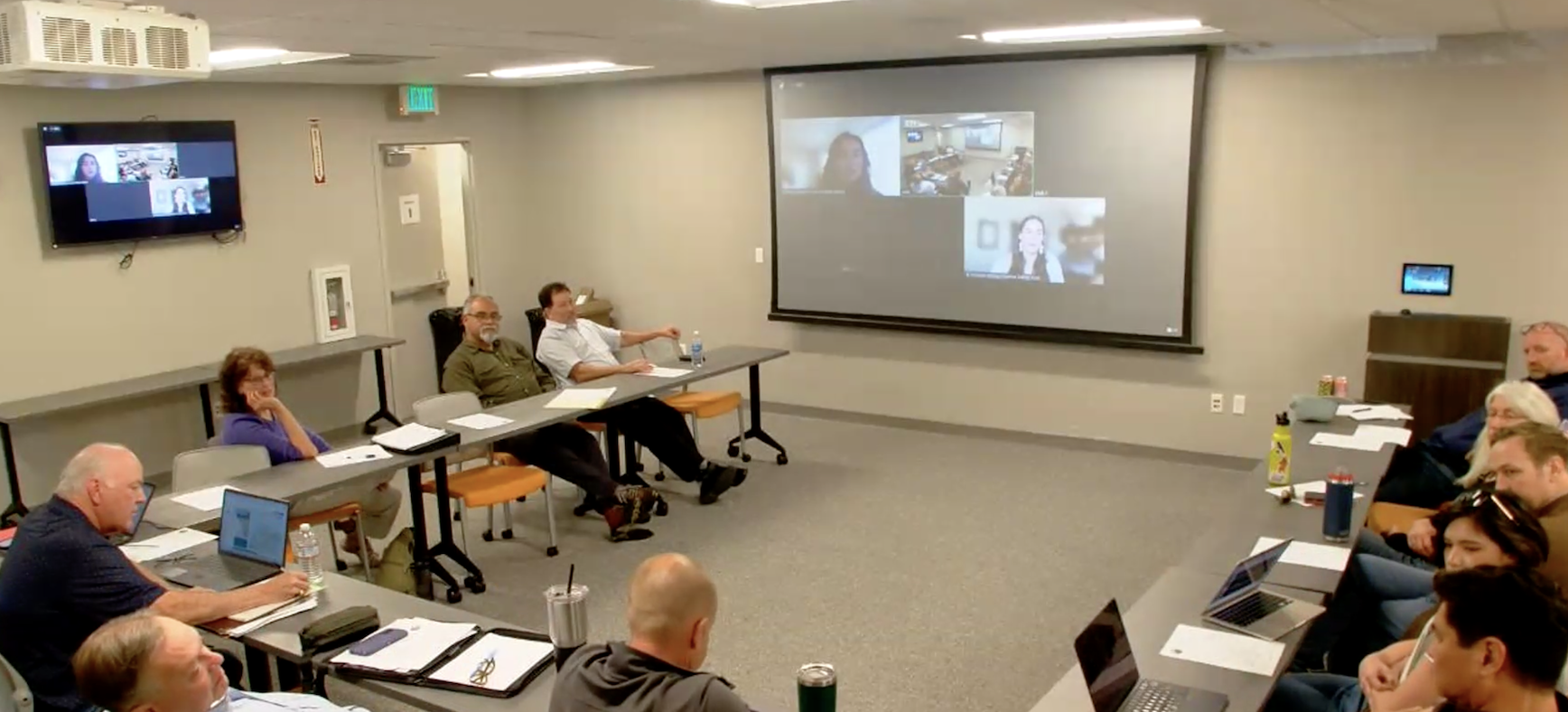
The Contra Costa County Hazardous Materials Commission devoted the bulk of its April 27 meeting to a stark warning: a proposed 45-mile underwater carbon dioxide pipeline through the San Francisco Bay Delta would run near more than 150,000 residents with no finalized federal or state safety regulations in place. Commissioners grilled two national experts, debated whether carbon capture is a climate lifeline or a fossil fuel lifeline, and agreed to invite the project developer for a future hearing.

  • Experts detail safety, ecological and regulatory gaps in the Montezuma Carbon Sequestration Hub, a proposed 45-mile underwater CO2 pipeline through the Bay Delta
  • Commissioners clash over whether carbon capture is worth the risk, with some calling the technology unproven and others asking what alternatives exist to fight the climate crisis
  • Five additional carbon sequestration projects flagged in the Delta region, one overlapping Discovery Bay's 15,000 residents
  • Hazmat program transfers to fire department July 1, upgrading from 8-to-5 coverage to around-the-clock response
  • Chronic commissioner absences threaten quorum; two seats flagged for potential vacancy and bylaws review fast-tracked

A 45-Mile Pipeline, No Rulebook

The commission's Operations Committee invited two national experts — Isabel Penman of Food and Water Watch and Amanda McKay of the Pipeline Safety Trust — to present on the Montezuma Carbon Sequestration Hub Project, a proposal by Montezuma LLC to build an underwater CO2 pipeline connecting industrial facilities, including Chevron's Richmond refinery and a PG&E gas plant in Antioch, to an injection site near Collinsville in Solano County.

The basics: Carbon capture and sequestration (CCS) involves capturing CO2 emissions from industrial sources, compressing the gas, transporting it via pipeline and injecting it deep underground for permanent storage. The Montezuma project would inject 40 to 100 million tons of CO2 over 40 years, two miles beneath a 3,200-acre site.

Why it matters: The pipeline route passes through the Bay Delta's ecologically sensitive waters adjacent to dense population centers — 124,000 people near the Carquinez Strait, 27,000 in Benicia and another 10,000 to 15,000 in the Rodeo-Crockett-Port Costa corridor — all while federal CO2 pipeline safety rules remain unfinished and state emergency rulemaking under SB 6 is not expected until July 2026.

What Could Go Wrong

Penman opened by walking commissioners through the physical properties that make CO2 pipelines uniquely dangerous. Unlike natural gas, CO2 is odorless, colorless, heavier than air and an asphyxiant — it displaces oxygen, disables combustion engines and pools in low-lying areas. She pointed to the 2020 rupture of a CO2 pipeline in Satartia, Mississippi:

"Over 300 community members had to be evacuated. There are stories from folks who are community members remembering being in their vehicles, and all of a sudden their car stopped working and they weren't sure why. And then waking up in the hospital," said Isabel Penman, Food and Water Watch.

McKay detailed the mechanical risks specific to CO2 transport. Because CO2 transitions rapidly between gas and liquid phases under pressure changes, a breach can trigger what engineers call fracture propagation:

"That rapid phase change increases the possibility of fracture propagation, which is essentially when the pipeline will open up almost like a zipper, releasing large amounts of CO2 at a very rapid rate," said Amanda McKay, Pipeline Safety Trust.

McKay noted that Contra Costa County has experienced 34 pipeline failures since 2010 — 24 hazardous liquid, seven gas distribution and three gas transmission — resulting in roughly 58,000 gallons of hazardous liquids spilled and approximately $17 million in damages. An underwater pipeline, she added, faces additional risks from anchor strikes and dredging.

The Ecological Dimension

Penman explained that CO2 mixed with water creates carbonic acid, which could generate aquatic dead zones in the Delta — habitat for endangered species including the Delta smelt. Impurities in industrial CO2 streams, including water and hydrogen sulfide, compound the corrosion risk inside the pipeline itself.

Beyond this single project, Penman flagged five additional carbon sequestration proposals by California Resources Corporation (CRC) in the Delta region. "I want to point out specifically Carbon Teravault Project 3, which the entire area of review goes under the entirety of Discovery Bay, which has a population of 15,000 people. It sprawls across three different counties, including Contra Costa County, and is bounded on all four sides by different fault lines," she said.

The Regulatory Vacuum

Federal CO2 pipeline safety rules were drafted under the previous administration but pulled back in early 2025. California's Office of the State Fire Marshal (OSFM), which has jurisdictional authority over hazardous liquid pipelines in the state, is conducting emergency rulemaking under SB 6, with rules expected by July 2026. The EPA has deemed the developer's Class 6 injection well application incomplete.

McKay urged commissioners to explore local tools. "I believe that Contra Costa County's was last updated in 2013. And so I think that there's an opportunity there to look at the franchise agreement and put additional protections into those franchise agreements," she said.

Does the Technology Even Work?

Penman challenged the fundamental premise that CCS delivers on its climate promises. "Every single project — there has not been a single example of a large commercial industrial-scale carbon capture and storage project actually capturing the amount of carbon that project developers have promised," she said.

She also described the "energy penalty" — CCS technology requires so much additional energy to power the capture equipment that it increases total fuel consumption by 13–44%, potentially raising local air pollutant emissions even as CO2 is captured.

Commissioners Weigh In

The presentation triggered a sharp internal debate. Commissioner Lisa highlighted the human geography: "There's 124,000 people living right next to that. It'll be going by Benicia where there's another 27,000 people." She added: "How many more hospitals are we going to need to build just in case we have this pipeline rupture?"

One commissioner argued the technology is too dangerous and unproven, advocating instead for emissions reduction and alternatives like tree planting and CO2-in-cement technology.

A staff member pushed back, framing CCS as a potential bridge technology: "Do we really have the option to ignore a solution? I don't know that many other solutions like this that are actively ready to combat this problem. So maybe what I'm trying to get at is, if not this, then what else do we have?"

Chair Mark Hughes posed the central question directly to presenters: "If this project could go forward and the risks could be reasonably mitigated and addressed, do you think in concept this is a good project?" He drew an analogy to early opposition to natural gas infrastructure, noting that similar risk debates accompanied the buildout of underground gas lines across Northern California decades ago.

Penman was unequivocal in response, arguing that CCS has a 50-year track record of failure and extends fossil fuel dependence rather than addressing climate goals.

Public commenter Charles Davidson cited the 1986 Lake Nyos disaster in Cameroon — in which a volcanic CO2 release killed hundreds — as evidence of catastrophic plume behavior. He argued that CCS investment near hundreds of thousands of people is wasteful compared to electrification, and recommended that any franchise agreements include active community monitoring and seismic instrumentation.

McKay closed with a call for zero-tolerance safety standards: "I think when we're talking about acceptable risk, we need to really remember that the goal is no risk. The goal is zero incidents from pipelines."

What's next: The commission agreed to invite Montezuma LLC representatives for a future presentation to hear the developer's perspective. A staff member offered to reach out to a contact at the project. The commission is building a record on CCS risks as one of its 2026 priorities, positioning itself to advise the Board of Supervisors on local regulatory responses.


HazMat Program Moves to Fire Department, Gaining 24/7 Coverage

Why it matters: Residents near Contra Costa's refineries and industrial corridor will get significantly faster hazmat emergency response when the program merges with the fire department.

Where things stand: The hazardous materials program will transfer to the fire department effective July 1. The existing hazmat response team and its three rigs will merge with the fire district's team. The upgrade moves from an 8-to-5 staffing model with after-hours on-call to 24/7 coverage. Specialty equipment will be retained, and fire personnel will receive cross-training in air monitoring and refinery-specific response. An ISO ad hoc committee meeting was announced for April 30. Commissioners were told meetings would continue at the current location after the transition.


Commission Tackles Chronic Absenteeism, Eyes Bylaw Overhaul

Why it matters: Both the Operations and Planning and Policy committees have struggled to make quorum, stalling policy work for months.

Where things stand: Multiple commissioners flagged two effectively inactive seats. One commissioner said plainly: "I'm very interested in planning and policy getting to bylaws because we've got two seats that are on our committee that we should really declare vacant."

The other side: Current bylaws only allow vacancy declarations in the last year of a member's term — a loophole that allows chronic non-participation. Because seats are appointed by external organizations, the commission has limited ability to force replacements. Alternative approaches discussed included delegation of authority to allow non-committee commissioners to participate and vote, though this raises its own quorum complications.

What's next: The Planning and Policy Committee will dedicate its next meeting entirely to a page-by-page bylaw review, with attendance enforcement provisions at the top of the agenda.


Minor Items

  • March meeting minutes approved by show of hands, no opposition, with one correction striking the phrase "and bring that to the Assembly" from item 12 to clarify the commission cannot speak on behalf of the Board of Supervisors.
  • September public forum planned for Sept. 17 at the IBEW hall (5–9 p.m., forum 5:30–7:30 p.m.); a letter requesting the venue and its $250 janitorial fee was sent, though the July 1 hazmat program transfer creates uncertainty about which budget covers the expense.
  • SB 966 flagged as priority legislation — the "gut and amend" bill pushed by United Steelworkers would codify federal Process Safety Management employee participation protections in state law, serving as a backstop if Cal/OSHA's Standards Board fails to act. A separate minimum staffing bill addresses worker safety during refinery shutdowns, relevant given the ongoing Benicia refinery shutdown. San Francisco's proposed legislation against uncertified lithium batteries was also discussed.
  • PFAS contamination pathway raised: A commissioner reported from a League of Women Voters meeting that the Contra Costa Water District uses granulated activated carbon (GAC) for water treatment, which absorbs PFAS. The spent GAC goes to landfills, and the district is part of a group seeking liability exemptions for potential PFAS contamination at disposal sites — a new data point for the commission, which had previously focused PFAS concerns on groundwater-dependent utilities.
  • 2026 commission priorities reviewed with no changes this month.
Experts Sound Alarm on Unregulated CO2 Pipeline Through the Bay Delta | Hazardous Materials Commission | Locunity