
Planning Commission - Jun 23, 2026 - Meeting
Planning Commission • Half Moon BayJune 23, 2026
Locunity is a independent informational service and is not an official government page for this commission.We use AI-assisted analysis and human editorial review to publish information.
SB 35 Briefing Exposes Half Moon Bay's Shrinking Control Over Housing Approvals
The Half Moon Bay Planning Commission got its clearest picture yet of what streamlined state housing law means for this small coastal city. A detailed briefing from the city attorney on SB 35 revealed that qualifying affordable housing projects can now bypass discretionary review entirely, setting the stage for a confrontation over the anticipated Midpen Metzger Street development.
State housing law strips local discretion: City attorney confirms Half Moon Bay is subject to SB 35 ministerial approvals due to unmet affordable housing goals and pending housing element certification
Midpen's Metzger Street project looms: The city's first SB 35 application is expected after tribal consultation concludes, with no discretionary review and no CEQA required
Commissioners press on transit, parking and fire safety: Urgent questions surface about whether a relaxed transit-stop definition could eliminate parking requirements citywide
Housing advocates and neighbors clash: Bilingual speakers describe overcrowded apartments and plead for construction while opponents cite evacuation risks and parking shortfalls
Gas station sign package approved 5-0 at the Highway 92 gateway, positioning the property for a potential retail conversion
State Law Meets Small-Town Reality
The basics: SB 35, as extended by SB 423, requires cities that have not met their affordable housing production goals to grant ministerial — meaning automatic, non-discretionary — approval to qualifying multifamily projects with at least 10% affordability. No public hearing, no CEQA review, no subjective design standards. Half Moon Bay landed on the state's compliance list because its housing element certification remains pending and it has insufficient progress on lower- and above-moderate-income units under its Regional Housing Needs Allocation.
City Attorney Mary Wagner of Burke, Williams & Sorensen walked commissioners through the statute for roughly 90 minutes, making clear the law fundamentally changes the city's relationship with housing developers.
"SB 35 creates a streamlined ministerial review and approval process for qualifying multifamily housing developments," said City Attorney Mary Wagner, adding that SB 423 extended the law's reach into the Coastal Zone — a critical change for Half Moon Bay — and pushed the sunset date to 2036.
Why it matters: The city has 60 days from application submittal to determine SB 35 eligibility for projects of 150 units or fewer, and 90 days to approve. Only objective planning standards — those involving "no personal or subjective judgment by a public official," as Wagner put it — may be applied. Subjective criteria like neighborhood compatibility or view protection are off the table.
Where things stand: The nonprofit developer MidPen Housing has filed a Notice of Intent for a project on Metzger Street but has not yet submitted a formal development application. Tribal consultation must conclude first. Wagner noted that building codes and fire codes still apply as objective standards and that the city may impose conditions of approval, so long as they do not reduce density or render the project infeasible.
She acknowledged legal gray areas remain:
"There's some debate about whether ministerial projects like an SB 35 project can be appealed. We'd have to work through your code to determine if that's applicable."
Commissioners Sound the Alarm on Transit and Parking
The sharpest exchange centered on parking. Under SB 35, parking is capped at one space per unit — but parking requirements drop to zero near transit stops, car-share stations, or areas with on-street parking permit programs. Vice Chair Rick Hernandez seized on this, demanding urgent clarity on whether AB 2553's broadened definition of "major transit stop" could apply to Half Moon Bay — a city without rail or bus rapid transit.
"I would very much like to get clarification as quickly as possible with an extreme sense of urgency as to whether or not AB 2553 affects Half Moon Bay in a material way," Vice Chair Hernandez said, noting the City Council had found no major transit stop in the city as recently as late 2024. He also pushed for the city's objective design standards to explicitly incorporate bicycle and pedestrian master plans so infrastructure requirements cannot be sidestepped.
Commissioner Christopher DelNagro pressed on fire safety, asking whether SB 423 had weakened protections in high-risk fire zones. "Now we can put these higher density units in high-risk fire zones, whereas before SB 423, you could not," Commissioner DelNagro argued. Wagner clarified that very high fire hazard severity zones can accommodate SB 35 projects only if fire hazard mitigation measures — such as building and fire code compliance — have been adopted.
Commissioner Steve Ruddock took a more pragmatic tone, reminding the audience that the commission's hands are tied by Sacramento: "All of these laws are state laws. And I think if our constituents here, the good people of Half Moon Bay, have issues with these types of laws, maybe they should call their state representative."
A Community Divided Over Metzger Street
Public comment ran for nearly 40 minutes and split sharply between housing advocates and neighbors worried about safety and character.
Carolina Carbajal, speaking in Spanish through an interpreter, described overcrowded conditions — seven people in a two-bedroom apartment — and gentrification pushing Latino families out. She urged the commission to support housing construction regardless of location.
Rocío Ávila, an Affordable Housing Committee member, also spoke in Spanish, sharing more than a decade of personal experience with overcrowded housing. She said the Metzger project represents a real opportunity for families who have waited years for stable housing and that SB 35 was created to help cities respond to the crisis.
Joanne Rokowski was blunt in her support: the city has roughly 1,000 units to build and has repeatedly found reasons not to — SB 35 will now force the issue.
On the other side, Jim Harvey, speaking for a legally blind neighbor, raised evacuation concerns about adding 80 to 100 cars to a narrow street with no direct Highway 1 access. He flagged two heritage trees with 48-inch diameters that would be affected by street widening and proposed Midpen purchase city-owned land to create a second access from Fourth Street to Poplar.
Ellie Carniglia argued parking cannot be treated as a non-issue, citing existing deficits at Midpen's 555 Kelly project and noting Half Moon Bay lacks the transit infrastructure of cities like Daly City or Mountain View. Mike Ferreira called Midpen's invocation of SB 35 "unnecessarily aggressive" when the city seemed ready to cooperate, and questioned the city's leverage over its own streets during the review process.
Reyna Diaz staked out middle ground, supporting affordable housing but urging the city to identify multiple sites rather than concentrating all units on Metzger, and advocating for two access points for safety.
The Numbers — and What Comes Next
Vice Chair Hernandez framed the scale of the challenge: by his estimate, the city needs roughly 1,000 to 1,100 new units across the current and next Regional Housing Needs Allocation (RHNA) cycle — a 20% increase in Half Moon Bay's total housing stock. He urged staff to move quickly on compliance: "Whatever you guys need to do to remove the friction and get us in compliance and protect our objective design standards, I think we need to do that."
Commissioner DelNagro raised a concern that new affordable units could be filled by applicants from outside Half Moon Bay rather than current residents in need. "Instead of helping to fill it with our local residents who are seeking the housing, we just attract more people outside of Half Moon Bay to absorb that housing," he said.
Community Development Director Leslie Lacko responded that some jurisdictions have addressed this with local preference ordinances, something the city could explore for future projects. She also announced the city will create a dedicated transparency webpage for the Metzger Street project with all application materials available to the public.
What's next: Staff will seek legal clarification on AB 2553's transit-stop applicability and AB 130 VMT tax implications. The Midpen application cannot be formally submitted until tribal consultation concludes. No vote was taken — this was an informational item — but the commission's questions and the community's divisions preview a contentious path ahead.
Gas Station Sign Package Clears the Way at Highway 92 Gateway
The commission unanimously approved a 13-sign program for the Texaco gas station at 201 San Mateo Road, located at the southeastern corner of Main Street and Highway 92 — a designated scenic corridor and community gateway.
Why it matters: The sign program legalizes existing unpermitted signs and adds new car wash wayfinding. Under the city's sign code, only three signs totaling 100 square feet would normally be allowed; the program maintains the allowed square footage but exceeds the number of signs, which Project Planner Scott Phillips said is typical for gas stations. The Architectural Advisory Committee had unanimously recommended approval.
Phillips noted the business owner proactively sought to clean up the signage: "This was not a result of any code enforcement case or anything of that nature."
Commissioner Ruddock said the package was appropriate in context: "I agree with the Architectural Advisory Committee and staff that there's nothing unusual or of concern in the context of this being a gas station on Highway 92 rather than a historic downtown frontage." Commissioner DelNagro added that the signs match the historical layout of the station.
Decisions: Approved 5-0 (For: Rems, Gorn, DelNagro, Hernandez, Ruddock; Against: none).
Staff indicated the property owner may explore a future garage-to-retail conversion at the site — a move the approved sign program would facilitate.
Minor Items
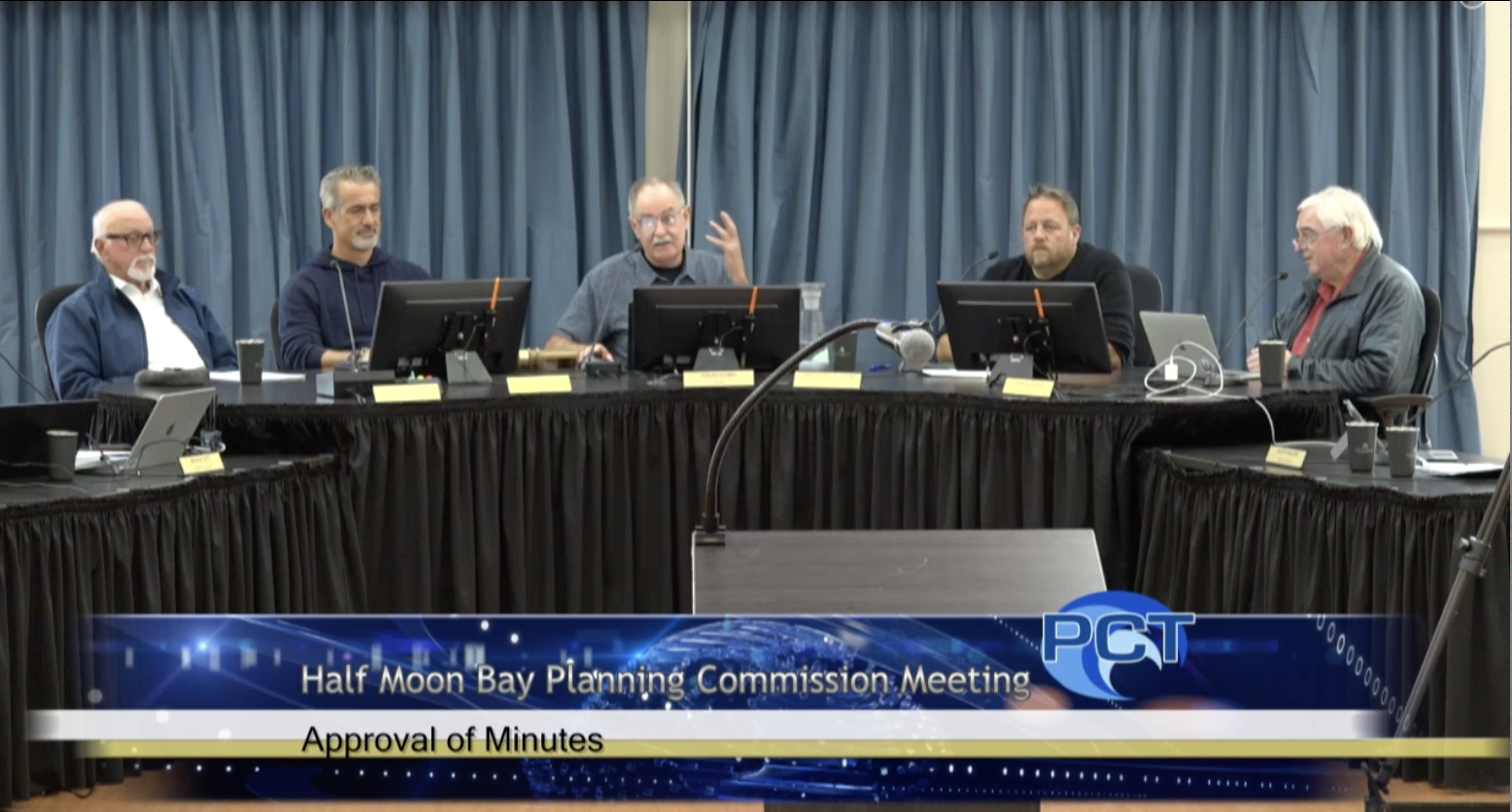
Meeting minutes approved: Three sets of minutes (April 14, May 12, May 26) cleared via roll-call votes, with commissioners abstaining when they had been absent from the relevant meeting.
Planning department reorganization: Director Leslie Lacko reported the department restructured from a flat model to a tiered organization with a new chief building official overseeing the permit technician and code enforcement officer, and a planner dedicated to housing replacing the former housing coordinator. One senior planner position is being recruited.
Rezoning and ADU ordinance timelines: HCD-required rezonings are with the Coastal Commission for preliminary review, with a staff meeting scheduled this week, and will come to the Planning Commission shortly. The ADU ordinance update is expected by September. Measure D code amendments may not be ready until January.
Recent permits: Tree removal, an ADU at 344 Spruce St., legalization of a junior ADU at 550 Terrace Ave., and a Measure D allocation for a downtown ADU were noted in the director's report.