
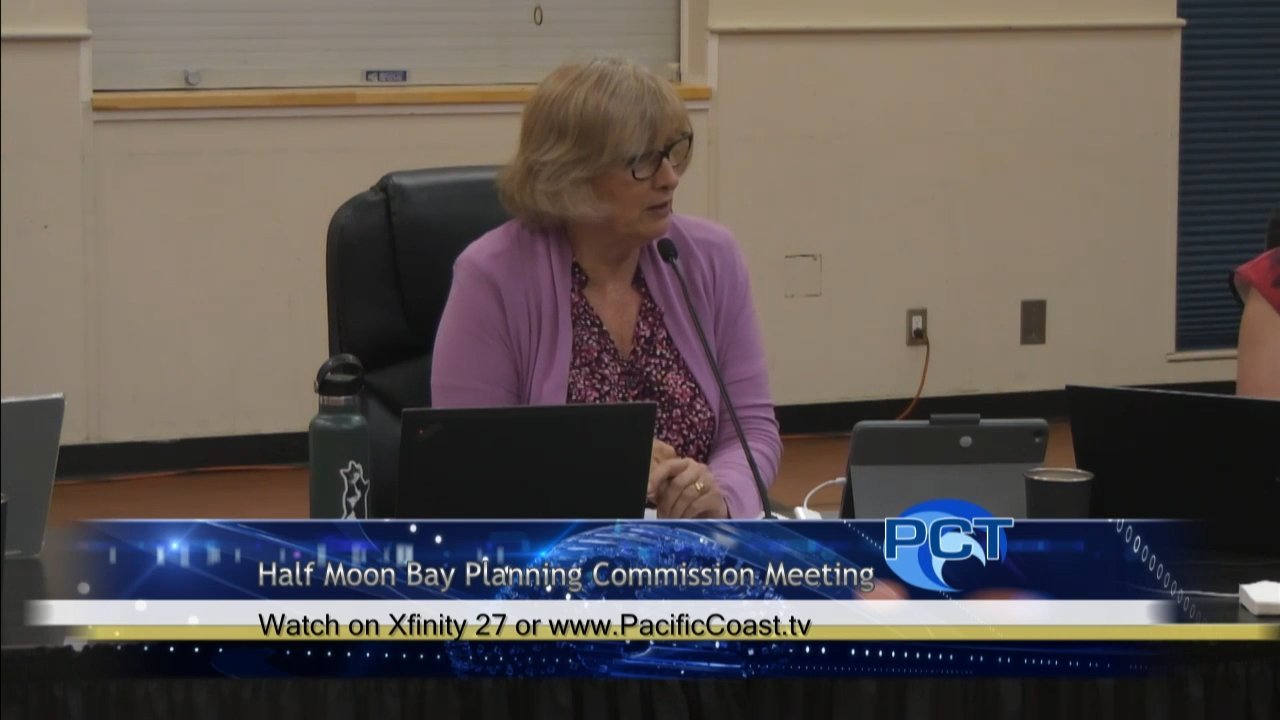
Planning Commission - Aug 05, 2026 - Meeting

Planning Commission - Aug 05, 2026 - Meeting

Planning CommissionHalf Moon BayAugust 5, 2026

Sources:

Locunity is a independent informational service and is not an official government page for this commission.We use AI-assisted analysis and human editorial review to publish information.

Half Moon Bay Reluctantly Advances State-Mandated Housing Rezonings

Half Moon Bay's Planning Commission voted 4-1 to recommend the city council adopt sweeping zoning changes required by the state — including by-right ministerial approval that strips public hearings from qualifying affordable housing projects — but not before commissioners vented deep frustration over what they described as Sacramento's erosion of local planning authority. The vote came amid an active Attorney General lawsuit, millions in lost grant funding, and a packed room of Catholic parishioners demanding the city remove their church property from the housing plan.

  • Commission approves housing element zoning amendments 4-1, including rezoning 10 parcels from R2 to R3, creating a workforce housing overlay, and establishing by-right ministerial approval for affordable housing — all under state mandate

  • Catholic church supporters pack the meeting to oppose the inclusion of Our Lady of the Pillar's 300 block Church Street property, with a parish attorney threatening federal litigation over religious freedom

  • Commission recommends swapping the church site within six months of state certification, seeking a compromise that avoids further delay

  • All five commissioners blast state housing mandates, but four conclude the legal and financial risks of defiance are too severe right now

  • By-right processing surprises commissioners who say they were not adequately briefed on how the provision eliminates public hearings for qualifying projects


Forced Into Compliance: The Housing Rezonings

The sole substantive item at this special meeting was a package of four municipal code amendments the state Department of Housing and Community Development requires before it will certify Half Moon Bay's sixth-cycle housing element. The amendments would rezone 10 parcels from R2 to R3 density along Poplar and Main Streets; modify Chapter 18.20 to exempt by-right affordable housing from public hearing requirements; create Chapter 18.43 establishing a workforce housing overlay on four public and quasi-public sites; and create Chapter 18.44 establishing by-right ministerial approval for housing developments with at least 20% affordable units on 14 designated parcels.

Why it matters: Without these changes, Half Moon Bay remains exposed to an active Attorney General lawsuit, state-imposed fines, loss of Caltrans Infill Infrastructure and SB1 grant funding the city has already been denied, and the builder's remedy — the nuclear option in state housing law that lets developers bypass all local zoning on any parcel in the city.

Where things stand: Staff reported the city has completed 143 of its 480-unit Regional Housing Needs Allocation and entitled 125, with these amendments providing capacity for an additional 272 units. Principal Planner Asher Kohn of M-Group walked through each amendment, emphasizing that by-right ministerial processing is not the city's invention — it is mandated by Government Code Section 65583.2(h)(1) for jurisdictions that failed to adopt concurrent rezonings with their housing element. City Attorney Mary Wagner confirmed this applies to most jurisdictions that missed the deadline.

The by-right provision drew the sharpest reaction. Under it, qualifying housing projects on designated sites would receive no planning commission review, no city council review, and no public hearing. Commissioner Steve Ruddock acknowledged his surprise: "I must admit that the cropping up of the ministerial review process in the documents as of last week was a surprise to me." Chair David Gorn went further: "I can tell you I haven't seen that kind of presentation or that kind of talk about ministerial approval of properties really ever before."

Staff responded that by-right processing had appeared in housing element documents since at least August 2024, though commissioners said the implications were never highlighted in deliberations.

Decisions: Vice Chair Rick Hernandez moved to adopt the resolution recommending city council approve all four zoning changes, with two added conditions: that the council consider replacing the 300 block Church Street site within six months of HCD and Coastal Commission certification, and that a statutory definition of by-right processing be added to the ordinance text. Chair Gorn seconded. The vote was 4-1 (For: Ruddock, DelNagro, Hernandez, Gorn; Against: Rems; Absent: 0).

Chair Gorn described his vote as "an extended extremely annoyed and really pissed off yes." Commissioner Christopher DelNagro voted "with apprehension." Commissioner Jacob (Jim) Rems was the lone no, citing concerns about the church property and the loss of local control.

What's next: The resolution now goes to the city council for final action. If adopted and certified by HCD and the Coastal Commission, it would end the city's noncompliant status, lift grant funding restrictions, and resolve the Attorney General lawsuit.


The Church Fight: Parishioners Demand Their Land Be Removed

The most emotionally charged segment of the nearly three-hour hearing centered on a single parcel: the 300 block of Church Street, owned by Our Lady of the Pillar Catholic Church. The property is listed as a housing opportunity site under the workforce housing overlay, but the church has no intention of selling — and has plans to build a K-8 classical Catholic school on the land.

Where things stand: Steve Wilson, attorney for the church and the Lippert family, told commissioners the parish would not sell or donate the property and warned of federal litigation over First Amendment free exercise rights. He noted that a previous city council member had put what he characterized as anti-Catholic hostility on the record, potentially tainting the process. "Our Lady of the Pillar will not sell or donate this property," he said, adding that the church had "very strong legal grounds to defeat eminent domain."

A stream of parishioners followed. Derek Kulda, founding board chair of Our Lady of the Pillar Academy, proposed a "win-win" — remove the church land and replace it with other suitable sites. He described a master redevelopment plan including an expanded church, banquet hall, clergy housing, and the K-8 school. Liesl Taner, a lifelong resident, business owner, and Catholic school parent, said the school already has more than 60 students with plans for permanent expansion. "It boggles me that time hasn't been taken the last two years to even think about or research other properties," she told the commission. David Colder, a sixth grader at the academy, asked commissioners to find other locations for housing so his school could grow.

The other side: City Attorney Mary Wagner pushed back on the legal framing: "The adoption of the overlay does not compel the church to develop housing on its property. It doesn't preclude the church from developing its proposed parochial school. And it doesn't constitute any indication that the city is considering condemning the church." She noted that the city of Carmel-by-the-Sea had successfully navigated a process to swap out controversial sites from its certified housing element — a precedent the commission could follow.

Commissioner Rems sided with the parishioners, questioning why only one religious site was singled out: "I'm also asking when this was proposed, why was only one religious site singled out for evaluation?"

Decisions: Rather than delay the entire package, the commission folded a site-swap recommendation into the final motion — directing city council to consider replacing the Church Street site within six months of HCD and Coastal Commission certification.


The Bigger Battle: Local Control vs. State Mandates

Beneath the specifics of each rezoning lay a simmering revolt against Sacramento's housing mandates. Every commissioner expressed some degree of frustration — but they disagreed sharply on what to do about it.

Commissioner DelNagro presented the most detailed critique, arguing HCD used outdated growth projections from 2013 to inflate RHNA numbers while California's population has been flat since 2019. "They chose to ignore the most recent data entirely. They've chosen to go with old data that projected a very strong growth rate. It's not reality," he said. He also noted Half Moon Bay has grown 300% since 1970, far exceeding San Mateo County's 37% growth over the same period.

Chair Gorn warned that eliminating public hearings would produce worse projects: "When you don't have public hearings and you don't have the planning commission and you don't have the city council weighing in about and looking at the project, then the project will be flawed." He defended the city's affordable housing track record, citing completed projects including Farm Worker Housing in Stone Pine Cove, 555 Kelly, 940 Main Street, Leslie Gardens, Moonridge, and Main Street Housing.

Commissioner Rems reported that officials at a recent conference across the state expressed depression about Sacramento taking away local project review authority. Public commenter Hal Bogner told commissioners there is "a growing and increasingly organized resistance and backlash throughout the state."

The other side: Vice Chair Hernandez urged a strategic approach — comply now, challenge the system later. "Are we going to deal with it now, when we're in the middle of litigation? For cycle six, which we're halfway through, and actually we're making great progress on and better progress than most other Bay Area cities," he said. He also proposed compensating for the loss of public hearings by investing in earlier-stage objective design standards — pointing to communities like Palo Alto where the planning commission spends more time defining standards upfront.

Commissioner Ruddock echoed the urgency: "What is urgent is that the city being out of compliance with the state housing laws is an extremely risky and dangerous posture for the city. It jeopardizes our ability to win grants and funding from the state in very important ways."

City Attorney Mary Wagner laid out the consequences of defiance in stark terms: "We already have a lawsuit from the AG's office. The city is at risk of having fines imposed. The city would continue to be ineligible for grant funding." Staff confirmed the city has already lost access to Caltrans Infill Infrastructure and SB1 grants — programs worth millions of dollars.


Minor Items

  • Minutes approved: The commission unanimously approved minutes from the June 23, 2026 meeting (5-0).

  • Public commenter Lee Argabright, a Poplar Street resident, asked whether all R2 zones citywide are being rezoned or only the Poplar strip; staff confirmed the changes apply only to the 10 designated parcels.

  • Public commenter Mariana Stark suggested four alternative Main Street properties for housing sites, including the Bank of America, a Water Department property, and the former Tom and Pete's fruit stand.

  • Public commenter Mike Ferreira raised concerns about ministerial approvals straining the city's limited planning staff and urged increased transparency, referencing the 555 Kelly "major transit stop" controversy.

  • Public commenter Brad Steinweed questioned why the workforce housing overlay references rural, coastal, and agricultural zones when none of the listed sites carry those designations.

  • Commissioner DelNagro flagged safety concerns about 940 Main Street proceeding under by-right processing: "I'm severely worried about 940 Main Street not having a secondary egress or ingress."