
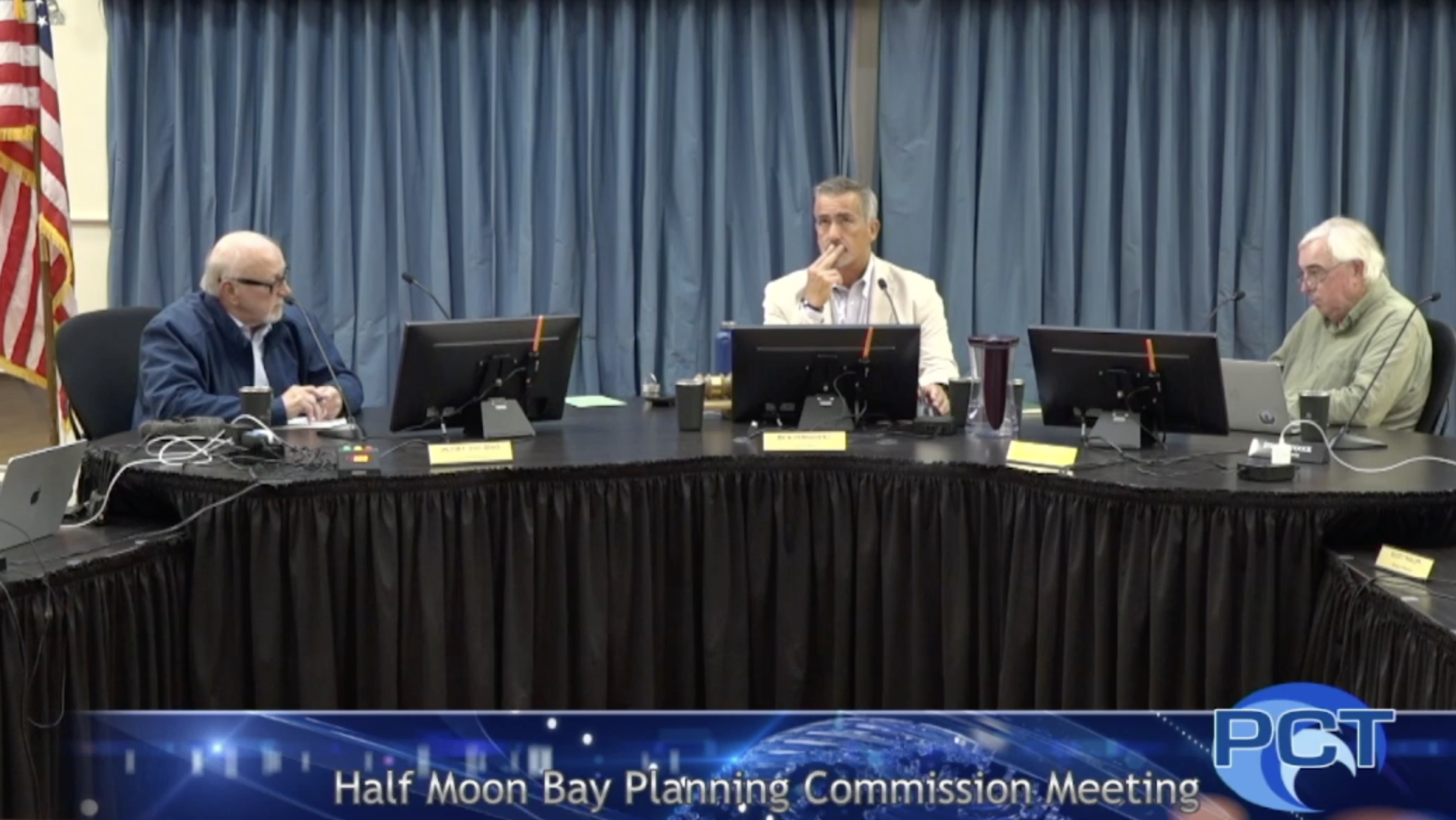
Planning Commission - Apr 14, 2026 - Meeting
Planning Commission • Half Moon BayApril 14, 2026
Locunity is a independent informational service and is not an official government page for this commission.We use AI-assisted analysis and human editorial review to publish information.
State Threatens Half Moon Bay Over Housing Compliance as Cell Tower, Habitat Debates Advance
Half Moon Bay's Planning Commission met April 14 with only three of five members present — and a full plate. The state's housing enforcer has put the city on a short list for potential Attorney General action, commissioners wrestled with how to camouflage what will be the city's tallest structure, and a land trust made the case that an outdated tree ordinance is blocking grassland restoration.
Half Moon Bay named among 15 cities facing potential AG referral over housing element non-compliance; transportation grants already at risk
68-foot Verizon cell tower approved 3-0 on Carter Hill with faux-tree camouflage and easement conditions after neighbor dispute
Coastside Land Trust warns crow explosion and cypress encroachment are destroying raptor habitat at Wavecrest; heritage tree policy reform urged
Wavecrest coastal trail nears completion as beach stairs rise and an unresolved Apple TV damage claim lingers
Housing Crackdown: HCD Puts Half Moon Bay on Notice
Community Development Director Leslie Lacko opened the meeting with an unusually detailed briefing on three enforcement letters the city has received from the California Department of Housing and Community Development — a rapid-fire escalation that places Half Moon Bay squarely in the state's crosshairs.
Why it matters: Non-compliance with state housing element law is already costing the city access to transportation grants and could soon result in state-imposed fines. The pressure lands at a moment when the city is still working through required rezonings and a Local Coastal Program amendment — processes that require Coastal Commission sign-off and cannot move quickly.
Where things stand: On March 24, HCD published a press release naming Half Moon Bay among 15 cities out of compliance with state housing element law. A formal notice of violation followed, threatening referral to the state Attorney General.
The city received confirmation in February that its housing element itself is technically compliant — but HCD is withholding full compliance status until required rezonings are completed. Staff met with HCD accountability staff on April 10 to discuss the rezoning schedule and LCP amendment timeline, and a written response correcting what the city says are errors in HCD's notice is due April 23.
A second letter, dated April 9, took direct aim at the 555 Kelly affordable housing project.
"[HCD] expressed their strong support for the project and indicated that if the current entitlements are not approved, they will hold the city out of compliance with the housing element. 555 Kelly is a pipeline project in our housing element," Lacko explained.
A third letter flagged the city's ADU ordinance as non-compliant with state law. Staff is meeting with HCD on April 15 regarding the ADU letter and April 17 regarding 555 Kelly.
Lacko did not mince words about the city's position:
"Our city is definitely a target of HCD right now, and we have a lot of work to do to meet their expectations."
She warned the fiscal consequences are already materializing, and that there are transportation grants the city may no longer qualify for.
The other side: Commissioner Jim Rems asked what happens to planning operations if the state proceeds to litigation. Lacko explained the Attorney General could assess fines that are typically redirected to affordable housing, and that the city's Public Works department may already be losing access to grant funding.
Acting Chair Rick Hernandez turned the spotlight on the 555 Kelly project's nonprofit partner, noting the planning commission had previously voted 5-0 in support.
"I'd hate for us to be held up because our partner hasn't done their job getting us to where we need to be," he said — a pointed signal that commissioners view delays on the project's financial side as a liability for the entire city.
What's next: Staff will meet with HCD on April 15 and April 17. A written response to the notice of violation is due April 23, and a special council meeting is planned to address the 555 Kelly entitlements.
Faux Trees and Neighbor Disputes: Cell Tower Approved With Conditions
The commission's lone action item — a coastal development permit and use permit for a new Verizon monopole at 200 Lewis Foster Drive on Carter Hill — generated nearly 50 minutes of discussion before winning unanimous approval with two significant added conditions.
The basics: Coastside County Water District is replacing water tanks at the site with new tanks 20 feet taller than the originals. The taller tanks now block the existing cell tower's signal. Verizon proposes replacing the old monopole with a new 68-foot, 8-inch tower. A temporary cell-on-wheels is providing interim service.
Planner Scott Phillips noted that because the height increase exceeds 20%, the federal Telecommunications Act allows the city full discretionary review. The project is categorically exempt from CEQA.
Where things stand: Two public commenters shaped the debate. Frank Garrity, a Highland Park neighborhood resident, supported the project but urged the commission to require faux-tree camouflage under the city's Policy 939, citing the tower's visibility from his neighborhood and Highway 1 — especially if eucalyptus trees in the area are removed for fire safety.
Keith Nerhan, who owns the adjacent property, raised a more fundamental objection. He disputed Verizon's claimed construction access easement through his land, stating no easement is recorded on his property and no rent has been paid. He requested a continuance to resolve the issue.
A Verizon representative said an easement exists for construction and maintenance and that title reports have been ordered.
Acting Chair Rick Hernandez connected the dots between fire safety and aesthetics in remarks that drove the camouflage condition:
"The Fire District has asked us to consider removing eucalyptus trees throughout the community. Thin them, remove them, replace them with other things. The images we received show the tower hidden by existing eucalyptus trees that are likely to not be there in 10 years."
Commissioner Debbie Ruddock asked about the faux-limb option; the Verizon representative said it would add approximately 5 feet of height.
Decisions: Rather than continue the matter, commissioners opted to approve with two added conditions. Ruddock supported moving forward:
"I do agree that a condition of approval making sure that the project is consistent with Policy 939 to disguise the tree appropriately does make sense. I know that we've required that at least once in recent years."
Commissioner Jim Rems initially favored continuance to resolve the easement question but ultimately agreed to conditional approval, noting the access issue has two dimensions.
"One being access to the site and two being the actual construction site that accommodates not only the tower, but the equipment and maybe anything else that they need to put on there to operate the site efficiently."
Phillips recommended specific condition language:
"The access easement through the adjacent property shall be updated, submitted and finalized prior to the issuance of building permits to the satisfaction of the Community Development Director and city engineer."
The motion passed 3-0 (For: Hernandez, Ruddock, Rems; Absent: Chair David Gorn, Commissioner Christopher DelNagro) with two conditions: (1) the final design must incorporate faux-tree camouflage consistent with Policy 939, approved by city staff; and (2) the access and construction easement must be finalized to the satisfaction of the Community Development Director and city engineer before building permits are issued — with the matter returning to the commission if unresolved.
Crows, Cypress, and Conservation: Land Trust Makes Case for Heritage Tree Reform
Sara Polgar, COO of the Coastside Land Trust, delivered a two-part informational presentation that consumed the final 50 minutes of the meeting — first on the Wavecrest Coastal Access Project's construction progress, then on a stewardship crisis threatening grassland bird habitat.
Trail Takes Shape, but Apple Owes a Bill
The Wavecrest coastal trail, which broke ground in July 2025, is substantially complete. The coastal trail and connector trails are in with compacted gravel, parking lots are operational with trash service, and eroded casual trails have been restored. The south beach access stairway is under active construction and expected to be finished within weeks.
Remaining 2026 work includes split rail fencing, signage, a connector trail segment, formalization of north beach access, and a restroom planned for September–October. Commissioner Debbie Ruddock praised the crushed granite surface's performance in wet weather and asked about bike racks, which Polgar confirmed are in the plan.
But a sore point remains: an Apple TV film crew violated conditions of their filming permits and caused sections of the trail surface to liquefy. Polgar said a formal damage claim was submitted.
"I have heard that they have received the claim and are investigating it. And I have followed up multiple times, but I have not heard anything further," she said.
Acting Chair Rick Hernandez suggested the mayor could lend support to the effort.
Grasslands Under Siege
The more substantive — and potentially more consequential — half of Polgar's presentation focused on the decline of grassland obligate bird species at Wavecrest: white-tailed kites, Northern Harriers, and savannah sparrows, all of which depend on open grasslands for hunting and nesting.
Two forces are converging against them. American crow populations are exploding across the Bay Area, with dramatic spikes visible in Christmas Bird Count data. The crows harass smaller raptors and nest near food-producing dumpsters at Smithfield Ballpark.
Meanwhile, Monterey cypress trees and coyote brush are rapidly converting grasslands into scrub and forest — a process that does not reverse naturally. Aerial imagery from 2005, 2015, and 2025 shows dramatic encroachment across the land trust's 50-acre parcel.
The policy collision: The Coastside Land Trust's plan to remove encroaching Monterey cypress runs directly into the city's heritage tree ordinance, which requires one-for-one replacement of trees over 12 inches in diameter. That would mean replanting the same invasive species CLT is trying to remove.
"We would have to replant an invasive species that we're actually trying to remove so that we can restore grasslands habitat, which is completely counter to what we're trying to do. And it would make it prohibitive to do the project, frankly," Polgar said.
Hernandez delivered extended remarks in support of reform, arguing that replacement costs drain funds from actual restoration work:
"The cost of doing a restoration is similar to the cost of replacing the trees. So the extent to which somebody who's acting as a steward for the land has a restoration plan that's backed by biology, backed by science, backed by a coherent plan, I think we need to think about modifying the way that the Heritage Tree policies work."
He also urged city staff to work with the land trust on wildlife-proof trash receptacles near Smithfield, noting that removing dumpsters and cans without lids have an impact on crows and ravens.
Ruddock drew an analogy to Yosemite Valley's ecological management and concurred:
"I would certainly hope that there'd be a flexible approach to our heritage tree policy to allow those things to come out and be replaced with something somewhere else that would be a coherent approach to the problem."
Community Development Director Leslie Lacko noted that Polgar has already agreed to serve on the stakeholder group for the heritage tree ordinance update — a signal that this policy collision is headed for a formal reckoning.
What's next: The heritage tree ordinance stakeholder process will determine whether conservation landowners get relief from the one-for-one replacement requirement. If reformed, the change would unblock CLT's 50-acre grassland restoration and could set precedent for how the city balances development, fire safety, and environmental stewardship.
Minor Items
New staff introductions: Director Tyko introduced Assistant Planner Ruby Zalduando and an associate planner joining the Community Development Department.