
Planning Commission - May 26, 2026 - Meeting

Planning Commission - May 26, 2026 - Meeting

Planning CommissionHalf Moon BayMay 26, 2026

Sources:

Locunity is a independent informational service and is not an official government page for this commission.We use AI-assisted analysis and human editorial review to publish information.

Commission Approves Emergency Coastal Trail Repair as Bluff Crumbles Into Ocean

Half Moon Bay's Planning Commission tackled an urgent safety crisis on the California Coastal Trail, where a section has literally fallen into the Pacific, before adopting a $90 million capital improvement program and learning about a 74-unit housing project that will bypass public hearings entirely.

  • Eroding bluff forces emergency coastal trail relocation; commission mandates asphalt over gravel to protect cyclists (4-0)

  • $90M, 34-project capital improvement program adopted, but staffing shortages threaten delivery

  • 74-unit SB35 affordable housing project near Main Street gets June 4 open house - a good chance for public input

  • Downtown mural unanimously approved for 507 Purissima Street


Crumbling Bluff Forces Trail Fix — Commission Demands Asphalt

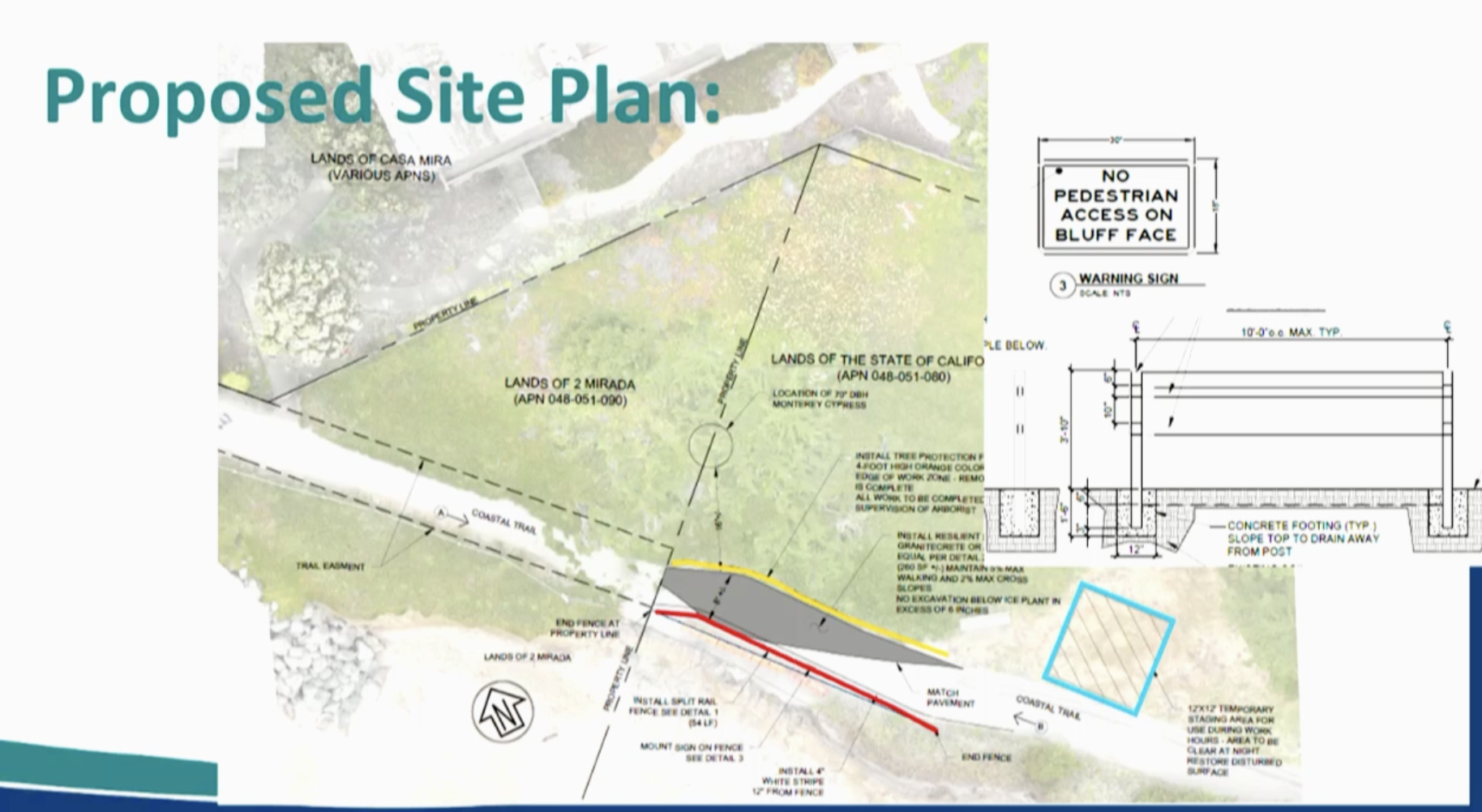
The longest item of the night centered on a 50-foot section of the California Coastal Trail south of Marauder Road that has collapsed into the ocean, leaving a 25-foot drop-off where pedestrians and cyclists once passed.

The basics: State Parks requested a coastal development permit to shift the trail segment slightly eastward, away from the eroding bluff edge. The proposal included decomposed granite (DG) surfacing, split-rail fencing, and warning signs. The site sits within a terrestrial environmentally sensitive habitat area and within 100 feet of the bluff edge, triggering the permit requirement.

Why it matters: This is a critical north-south link on the California Coastal Trail between Poplar Beach and El Granada. The trail's collapse has forced makeshift orange barricades — some of which have themselves gone over the edge — and created what multiple speakers described as a life-threatening hazard for cyclists, runners, and families.

Where things stand: The central debate came down to surface material. Commissioner Christopher DelNagro challenged the DG proposal, noting it would be the only gravel section of the coastal trail within city limits and that the city's Bicycle and Pedestrian Advisory Committee had not reviewed the material choice.

"That's a deficiency you need to remedy," said Commissioner DelNagro. "This is a major bicycle and pedestrian transit section. My kids ride this all the way up to Granada. Unfortunately, DG gravel is not amenable to many bicycle types."

Linda Hitchcock of California State Parks explained that DG was chosen for speed on what she described as a temporary managed retreat — the first step in eventually moving the trail further east. "This is a temporary managed retreat. This is the first step in moving this trail eastward. The DG was decided to be able to do this relatively quickly," she said.

Project Engineer Robert Stevens defended the DG, comparing it to the stabilized surface used on the Tunitas Creek beach path and noting it includes a binding agent. But he acknowledged asphalt was feasible, estimating the cost difference at roughly $10,000 more on a project budgeted at approximately $35,000. He later proposed a compromise: "Dale was pulling my leg here, and he was suggesting, why don't you just do a thinner section of asphalt here and you probably will be able to get it down to the price range that you need it to be in."

The other side: Del Kitching, part-owner of a triplex at 2 Marauder Road, delivered extensive public comment describing the 25-foot drop as a life-threatening emergency. He said he alerted both the city and State Parks in January 2025 and received no response. He reported orange barriers had been in place since 2016-17, called them inadequate, and argued the trail should be rerouted through state park land east of Casa Mira. He also raised concerns about e-bikes traveling 30 mph at night near the bluff edge and people accessing the beach through riprap on his property.

Tyler Ladinsky, a coastal erosion professional, recommended hiring a consultant to study erosion rates, warning the repair could fail within a few years without proper analysis.

Planning Consultant Bridget Jett provided critical context: managed retreat is inevitable at this site, riprap will not be permitted by the Coastal Commission, and ongoing litigation between the Casa Mira condominium association and the Coastal Commission over an unpermitted seawall complicates any long-term solution.

Chair David Gorn was blunt about the project's durability. "I'd be surprised if it lasted the winter," he said. "The riprap stops right before it. All the force of the water goes to that spot. That's why it washed out."

Still, he framed the commission's task narrowly: "Nobody up here wants to say no to fixing this trail, even if it lasts six months or a year or two years. But it doesn't make sense to fix it to something that is not entirely safe all by itself."

Commissioner DelNagro calculated the cost difference as modest — roughly $1,000 to $1,250 in materials for the small section — and pushed for asphalt as the standard.

Decisions: The commission approved the coastal development permit 4-0, with an explicit condition requiring asphalt instead of decomposed granite. Commissioner DelNagro moved; Commissioner Steve Ruddock seconded. Vice Chair Rick Hernandez was absent.

Hitchcock noted that the project is funded by Casa Mira and that switching to asphalt may require going back for additional money: "We're working with Robert Stevens on the cost estimate, and everything is being paid for by Casa Mira. So we would have to go back and ask for additional money if we switch to asphalt."

What's next: State Parks must secure funding for the asphalt surface — potentially requiring additional funds from Casa Mira — or return to the commission. A broader Coastal Trail Safety and Rehabilitation Project in the city's CIP would resurface 3.5 miles of trail from Marauder Road to Seymour Bridge, but that is a longer-term effort. The commission also expressed interest in BPAC review of trail surface materials.


$90M Capital Plan Advances, but Staff Shortages Cloud Delivery

Why it matters: The commission adopted a resolution finding the city's three-year Capital Improvement Program consistent with the general plan — a required step before budget approval. The CIP encompasses 34 projects worth approximately $90 million across stormwater, economic development, parks, facilities, sanitary sewers, streets, and trails. But with only about half funded and staffing as the primary bottleneck, the plan is as much a statement of ambition as a construction schedule.

Where things stand: Assistant Engineer Mike Brumfield and Interim City Engineer Dale Leda presented the program, which shifts from a previous one-and-five-year format to a streamlined three-year structure with a new prioritization framework emphasizing public safety, funding availability, and project readiness.

"Our CIP is worth around $90 million currently," said Interim City Engineer Leda. "Of that $90 million, I think currently we have around $45 million in funds. And of that $45 million, around 80% of that is grant funds."

Completed projects include Arletta Park neighborhood pavement rehabilitation and Carter Park. New additions include Corp Yard improvements (phase 2), the annual pavement management project, the San Mateo County Landfill clean closure, and City Hall Plaza. The coastal trail overlay was renamed the Coastal Trail Safety and Rehabilitation Project, expanding its scope to include signage and striping over 3.5 miles.

Commissioner Ruddock asked about the Main Street Bridge project, which has been delayed by Caltrans signal timing issues. Lita said it is expected to proceed soon, with scheduling balanced around Fourth of July and school events. Ruddock also asked about Magnolia Park, which Lita said is not prioritized due to lack of funding, shovel-readiness, and staffing.

Chair Gorn pressed on long-term stormwater projects — Pullman, Kehoe, and Pilarcitos — which have moved slowly. "Since we are going to have bigger and bigger storms, we are going to have bigger and bigger problems," he said. "I did notice that Pullman is in preliminary design, which is probably the first time I've seen that." Lita confirmed the Pullman bypass is advancing and the city has requested an easement from SAM for the Kehoe watershed.

Commissioner DelNagro raised fire risk mitigation (covered by the Climate Action Plan implementation), evacuation improvements (addressed by the South Corridor project), and the dangerous Lewis Foster Drive intersection at the high school entrance. "Every morning and every evening at the end of school, I watch high schoolers who are just learning how to drive, pull through fast moving traffic on Main Street," he said, asking whether the Safe Streets for All action plan would address it. He also flagged the long-stalled bike and pedestrian connectivity to the train depot and asked about the city's grant-writing capacity.

Decisions: Adopted 4-0. Commissioner Ruddock moved; Commissioner DelNagro seconded. Vice Chair Hernandez absent.

What's next: The CIP now moves to the budget process. Staffing remains the critical constraint — Lita described it as the primary bottleneck limiting project delivery despite strong grant funding. The Pilarcitos Creek restoration is expected to begin mid-2026.


74-Unit SB35 Housing Project Heads to Open House — No Public Hearing

Planning Consultant Bridget Jett announced that Mid-Peninsula Housing will hold an open house on June 4 at 6 p.m. at 801 Arnold Street to present a proposed 74-unit multifamily project on the parcel between Main Street and Cabrillo Highway along Metzger.

Why it matters: The project qualifies under SB35, the state streamlining law for affordable housing, which means no public hearing will occur. "These open houses that Mid Penn Housing is holding are really the only opportunity for feedback," Jett said. "Because under SB35 there will be no public hearing."

Commissioner DelNagro expressed satisfaction that the existing house on the property would be preserved.

For residents and stakeholders with concerns or input about a significant housing development near Main Street, June 4 is the window.


Minor Items

  • Downtown mural approved (4-0): A permanent artistic mural at 507 Purissima Street (PDP 26032) was unanimously approved. The mural wraps around the west-facing facade of the building owned and operated by Alice in the Commercial Downtown zoning district, includes the phrase "Half Moon Bay," has no commercial advertising, and will receive two coats of protective sealer. Staff determined the project is categorically exempt from CEQA.

  • Minutes approved: May 12, 2026, minutes approved (3-0; Commissioner Ruddock abstained due to absence from that meeting; Vice Chair Hernandez absent). April 14 minutes postponed to the next meeting due to quorum issues.

  • Recent permits: A second-story addition/remodel at 960 Pilarcitos Avenue and a remodel/addition at 708 Johnston Street were approved at director's hearing. A tree removal on Troon Way and an ADU at 424 Valdez were also noted.

  • Commissioner DelNagro praised a recent community event where over $200,000 in scholarships were awarded to Half Moon Bay high school students, calling it "probably the most impressive thing I have seen from high school."

Commission Approves Emergency Coastal Trail Repair as Bluff Crumbles Into Ocean | Planning Commission | Locunity