
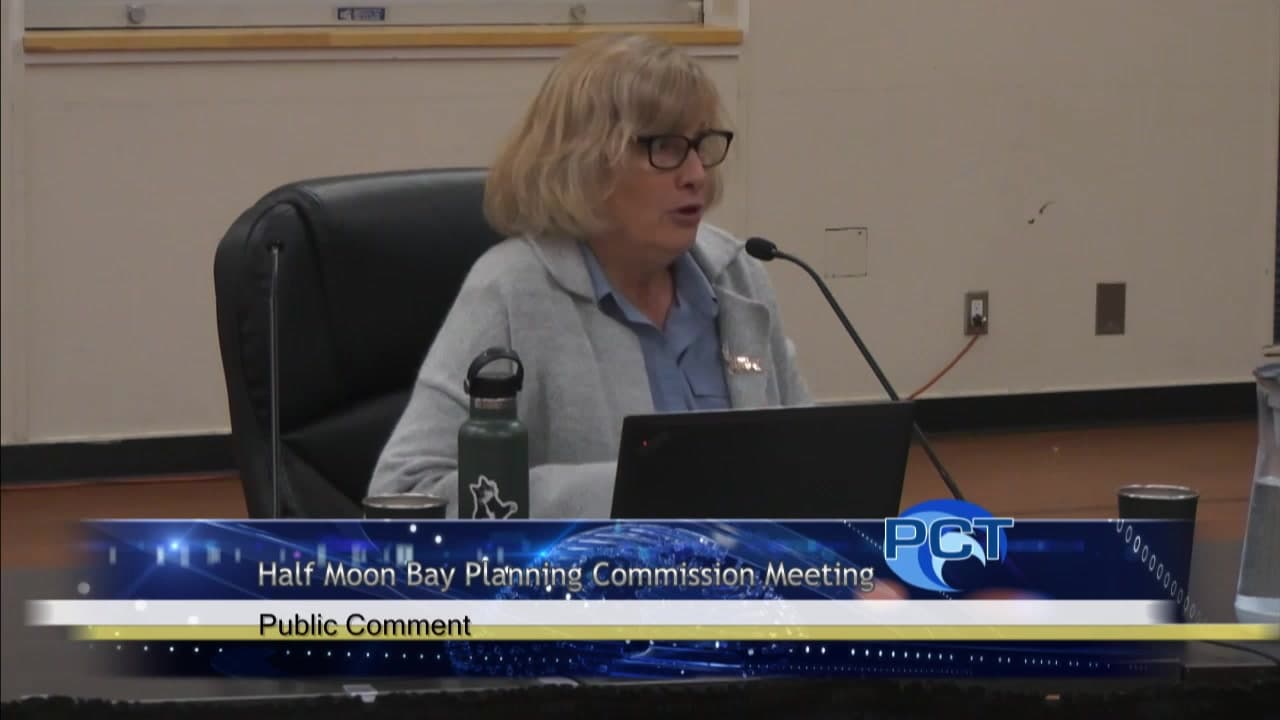
Half Moon Bay Planners Split Over Banking Unused Measure D Allocations
Planning Commission • Half Moon BayOctober 27, 2026
Locunity is an independent informational service and is not an official government page for this commission. All information is sourced from public footage and an analysis of official agendas with the aid of responsible, fact-checked AI. to report an error or omission.
Half Moon Bay's Planning Commission spent most of its Oct. 27, 2026 meeting debating whether housing allocations that go unused should get a second life. The study session ended without a vote. Staff will take draft Measure D amendments, including both rollover options, to California Coastal Commission staff for informal feedback before anything reaches the City Council.
- Commissioners split on Measure D rollovers: two called them contrary to voter intent, and two wanted limits or Coastal Commission input.
- ADUs would count as half an allocation under the draft amendments, and JADUs would be exempt.
- Scoring overhaul: infill, walkability, affordable housing and traffic mitigation each drew six dots in a priorities exercise.
- Big projects could crowd out homeowners: commissioners flagged the issue against a 480-unit state housing target.
- No changes for 2027: drafts go to Coastal Commission staff for an informal six-week review.
Rollovers Divide Commission Over Voter Intent
The basics: Measure D is Half Moon Bay's voter-approved system for allocating permission to build new homes. The city's 6th Cycle Housing Element, under Program 6-8, requires it to consider letting unused allocations roll over.
Why it matters: Allocations are scarce. Critics say banking them could undermine the managed-growth intent voters wrote into Measure D. Supporters see rollovers as a way to keep housing capacity from expiring unused.
Where things stand: Staff presented two options. The first would fold expired allocations into the December population-based determination. The second would reassign them to other applicants later in the year.
Staff said the city does not currently reassign unused allocations. Under either option, rollovers would apply only going forward and only within the same downtown or non-downtown zone. Staff said the city attorney had reviewed the legality.
Commissioner Christopher DelNagro said he would accept rollovers only with tight guardrails, a one-time limit and a sunset. "I don't like this year-after-year thing," said DelNagro.
Vice Chair Rick Hernandez favored a single, simple rollover and wanted to ask the Coastal Commission. "I don't think it's opening Pandora's box," said Hernandez.
The other side: Commissioner Steve Ruddock questioned the legal basis for rollovers and warned against letting allocations pile up year after year. Chair David Gorn opposed even raising the idea with the Coastal Commission. "I think doing the rollover is not what the intent of Measure D was," said Gorn.
Former Councilmember Mike Ferreira, speaking during public comment, said voters rejected carryovers in 1991-92 under Measures A and B. In his view, that makes rollovers a decision for the people. He also questioned whether the housing element should drive changes to the Local Coastal Program ahead of the Coastal Act.
Decisions and stakeholder impacts: No vote was taken. Ruddock said a majority appeared to oppose rollovers. Community Development Director Leslie Lacko said she did not hear a clear majority and would likely present both scenarios to Coastal Commission staff.
The outcome matters most to applicants whose allocations lapse and to slow-growth residents wary of accumulated capacity. It also matters to the city's housing element compliance.
What's next: Staff will revise the drafts and send them to Coastal Commission staff for an informal review of about six weeks. "We're seeking guidance on what they would and wouldn't approve," said Lacko.
The amendments will then return to the Planning Commission with a recommendation and go on to the City Council. No further study session is planned. Commissioners offered to form a working group and asked to see what staff sends. "Any draft amendments will not be applicable to 2027," said Associate Planner Ruby Zalduondo.
Scoring Overhaul Targets Infill, Safety and Locals
Why it matters: Scoring decides who gets scarce allocations. Staff reported spending about 17 hours on Measure D over the past year and want simpler criteria.
Where things stand: Staff proposed removing criteria that every project meets or that duplicate other codes. Staff did not propose adding any new criteria until hearing from the commission and the public.
Participants worked with three boards labeled remove, add and prioritize. Infill, walkability/active transit, affordable housing and traffic mitigation each drew six dots. Infrastructure burden drew four, and several criteria drew none.
Commissioners suggested several new scoring points:
- Multiple ingress and egress routes
- Home hardening against fire
- Home sharing and multigenerational housing
- Agricultural set-asides
- Work-live arrangements or a local preference
- A primary-residence preference
- Efficiency measured per person rather than by square footage
"There should be points for developments that do have or are located in an area where there's multiple in and out for safety," said DelNagro.
Big projects, scarce units: Gorn asked why large projects receive allocations early instead of waiting for the transfer. Staff pointed to development phasing agreements and per-applicant limits.
Staff also read the city's Regional Housing Needs Allocation (RHNA) targets: 181 very low-income, 104 low-income, 54 moderate-income and 141 above-moderate units, for 480 total. With roughly 65 allocations available each year, Gorn and Hernandez worried that large below-market-rate projects such as Podesta could absorb most of them.
Hernandez urged prioritizing infill and distinguishing downtown projects from edge development. He tied the issue to local ownership. "We need to have people who can build wealth in our community," said Hernandez.
DelNagro asked how the city would enforce the sequencing of affordable units. Staff cited recorded affordable housing agreements, like the one used at Creekside.
Decisions and stakeholder impacts: No vote was taken. A simpler, infill-weighted system would favor downtown builders and individual homeowners. Large phased developments would face more scrutiny of how they draw down the annual pool.
ADUs at Half Value, JADUs Exempt
Why it matters: The changes implement the housing element and could ease construction of accessory dwelling units (ADUs). But infrastructure and population concerns led the Coastal Commission to reject exemptions in 2014.
Where things stand: The drafts would count each ADU as 0.5 of a Measure D allocation. Junior ADUs (JADUs), units under 500 square feet inside existing homes, would be exempt. "These are not changes to any ballot measure," said Lacko, describing the parts of the package the Council had already directed.
Staff traced how ADUs have been treated, from Measure A through the 2014 Coastal Commission finding to their 2018 removal from the exemption list. Staff said ADUs place lower demand on infrastructure than other homes.
The other side: Ferreira said ADUs still affect water, sewer and parking, and he doubted that 50% is the right value. DelNagro worried that giving JADUs a zero value could be challenged on population grounds.
Hernandez said he had reconsidered his earlier position that ADUs consume nothing and now supports one-half.
What's next: Staff said initial feedback from Coastal Commission staff should clarify whether the agency will accept the values.
Minor Items
- Minutes approved: Oct. 13, 2026 minutes passed by roll call. For: DelNagro, Ruddock, Hernandez, Gorn. Against: 0. Absent: Commissioner Jacob (Jim) Rems.
- Parking study grant: The city applied for a grant of more than $500,000 for a downtown parking study, parking structure feasibility study and wayfinding plan. The City Council approved the submission Oct. 20.
- Storm readiness: The city is running a weekly storm readiness campaign through October, following San Mateo County's preemptive emergency declaration.
- Tree permit: Staff reported a tree permit issued at 2400 Cabrillo Highway.
- Correspondence: Three written public comments arrived after the agenda packet was posted and were shared with commissioners.
Looking Ahead
Staff's safety element recommendation, which includes a five-year update period, goes to the City Council on Nov. 17. The Measure D drafts head to Coastal Commission staff for informal review before returning to this commission.