Board of Directors - Aug 20, 2026 - Meeting
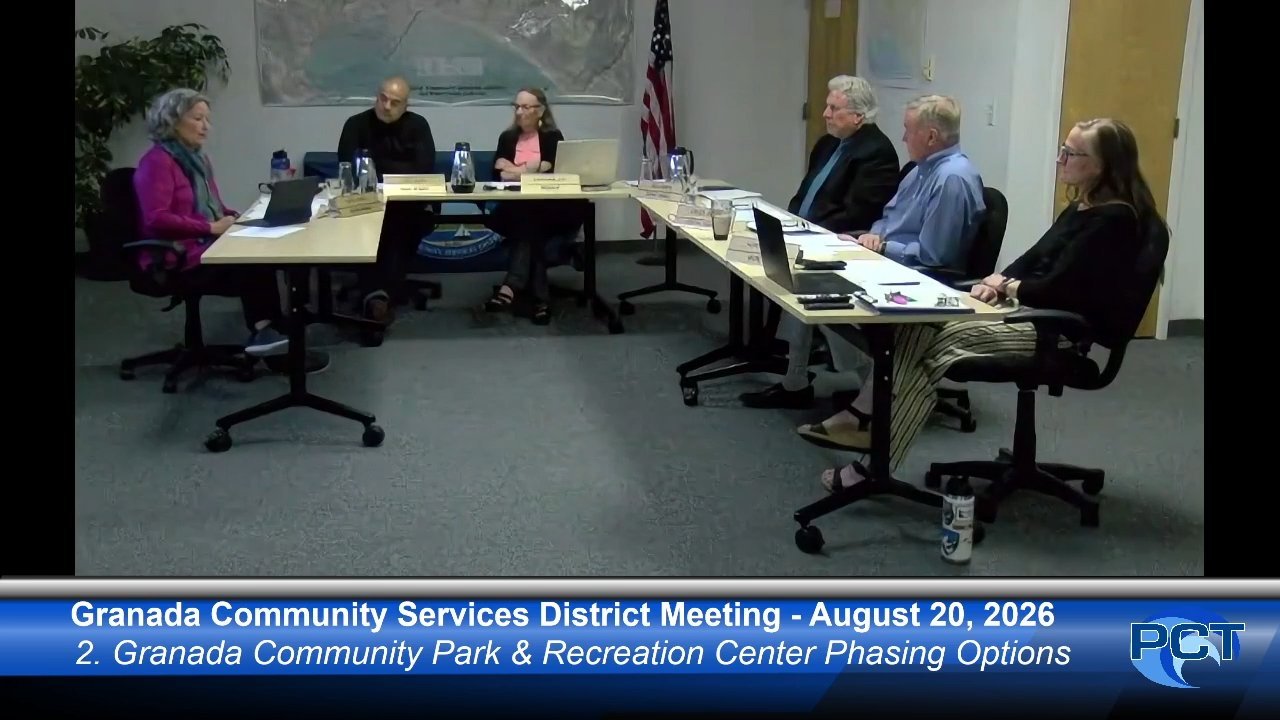
Board of Directors • Granada Community Services DistrictAugust 20, 2026
Locunity is a independent informational service and is not an official government page for this commission.We use AI-assisted analysis and human editorial review to publish information.
Board Shelves $7.8M Community Center, Focuses on Park as Sewer Costs Mount
The Granada Community Services District board made a pivotal capital planning shift this week, deferring an expensive new community center building indefinitely while advancing a lower-cost renovation — all as the district confronts its largest-ever infrastructure bill: an $16.5M sewer force main replacement driven by an environmental lawsuit. Meanwhile, four residents showed up with a pointed message: buy the Post Office lot before it's gone.
Board defers $7.8M community center, pivots to park-first strategy and scaled-down renovation of 480 Alhambra
$650K in design contracts approved to produce bid-ready park construction documents
GCSD approves its share of $16.5M sewer force main replacement after winning interagency budget process fight at SAM
Residents rally for GCSD to acquire the Post Office lot and Burnham Strip parcels before developers move in
State parks grant falls through; board authorizes flexible grant-chasing authority up to $20K
The Capital Plan Pivot: Park First, Renovation Second, New Building on Ice
General Manager Chuck Duffy presented the board with the financial reality: with roughly $650,000 a year available for debt service after accounting for $120,000 in park operations and maintenance and $293,000 in administrative costs, the district's approximately $1 million in annual parks revenue leaves almost no room for a new building.
Why it matters: The board's decision to shelve the proposed $7.8M new community center and pursue a scaled-down renovation of 480 Avenue Alhambra fundamentally reshapes GCSD's capital outlook — keeping annual debt service manageable and potentially freeing millions for what residents clearly want most: acquiring more open space.
Where things stand: Duffy directly challenged the $7.2M renovation estimate as unrealistic at $2,300 per square foot, calling it inflated. "I keep seeing this number. Seven and a half million, 7.2 million to renovate 480. I don't believe that number," said General Manager Duffy. He instead estimated a more realistic renovation range of $2–3M by treating the building as three discrete components: parking lot, exterior cladding, and interior systems.
The board agreed on a three-phase approach: park construction first, 480 Alhambra renovation second, new building deferred. GM Duffy clarified the first two phases would not be sequential — "They're separate but parallel. Look at it that way," he said. The district also discussed using anticipated ERAF refund money, estimated at $2.5–3M over five years, for amenities and add-ons beyond initial construction.
The other side: Director Nancy Marsh raised two concerns: ensuring the building doesn't sit empty after the preschool lease ends, and maintaining community-center-quality design features. "I have a concern about ending the lease to the preschool and then having the building empty for two years, when we could have extended the preschool," she said. Director Matt Allen initially questioned whether building new might make more sense if renovation costs approached the replacement price — but accepted the significant gap between $2–3M and $7.8M.
Public commenters pushed back on the spending trajectory entirely. Leonard, a public commenter, objected to committing all district revenue: "I see a total here of, let's just call it $23 million. And that's essentially 30 years of property tax revenue. That's insane for a district like this." Janet, a public commenter, echoed the concern and questioned the $1.5M construction document budget, suggesting more cost-effective approaches.
What's next: Staff will proceed with the park and renovation tracks in parallel. KCRH and BKF have been contracted to produce bid-ready construction documents (see below). The new building remains off the table for the foreseeable future.
$650K in Design Contracts: The Last Step Before Construction Bids
The board approved two consultant contracts totaling approximately $650,000 to produce construction-level bid documents for the community park.
The basics: KCRH Landscape Architecture will handle landscape architectural services — including bid documents, furniture and amenity specifications, and community involvement in playground design — for $350,000 (about $55–60K of which covers subconsultants). BKF will cover civil engineering and structural work for $310,000. Both contracts draw from the previously budgeted $1.5M.
Where things stand: Public commenter Dan advocated for rustic, natural materials and no plastic playground equipment. Director Marsh noted the community has been clear about wanting no bright colors. But Board President Barbara Dye offered a practical caution: "A lot of those natural playgrounds look really great to the adults and the kids don't play with the stuff."
President Dye also emphasized the depth of public input behind the design: "We spent eight years listening to the community on the uses of the park, and we came up with a mix of passive and active uses. So I feel like we really tried hard to get that right."
Decisions: Approved 4-0 (For: Bowles, Marsh, Allen, Dye; Absent: Randle). Once complete, the park can go out for competitive construction bids — the final step before shovels hit the ground.
$16.5M Sewer Force Main: GCSD Wins Budget Process Fight, Then Approves Its Share
The board approved a budget amendment for GCSD's 18.21% share of a $16.5M project to replace the SAM IPS Montara Force Main — a 40-year-old ductile iron pipe whose replacement was triggered by a settlement with the Ecological Rights Foundation after a sewer spill.
Why it matters: This is the district's largest infrastructure expenditure in memory and will significantly draw down sewer reserves for years. It also set a governance precedent: GCSD successfully insisted that the Sewer Authority Mid-Coastside get member agency budget approvals before its general manager could sign the design-build contract.
The Budget Process Showdown
Director Marsh described a contentious SAM board meeting where GCSD drew a hard line on process. "We proposed that the budget go out first rather than empowering the GM to sign the contract and then doing the budget two weeks later," she said. Legal counsel Bill Parkin and Half Moon Bay's attorney supported this position. After 45 minutes of debate, Half Moon Bay ultimately sided with GCSD.
GM Duffy was characteristically blunt about the underlying principle: "Anybody thinks seriously that you can spend $16 million without going back to the member agencies. It's beyond the pale."
The Deal Math
Two construction options were presented: a one-year plan at $17.3M and a two-year plan with a $13.2M guaranteed maximum price plus $3.3M in soft costs and contingency, totaling $16.5M. The board and staff supported the two-year option. President Dye noted: "The two-year version is much better environmentally. It's not good to be digging in wetlands during breeding season. So this is a good result and it's cheaper."
Director Marsh highlighted productive contractor negotiations: "They went back and reviewed and changed the exclusions. So the exclusions are now half a page instead of a full page." Maguire Hester, the design-build contractor, also extended the proposal deadline to the end of August and agreed to absorb pipe price increases during that period. HDPE pipe prices have been rising $50,000–$100,000 per month due to oil market volatility. The contractor has a three-month pipe lead time and expects completion by December 2027.
Director Allen clarified the legal backstop: the JPA requires that when expenses aren't included in the general budget, a budget amendment with member agency approval is required — "when you don't include everything in a general budget, you do have to do a budget amendment later for those things that weren't included."
Decisions: Approved 4-0 via resolution (For: Bowles, Marsh, Allen, Dye; Absent: Randle). The Ecological Rights Foundation has verbally agreed to extend the settlement deadline.
Community Campaign: Save the Post Office Lot
Four public speakers delivered a coordinated appeal for the board to begin formal talks with the Harbor District to acquire the Post Office lot and Burnham Strip parcels for community open space.
Why it matters: The Post Office corner is widely seen as the community's last chance at a town square. Once sold to a private developer, the open space is gone forever in a district where public land is vanishing.
Where things stand: Dan, a public commenter, referenced a 2014 petition with over 400 signatures supporting community use of the lot, suggesting it could host seating areas, community movies, or serve as an extension of the park across the street. Lenny, a public commenter, framed the issue as fundamental: "I urge you GCSD to acquire that Post Office lot. It's a key parcel in the hub of the community. Especially since we lost the Village Green section." He warned against privatization, citing the community's negative experience with the RV lot.
Leonard, a public commenter, invoked Mark Twain and the 1978 community plan, arguing GCSD is the successor to the Midcoast Parklands land trust: "Buy land. They're not making it anymore. Land trusts are created when there's no government agency to protect land. Parks agencies such as GCSD are the true land trusts." Janet, a public commenter, noted there may be an option for the Harbor District to donate the land and suggested using part of the projected $4M park reserve for acquisition.
Director Marsh corrected a prior misstatement about the district's legal authority, citing the California Public Resources Code's broad definition of recreation, which explicitly includes "open space conservation." She expressed concerns about affordability but confirmed the district's power to act. President Dye confirmed the topic is on the list for a future agenda.
Grant Strategy Reset
After discovering the State Parks Program round five grant required all community engagement meetings to have occurred after Nov. 5, 2024 — a cutoff that disqualifies GCSD's years of outreach — the board pivoted.
Rather than approving a contract tied to a specific grant, the board authorized GM Duffy to enter into contracts up to $20,000 for grant writing and funding support when appropriate opportunities arise. Townsend Public Affairs, the lobbying firm originally proposed for the state parks application, suggested the Land and Water Conservation Fund as an alternative.
Director Marsh emphasized Townsend's real value lies beyond grant writing — in securing state and federal earmarks through relationships with elected representatives. "The city of Mendota got $8 million for a community center. That money is out there," she said.
Decisions: Approved 4-0 (For: Bowles, Marsh, Allen, Dye; Absent: Randle).
Minor Items
CERT Great Shakeout: Board approved 4-0 the Community Emergency Response Team's use of the 480 Avenue Alhambra parking lot for the Sept. 26 earthquake preparedness drill, offering better security and restroom access than the previous dirt lot venue.
Consent agenda approved 4-0, including financial reports and an updated SDRMA memorandum of understanding with clarifying language only. Parks and sewer reserves both currently sit at $3.7M — a figure that underscores the dual capital demands ahead.
Staff report: Updates included a CalRecycle electronic report, 480 Alhambra building repairs, San Mateo Mid Coast Planning Partners Group meetings, and a CCWD ribbon cutting.
Director Jen Randle was absent from the meeting. All votes passed 4-0.