
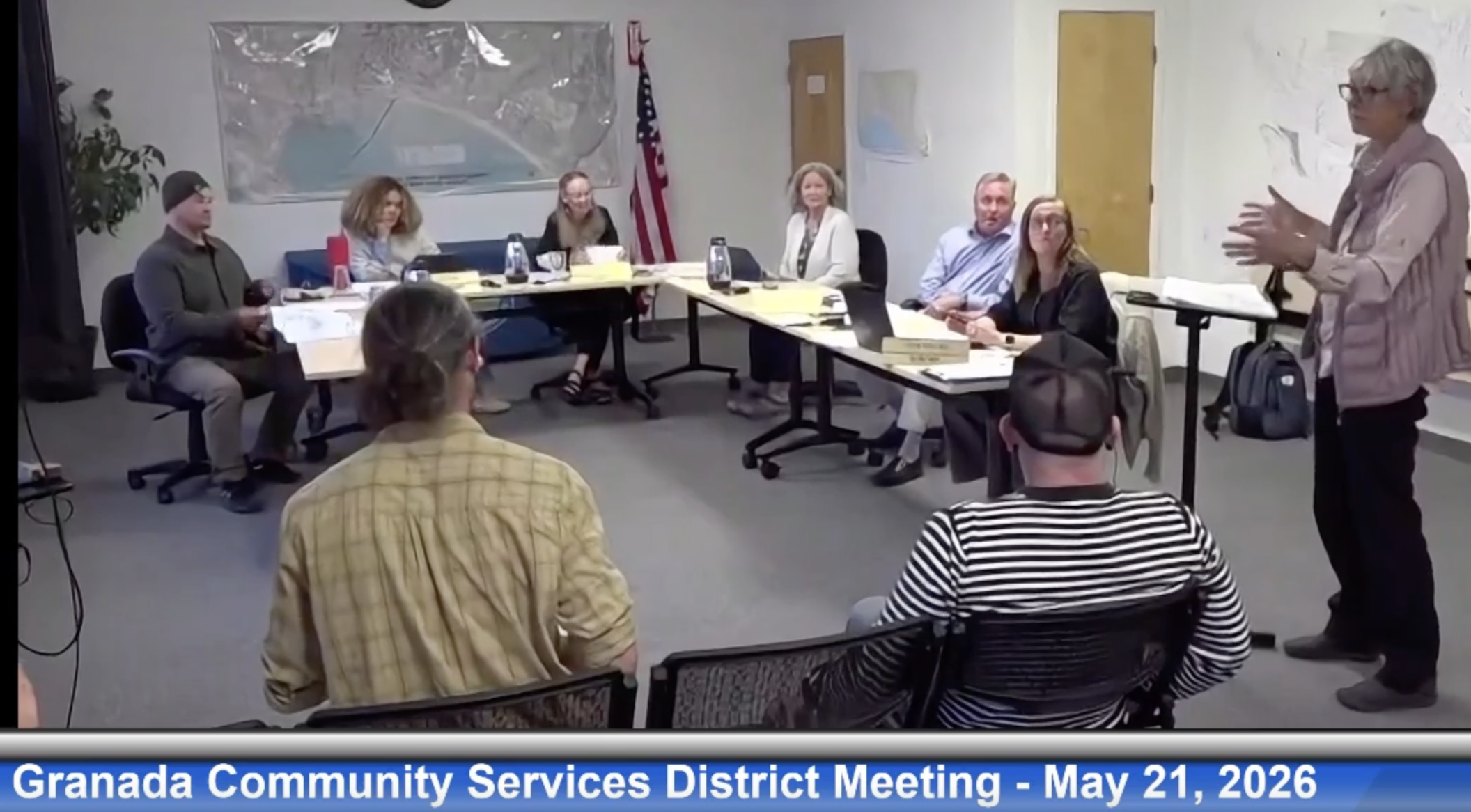
Board of Directors - May 21, 2026 - Meeting
Board of Directors • Granada Community Services DistrictMay 21, 2026
Locunity is a independent informational service and is not an official government page for this commission.We use AI-assisted analysis and human editorial review to publish information.
Board Demands Budget Accountability After $6M in SAM Overruns
The Granada Community Services District board tackled a decade of sewer infrastructure cost overruns, approved a reshaped community park plan forced by state regulators, and renewed a popular youth environmental education program at its May 21 meeting. The common thread: a small coastal district negotiating the gap between ambitious plans and the bureaucratic realities of multi-agency governance, state permitting, and tight budgets.
Board adopts sweeping SAM budget reforms after $21M in infrastructure spending blew past $15M budget over five years
Revised park master plan drops dirt lot development after Coastal Commission and Caltrans intervene; skate area nearly doubles to 2,500 square feet
$36,000 grant renewed for Coastside Land Trust youth environmental education, with seventh-grade bird ecology pilot launching in September
GCSD draft budget allocates $2.3M for community center and $2.294M for district's share of $12M Montera Force Main
Coastside Allies representative warns community members are discussing litigation and civil grand jury complaints over SAM spending
$21M Spent, $15M Budgeted: Board Forces Line-Item Tracking on Sewer Authority
Why it matters: The Sewer Authority Midcoast, a joint agency serving Granada, Half Moon Bay, and Montara, spent $21 million on infrastructure over five years against a $15 million budget — with 8 of 19 completed projects exceeding their budgets by 50% to 500%. The board's adoption of revised Resolution 2601 represents the most significant financial oversight reform in the authority's history.
Where things stand: Director Nancy Marsh delivered the evening's most extensive remarks, walking through months of negotiations with SAM's finance committee. The core problem, she explained, was structural: SAM's infrastructure budget was treated as a single bucket rather than discrete project line items, with overruns funded by quietly borrowing from future project budgets.
"Our concern is not with the budget and how the budget is structured. There's a lot of detail in the budget and our concern is not necessarily tracking. It's where things are tracked and how they're made visible to whom," said Director Marsh.
Marsh detailed how $4.2 million was spent over five years on non-project capital improvements — routine repairs and maintenance — that was never formally budgeted. The board only saw quarterly performance reports at a unified level, with no project-by-project variance tracking.
"That's how we have managed to spend, as we said last time, 21 million invested into this plant in the last five years," Director Marsh said. "It's all gone into infrastructure. None has gone to trips to Rio de Janeiro."
The reforms: The agreed-upon changes include giving non-project repairs their own budget line ($417,000 this year); monthly financial reports to the full board including a combined CIP project report showing variance by project; quarterly non-project detail; a reserve fund for small overages; and, for major overages, mid-year budget corrections with increased assessments from member agencies rather than transfers from other projects. Rolling projects that exhaust their budgets will receive new funding in the new fiscal year rather than drawing from other projects.
General Manager Chuck Duffy noted the resolution language was softened from the original draft to remove conditional approval language. "We don't like to make conditional approvals because two other agencies have to approve as well. So soften the language," he said, reflecting the trust-building needed with partner agencies Half Moon Bay and Montara.
The other side: Kevin Sniecinski from Coastside Allies delivered a pointed public comment, warning that community members are actively discussing litigation, civil grand jury complaints, and town hall requests.
"I would be fired from any job that I had if I were to treat a budget like that," Sniecinski said. He called small expenditures on gift cards and dinners "salt in a very big wound" given the scale of overruns, and estimated misuse of funds at $1 million to potentially $3–4 million. Four resident letters echoed similar concerns.
Sniecinski drew a sharp contrast with GCSD's own transparency: "The community is going to expect a level of detail and excellence when it comes to project planning and budgets from GCSD. The example being the community center, which has had broad support and you've been very transparent about everything budget-wise from day one."
Director Jen Randle pushed for quantitative performance metrics for the SAM general manager, rather than subjective evaluations. "I think there's an opportunity to move from more of a subjective or qualitative 'meets expectation' based on a board's point of view versus just the numbers, the analytics, like a report card or a dashboard," she said.
President Barbara Dye noted she reviews nearly every SAM check as co-signer and acknowledged the legitimacy concerns. "I have to say they are all legitimate expenses. They may be too high, but there's nothing there," she said.
Decisions: The board approved the SAM general budget and revised Resolution 2601 by voice vote, 4-0 (Director Wanda Bowles absent). The SAM collections budget was approved separately, also 4-0, with praise for the field service team.
What's next: Monthly CIP variance reports will now go to the full board. The Montera Force Main project — expected to cost $12 million, with GCSD's 18% share budgeted at $2.294 million — recently received its coastal development permit. An ongoing easement dispute with Half Moon Bay over a solar installation at the SAM facility remains unresolved.
Park Plan Reshaped After Coastal Commission, Caltrans Demand Parking Preservation
Why it matters: After a decade of planning, the Granada Community Park and Recreation Center project hit a regulatory wall — and came out the other side with a plan that resolves the community's biggest objection while sacrificing habitat restoration and a planned Village Green.
Where things stand: Tom Conroy of KCRH Landscape Architecture presented revised plans following meetings with the Coastal Commission, Caltrans, San Mateo County Planning, and the Mid Coast Community Council. The upshot: Caltrans will be required to return its right-of-way to informal parking, and the Coastal Commission expects GCSD to maintain two-way vehicular access through the district-owned dirt lot.
"At this point, we have never been closer," Conrad said of the permitting timeline. "But as has been the case throughout this project, these little incremental steps are not necessarily linear."
Key changes include eliminating all development on the dirt lot, leaving it as-is for informal parking; nearly doubling the skate area to approximately 2,500 square feet; reducing off-street parking along Obispo Road from 19 to 16 stalls for a more graceful park entry; and dropping the bridge that would have crossed to the Village Green. Conrad noted the revised plan now provides nearly three times the required parking.
"Director Allen, at the November meeting, I recall you saying, imploring us to find some additional space for the skate area," Conrad said. "With the elimination of the bridge that crossed from this area over to the village green and the related trails, we've been able to nearly double the size of the skate area."
General Manager Duffy recounted how the Coastal Commission representative was blunt about preserving the informal lot: "He basically said, 'You guys are gonna — that parking's been there 50 years.' And I said at one point, 'Look, it's unfair for us to have to provide parking for Surfers Beach.' But I live in the real world and I know we have to."
The other side: President Dye expressed sadness about losing the habitat restoration and Village Green components. "We've eliminated the habitat restoration in the riparian corridor for the main drainage at the bottom of Portola. And I know that if we did it, it would then take — it would have to have a buffer out into the dirt parking lot. But I'm sad about that," she said.
Director Marsh flagged traffic concerns at the Obispo intersection, noting from her experience as a neighborhood resident that Caltrans and the county will need to coordinate on that access point.
Director Randle struck an optimistic note: "I just wanted to say thank you for being so proactive around realizing this was going to become a real issue."
Public commenters weighed in on parking logistics. Brigitte Bauer questioned how vehicles would enter, turn around, and exit the Caltrans right-of-way. Dan, a 37-year area resident, reiterated his position that the lot should remain completely informal with no light poles or beautification. Kevin Sniecinski from Coastside Allies praised the district's transparency over the project's 10-year arc but flagged that Half Moon Bay is promoting Surfers Beach parking in residential El Granada on its website.
Construction manager Mike Wasserman of Capital Program Management was introduced and will present a preliminary project budget next month.
Decisions: Approved 4-0 by roll call vote (Bowles absent).
What's next: The coastal development permit application is expected to be submitted in early June. The dirt lot preservation also provides flexibility for future multimodal trail connections.
$36K Grant Renewed for Youth Land Stewards Program
Why it matters: The Coastside Land Trust's Junior Land Stewards program reaches all 60 fourth graders at El Granada Elementary each year and is now building a K-12 environmental education pipeline on the coast.
Haley from the Coastside Land Trust presented the program's progress: four walking field trips per year (two at Quarry Park, two at Miramar Surf East), weekly nature journaling, and a habitat restoration project where students grow a pollinator garden at El Granada Elementary. High school students from AP Environmental Science and Marine Ecology serve as field guides.
"This year was the first year that we had high school students act as field guides that were once Junior Land Stewards in fourth grade," Haley said — a milestone marking the program's growing reach.
She also announced a new expansion: "We just got approved by the district to pilot a seventh-grade program, much like the fourth-grade program, but focused on bird ecology. And it's more like data-driven and how birds are like signals of the changing environment." The "Wing Watchers" pilot launches in September.
Decisions: Director Marsh moved to continue the $12,000 annual grant for three school years, seconded by Director Allen. Approved 4-0 by voice vote (Bowles absent). President Dye noted she has volunteered with the program and praised its impact on getting kids outdoors.
GCSD Draft Budget: $2.3M for Community Center, 5% Sewer Increase
The basics: General Manager Chuck Duffy presented the GCSD draft budget covering both sewer and parks divisions.
On the sewer side, the district is budgeting $2.294 million for its 18% share of the $12 million Montera Force Main project. Sewer reserves are projected at $3.9 million at June 30, with a $1.4 million deficit leaving $2.4 million in reserves — a level Duffy said he is comfortable with. A 5% sewer service charge increase is included.
On the parks side, property tax revenue is projected at about $1.6 million. Administrative expenses are flat, with a slight dip due to resolved legal costs from the Half Moon Bay lawsuit. The parks capital budget includes a $2.3 million placeholder for the community center project, which will be refined next month when Capital Program Management provides actual phasing and cost estimates.
Director Marsh lobbied for restraint after the force main is complete: "We think of it as a cap, but I think actually we need a little bit of a project holiday. Let the staff catch up, finish all the trailing projects and let the agencies catch up with their own CIP projects."
What's next: A public hearing will be required for the final budget. CPM's preliminary community center budget is expected at the next meeting.
Minor Items
Consent agenda approved 4-0 (Bowles absent).
Eucalyptus clearing: Kevin from Coastside Allies reported the county will complete eucalyptus tree clearing to establish a 50-foot barrier behind Albernada Boulevard in Q4.
Kaiser vaccine drive: A Kaiser Permanente vaccine clinic at Senior Coastsiders and a reinstated bus shuttle service for seniors were announced during public comment.
Recreation programs: Staff reported near-capacity chair yoga, 190-customer quarterly recycling events, sound baths, spring fest, nature walks, and upcoming sewing and drawing classes.
Preschool building: The district plans to take over a building from a departing preschool operator, with GCSD assuming utilities July 1 and the tenant vacating by July 24. Potential refurbishment depends on building condition and whether temporary renovations are worth the investment before the new community center is built.
Election policy deferred: The board postponed its decision on whether candidate statements for the November 2026 election should be 200 or 400 words, and whether the district pays. Kevin from Coastside Allies advocated for 400 words, arguing the shorter limit is challenging for newcomers. Director Marsh favored 200 for readability. The board will revisit in June with cost data and jurisdictional comparisons.
Montera Force Main coastal development permit issued, clearing a key regulatory hurdle.
Half Moon Bay easement dispute over a solar installation at the SAM facility continues unresolved.