
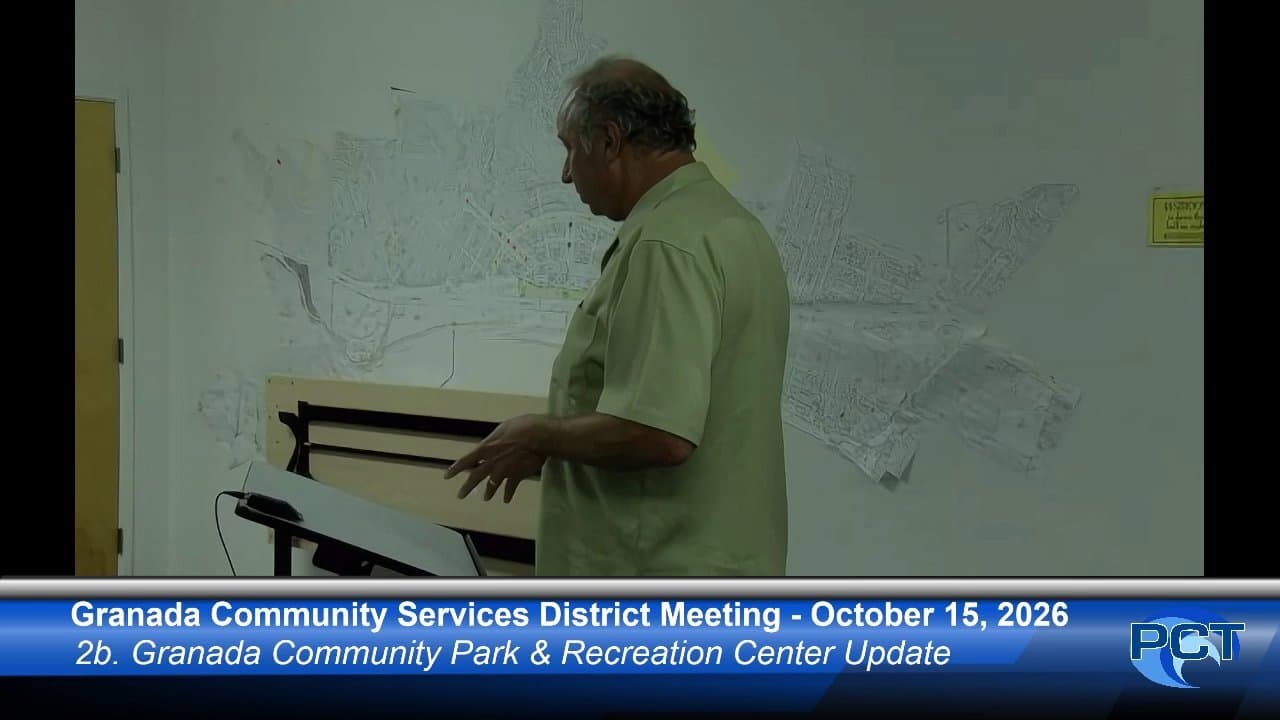
Granada Board Backs On-Site Staff for Community Center Design
Board of Directors • Granada Community Services DistrictOctober 15, 2026
Locunity is an independent informational service and is not an official government page for this commission. All information is sourced from public footage and an analysis of official agendas with the aid of responsible, fact-checked AI. to report an error or omission.
The Granada Community Services District's community center now has its first firm design rule: staff will work inside the building. On Oct. 15, directors approved that guidance before the project goes out to bid. They also advanced a senior-services partnership, hired a financial advisor and heard that the Midcoast's sewer plant is running on a rented generator.
- On-site staff offices approved for the Granada Community Center. Layout, kitchen and roll-up doors are left to design-build.
- Request for qualifications to be advertised Oct. 19. Directors asked staff for a full RFQ/RFP timeline.
- 3-0 vote advances Senior Coastsiders partnership on park property after Vice President Wanda Bowles recused.
- Sewer plant on a rented generator after a third bus duct failure.
- Army Corps resilience study could cost the district about $400,000 and $500,000 over the next two fiscal years if no grants are found.
- Ridgeline hired as municipal advisor ahead of any borrowing for the center.
Staff Stay in the Building, Details Wait
Why it matters: Putting staff offices in the recreation center takes space from programs and events. The decision sets a fixed requirement for the request for proposals on a tight budget, with the existing building being reused.
Where things stand: Assistant General Manager Hope Atwater said comments to San Mateo County are being compiled for resubmission. The request for qualifications will run Oct. 19 in the Daily Journal and again the following week. Staff will then shortlist firms for a request for proposals.
Mike Wasserman of Capital Program Management recommended progressive design-build. Under that approach, one team designs and builds the project, and the board gives design input in rounds as the work develops.
Director Nancy Marsh made the case for staff on site and asked that the firm list include companies with community-center experience.
"Every CRC I've ever seen, and I'm up to about 10 now, has staff on site," said Director Nancy Marsh.
Marsh also said event space needs a catering kitchen to be viable. Atwater responded that contacts at the library and in Burlingame reported catering kitchens are rarely used.
The other side: Board President Barbara Dye resisted choosing between the two draft layouts and wanted both options explored.
"I just am uncomfortable making a decision based on these two layouts," said Board President Barbara Dye.
Director Jen Randle argued for consolidation. "Principally, I feel like we should have one space and we should have it all figured out under one roof," she said.
Roll-up doors were the costliest idea discussed. Atwater said the doors were left out of the drafts for budget reasons. "The reason that is not in here is because of the price," she said. Wasserman warned about the structural risk.
"That's a major structural change to our building, which might trigger a whole structural upgrade to the building," said Mike Wasserman, consultant, Capital Program Management.
Wasserman added that the district is limited by its debt service capacity, meaning how much annual loan repayment it can afford. General Manager Chuck Duffy said value engineering, the design-phase review of cost trade-offs, would handle those questions.
Public commenter Pat Tierney urged on-site staff in Phase 1, rental income to offset coordinator costs, a catering kitchen and storage for seasonal events. "Absolutely every community center I knew of in San Francisco is locked and closed if there is not a staff member there," Tierney said.
Decisions and stakeholder impacts: Marsh noted that only the staffing question needed an answer that night. Randle moved to include staff offices on site, and the motion passed with no opposition. Future users gain a building that can stay open when staffed. Event renters may lose square footage. The design-build team inherits open questions on the kitchen, doors and layout.
What's next: The RFQ is advertised Oct. 19. Staff will return with a timeline for the RFQ and RFP.
Senior Coastsiders Talks Move Forward, 3-0
Why it matters: A second building on the district's park property at 480 Avenue Alhambra could bring senior services to the Midcoast, with shared space and staff. The kitchen, zoning and fundraising questions are still unresolved.
Where things stand: Two disclosures came first. One director disclosed a seat on the Senior Coastsiders board. Bowles disclosed a Government Code 1090/1091 conflict, the state law barring officials from having a financial interest in contracts they vote on, and left the room.
"I'm a paid consultant to Senior Coastsiders, serving the community as the digital literacy leader," said Board Vice President Wanda Bowles.
Sandy Winter, executive director of Senior Coastsiders, said the project is part of the nonprofit's strategic plan and its 50th-anniversary capital campaign. She cited intergenerational programming, shared staff, and evening and weekend use of the nonprofit's own space by others. She also pointed to the group's arrangement with co-tenants at 925 Main Street: "We've negotiated to have a 99-year lease in our case," she said.
The kitchen is the main friction point. The plans show only a catering kitchen.
"I would like us to have a commercial kitchen because I think that gives us more opportunities," said Winter.
Her fallback is to bring in food prepared offsite, as she does for ALAS and Puente.
The basics: Director Nancy Marsh reminded the board that "the zone limitations on the lot are for 10% lot cover." That limit required merging lots, and Duffy said the merger is under way.
The other side: No one opposed the partnership. Public commenter Pat Tierney called herself "a big, strong supporter of this collaboration with Senior Coastsiders and GCSD." She also pressed for after-school, summer-camp and emergency-resource uses so the site serves all ages.
Decisions and stakeholder impacts: Marsh moved to direct staff to continue discussions on a joint Mid-Coast home for Senior Coastsiders. The vote was For: 3, Against: 0, with Bowles recused and Director Matt Allen absent. Midcoast seniors stand to gain local services. Families could benefit if Tierney's all-ages uses are adopted. The nonprofit now faces fundraising and kitchen design decisions.
What's next: Staff will continue negotiations. Lot-merger work is ongoing.
Sewer Plant Runs on a Rented Generator
Why it matters: Failures and flood risk at the Sewer Authority Mid-Coastside (SAM) plant carry real costs for the district, even though no vote was taken.
Where things stand: The bus duct, the electrical conduit that feeds power to the plant, has failed again.
"This is the third time the SAM bus duct has blown up," said General Manager Chuck Duffy.
"SAM staff are working 10-hour shifts because someone has to be there 24 hours a day," said Board President Barbara Dye, describing round-the-clock monitoring of the generator.
The district is working with PG&E on permission to use existing bypass lines. Repairs have been delayed by the search for a specialist.
The bigger picture: One Shoreline, a consortium of agencies, presented a project with the U.S. Army Corps of Engineers to improve plant redundancy, drainage and climate resilience. Directors said planning costs are split 50/50.
"The maximum from the federal government on that would be $15 million, and they pay 65% of that and local pays 35%," said Director Nancy Marsh.
Directors estimated the local share at perhaps $7.4M. They also noted issues at the Pilarcitos Creek mouth and berm. The SAM board was described as unanimous in pursuing the project.
What's next: Without grants, the district faces about $400,000 and $500,000 in study costs over the next two fiscal years. Work on the Montecito/Montara force main is also progressing.
Advisor Hired Before Any Borrowing
Capital Program Management solicited proposals from about seven groups. Five responded, and Atwater said "Ridgeline came out ahead," ranking first and least expensive. Ridgeline will hold a financing workshop for the board.
"I am concerned that the request for proposals is only to banks," said Board President Barbara Dye. Staff said the county financing option is known and not excluded.
Directors discussed a flat fee of roughly 2.5% to 3.5% depending on loan size, or $20,000 to $30,000. Duffy compared that to $50,000 to $60,000 for a bank private placement and $500,000 for a Mello-Roos or assessment district. "This is actually pretty cheap," he said. Randle's motion passed with four ayes and no opposition.
Minor Items
- Dudek contract renewed: The general manager services contract was extended three years. The hourly rate rises from $225 to $255, which staff described as about 3% annually, in line with CPI. It passed by hand with no opposition.
- Consent agenda: Approved 4-0 with a correction to the Sept. 17 minutes.
- Winter Festival: The El Granada Winter Festival is set for Dec. 19, from 10 a.m. to 6 p.m., with craft vendors and library children's crafts. Staff is still seeking food trucks and a Santa.
- Recreation report: Recology's quarterly recycling day served 126 customers. Learn to Draw is popular, while Friday 4:30 p.m. yoga is under-attended.
- Peer district: Dye suggested reaching out to the Groveland Community Services District. Duffy said a connection already exists.
Looking ahead: Watch for the RFQ in the Daily Journal on Oct. 19, a staff timeline for the RFQ and RFP, and Ridgeline's financing workshop for the board.