
Board of Directors - Apr 21, 2026 - Meeting

Board of Directors - Apr 21, 2026 - Meeting

Board of DirectorsEast Bay Regional Park DistrictApril 21, 2026

Sources:

Locunity is a independent informational service and is not an official government page for this commission.We use AI-assisted analysis and human editorial review to publish information.

Board Backs E-Bike Registration Bill 4-2 as Safety and Equity Collide

The East Bay Regional Park District board's April 21 meeting turned into a revealing debate over who trail safety regulation actually serves — and who it might leave behind. The headline vote, a split 4-2 decision to support a first-of-its-kind state e-bike registration bill, exposed a fault line between directors who see license plates as essential enforcement tools and those who worry the fees will price low-income riders off the trails. Meanwhile, the board unanimously approved more than $2.3 million in wildfire and environmental cleanup contracts, heard that a mass tree die-off has been stabilized through $11.6 million in leveraged grant funding, and fielded pointed public criticism over cashless park payment policies and a stalled 74-year-old steam train lease.

  • Board supports AB 1942 e-bike registration bill 4-2, overriding opposition from cycling advocacy groups who call it misdirected

  • Fire department stabilizes tree die-off crisis by leveraging $1.4M in district funds into $12.9M total for Anthony Chabot fuels work

  • $1.61M in FEMA-funded contracts approved to thin eucalyptus on 56 acres in Tilden Park near the Berkeley Hills wildland-urban interface

  • Gun club lead cleanup advances with Geosyntech contract for on-site consolidation design at one-eighth the cost of full excavation

  • Hayward Marsh restoration targets September 2026 construction start, building endangered Least Tern nesting habitat and adapting the Bay Trail for rising seas

  • Park ranger warns cashless policy is "frankly cruel" to unbanked families, citing Federal Reserve data on racial banking disparities


E-Bike Registration Splits the Board

The basics: AB 1942, the E-Bike Accountability Act by Assembly Member Bauer Kahan, would require DMV registration and special license plates for Class 2 and 3 e-bikes — a first for California. Director John Mercurio pulled the item from the consent calendar to force a full debate.

Why it matters: E-bike speed on paved regional trails like Iron Horse Trail is a top safety complaint. The bill's sponsor list includes John Muir Health Clinic, driven by child injury data. But at least eight bills are addressing e-bike regulation statewide this session, and cycling advocacy groups say this one targets the wrong vehicles.

Where things stand: Mercurio argued the district should shift from support to watch, citing enforcement challenges and community opposition from groups including Cal Bike, CAMTB, and Bike East Bay.

"The real issue are the emotos, which aren't even considered in this. Those are small motorcycles that preteens and teens are using without adequate training," he said.

Director Lynda Deschambault pushed back forcefully, arguing identification is the real value.

"I don't think it's just about speeding. What I really love about this is the identification portion," she said, adding that a fee structure could fund enforcement.

Director Elizabeth Echols agreed.

"I do think that for those who are not following our rules and who are speeding on our trails, it is helpful to have a license plate. I think it does make people more accountable," she said.

The other side: Board President Olivia Sanwong raised a pointed equity question, asking for staff to provide more information on the impact to low-income communities. Eric Pfuehler, Division Lead of Government & Legislative Affairs, noted the bill's legislative trajectory but did not have specific low-income impact data on hand.

Scott from the Bicycle Trails Council East Bay urged a neutral position, recommending the board support SB 1167 by Senator Blakespear instead, which targets emoto sales rather than registered e-bikes. Noam, an East Bay advocacy consultant, confirmed the first-house deadline is the end of May.

Decisions: AB 2051 and AB 2184 passed unanimously, 6-0. AB 1942 went to roll call, passed 4-2-1 (For: Echols, Deschambault, Dennis Waespi, Sanwong voted; Against: Espana, Mercurio; Absent: Coffey)

What's next: The district's positions will be communicated during Sacramento advocacy days ahead of the May first-house deadline.


Tree Die-Off Stabilized After $12.9M Chabot Investment

Why it matters: Since 2020, the East Bay Regional Park District has been in emergency-management mode responding to a mass tree die-off driven by bark beetle and drought. The fire department's 2025 annual report delivered the first definitive stabilization message.

Where things stand: Assistant Fire Chief Carrie Hailey reported the district increased fuels management staffing by 50% since 2020 — 10 additional positions — and treated 1,477 highly critical acres in 2025. In Anthony Chabot alone, $12.9 million has been invested, with only $1.4 million from district funds. "$11.6 million in grant funding" from Cal Fire, FEMA, and the State Coastal Conservancy covered the rest.

"The incident now is stable. We've stabilized the situation where trees are not dying off in large amounts that we were concerned or we lose all of our forested areas," Hailey said.

Director Lynda Deschambault pressed on whether the work is holding up over time. Acting General Manager Max Korten described a district-wide vegetation mapping effort and an upcoming vegetation management strategy that will guide long-term priorities.

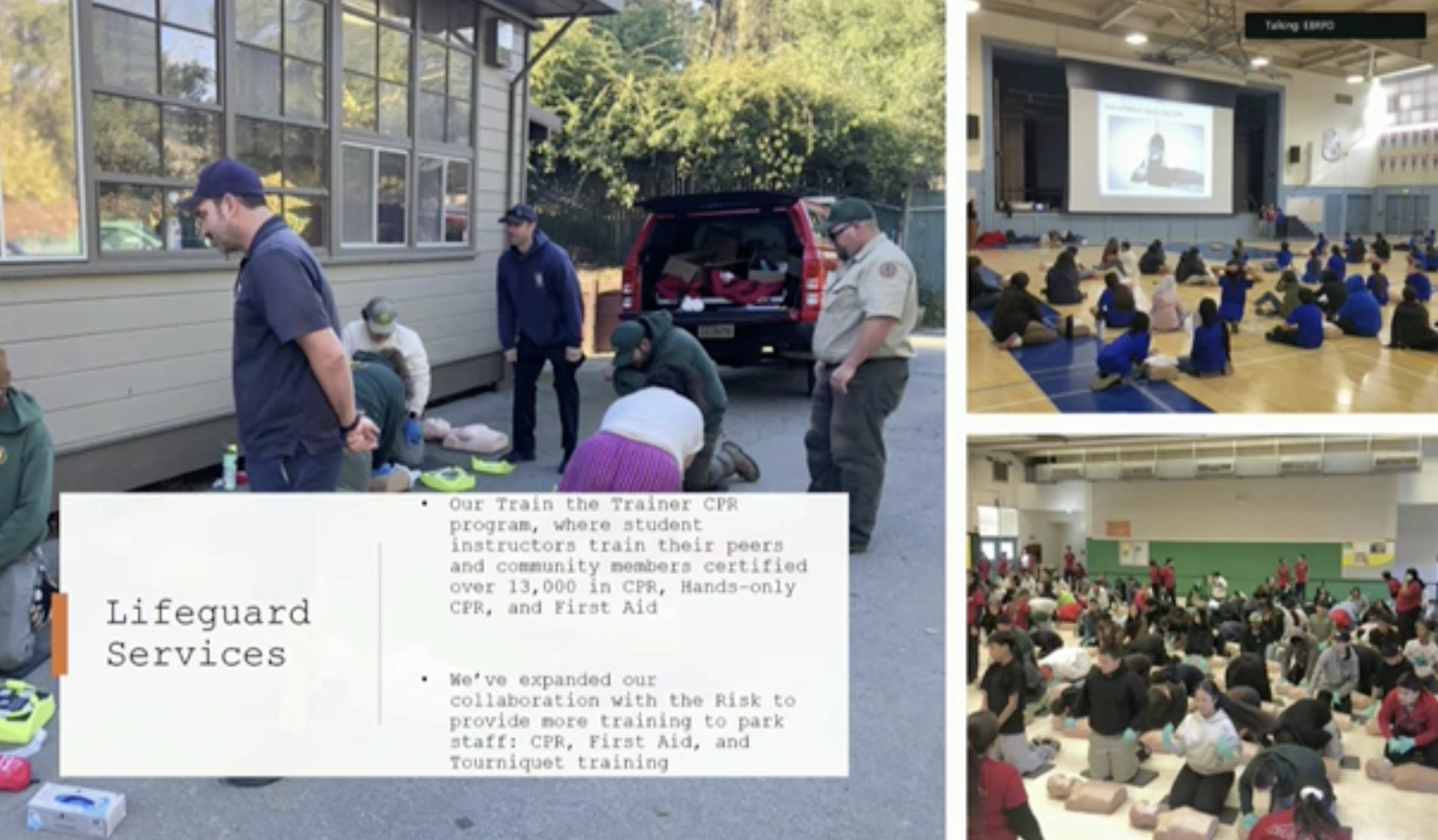
Aquatic safety milestone: Assistant Fire Chief Pete De Quincey reported that lifeguard train-the-trainer programs reached 13,000 students and community members in CPR and first aid across two counties. He shared that 183 people returned from the previous year — a nationally uncommon retention rate of over 90%. The Aquatic Adventure Camp won a 2026 NACPRO national award.

Director Waespi urged the department to seek more recognition:

"The only thing I would wish you would do, not better, but more, get some more awards. The stuff you guys do is so innovative, nobody else is doing it."


$1.61M Approved for Eucalyptus Thinning Near Berkeley Hills

Why it matters: Tilden Regional Park sits directly above one of Northern California's most densely populated wildland-urban interfaces, where 90+ mph fire weather can push flames into neighborhoods within minutes.

Where things stand: The board unanimously approved two specialty fuels reduction contracts funded primarily by a FEMA Hazard Mitigation Grant with a $1.2 million district match. Unit 1 targets 28.7 acres near the historic 1911 Merry-Go-Round for $947,100 with Expert Tree Services, removing eucalyptus stems while retaining mature trees for shade and habitat. Unit 2 covers 27.6 acres near the golf course and Grizzly Peak for $663,018 with Bay Area Tree Specialists, prioritizing Sutton oak defense and pathogen management.

Director Waespi asked about contractor selection methodology and the logistics of hauling biomass to Woodland — 86 miles each way. Staff clarified that a separate state grant covers hauling costs.

The other side: Judy Smith, a Parks Advisory Committee member, raised canopy replacement concerns, asking whether native trees are planted to replace removed eucalyptus and citing loss of shade and bird habitat at Reinhardt after elm removals. Director Lynda Deschambault suggested incorporating the work into the PAC's six-month biodiversity and fuels management pilot and asked about using a carbonizer on-site instead of long-distance hauling.

Decisions: Passed 6-0 (Coffey absent). Assistant Fire Chief Carrie Hailey noted another similar contract will come before the board at the May 5 meeting.


Gun Club Cleanup Design Moves Forward After a Decade

Why it matters: The former Anthony Chabot Marksmanship Range operated from 1963 to 2016, leaving lead and clay pigeon contamination from more than 50 years of use. The district is responsible for cleanup since it caused the contamination — meaning no outside grants are available.

Where things stand: Civil Engineer Mac Olsen presented three remedial options: institutional controls only, full excavation and off-site disposal, or on-site consolidation and isolation. Staff recommended on-site consolidation because it achieves similar risk reduction at one-eighth the cost. Four proposals were received; Geosyntech was selected.

Acting Assistant GM Matt Graul provided historical context, noting that continued operation would have required $15–20 million in stormwater treatment alone.

Director Lynda Deschambault pressed on cap type and long-term monitoring, drawing a direct comparison to Point Isabel where a cap later required replacement.

"I hope we don't hear back that this is going to be another $5.9 million because the cap was chosen to be a dirt cap and it's not sufficient," she said.

President Olivia Sanwong proposed a solution:

"There could be option A, option B, if there's an option C, and then show the construction costs and then the anticipated O&M cost."

Staff committed to presenting a cost comparison matrix at the executive committee stage.

Director John Mercurio recalled the original closure debate.

"The board was courageous enough, I believe I would characterize it that way, to bite the bullet, close it, and then pay for the cleanup," he said.

Decisions: Passed 6-0 (Coffey absent). Staff will return with preliminary design and cap options including construction versus long-term operations and maintenance cost tradeoffs.


Hayward Marsh Restoration Nears Construction

Why it matters: The Restore Hayward Marsh project at Hayward Regional Shoreline is the district's most comprehensive sea-level-rise adaptation initiative, combining endangered species habitat creation with Bay Trail adaptive retreat and living shoreline features.

Where things stand: Restoration Projects Manager Chris Barton and Project Manager Karla Meyers presented the multi-phase effort. Phase 1A will build up a levee and construction access road, with a September 2026 start. Total spent to date is approximately $2 million on feasibility, design, and permitting. A $2 million Restoration Authority grant was recently awarded, though the Phase 1A construction estimate is running 25–30% higher than the original $1.8 million projection.

The project involves 28-agency coordination, BCDC and Army Corps permits, and creation of new nesting islands in Pond 2A designed for California Least Tern inland migration as seas rise. Salt marsh harvest mouse and Western Snowy Plover habitat are also part of the design.

Director Dennis Waespi praised the collaborative effort:

"You're turning water into wine down there. It was an outfall for a sewer district, and now it's going to be beautiful."

Director John Mercurio asked about fill material sourcing; staff said they will use a dirt broker similar to the Oyster Bay model.

What's next: The board will see a construction contract award request in August.


Park Ranger Calls Cashless Policy 'Frankly Cruel'

During public comment, Park Ranger April Storm Dancer, a 19-year veteran at Anthony Chabot, delivered a pointed critique of the district's expanding cashless payment policy. She cited Federal Reserve data showing only 52% of Black Americans and 63% of Hispanic Americans are fully banked, arguing the policy contradicts the district's own equity statement.

Storm Dancer described turning away families at campgrounds and swimming areas who can only pay cash — including people who have lost their homes but still have cars. She called the policy "frankly cruel" and referenced the legal tender status of U.S. currency.


Steam Train Operator Says 7.5-Year Lease Stall Threatens 74-Year Cultural Asset

Ellen Thompson, owner of the Redwood Valley Railway Company — the Tilden Park steam train that has operated for 74 years without district funding — told the board her lease renewal has been stalled for 7.5 years through 12 staff changes. She described staff wanting to replace a polished working draft with an inferior document and questioned whether the delays reflect a long-term policy to eliminate Tilden attractions, personal agendas, or negligence. She acknowledged that Acting General Manager Max Korten has offered to help restart the process. Without a renewed lease, the railway cannot obtain county permits for capital improvements.


Wildcat Canyon Flow Trail Draws Neighborhood Opposition

Two public commenters raised alarm about a proposed destination mountain bike flow trail in Wildcat Canyon Regional Park. Leslie Goldstein of El Cerrito cited safety concerns about trail design running 5–10 feet from barbed wire fencing on steep grades, two miles from emergency vehicle access, and noted it would violate the 1985 Land Use Plan requiring the area to be free from intensive recreation. She warned of litigation risk.

Janet Flint of Richmond reported that 95% of people she surveyed at Alvarado Trailhead had never heard of the project. She described the engineered design — at least 36 banked turns, potentially 80 jumps, and 100-plus rollers — and emphasized that 82–88% of district users are hikers and walkers who would be affected by increased bike traffic on shared access trails.


Minor Items

  • Consent calendar (items 1–6, 8–10) approved 6-0, including out-of-state travel authorizations.

  • Point Isabel land transfer to Union Pacific Railroad approved 6-0, resolving a 0.24-acre property-line issue where a remediated oil contamination soil cap extended onto jointly-owned park district and state parks land. The administrative fix permanently removes environmental monitoring obligations for both agencies.

  • AFSCME 2428 Second Vice President Matt McDonnell argued that adding a bachelor's degree requirement for Park Unit Manager positions creates unfair barriers for qualified internal candidates.

  • Nick Collins, founder of the 510 Hikers nonprofit, questioned why his organization was not selected for a district pilot program despite bringing 150 participants to a recent hike.

  • Acting GM Max Korten showcased a new park signage refresh program starting at Del Valle, with updated maps and wildlife information. Seasonal openings include Anthony Chabot campground on April 1, swim-at-your-own-risk at Lake Temescal, and Iris garden at Dry Creek. Upcoming district plan community events include the Sunol Wildflower Festival and a Ward 7 stakeholder Zoom meeting.

Board Backs E-Bike Registration Bill 4-2 as Safety and Equity Collide | Board of Directors | Locunity