
Park District Previews First Data-Driven Vegetation Strategy as Flow Trail Fight Simmers
Board of Directors • East Bay Regional Park DistrictOctober 6, 2026
Locunity is an independent informational service and is not an official government page for this commission. All information is sourced from public footage and an analysis of official agendas with the aid of responsible, fact-checked AI. to report an error or omission.
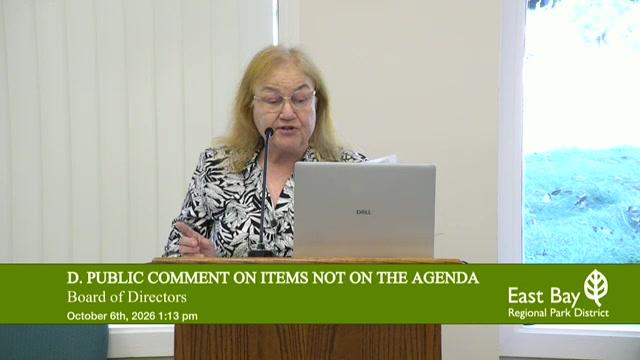
The East Bay Regional Park District is building a map to decide where its limited wildfire and habitat dollars go first. At its Oct. 6, 2026, meeting, the Board of Directors heard an information-only briefing on that strategy, with a vote expected later. Earlier, a wave of public commenters turned the Wildcat Canyon Flow Trail into a test of public trust. The trail fight centered on a conditional $1 million donation and a draft environmental review that critics say few residents know is coming.
- First district-wide vegetation strategy previewed, with four draft goals and three data models; no vote yet
- Park advisers say they had too little time to shape the strategy. Environmental groups push for trees, birds and prescribed fire.
- Wildcat Flow Trail opponents allege staff-donor coordination. Supporters cite youth health and safer trails.
- Community partners tell the board that new park users need translation, accessible paths, transit and swim programs
A Map Before the Money
The basics: Vegetation management is the cutting, grazing, burning and thinning used to lower wildfire risk and restore habitat. Staff presented a "prioritization framework" that layers three models: community, ecology and feasibility. Places where the models overlap are flagged as priority areas.
Why it matters: Wildfire is the public's top concern, and resources are limited. The framework would steer where crews work first and support grant applications and partnerships.
Where things stand: Claire Griffin, Management Analyst in the General Manager's Office, laid out four draft goals:
- Reduce wildfire risk and protect communities
- Protect and restore healthy ecosystems
- Maintain safe, accessible parks and trails
- Strengthen coordination, communication and sustainable management
Kristen Van Dam, Ecological Services Coordinator in the Stewardship Department, said the effort is new ground for the agency. "This project is the first of its kind for the Park District," she said. She stressed its limits: "It is not a new wildfire plan. It is not actually a plan at all." Staff told directors the map is the strategy.
Directors pressed on what happens after the first cut. "Once you treat these areas, if you don't maintain them, then that work is wasted after a few years," said Director Elizabeth Echols (Ward 1). General Manager Max Korten answered directly. "We are not walking away from any of the existing places that we've treated and done initial work," he said.
Board President Olivia Sanwong (Ward 5) asked that the document include the history behind the work. She also asked who helps ranchers with livestock evacuation and urged that ranchers be counted under "protecting communities." Director Lynda Deschambault (Ward 2) asked staff to add greenhouse gas reduction as a goal. Directors also raised critical infrastructure, tree inventories, sheep grazing, review loops and a public-facing version of the document.
Decisions and stakeholder impacts: No vote was taken. Board support was broad. Director Dennis Waespi (Ward 3) said constituents want wildfire risk reduction as the priority. He noted that "we've gone from $2 million to $10 million last year." Director John Mercurio (Ward 6) backed the approach. "We have limited resources, we need to be able to go out and do this work in an intelligent way," he said. Korten said the framework works "no matter what the level of funding is."
What's next: Staff expect the models to be finalized by the end of October. The Natural and Cultural Resources Committee will review the strategy Oct. 28. Staff expect to return for board acceptance, likely around January.
Advisers and Advocates Want a Bigger Say
Why it matters: This was the first time the district's Park Advisory Committee (PAC) handled an action item under its new process. Two members said the process fell short.
Where things stand: Irene Dieter, a PAC member, said the committee met twice on the topic. "I personally don't think it was enough time to dive deep into this subject matter," she said. She urged attention to trees, a tree inventory and wildlife habitat.
Judy Smith, the PAC appointee for Ward 2, said staff interpreted the notes from the committee's breakout sessions. She said the May 26 meeting left little room for feedback. "It just feels like we're asked to rubber stamp something that doesn't entirely encompass our views," she said. Smith asked for a separate PAC meeting before reports reach the board.
The other side: Environmental groups largely supported the effort but wanted it to go further.
- Cordis Cooper, of the Sierra Club Bay Area chapter's East Bay Public Lands Committee, called for more prescribed fire and maintenance planning. "We are keen to see the District dramatically expand the use of prescribed fire and managed wildfire," she said.
- Jim Hansen, of the California Plant Society East Bay Chapter's Conservation Committee, warned that ecology must not be an afterthought. He suggested renaming the plan and cautioned against over-severe clearing.
- A Golden Gate Bird Alliance speaker asked that work avoid bird breeding season and offered California Bird Atlas data.
- Norman LaForce urged species mapping, keeping dead vegetation as habitat and a focus on homes. "The key is home hardening," he said.
- Kelly Brew argued that mitigation costs per acre are steep. "The park district's in a bad position because it's sitting as the owner of a lot of land that's actually a liability," Brew said.
Decisions and stakeholder impacts: Korten called the PAC feedback helpful for improving a first-year process. Echols said the committee dug into a meaty topic. Environmental groups, PAC members and directors all asked for more on trees, maintenance and climate. That gives them shared leverage before the January return.
Wildcat Flow Trail: Trust Becomes the Issue
Why it matters: The proposed Wildcat Canyon Flow Trail involves a conditional $1 million donation. One speaker tied public trust to a possible 2028 tax measure. Opponents want the process slowed before the draft environmental impact report (EIR) is released.
Where things stand: Opponents focused on process more than dirt. LaForce criticized the conduct of some mountain bike advocates and asked that the donation's terms be made public. "That's pay-to-play, and that has no place in the Park District," he said.
Leslie Goldstein, speaking on behalf of community members, cited public records showing private coordination between staff and one user group. "Staff personally drafted the Flow Trail proposal for the donor under the subject line Trail Advocacy," she said. She asked for a pause, an independent procedural audit and a restart of public engagement.
Janet Flint, a volunteer with Friends of Wildcat Canyon Park, said her group spoke with about 600 people. More than 85% had not heard of the project. "The level of public awareness about the Flow Trail and the draft EIR is low," she said. She asked the board to direct a mailed announcement about the draft EIR.
Sally Tobin offered a resolution of her own. It would require trail proposals to be placed on public agendas and state that "the coercive donation will be refused." Bara Sapir described online harassment of women who oppose the trail. "Adults demonstrate the way to win a public discussion is to mock the women who speak up," she said. She asked for real outreach before the EIR.
The other side: Supporters framed the trail as a health and safety upgrade. "Mountain biking is actually an incredibly healthy way for our children and teens to spend their time," said Lauren Purcell. Lucinda Bingham cited family time outdoors and relief for crowded trails. Carrie Schulman said the trail would separate hikers from fast bikes.
Decisions and stakeholder impacts: Because the trail was not on the agenda, the board took no action. Several specific requests remain unanswered: a donation disclosure, mailed notice, an audit and a pause. Each would need board or staff action.
What's next: Watch for the draft EIR release. Watch also for whether the board directs broader notice before the public comment period opens.
Seniors and Youth Map Their Park Needs
General Manager Max Korten brought two community organizations to the board as part of district plan outreach. "We thought it'd be worthwhile to bring folks from those organizations to your board," he said.
Charlene Nguyen, Senior Program Manager at the Vietnamese American Community Center of the East Bay, reported 160 surveys. She also described an outing to Arden Wood Historic Park with about 60 low-income seniors. "What would help is really translated materials, clearer accessibility, and more programs designed for older adults," she said.
Jeff Bembelton, Executive Director of Forest and Tree, described a youth photo workshop at Arrowhead Marsh. He also described a "Scoops for Parks" event that reached about 200 people. Participants asked for nearby green space, transit access, multilingual signage and swim lessons. Young people said "they hope that someone or there's a program to have them learn how to swim as part of their upbringing," Bembelton said.
Why it matters: The input points the district plan toward language access, transit and programming for audiences the district has not traditionally reached. Echols asked for copies of the findings.
Minor Items
- Consent calendar approved: Items G1-G14 passed by voice vote (For: 7, Against: 0, Absent: 0). Deschambault moved and Echols seconded. Deschambault tallied the bundle at "about $1.65 million" and asked for budget-to-date context. Korten promised more backward-looking transparency.
- Equestrian license: Tiffany Margulisi, Acting Assistant Finance Officer, said the North Peak Equestrian Center agreement covers a private back area not open to the public. Staff said it resolves an earlier encroachment.
- Storm prep and Golden Gate Fields: Korten said the National Weather Service forecasts a high chance of above-normal rain. Crews are clearing culverts and removing hazardous trees. Echols described $125 million in state funding for Golden Gate Fields. "The money is huge, but this is just the beginning," she said.
- Tilden steam train: Ellen Thompson, owner of Redwood Valley Railway Company, said "we've been trying to renew our contract with the district for 8 years." She cited 15 changes in staff contacts during the talks.
- Chenard Winery and Alameda restroom: Amelia Marshall opposed demolishing the Chenard Winery for a Pleasanton Ridge staging area. Separately, Ken Gonzalez said a restroom at Shoreline and Grand in Alameda is still rubble. He was referred to staff.
Looking Ahead
The Natural and Cultural Resources Committee takes up the vegetation strategy Oct. 28. Board acceptance is expected around January. Deschambault also asked for a future agenda item on greenhouse gas and sequestration inventories of district lands. She asked, too, for discussion of a youth appointee to the Park Advisory Committee.