
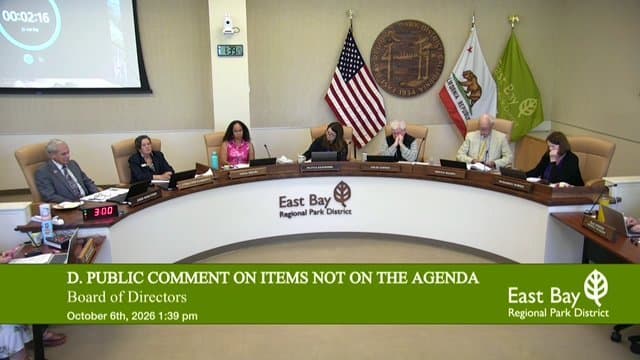
Park District Previews Wildfire Vegetation Strategy as Flow Trail Fight Flares
Board of Directors • East Bay Regional Park DistrictOctober 6, 2026
Locunity is an independent informational service and is not an official government page for this commission. All information is sourced from public footage and an analysis of official agendas with the aid of responsible, fact-checked AI. to report an error or omission.
The East Bay Regional Park District is building a map that will decide where limited wildfire and habitat dollars go across its lands. On Oct. 6, 2026, staff previewed that framework as an information item, and directors and advocates pushed for trees, climate goals and long-term maintenance to be built in. Before that, a sharp public comment split over the proposed Wildcat Flow Trail raised questions about transparency ahead of a possible 2028 tax measure.
- First district-wide vegetation strategy previewed with four draft goals; no vote taken
- Park Advisory Committee members say their review felt like a "rubber stamp"
- Wildcat Flow Trail opponents allege donor coordination; supporters cite youth health and trail safety
- Community partners report seniors and youth want safe, multilingual, accessible parks
A Map, Not a Plan: Vegetation Strategy Takes Shape
The basics: Vegetation work happens across district divisions without a cohesive strategy. Staff proposed a framework with five elements: goals and objectives, actions, project prioritization, roles and responsibilities, and external coordination. It draws on the district's 2024 fine-scale vegetation and wildfire hazard mapping.
Why it matters: The district has limited resources to cover vast acreage. The framework will target spending, support grant applications and respond to defensible-space compliance notices from partner fire agencies.
Where things stand: The four draft goals are reducing wildfire risk, protecting and restoring ecosystems, maintaining safe and accessible parks and trails, and strengthening coordination. A GIS framework blends three logic models: community, ecology and feasibility.
"It is not a new wildfire plan. It is not actually a plan at all," said Kristen Van Dam, Ecological Services Coordinator, Stewardship Department. She said the models are still in beta testing and will be finalized by the end of October.
General Manager Max Korten said pressure from neighbors helped drive the work. "We were getting notices from some of our partner fire agencies that we were out of compliance with their defensible space ordinance," said Korten.
Board pushback: Director Elizabeth Echols, Ward 1, warned that "once you treat these areas, if you don't maintain them, then that work is wasted after a few years." Korten replied that "we are not walking away from any of the existing places that we've treated and done initial work."
Board Chair Olivia Sanwong pointed to the 2020 SCU Lightning Complex Fire, crediting the district's fire department, CAL FIRE and mutual aid agencies with protecting the Del Valle Water Treatment Plant. Her point was that critical infrastructure matters beyond district land. Director Lynda Deschambault, Ward 2, asked for a tree inventory and said, "I'd love to see you add a line that greenhouse gas reductions is one of the ultimate goals there." Director John Mercurio, Ward 6, urged sharing the strategy with neighboring fire agencies. Another director said constituents rank wildfire risk reduction first.
The other side: Two Park Advisory Committee (PAC) members said their two meetings were not enough time and that concerns they raised were not incorporated. Both noted that trees go unmentioned. "It just feels like we're asked to rubber stamp something that doesn't entirely encompass our views," said Judy Smith, PAC appointee for Ward 2. Irene Dieter, PAC member, said "the public is unaware of what the Park District does beyond wildfire risk management when it comes to vegetation management."
Echols defended the process: "I just love that the PAC was able to take a meaty topic like this and really dig in and provide valuable input into the decision-making."
Decisions and stakeholder impacts: No vote was taken. Environmental groups largely backed the framework but asked for changes. "We are keen to see the district dramatically expand the use of prescribed fire and managed wildfire," said Court Cooper, Sierra Club Bay Area chapter. Whitney Grover, Director of Conservation, Golden Gate Bird Alliance, asked that work be scheduled outside bird breeding season and offered California Bird Atlas data. Jim Hansen of the California Plant Society East Bay Chapter warned against over-severe clearing. Norman LaForce said "the key is home hardening."
What's next: Staff will refine the goals and take them to the Natural and Cultural Resources Committee on Oct. 28, 2026. The full board is expected to take them up likely in January. "Our hope is to begin implementation early in 2027," said Claire Griffing, Management Analyst, General Manager's Office.
Wildcat Flow Trail Splits Public Comment
Why it matters: A pending draft environmental impact report (EIR), a $1 million donation pledge tied to a specific site and a possible 2028 tax measure raise the stakes on the project and on public trust in the district.
Where things stand: The trail was not on the agenda, but it dominated roughly 30 minutes of comment. Opponents cited public records they say show two years of private staff coordination with cycling advocates.
"That's pay-to-play, and that has no place in the Park District," said LaForce, who asked for public disclosure of the donor terms. Leslie Goldstein asked for an independent audit and a restart of engagement. "We ask the board tonight to pause all further planning and environmental review on the Wildcat Flow Trail," said Goldstein.
Janet Flint, volunteer, Friends of Wildcat Canyon Park, said the group's outreach to 600 people found "over 85%, an astonishing majority of the people we meet, have not heard about the Flow Trail." She urged a mailed draft EIR notice to 150,000 households at about $39,000.
Sally Tobin offered a personal resolution that would require public disclosure and board approval of trail proposals, and refusal of the conditional donation. Bara Sapir described online harassment of women opposing the trail.
The other side: Supporters framed the trail as a health and safety investment. "Mountain biking is actually an incredibly healthy way for our children and teens to spend their time," said Lauren Purcell, a psychotherapist and parent. Lucinda Bingham, a Berkeley parent, cited family bonding and less crowded trails. Carrie Schulman said the trail would separate hikers and bikers and give kids a safe place to ride.
What's next: The board took no action. Watch for the draft EIR release and whether the district expands outreach, as opponents requested.
Seniors and Youth Want Safe, Accessible Parks
Two community partners shared outreach findings for the district plan. The general manager said partner organizations will present regularly this fall and winter.
Charlene Nguyen, Senior Program Manager, Vietnamese American Community Center of the East Bay, reported 160 surveys and outings, including 60 seniors at Ardenwood. "The highest priority for them is well-maintained parks," said Nguyen. Seniors also asked for paved accessible paths, translated materials and programs for older adults.
Jeff Embolton, Executive Director, Forest and Tree, described a youth photo workshop at Arrowhead Marsh and a "Scoops for Parks" survey that reached about 200 Fruitvale residents. The top need, he said, "was access to more nearby green spaces in the Fruitvale and San Antonio neighborhoods." Residents also cited transit, multilingual signage and swim lessons. Echols asked for copies of both reports.
Minor Items
- Consent calendar passed: Items G1–G14, about $1.65M, were approved by voice vote (For: 7, Sanwong, Coffey, Waespi, Echols, Mercurio, Espana, Deschambault; Against: 0; Absent: 0). Deschambault asked for clearer year-to-date budget context, and the general manager promised more finance transparency.
- Golden Gate Fields: Echols reported the governor signed the $125M state budget item for the acquisition.
- Storm prep: Korten cited an "over 90% chance of above-normal precipitation this winter." Crews are clearing culverts and staging tiger dams.
- Chenard Winery: Amelia Marshall opposed demolishing the winery for a Garin to Pleasanton Ridge Trail staging area and criticized the public notice.
- Stalled projects: Ellen Thompson, owner of Redwood Valley Railway, said contract renewal has stalled for eight years through 15 staff changes. Separately, Ken Gonzalez asked for accountability on an Alameda restroom once slated for spring 2025.
Looking Ahead
Deschambault requested future agenda items on carbon sequestration inventories across riparian areas and grasslands, and a discussion of a youth committee or youth PAC appointee. "I'd love to know what we might do with a youth committee," said Deschambault.