
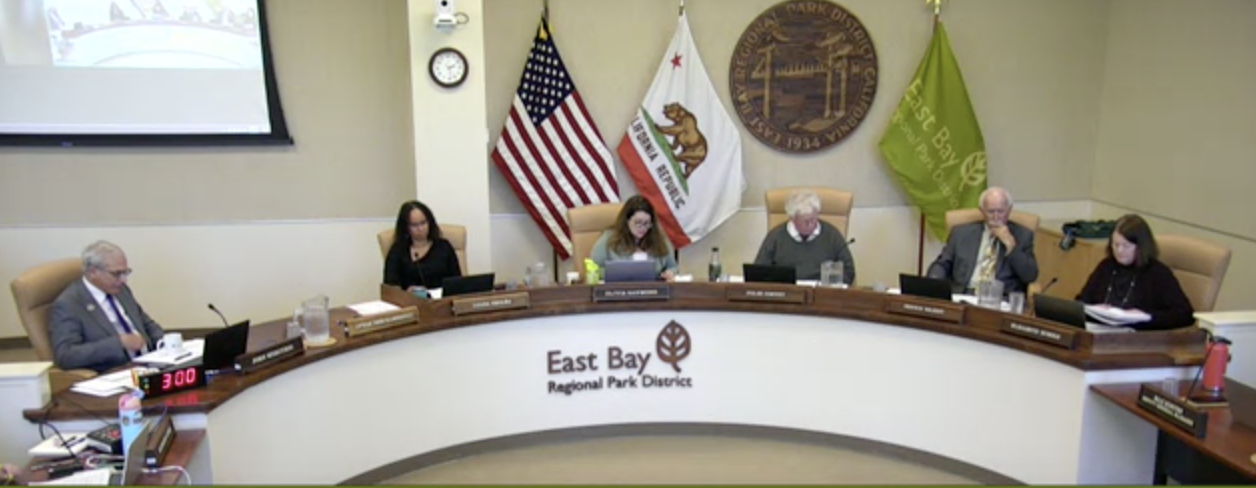
Board of Directors - Mar 03, 2026 - Meeting

Board of Directors - Mar 03, 2026 - Meeting

Board of DirectorsEast Bay Regional Park DistrictMarch 3, 2026

Sources:

Locunity is a independent informational service and is not an official government page for this commission.We use AI-assisted analysis and human editorial review to publish information.

Park Residents Sound Alarm on Surprise $15K Tax as Board Approves $8M in Contracts

Five district employees living in park housing packed the board room to protest a December decision that could add up to $14,000 in annual taxable income, while the East Bay Regional Park District Board of Directors moved unanimously on major contracts for Bay Trail construction, waste collection, and goat grazing — locking in millions in spending and savings for the years ahead.

  • Park residents mobilize against surprise housing tax, citing IRS exemption criteria and warning a 90-year security residency program could collapse

  • $887K boost approved for Bay Trail construction management at Point Molate, keeping the $13.5M joint project with Richmond on track

  • Competitive bidding saves district $100K/year on waste collection, with plans to expand the model district-wide

  • $5.9M in goat grazing contracts renewed for fire hazard reduction across nearly 1,000 acres

  • Superfund cap repair advances 6-0-1 after director raises monitoring and public disclosure concerns

  • Tilden steam train operator warns 7.5-year lease impasse may force closure of a 74-year institution

  • Board preps DC advocacy trip as proposed federal legislation threatens rail-banking for Bay Trail expansion


"After 90 Years, We're Suddenly Noncompliant"

Five park district employees who live in on-site housing delivered the most intense public comment of the evening, opposing a December 2025 internal decision to treat the gap between their rent and fair market value as taxable income — a change that could cost some residents more than $14,000 a year.

Why it matters: The district's security residency program stations employees on-site around the clock, providing 24/7 park safety coverage. Residents argue the housing falls squarely under IRS Code Section 119/15B, which exempts lodging provided on employer premises, for employer convenience, and required as a condition of employment. Comparable agencies — California State Parks, Mid-Peninsula Regional Open Space, EBMUD, and the San Francisco Watershed — do not tax their resident employees similarly.

Where things stand: Grant Boysen, district police officer and four-year security resident, set the tone: "The IRS did not contact the district. There was no audit. There was no citation, no mandates. Yet after nearly 90 years of this program operating without issue, we are told we are suddenly noncompliant." He called the policy "intentional, a deliberate and malicious policy" designed to push residents out.

One park ranger laid out the dollar impact: "For me, that would mean my taxable income would increase by over $14,000 for the year. This amount would be automatically added to my taxable earnings each pay period and the tax automatically deducted."

Another park ranger, a recent resident, described chaotic implementation — two weeks' notice before the holidays, no individual tax amounts provided, a non-functional payroll calculator, and a suggestion to use the Employee Assistance Program to hire a financial consultant. "I still do not know whether I will owe 200, 500, or potentially over 1,000 per month," she said.

Residents also raised concerns about the underlying appraisals: no physical inspections of the units, no consultation with a CPA, and unanswered emails. Three separate CPAs consulted by residents have confirmed the tax exemption interpretation, according to public commenter Brett Whitmer, who described the process as "incredibly opaque."

The other side: Acting General Manager Max Korten acknowledged the concerns and committed to action: "Our team is dedicated to working with them in a thoughtful way and listening to concerns and being responsive. And we have been working on looking at redoing the appraisals for those housing locations." He said staff expects to follow up with residents within a week. Director Dennis Waespi urged the board to move faster, calling the residents "our people" who are "getting hammered pretty hard here."

What's next: The board originally planned to address the issue in July, but directors signaled willingness to accelerate. Director Waespi requested an earlier agenda item, and the issue is expected to return well before summer.


Bay Trail Boost: $887K Keeps Richmond Segment on Track

The board unanimously approved an $886,954 amendment to the WSP USA construction management contract for the San Francisco Bay Trail at Point Molate, bringing the total contract to $1,617,231.

Why it matters: The 2.5-mile segment closes a critical gap in the Bay Trail, a regional trail network stretching across the San Francisco Bay shoreline. The roughly $13.5M project is jointly funded with the City of Richmond under a cooperative agreement — approximately 54% district and 46% Richmond.

Where things stand: Trails Program Manager Sean Dugan reported the project is in week 20 of construction (month 5 of an estimated 13-month timeline) and tracking on schedule. The CM firm was originally hired in 2021 when only the district's portion was planned; the scope expanded to cover the full segment. Construction management costs are running at about 18% of total construction costs versus a 15% target — a premium Director Elizabeth Echols and staff attributed to the expanded scope and oversight requirements.

The district has already invested approximately $1.3–1.4 million in pre-construction costs that won't be reimbursed by Richmond. A short gap section remains under Richmond's responsibility and is still in planning.

Decisions: Passed 7-0 (For: Sanwong, Coffey, Echols, Deschambault, Waespi, Espana, Mercurio; Against: 0; Absent: 0).


Goats for Fire Safety: $5.9M Keeps a 40-Year Program Going

The board approved three four-year goat grazing contracts and four on-call contracts totaling up to $5.9 million for fire hazard reduction across 968 acres.

The basics: The district has used goats for wildland fuel reduction since 1983. At roughly $810 per acre, grazing remains far cheaper than mechanical tree removal, which has risen significantly in cost.

Where things stand: Assistant Fire Chief Kari Hale outlined the contracts — California Grazing Company, Goats R Us, and Star Creek Land Stewards will handle designated zones, while a fourth contractor, Capra, joins them on a new on-call roster at $400,000 per year for flexible deployment. Contractors were scored on a 100-point matrix covering qualifications, capabilities, references, and cost-effectiveness.

Key challenges include scheduling — everyone wants May grazing, but work extends through August — and overgrazing oversight. District captains and fuel reduction coordinators monitor the herds. Director Waespi floated the idea of exploring in-house goat herding. Public commenter Jim Hansen of the California Plant Society asked that contracts reference the wildfire hazard plan's performance standards, including grazing to 4–6 inches.

Acting General Manager Max Korten noted the ecological benefits: goats mimic natural disturbance, and the program aligns with the district's broader vegetation management strategy.

Decisions: Passed 7-0 (For: Sanwong, Coffey, Echols, Deschambault, Waespi, Espana, Mercurio; Against: 0; Absent: 0).


Waste Contract Cuts Costs by 30%

A five-year, $1.2 million contract with Waste Management of Alameda County for recycling, compost, and trash collection at 10 park facilities will save the district more than $100,000 annually.

Why it matters: The district had been paying full franchise rates without a contract at most locations — approximately $343,000 per year. The new competitive contract drops that to roughly $240,000, a nearly 30% reduction achieved by bundling sites and eliminating franchise fees.

Where things stand: Sanitation Recycling Coordinator Andrew Green said six proposals came in from a March 2025 RFP. Nine of the 10 facilities already used Waste Management; Crown Beach will switch from ACI. Half the locations continue using Civicor, a community partner, for recycling. Director Waespi pressed on how the savings were achieved: "So how did those guys knock off 25%? How'd they do it?" Staff explained that moving from uncontracted franchise rates to competitive contracted rates — and bundling multiple locations — drove the reduction.

Director Deschambault asked about covered bins to prevent animal attraction and expanding the model to the remaining 44 collection sites. Board President Olivia Sanwong highlighted the link between covered bins, sustainability messaging, and owl protection. Staff described the contract as a pilot that will inform future bids for Tilden, Anthony Chabot, and other park zones.

Decisions: Passed 7-0 (For: Sanwong, Coffey, Echols, Deschambault, Waespi, Espana, Mercurio; Against: 0; Absent: 0).


Superfund Cap Repair Advances — With One Abstention

The board adopted a mitigated negative declaration for repairing a 30-year cap at a state Superfund site, but not without pointed questions from Director Lynda Deschambault, who abstained.

Why it matters: The cap repair is required by a Water Board replacement letter and unlocks grant funding. But Director Deschambault argued the environmental review lacked provisions for toxicity monitoring, worker protection, and public signage about lead and zinc contamination at the site.

"I just would not be personally comfortable moving forward until those pieces are finalized and put in place," she said. "I'd like to see some signage out there. I don't know why we aren't being a little more honest and direct — community right to know — and put up some signs that there is some lead and zinc exposure out there."

Staff explained the project is at 60% design, with the Water Board having reviewed 30% plans and design alternatives. Acting General Manager Korten clarified that CEQA review typically occurs at 30% design, with permitting to follow. Director Deschambault noted the CEQA document states Water Board approval is only "anticipated" and questioned spending significant money without finalized approvals.

Decisions: Passed 6-0-1 (For: Sanwong, Coffey, Echols, Waespi, Espana, Mercurio; Abstain: Deschambault; Against: 0; Absent: 0).

What's next: Director Deschambault also requested a comprehensive inventory of all district sites with toxic waste as a future agenda item.


74-Year-Old Steam Train May Run Out of Track

Ellen Thompson, owner of Redwood Valley Railway Company, told the board that seven and a half years of failed lease negotiations threaten the future of the Tilden Park steam train, which has operated since 1952.

"Now we're being asked to abandon the lease document that's been polished and perfected for 74 years in favor of a new one that's written with no experience of our situation," she said. Thompson cited 12 staff turnovers during negotiations, reversal of previously settled issues in new drafts, demands to sign unfinished documents, and an inability to have face-to-face meetings. Without a lease, the company cannot obtain county permits for capital improvements needed to handle increasing attendance. The operation receives no district money, grants, or donations — all infrastructure is privately funded.

Public commenter Jeffrey Bernaford also spoke in support, delivering a personal appeal for the train's preservation. Acting General Manager Korten said staff continues working toward an agreement and feels positive about the partnership.


Rail-Banking Under Threat: Board Preps DC Trip

A House bill by Transportation Committee Chair Sam Graves would require trail sponsors to obtain permission from every adjacent property owner and pay compensation — effectively gutting the 1983 rail-banking act the district needs for Bay Trail expansion in Richmond.

Where things stand: Division Lead Eric Feeler and federal consultant Lisa Lisa Kountoupes of KDCR briefed the board on the March 24–27 DC advocacy trip. Three priorities: defending Land and Water Conservation Fund funding (Congress restored the full $900M after the administration tried to divert it, but the Outdoor Recreation Legacy Program has been suspended under a secretarial order); seeking appropriations through Rep. Mark DeSaulnier for Thurgood Marshall Regional Park; and opposing the rail-banking bill.

Kountoupes described a tense Washington environment: "I think in general, it's not surprising that I think you'll find the members, the situation is very fraught. I think a lot of the members, even though it's only the beginning of March, are pretty exhausted." A continuing resolution is likely for FY27, and midterm election focus is intensifying.

Director John Mercurio, a longtime Rails to Trails Conservancy member, urged the delegation to emphasize economic benefits: "These places where there used to be a lot of railroads and a good number of them have been turned into trails. And they are economic drivers."


Wildcat Canyon Bike Trail Draws Opposition

Two public commenters challenged the proposed Wildcat Canyon bike trail during open comment.

Randall Arnold questioned staff's positive bias toward the project, the low projected usage increase, donor influence on trail location, the safety of high-speed biking, the appearance of high fencing with barbed wire in renderings, and the district's backlog of deferred trail maintenance. He argued more bikers would create more illegal trails, not fewer.

Sally Tobin, president of Friends of Wildcat Canyon Park, focused on wildlife: bobcats are a keystone species, and proposed fencing — including barbed wire — along with increased nighttime cycling would harm nocturnal predators like owls and bobcats. She referenced the California Department of Fish and Wildlife's non-invasive bobcat study methodology and called for effective mitigations in the environmental impact report.


Minor Items

  • Consent calendar (items 1–3, 5–8) approved 7-0, including acceptance of wind energy mitigation funds for golden eagle conservation dating back to 2010.

  • $1.5M Wildlife Conservation Board grant secured for Roddy Ranch, freeing previously allocated WW acquisition funds for future land purchases.

  • All Abilities Day at Big Break expected to draw more than 500 participants, with ASL and Spanish interpreters and wheelchair accessibility.

  • Charles Sakai unanimously appointed as chief labor negotiator in closed session.

  • Sean Connolly, a district employee, thanked the acting GM for reinstating the telework policy, citing improved morale.

  • Stephen Richards reported a broken irrigation system near Crab Cove that has gone unrepaired for over a year despite multiple reports.

  • Patterson property celebration at Coyote Hills scheduled for the following Saturday.

Park Residents Sound Alarm on Surprise $15K Tax as Board Approves $8M in Contracts | Board of Directors | Locunity